

In the fast-paced environment of Agile development, the velocity of delivery is often celebrated as the primary metric of success. However, speed without visibility creates a disconnect between the teams building the product and the individuals funding or relying upon it. Effective stakeholder engagement is not merely about sending status updates; it is about fostering a shared understanding of value, progress, and challenges. When communication is structured, transparent, and tailored to specific audiences, the entire organization aligns behind the iterative journey.
This guide explores the mechanics of communicating progress within an Agile framework. It moves beyond simple status reporting to discuss how to build trust, manage expectations, and ensure that every update drives decision-making. Whether you are a Scrum Master, Product Owner, or Project Lead, mastering these communication dynamics is essential for sustainable delivery.
The Critical Role of Transparency in Agile Teams 🏗️
Transparency is a core pillar of the Agile mindset, yet it is frequently misunderstood. It does not mean sharing every single email, meeting note, or code commit with everyone. Instead, it means providing a clear, accurate, and timely view of the work status so that stakeholders can make informed decisions. In traditional methodologies, reporting often happens at the end of a cycle. In Agile, reporting is continuous, embedded within the rhythm of the work.
When stakeholders feel disconnected from the process, they often resort to micromanagement or demand rigid scope changes. This behavior usually stems from a lack of visibility into the actual constraints the team faces. By proactively sharing progress, the team demonstrates control over their work. This reduces anxiety for business leaders and allows them to focus on strategic questions rather than tactical inquiries.
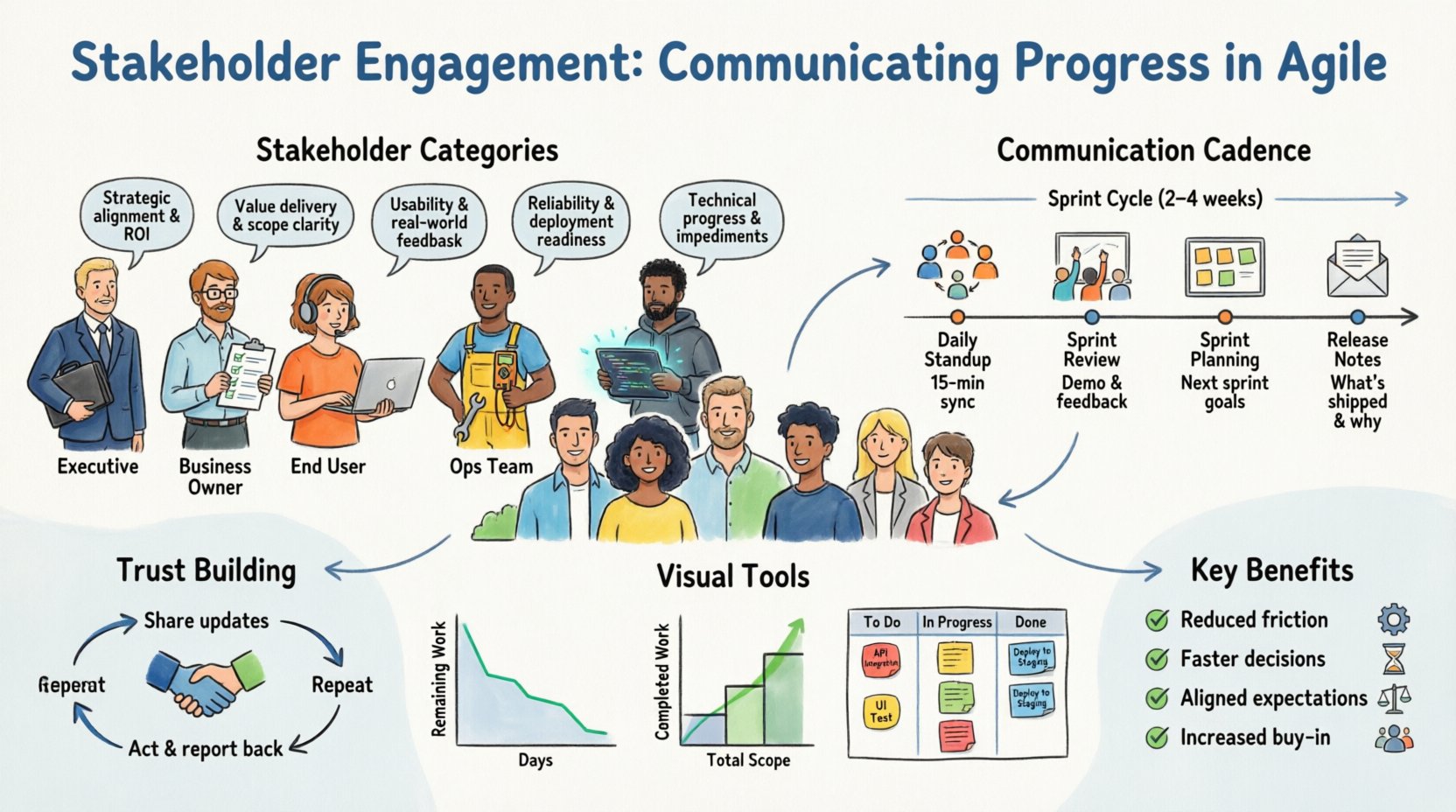
Key benefits of robust stakeholder engagement include:
Reduced Friction: Fewer interruptions during sprint cycles as trust is established.
Faster Decision Making: Access to real-time data allows for quicker pivots or confirmations.
Aligned Expectations: Everyone understands what is possible within the given timeframe.
Increased Buy-in: Stakeholders feel part of the journey rather than passive observers.
Identifying and Categorizing Your Stakeholders 🎯
Not all stakeholders require the same level of detail. Treating a technical lead the same way as a marketing executive leads to confusion and information overload. The first step in effective engagement is mapping your audience. Understanding who needs what information allows you to tailor your communication strategy effectively.
Stakeholders generally fall into categories based on their influence and interest. High influence, high interest stakeholders require the most attention and frequent updates. Low influence, low interest stakeholders need minimal updates, perhaps just high-level summaries.
Stakeholder Type | Primary Interest | Communication Frequency | Preferred Format |
|---|---|---|---|
Sponsors & Executives | ROI, Strategic Goals, Budget | Monthly / Quarterly | Executive Summaries |
Business Owners | Feature Completion, User Value | Bi-Weekly | Demo / Review |
End Users | Usability, New Features | Ad-hoc / Beta Access | Prototypes / Feedback Forms |
Operations / Support | Stability, Deployment, Training | Weekly / Release Cycle | Release Notes / Technical Docs |
Development Team | Tasks, Blockers, Dependencies | Daily | Stand-up / Board |
By categorizing your audience, you can design a communication plan that respects everyone’s time while ensuring critical information reaches the right people. For example, executives do not need to know about specific bug fixes, but they do need to know if a major feature is at risk. Conversely, the operations team needs detailed deployment information that the executive sponsor does not care about.
Establishing a Predictable Communication Cadence 📅
Agile thrives on rhythm. Just as the team operates in sprints, the communication regarding that work should follow a similar cadence. Predictability is key to reducing anxiety. If stakeholders never know when they will hear from the team, they will constantly check in, disrupting the flow of work. Establishing a schedule for updates creates a safe space for the team to focus.
A standard cadence typically includes the following touchpoints:
Daily Stand-ups: While these are internal, the output (blockers, progress) can be summarized for broader visibility.
Sprint Reviews: The primary event for stakeholder engagement. This is where the work is demonstrated.
Sprint Planning: Allows stakeholders to prioritize the backlog for the upcoming cycle.
Release Notes: Formal documentation of what is shipped to production.
Health Checks: Periodic surveys or meetings to gauge satisfaction with the process.
It is vital to stick to these times. If a stakeholder requests an urgent update outside the schedule, evaluate if it is truly necessary. Often, the request stems from a lack of trust in the established rhythm. Reiterating the schedule and the value of the upcoming review often satisfies the immediate need without breaking the workflow.
Visualizing Work Without Overwhelming Details 📊
Agile relies heavily on visual management. Charts and boards provide a snapshot of reality that is faster to digest than text reports. However, visual data must be interpreted correctly. A burn-down chart, for instance, can be misleading if the scope changes mid-sprint. Understanding the limitations of these tools is part of communicating progress accurately.
Common visual artifacts used to track progress include:
Burn-down Charts: Show the remaining work over time. A flat line indicates a blockage or added scope.
Burn-up Charts: Show completed work against total scope. Useful for tracking scope creep.
Cumulative Flow Diagrams: Reveal bottlenecks in the workflow by showing how many items are in each status.
Task Boards: A Kanban-style board showing the state of work (To Do, In Progress, Done).
When presenting these visuals, always provide context. Do not just show a chart and say “we are on track.” Explain why. If a line is flat, explain that a dependency was delayed. If the scope line moved up, explain that a new requirement was added during the planning phase. Context turns data into information, and information into knowledge.
Ensure that the tools used to display this data are accessible. If stakeholders cannot view the board without logging into a complex system, the visualization fails. Dashboards should be public-facing or easily shareable links that refresh in real-time.
Delivering Uncomfortable News with Integrity 🛡️
Agile teams often face delays, technical debt issues, or scope changes that threaten timelines. Hiding these issues is the fastest way to destroy trust. When bad news arrives, it should be delivered immediately, with a proposed solution or alternative. This approach shifts the conversation from blame to problem-solving.
The formula for delivering difficult news involves three steps:
State the Fact: “We have encountered a technical blocker that will delay the payment integration.”
Explain the Impact: “This means the checkout flow will not be ready by Friday.”
Offer Options: “We can cut the non-essential fields to meet Friday, or we can shift the launch date to next week.”
This method respects the stakeholder’s time and intelligence. It acknowledges the reality of the situation while empowering the stakeholder to make a choice. It also demonstrates that the team is managing the risk, not hiding from it. Hiding a problem until the last minute forces stakeholders to make decisions under pressure, which often leads to poor outcomes.
Integrating Feedback Loops into Reporting 🔄
Communication is a two-way street. It is not enough to broadcast updates; you must actively solicit feedback. Agile is built on inspection and adaptation. If stakeholders are not giving feedback on the progress, the product may drift away from user needs.
To integrate feedback effectively:
Invite Questions During Reviews: Make the Sprint Review a dialogue, not a presentation. Ask open-ended questions like, “Does this align with what you expected?”
Use Surveys: After a release or a quarter, ask stakeholders to rate their confidence in the team and the product direction.
Shadow Sessions: Occasionally invite stakeholders to observe the team working. This builds empathy for the challenges involved.
Office Hours: Designate specific times where stakeholders can drop in for informal chats without a formal agenda.
When feedback is received, acknowledge it and log it. Even if the feedback is not acted upon immediately, the stakeholder needs to know it was heard. This validates their contribution to the project and encourages continued engagement.
Measuring the Health of Stakeholder Relationships 📉
How do you know if your engagement strategy is working? You need metrics that go beyond velocity or story points. Relationship health is a qualitative metric, but it can be tracked quantitatively through specific indicators.
Key indicators of healthy engagement include:
Attendance: Are stakeholders showing up to reviews consistently?
Decision Speed: Are decisions made during reviews, or are they pushed back indefinitely?
Interruption Rate: Is the team interrupted outside of scheduled times for updates?
Feedback Quality: Is the feedback specific and actionable, or vague and critical?
If these metrics indicate friction, it is time to adjust the communication plan. Perhaps the cadence is too slow, or the reports are too technical. Listening to the stakeholders about their communication needs is itself a form of engagement.
Common Pitfalls in Agile Reporting 🚫
Even with the best intentions, teams can fall into traps that undermine stakeholder confidence. Recognizing these pitfalls helps in avoiding them.
Focus on Output over Outcome: Reporting on the number of tickets closed is less valuable than reporting on the value delivered. Users do not care about tickets; they care about problems solved.
Over-communicating: Sending too many emails or status updates can lead to “report fatigue.” Stakeholders may stop reading them entirely.
Using Jargon: Terms like “velocity,” “spikes,” or “refactoring” may confuse non-technical stakeholders. Translate technical terms into business impact.
Ignoring the Negative: Focusing only on successes creates a false sense of security. Balance positive news with risks and challenges.
One-Size-Fits-All: Using the same report for a C-level executive and a product manager is inefficient. Tailor the content to the audience.
Building Trust Over Time 🤝
Trust is the currency of stakeholder engagement. It is built slowly through consistent delivery and honest communication. When a team consistently delivers what they promise, stakeholders feel secure. When they communicate clearly when things go wrong, stakeholders feel respected.
This relationship is not static. It requires maintenance. Regular check-ins, even when there is no major news, keep the lines of communication open. It signals that the team is active and thinking about the project’s success. Over time, this leads to a partnership where stakeholders feel confident enough to trust the team with complex problems, rather than dictating solutions.
Ultimately, the goal is to create an environment where progress is not just reported, but understood. When stakeholders understand the process, they become advocates for the team. They defend the process against external pressures and help protect the team’s focus. This level of alignment is the true mark of a mature Agile organization.
By applying these principles, you transform reporting from a bureaucratic obligation into a strategic asset. You create a channel where information flows freely, decisions are made with clarity, and the entire organization moves forward together toward a shared vision.