


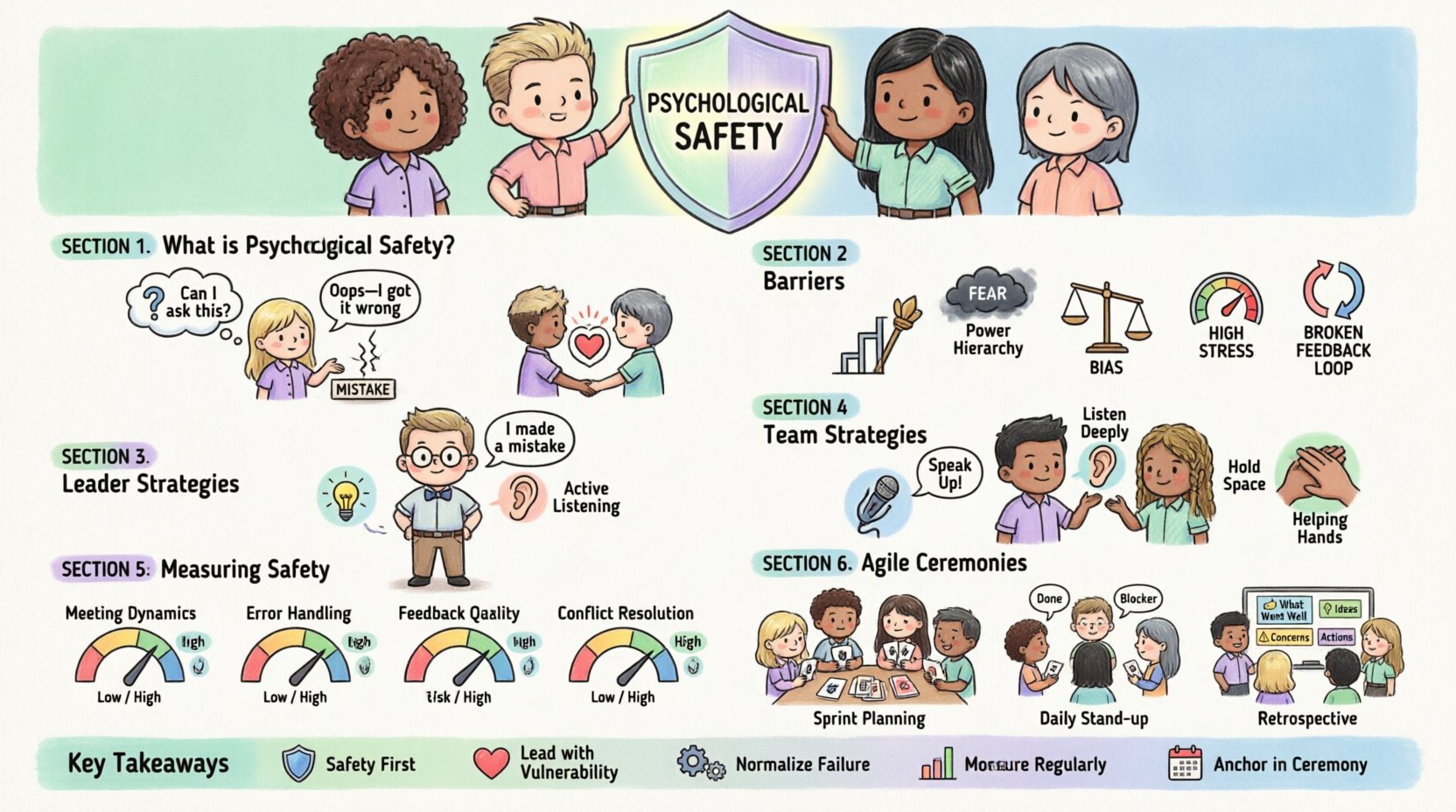
In the fast-paced world of Agile development, speed and adaptability are often celebrated as the primary markers of success. However, the most resilient teams are not just those that move quickly; they are the ones that communicate openly, admit mistakes without fear, and innovate through collaboration. This environment is known as psychological safety. Without it, high performance is unsustainable, regardless of the process framework adopted. This guide explores how to cultivate psychological safety within Agile teams, focusing on practical actions and structural changes rather than fleeting trends.
What is Psychological Safety? 🤔
Psychological safety is a shared belief held by members of a team that the team is safe for interpersonal risk-taking. It means that team members feel comfortable being themselves, asking questions, and admitting errors without fear of negative consequences. In an Agile context, this concept is critical because the methodology relies heavily on transparency, inspection, and adaptation. If a team cannot inspect their own work honestly, they cannot adapt effectively.
Interpersonal Risk-Taking: This includes proposing a new idea, challenging the status quo, or admitting a mistake.
Shared Belief: It is not an individual feeling but a collective trust within the group.
Safe Environment: The absence of punishment or humiliation for speaking up.
Research indicates that teams with high psychological safety make fewer errors, solve problems more efficiently, and demonstrate higher levels of innovation. It is the foundation upon which trust is built.
The Science Behind Safe Teams 🧠
Dr. Amy Edmondson, a pioneer in this field, defined psychological safety as the critical ingredient for learning and performance. Her studies show that high-performing teams are not those with the smartest individuals, but those where members feel safe to take risks. In Agile frameworks like Scrum or Kanban, the feedback loops are designed to catch issues early. If team members hide issues due to fear, these loops fail.
Consider the concept of the blameless post-mortem. When a release fails, the goal is to understand the process failure, not the person who made the mistake. This approach requires a team culture where admitting fault is viewed as a contribution to improvement rather than a personal attack.
Barriers to Psychological Safety in Agile Environments 🚧
Even in teams dedicated to collaboration, barriers can emerge. Recognizing these obstacles is the first step to removing them.
Power Dynamics: If a Product Owner or Scrum Master dominates conversations, junior members may hesitate to share dissenting opinions.
Fear of Failure: In high-pressure delivery environments, the fear of not meeting a sprint goal can lead to hiding problems until it is too late.
Implicit Bias: Unconscious biases regarding gender, tenure, or background can make certain members feel less valued or less safe to speak.
Performance Pressure: Overemphasis on velocity metrics can discourage teams from slowing down to reflect or refactor code.
Lack of Feedback Mechanisms: If there is no structured way to give negative feedback constructively, issues fester.
Strategies for Leaders to Foster Safety 🛠️
Leaders, including Scrum Masters, Team Leads, and Engineering Managers, play a pivotal role in setting the tone. Their actions signal what is acceptable and what is not. Here are specific ways to model and encourage safety.
1. Model Vulnerability
Leaders should admit their own mistakes publicly. When a manager says, “I missed that requirement, and here is how I will fix it,” it gives permission for others to do the same. This breaks the illusion of infallibility.
Admit when you do not know the answer.
Share stories of past failures and what was learned.
Ask for feedback on your own performance during retrospectives.
2. Frame Work as a Learning Problem
Instead of framing every task as a test of competence, frame it as a learning opportunity. When a complex technical challenge arises, treat it as a problem to solve together rather than a test of individual genius.
Use language like “Let’s explore this” instead of “You need to fix this.”
Encourage experimentation and prototyping.
Praise the effort and the learning process, not just the final output.
3. Listen Actively and Validate
Active listening involves hearing what is said and what is not said. It means acknowledging the speaker’s contribution regardless of whether you agree with it.
Nod and maintain eye contact during discussions.
Repeat back what you heard to ensure understanding.
Thank people for raising difficult topics.
Strategies for Team Members 🤝
Safety is a collective responsibility. While leaders set the stage, every member must contribute to the atmosphere. Here is how team members can actively participate in building safety.
1. Speak Up with Intent
If you have a concern, a question, or an idea, share it. Start small if necessary. The goal is to normalize the act of speaking up.
Ask clarifying questions during planning sessions.
Point out potential risks during estimation.
Share ideas for process improvements in retrospectives.
2. Listen Without Judgment
When others speak, listen to understand, not to reply. Avoid interrupting or dismissing ideas immediately. Create space for diverse perspectives.
Allow pauses after someone finishes speaking.
Ask follow-up questions to dig deeper.
Resist the urge to correct tone or delivery style.
3. Support Peers
When a team member makes a mistake or admits a struggle, offer support rather than criticism. This reinforces the idea that the team succeeds or fails together.
Offer help when someone is stuck.
Publicly acknowledge the effort behind a difficult task.
Defend teammates from external blame.
Measuring Psychological Safety 📊
You cannot improve what you do not measure. While subjective feelings are important, there are objective ways to gauge the health of the team culture. Teams can use surveys and retrospective data to track progress over time.
Indicator | Low Safety Signs | High Safety Signs |
|---|---|---|
Meeting Dynamics | One or two people dominate; silence is common. | Diverse voices; lively debate; ideas build on each other. |
Error Handling | Mistakes are hidden or blamed. | Mistakes are discussed openly as learning opportunities. |
Risk Taking | Teams stick to known solutions to avoid failure. | Teams experiment with new approaches and technologies. |
Feedback | Feedback is rare or delivered aggressively. | Feedback is frequent, constructive, and welcomed. |
Conflict | Conflict is avoided or becomes personal. | Conflict is focused on tasks and resolved respectfully. |
Surveys specifically designed to measure psychological safety can be administered periodically. Questions might include statements like, “It is safe to take a risk on this team,” and team members rate their agreement on a scale. Tracking these scores over sprints or quarters helps identify trends.
Handling Failure and Post-Mortems 🔄
In Agile, failure is a data point, not a character flaw. The way a team handles failure defines its culture more than its successes do. A blameless post-mortem is a structured meeting held after an incident or a failed sprint to analyze what happened.
To run an effective post-mortem:
Focus on Process: Ask “What in the system allowed this to happen?” rather than “Who did this?”
Document Everything: Record the timeline of events to ensure facts are not disputed later.
Actionable Items: Create specific tasks to prevent recurrence. Do not just identify the problem; fix the process.
Celebrate the Fix: Acknowledge the team for identifying the root cause and creating a solution.
When teams see that their leaders will not punish them for honest mistakes, they become more proactive in identifying risks. This proactive identification saves time and resources in the long run.
Integrating Safety into Agile Ceremonies 📅
Psychological safety should not be a separate topic; it should be woven into the fabric of daily Agile rituals.
Sprint Planning
Encourage the team to challenge estimates. If a story seems too ambitious, members should feel safe saying so. This prevents overcommitment and burnout. Use planning poker to democratize estimation, ensuring that quiet voices are heard alongside vocal ones.
Daily Stand-ups
Keep these meetings focused on collaboration. If someone is blocked, the team should offer help rather than judgment. Avoid using stand-ups as status reports for management, which can induce anxiety.
Retrospectives
This is the most critical ceremony for safety. Use varied formats to keep engagement high. Techniques like “Start, Stop, Continue” or “Mad, Sad, Glad” can help surface emotions. Ensure that action items from retrospectives are actually followed up on. If the team sees that their feedback leads to no change, they will stop providing feedback.
Long-Term Sustainability 🌱
Building psychological safety is not a one-time project; it is an ongoing practice. Teams change, members leave, and new challenges arise. Maintaining safety requires continuous attention.
Onboarding: Introduce new members to the team culture explicitly. Explain how the team handles mistakes and feedback.
Check-ins: Regular one-on-one meetings allow leaders to gauge individual well-being and concerns.
Training: Provide training on communication, conflict resolution, and bias awareness.
Recognition: Celebrate behaviors that demonstrate safety, such as admitting a mistake or helping a peer.
Common Misconceptions ❌
There are several myths about psychological safety that can hinder progress.
Misconception 1: It means being nice.
Psychological safety does not mean avoiding conflict or being polite at all costs. It means being able to have difficult conversations without fear. You can disagree strongly while maintaining respect.Misconception 2: It lowers standards.
High safety actually raises standards. When people are not afraid of being wrong, they push for better solutions and hold each other accountable more effectively.Misconception 3: It is a soft skill.
It is a hard requirement for high performance. Teams without safety suffer from hidden defects, technical debt, and high turnover.Misconception 4: It is the leader’s job only.
While leaders set the tone, every member must uphold the culture. A single toxic individual can undermine safety for the whole group.
Conclusion: The Path Forward 🚀
Creating a high-performance Agile team is about more than velocity charts and burndown graphs. It is about the human element. When team members feel safe, they engage more deeply, innovate more freely, and deliver higher quality work. The journey to psychological safety requires patience and intentionality. It starts with small actions: asking a question, admitting a mistake, listening without interrupting. Over time, these actions compound to create a culture where excellence is possible.
By focusing on trust, transparency, and mutual respect, Agile teams can unlock their full potential. This is not just about delivering software; it is about building a sustainable, healthy, and resilient work environment. Start today by examining your own team’s dynamics and identifying one area where you can foster more safety.
Key Takeaways 📝
Psychological safety is the belief that one will not be punished for speaking up.
Leaders must model vulnerability and frame work as learning.
Teams need structured ways to handle failure and feedback.
Measurement and continuous improvement are essential for long-term success.
Agile ceremonies provide natural opportunities to reinforce safety.
Investing in this culture is investing in the future of the team. As you move forward, remember that safety is the soil in which high performance grows. Nurture it, protect it, and watch your team thrive.