


Understanding industry structure is fundamental to strategic management. For students entering the field of business strategy, few frameworks hold as much weight as the Porter Five Forces Analysis. Developed by Michael E. Porter at Harvard Business School in 1979, this model provides a systematic way to evaluate the competitive environment of an industry. It shifts the focus from internal company capabilities to the external market dynamics that dictate profitability.
This guide is designed for beginners who are navigating their first strategic management courses or preparing for case interviews. We will explore the five distinct forces, examine how they interact, and provide a practical methodology for conducting your own analysis. By the end of this walkthrough, you will understand how to deconstruct an industry and identify the sources of competitive pressure.
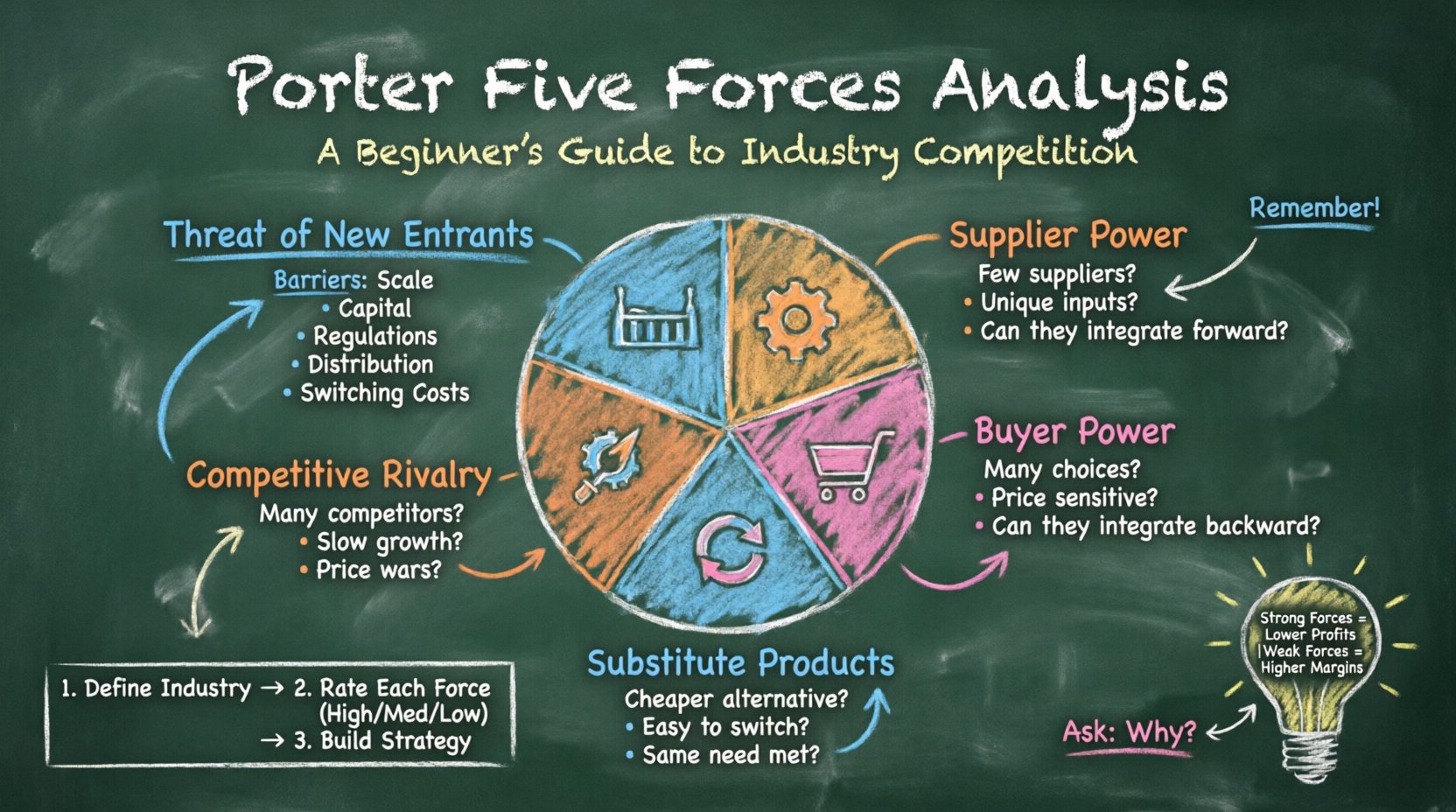
Why This Framework Matters 🧠
Traditional business analysis often focuses on a company’s internal strengths and weaknesses. However, a strong company can still fail in a poorly structured industry. The Porter Five Forces framework addresses this by asking a critical question: What determines the long-term profit potential of an industry?
Porter argued that the answer lies in the structural characteristics of the industry. These characteristics determine the intensity of competition and the bargaining power of various stakeholders. When these forces are strong, profitability tends to be low. When they are weak, companies can sustain higher margins.
- Profitability: The ultimate goal of most business strategies is sustained profitability.
- Structure: The industry structure dictates the rules of the game.
- Strategy: Understanding the forces allows for better positioning.
This approach moves beyond simple financial ratios. It requires a qualitative assessment of market dynamics. It is essential for anyone looking to understand why some sectors are highly lucrative while others struggle with thin margins.
The Five Forces Overview 📋
Before diving into the detailed steps, it is helpful to visualize the five components that make up the framework. Each force represents a different type of competitive pressure.
| Force | Core Question | Impact on Profitability |
|---|---|---|
| 1. Threat of New Entrants | How easy is it for new competitors to enter the market? | High threat lowers potential returns. |
| 2. Bargaining Power of Suppliers | Can suppliers raise prices or reduce quality? | High power squeezes margins. |
| 3. Bargaining Power of Buyers | Can customers demand lower prices or better service? | High power forces price reductions. |
| 4. Threat of Substitute Products | Can customers switch to a different solution? | High threat caps price levels. |
| 5. Rivalry Among Existing Competitors | How intense is the competition between current firms? | High rivalry leads to price wars. |
Each force must be assessed individually before synthesizing the findings into a cohesive strategic view. The following sections break down each force in detail.
1. Threat of New Entrants 🚧
This force examines the ease with which new competitors can enter the market. If entry is easy, established companies face constant pressure to lower prices or improve products to defend their share. If entry is difficult, incumbents enjoy a period of stability and higher returns.
Key Barriers to Entry
Several factors contribute to the difficulty of entry. Understanding these barriers is crucial for accurate analysis.
- Economies of Scale: Large firms often have lower average costs per unit. New entrants must achieve significant volume quickly to compete on price.
- Capital Requirements: Some industries require massive upfront investment in facilities, machinery, or research and development.
- Regulatory Barriers: Government licenses, patents, or safety standards can legally block new players.
- Access to Distribution Channels: If existing firms have exclusive contracts with retailers or suppliers, new entrants struggle to reach customers.
- Switching Costs: If customers face high costs to switch providers, new entrants must offer a compelling reason to overcome this inertia.
Assessment Strategy
When evaluating this force, consider the following:
- Are there proprietary technologies that protect current players?
- Does the industry require specialized talent that is scarce?
- Are there strong brand loyalties that act as a psychological barrier?
2. Bargaining Power of Suppliers ⚙️
Suppliers hold power when they can raise prices or reduce the quality of goods and services. This directly impacts the cost structure of the industry. If suppliers are strong, they capture more of the industry’s value, leaving less for the companies in the sector.
Factors Influencing Supplier Power
Supplier power is rarely uniform. It depends on specific market conditions.
- Concentration of Suppliers: If there are few suppliers dominating the market, they have significant leverage. A single supplier monopoly creates high power.
- Differentiation of Inputs: If the raw materials are unique or specialized, buyers cannot easily switch. Standard commodities like steel or sugar generally result in lower supplier power.
- Switching Costs: If a company must retool machinery or retrain staff to switch suppliers, the current supplier holds more power.
- Threat of Forward Integration: If a supplier could easily become a competitor, they have leverage in negotiations.
- Importance to the Buyer: If the supplier’s product is a small fraction of the buyer’s total cost, the supplier has less power.
Assessment Strategy
To gauge supplier power, ask:
- Is the supply market fragmented or concentrated?
- Are there many alternative sources for the key inputs?
- Does the supplier have a history of aggressive pricing behavior?
3. Bargaining Power of Buyers 🛒
Buyers exert pressure by demanding lower prices, higher quality, or more services. When buyer power is high, the industry’s profitability suffers because the value created is transferred to the customer.
Factors Influencing Buyer Power
Buyer power is the mirror image of supplier power, but it focuses on the demand side of the equation.
- Concentration of Buyers: If there are few large buyers purchasing from many small sellers, the buyers hold the power. Bulk purchasing amplifies this effect.
- Price Sensitivity: If customers are highly sensitive to price changes, they will shop around aggressively.
- Availability of Information: Modern technology allows buyers to compare prices and features instantly, increasing their leverage.
- Threat of Backward Integration: If buyers could easily manufacture the product themselves, they can threaten to do so to drive down prices.
- Product Differentiation: If the product is unique, buyers have less power. If the product is a commodity, power shifts to the buyer.
Assessment Strategy
Consider these points during analysis:
- How many customers make up the majority of sales volume?
- Are the products being sold standardized or customized?
- Does the buyer face high costs if they stop purchasing from the current supplier?
4. Threat of Substitute Products 🔄
Substitutes are products from outside the industry that satisfy the same need. For example, video conferencing software is a substitute for business travel. This force is often overlooked but can be the most dangerous long-term threat.
Factors Influencing Substitution
Substitution is not about direct competition within the same industry; it is about competing for the same customer budget or need.
- Price-Performance Trade-off: If a substitute is cheaper and performs adequately, it poses a significant threat. Even if the substitute is slightly more expensive, convenience can drive adoption.
- Switching Costs: If customers find it easy to switch to a substitute, the threat is high. Complex integration or learning curves reduce this threat.
- Buyer Propensity to Substitute: Some customers are naturally open to trying new technologies or methods, while others are resistant to change.
- Innovation in Adjacent Industries: Often, substitutes come from different sectors entirely. For instance, the entertainment industry competes with the video game industry for leisure time.
Assessment Strategy
To identify substitutes, think broadly:
- What alternative solutions exist for the customer’s problem?
- Is there a trend towards digitalization or automation that bypasses the core product?
- How does the total cost of ownership compare to the substitute?
5. Rivalry Among Existing Competitors ⚔️
This force represents the intensity of competition between firms currently operating in the industry. It is often the most visible force, manifesting as price wars, advertising battles, and new product launches.
Factors Influencing Rivalry
Rivalry is the most direct determinant of current industry profitability.
- Number of Competitors: A large number of equally sized competitors often leads to intense rivalry. A market dominated by one or two leaders may see less aggressive competition.
- Industry Growth Rate: In slow-growth or declining industries, firms fight for market share. In high-growth industries, firms can expand without taking share from others.
- Fixed Costs: High fixed costs create pressure to utilize capacity, often leading to price cuts to fill orders.
- Product Differentiation: If products are identical, competition focuses on price. Differentiation allows firms to compete on features or brand.
- Exit Barriers: If it is difficult or expensive to leave the industry, firms may stay and compete aggressively to survive, even at a loss.
Assessment Strategy
Evaluate the competitive landscape with these questions:
- Are there price wars occurring frequently?
- Is the industry capacity expanding faster than demand?
- How many firms are actively vying for the same customer segment?
Step-by-Step Walkthrough for Analysis 📝
Now that the theoretical components are clear, here is a practical method for conducting a Five Forces Analysis. This process is suitable for academic case studies or real-world business planning.
Step 1: Define the Industry Scope 🔍
Before analyzing, you must define what constitutes the industry. This is not always obvious. For example, is the “coffee industry” defined by coffee shops, or does it include bottled coffee and vending machines? A broad definition captures more substitutes, while a narrow definition focuses on direct rivals.
- Identify the primary customers.
- Identify the primary products or services.
- Set geographic boundaries (local, national, global).
Step 2: Gather Data on Each Force 📊
Collect information relevant to the five forces. This data can come from annual reports, industry publications, news articles, and market research.
- For Suppliers: Look at concentration ratios and input cost trends.
- For Buyers: Analyze customer concentration and price elasticity.
- For Entrants: Review patent filings and capital expenditure trends.
- For Substitutes: Track innovation in adjacent markets.
- For Rivalry: Monitor advertising spend and pricing changes.
Step 3: Assess the Intensity of Each Force 📏
Rate each force as High, Medium, or Low. This rating should be based on the evidence gathered in the previous step.
- High: The force exerts significant downward pressure on profitability.
- Medium: The force is present but manageable.
- Low: The force has little impact on the industry structure.
Step 4: Identify Strategic Implications 💡
Once the forces are rated, determine what they mean for strategy. This is where the analysis becomes actionable.
- If supplier power is high, consider backward integration or long-term contracts.
- If rivalry is high, consider differentiation or niche targeting.
- If entry barriers are low, invest in building brand loyalty or switching costs.
Step 5: Synthesize Findings into a Visual Model 🎨
Create a diagram or chart that summarizes the findings. This visual aid helps stakeholders quickly grasp the competitive landscape. Ensure that the most critical forces are highlighted.
Step 6: Review and Update Regularly 🔄
Industry structures are not static. They change due to technology, regulation, and consumer behavior. An analysis conducted today may be obsolete in five years. Schedule periodic reviews to ensure the strategy remains aligned with the market.
Case Study: The Commercial Airline Industry ✈️
To illustrate the framework, let us apply it to the commercial airline industry. This sector is known for volatile profits and intense competition.
1. Threat of New Entrants: Medium to High
While building an airline requires massive capital, low-cost carriers have entered the market frequently. However, regulatory hurdles and slot availability at major airports remain significant barriers.
2. Bargaining Power of Suppliers: High
The market for aircraft is an oligopoly, dominated by Boeing and Airbus. This concentration gives them significant power over pricing. Additionally, fuel prices are volatile and largely outside the control of airlines.
3. Bargaining Power of Buyers: High
Individual travelers have many choices and can easily compare prices online. Corporate travelers also have leverage due to their volume. This forces airlines to compete heavily on price.
4. Threat of Substitutes: Medium
For short distances, high-speed rail or video conferencing can substitute for travel. For long distances, substitutes are fewer, but the threat exists for business meetings.
5. Rivalry Among Existing Competitors: High
The industry is characterized by high fixed costs and overcapacity. Price wars are common, especially during economic downturns. Many airlines operate on thin margins.
Strategic Takeaway: Airlines must focus on operational efficiency and loyalty programs to mitigate buyer power and differentiation challenges. They cannot easily pass on fuel costs due to competitive pressure.
Common Pitfalls and Limitations ⚠️
While the framework is powerful, it is not without limitations. Beginners often fall into specific traps when applying the model.
- Static Analysis: The model provides a snapshot in time. It does not account for rapid technological disruption or dynamic changes.
- Ignoring Internal Capabilities: Two companies in the same industry can perform differently based on their internal strengths. The model focuses on the industry, not the firm.
- Defining the Industry Too Narrowly: If you define the industry too tightly, you may miss substitute threats from adjacent sectors.
- Overlooking Complements: Products that increase the value of your product (like software for hardware) are not explicitly covered but are vital to consider.
To address these limitations, combine the Five Forces with other strategic tools. A SWOT analysis can help incorporate internal factors. A PESTEL analysis can help account for broader macroeconomic trends.
Final Thoughts on Strategic Application 🧭
The Porter Five Forces Analysis remains a cornerstone of strategic education and practice. It forces analysts to look beyond the company walls and understand the ecosystem in which they operate. For business school students, mastering this framework is a critical step toward developing professional judgment.
When you conduct an analysis, remember that the goal is not just to list the forces, but to understand the why behind them. Why are suppliers strong? Why is rivalry high? The answers to these questions form the basis of a defensible strategy.
Use this guide as a reference point. As you encounter new industries, apply these steps rigorously. Over time, you will develop an intuition for industry structure that goes beyond the checklist. This intuition is what distinguishes a good strategist from a good analyst.
Remember that strategy is about making choices. The Five Forces help you decide where to play and how to win. By understanding the forces, you can position your organization to thrive even in difficult environments.
Related posts:
 Porter Five Forces Analysis: A Real-World Case Study for MBA Students
 Porter Five Forces Analysis: What Students Often Misunderstand (And How to Fix It)
 Porter Five Forces Analysis: A Best Practices Guide for Business School Assignments
 Porter Five Forces Analysis: Why the Framework Matters Even in Disruptive Markets