


In the ever-shifting landscape of global business, strategies that once seemed outdated often prove their worth when re-examined through a modern lens. The Porter Five Forces Analysis remains a cornerstone of strategic thinking, offering a structured way to evaluate industry profitability and competitive intensity. Despite the rise of agile methodologies and disruptive business models, this framework provides a necessary foundation for understanding market dynamics.
Today, companies face pressure from tech giants, changing consumer behaviors, and rapid innovation cycles. Navigating these challenges requires more than intuition; it demands a rigorous assessment of the forces at play. This guide explores the mechanics of the analysis, its application in current environments, and how organizations can leverage it without relying on specific software tools.
Understanding the Framework 🧩
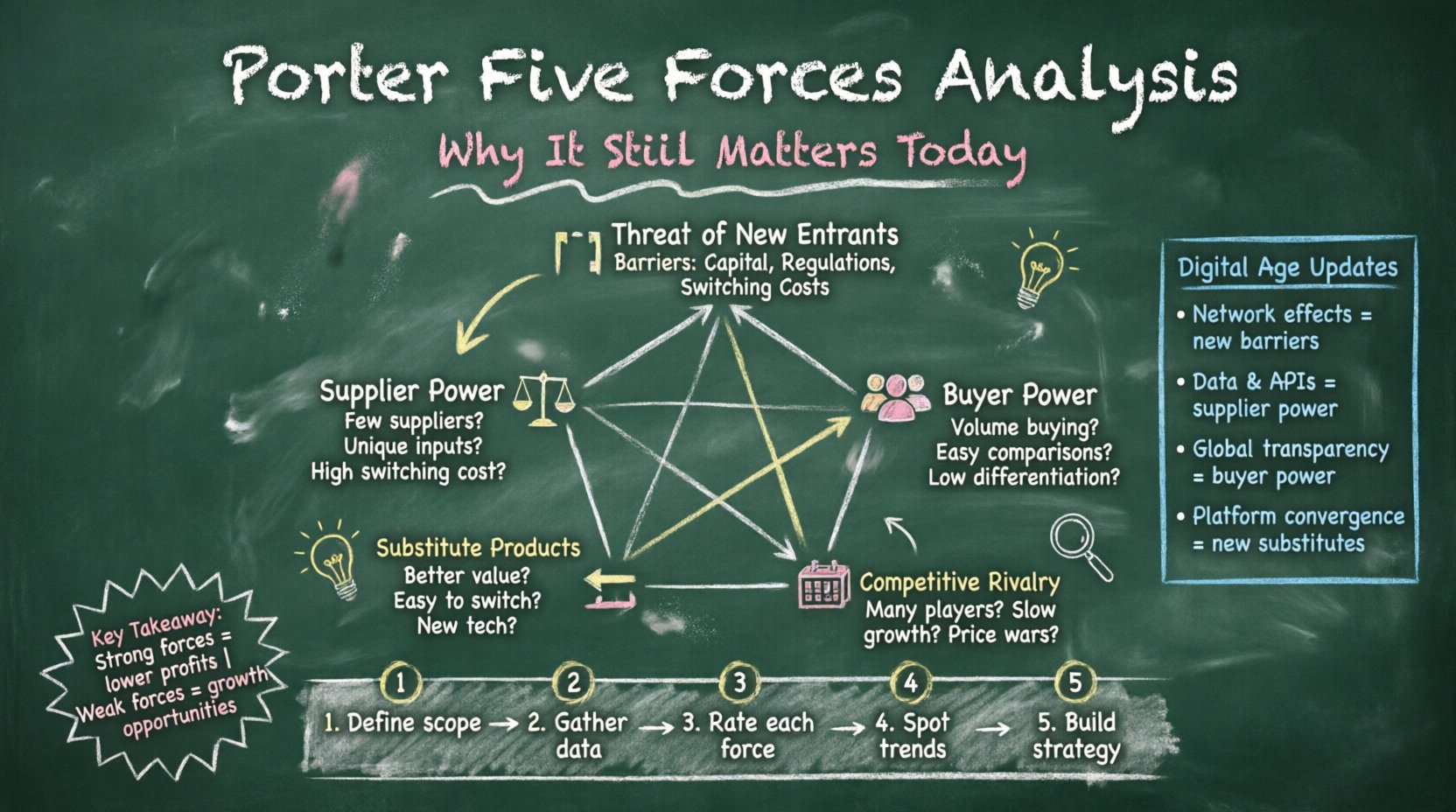
Developed by Michael Porter in 1979, this model identifies five key factors that determine the competitive intensity and attractiveness of a market. It moves beyond simple competitor analysis to look at the structural elements of the industry itself. By understanding these pressures, leaders can make informed decisions about resource allocation, pricing, and long-term positioning.
The core premise is simple: industry profitability is not just about beating the competition. It is about understanding the forces that shape the industry structure. If these forces are strong, profits are likely to be low. If they are weak, the industry offers opportunities for sustainable growth.
- Industry Structure: The inherent characteristics of the sector.
- Competitive Intensity: How aggressively players fight for market share.
- Profitability Potential: The ceiling for financial returns.
The Five Forces Defined 🛡️
To apply this framework effectively, one must understand each force individually. Below is a detailed breakdown of the components that make up the analysis.
1. Threat of New Entrants 🚪
This force measures how easy or difficult it is for new competitors to enter the market. High barriers to entry protect existing companies from losing market share. Low barriers invite disruption.
- Capital Requirements: Does the industry require massive upfront investment?
- Regulatory Hurdles: Are there licenses or compliance standards?
- Switching Costs: Is it hard for customers to move to a new provider?
- Access to Distribution: Can new players reach customers effectively?
In the modern context, digital platforms have lowered barriers in some sectors while raising them in others. For example, software as a service (SaaS) allows startups to launch with minimal capital, whereas biotech firms still face heavy regulatory scrutiny.
2. Bargaining Power of Suppliers ⚖️
Suppliers can drive up prices or reduce quality, impacting profitability. This power increases when there are few suppliers or when the product is unique.
- Concentration: Is the supplier market dominated by a few players?
- Uniqueness: Is the input specialized or commoditized?
- Switching Costs: How expensive is it to change suppliers?
- Threat of Forward Integration: Can suppliers enter the market themselves?
Supply chain disruptions in recent years have highlighted the critical nature of this force. Companies that rely on single-source suppliers face significant risk.
3. Bargaining Power of Buyers 👥
Buyers exert pressure by demanding lower prices or higher quality. Their power grows when they buy in large volumes or when the product is standardized.
- Volume of Purchase: Do they buy a small or large share of the supplier?
- Product Differentiation: Is the offering unique or generic?
- Price Sensitivity: How much does cost influence the decision?
- Availability of Information: Do buyers know the true market cost?
Internet access has empowered buyers. Comparison shopping is instant, and reviews are public. This has shifted power significantly toward consumers in retail and service industries.
4. Threat of Substitute Products 🔄
Substitutes are products from outside the industry that solve the same problem. They place a ceiling on prices. If a substitute is cheaper or better, demand shifts.
- Price Performance: Does the substitute offer better value?
- Switching Costs: Is it easy for users to change habits?
- Consumer Perception: Are substitutes viewed as viable alternatives?
- Technological Convergence: Are technologies merging to create new options?
Consider the impact of streaming services on traditional cable television. The substitute was not just cheaper; it offered superior convenience, fundamentally altering the industry structure.
5. Rivalry Among Existing Competitors ⚔️
This force looks at how aggressively current players compete. Intense rivalry leads to price wars, advertising battles, and innovation races.
- Number of Competitors: Is the market fragmented or consolidated?
- Industry Growth: Is the market expanding or stagnant?
- Fixed Costs: Are there high costs that pressure firms to fill capacity?
- Diversity of Competitors: Do players have different strategies and cultures?
In saturated markets, competition often shifts from price to ecosystem and customer experience. The fight is no longer just about the product; it is about the entire user journey.
Adapting to the Digital Economy 💻
One common criticism of the Porter model is that it was designed for a pre-internet era. However, the underlying principles of supply, demand, and competition remain valid. The application has simply evolved.
Here is how the forces manifest in a digital-first environment:
| Force | Traditional Context | Modern Digital Context |
|---|---|---|
| New Entrants | High capital barriers (factories, inventory) | Cloud infrastructure lowers entry costs; network effects create new barriers |
| Supplier Power | Raw material scarcity | Data ownership, API access, and talent scarcity |
| Buyer Power | Local market availability | Global comparison, instant transparency, social influence |
| Substitutes | Cross-industry alternatives | Platform convergence and AI automation |
| Rivalry | Price and location wars | Speed of iteration, ecosystem lock-in, data dominance |
Network effects are a modern barrier that Porter did not explicitly detail. A platform becomes more valuable as more users join, making it harder for new entrants to gain traction even with low capital costs.
Step-by-Step Implementation Process 📝
Conducting an analysis requires data gathering and structured thinking. There is no need for expensive software to execute this. A team of strategists can use whiteboards, spreadsheets, and interviews to build the assessment.
- Define the Industry Scope: Clearly outline the boundaries. Are you looking at the entire market or a specific segment?
- Gather Data: Collect information on market size, growth rates, competitor financials, and customer feedback.
- Analyze Each Force: Evaluate the strength of each force on a scale (Low, Medium, High). Identify specific drivers.
- Identify Trends: Look at how these forces are changing over time. Is supplier power increasing or decreasing?
- Assess Profitability: Combine the findings to determine the overall attractiveness of the industry.
- Develop Strategy: Use the insights to position the company. Should you differentiate? Should you reduce costs? Should you integrate vertically?
During this process, cross-functional teams should participate. Sales teams provide buyer insights, procurement handles supplier data, and R&D tracks technological shifts.
Common Pitfalls to Avoid ⚠️
Even with a solid framework, execution can go wrong. Awareness of these common errors helps ensure the analysis yields actionable results.
- Static View: Treating the analysis as a one-time event. Markets change, and the forces shift. Regular reviews are essential.
- Ignoring Indirect Competitors: Focusing only on direct rivals misses the threat of substitutes from different sectors.
- Overlooking Internal Capabilities: External analysis must be paired with an internal assessment of strengths and weaknesses.
- Assuming Uniformity: Assuming all companies in the industry face the same forces. Positioning matters significantly.
- Qualitative Bias: Relying solely on opinion without hard data to support the assessment.
Integration with Other Strategic Tools ⚖️
No single framework tells the whole story. To build a robust strategy, the Five Forces should be integrated with other analytical tools.
SWOT Analysis
While Five Forces looks outward, SWOT (Strengths, Weaknesses, Opportunities, Threats) looks both inward and outward. The threats identified in the Five Forces map directly to the Threats in a SWOT analysis.
PESTEL Analysis
PESTEL (Political, Economic, Social, Technological, Environmental, Legal) covers macro-environmental factors. These factors influence the Five Forces. For example, a new regulation (Political) might increase the Barrier to Entry for new players.
Value Chain Analysis
Once the external environment is understood, Value Chain Analysis helps determine where the company creates value internally. This aligns external opportunities with internal operations.
Real-World Application Examples 🌍
Applying theory to practice clarifies its utility. Consider how different industries navigate these forces.
The Airline Industry
This sector is a classic example of high rivalry and low profitability.
- Rivalry: Extremely high. Price wars are common.
- Supplier Power: High. Few aircraft manufacturers (Boeing, Airbus) dominate.
- Buyer Power: High. Customers can easily compare prices online.
- Substitutes: Trains or video conferencing for business travel.
- Entrants: Capital intensive, but low-cost carriers can enter niche markets.
The Smartphone Market
This market shows how technology changes the dynamics.
- Rivalry: Intense but concentrated among a few major players.
- Supplier Power: Moderate. Chipsets and screens are specialized but available.
- Buyer Power: High. Switching costs are low for hardware but high for ecosystems.
- Substitutes: Tablets or personal computers for certain tasks.
- Entrants: Low. Brand loyalty and ecosystem integration create barriers.
The Streaming Service Industry
A modern example of digital disruption.
- Rivalry: Growing as new entrants launch.
- Supplier Power: High. Content creators and talent demand higher fees.
- Buyer Power: High. Subscription fatigue is real; customers cancel easily.
- Substitutes: YouTube, TikTok, and other entertainment forms.
- Entrants: Moderate. Tech giants can enter, but content libraries are a barrier.
Limitations of the Framework 📉
It is important to acknowledge where the model falls short. This ensures a balanced view.
- Focus on Industry vs. Firm: It emphasizes industry structure over specific firm capabilities. A strong company can outperform a weak industry.
- Static Snapshot: It describes the market at a point in time. It does not inherently account for rapid change or innovation dynamics.
- Assumption of Profit Maximization: It assumes firms are solely focused on profit, ignoring social or environmental goals which may alter strategic choices.
- Complementary Products: It does not fully account for the role of complements (products that increase the value of the main product), which are crucial in tech ecosystems.
To mitigate these limitations, analysts should treat the Five Forces as a starting point for discussion rather than a definitive answer. It sets the stage for deeper inquiry.
Key Takeaways for Strategic Leaders 🚀
Strategic planning requires clarity on where the pressure points lie. The Five Forces Analysis provides a map for this terrain. By systematically evaluating the five areas, leaders can anticipate shifts before they happen.
- Continuous Monitoring: Update the analysis regularly to reflect market changes.
- External Focus: Do not ignore the market environment in favor of internal metrics.
- Actionable Insights: Translate findings into specific strategic moves, such as vertical integration or differentiation.
- Holistic View: Combine with internal analysis tools for a complete picture.
The landscape of business is never static. New technologies emerge, regulations change, and consumer preferences shift. However, the fundamental questions of who holds power and where value is created remain constant. The Porter Five Forces Analysis answers these questions with precision.
For organizations navigating uncertainty, this tool offers a structured path forward. It does not guarantee success, but it significantly reduces the risk of strategic blind spots. By understanding the forces shaping the industry, companies can position themselves to thrive regardless of external volatility.
Ultimately, the value lies not in the diagram itself, but in the conversation it sparks. When teams sit down to discuss supplier power or the threat of new entrants, they align their understanding of the business environment. This shared knowledge is the true asset that drives better decision-making.
As you move forward with your strategic planning, remember that the framework is a guide, not a rulebook. Use it to challenge assumptions and uncover hidden opportunities. The market will continue to evolve, but the principles of competitive advantage remain a reliable compass for the journey ahead.
Related posts:
 Porter Five Forces Analysis Explained: How to Assess Industry Attractiveness in 10 Minutes
 Porter Five Forces Analysis: A Checklist for Evaluating Market Competition Accurately
 Porter Five Forces Analysis: How New Entrants Shape Industry Dynamics (And How to Predict Them)
 Porter Five Forces Analysis: A No-Jargon Guide for Strategy Course Beginners