


Understanding the competitive landscape requires more than just looking at direct rivals. It demands a structural view of the industry ecosystem. Michael Porter’s Five Forces framework provides this lens, breaking down the factors that shape profitability. Among these five forces, Supplier Power often dictates the baseline margin potential for an entire sector. When suppliers hold significant leverage, they can squeeze profitability, dictate terms, and alter product quality.
This guide explores the mechanics of supplier power within the context of strategic management. We will examine how to assess this force, identify the drivers behind it, and implement tactics to mitigate risk. By understanding these dynamics, organizations can secure their supply chains and maintain financial resilience.
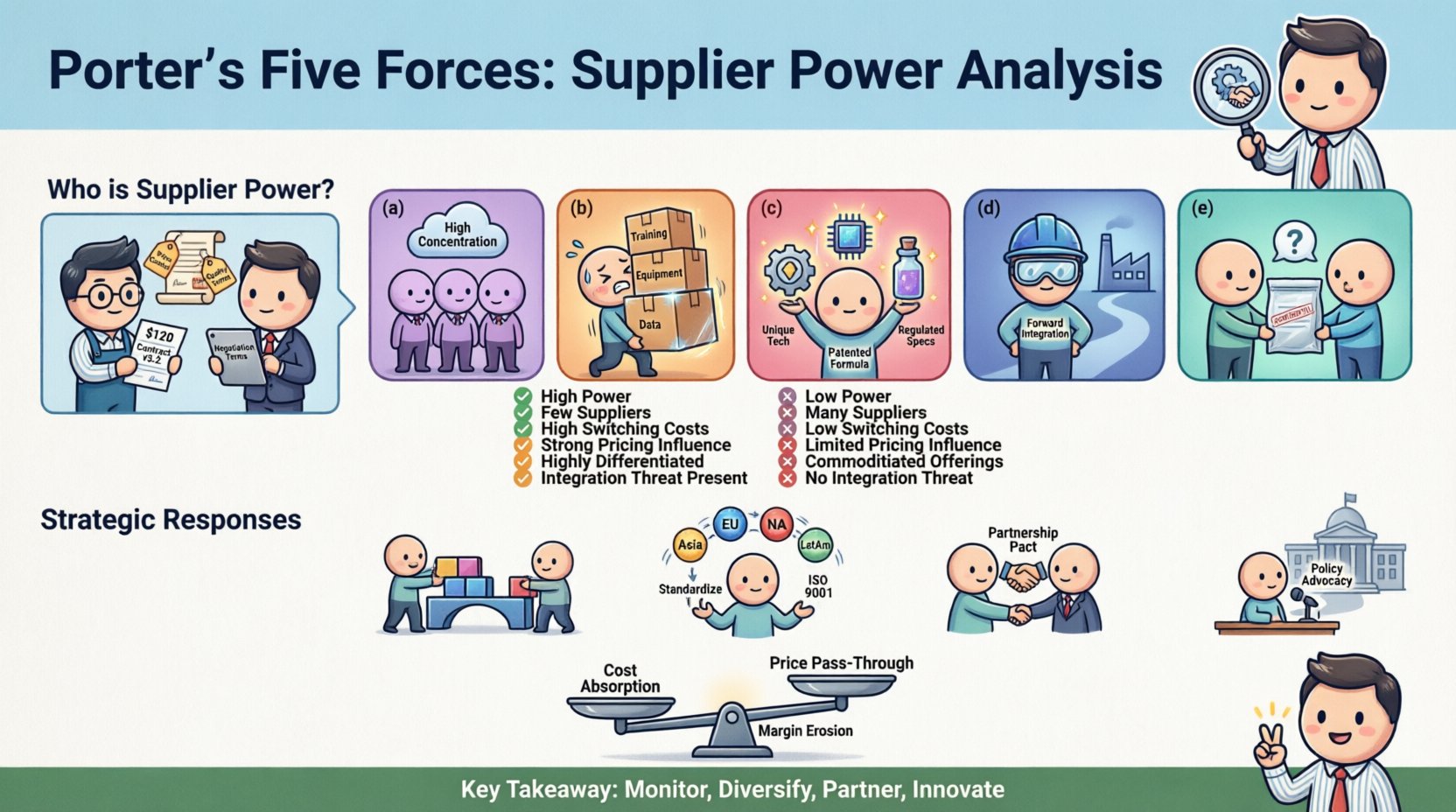
Defining Supplier Power in the Competitive Framework 🔍
Supplier power refers to the ability of providers of raw materials, components, or services to influence prices and terms. High supplier power means the industry faces pressure to accept higher costs or lower quality. Low supplier power allows buyers to negotiate favorable conditions.
This force is not static. It shifts based on market conditions, technology changes, and geopolitical events. Recognizing the current state of supplier power is essential for accurate forecasting and long-term planning.
Key characteristics of strong supplier power include:
- Supplier concentration is high relative to the industry.
- Switching costs for buyers are prohibitively expensive.
- Supplied products are differentiated or unique.
- Suppliers pose a credible threat of forward integration.
- There is no viable substitute for the supplied input.
Core Drivers of Supplier Power 🚀
To assess supplier power effectively, one must look at the underlying structural drivers. These factors determine how much leverage a supplier group holds over their customers.
1. Concentration and Competition
If an industry relies on a few dominant suppliers, power shifts to the providers. Conversely, if there are many small suppliers competing for business, the buyer holds the advantage.
- High Concentration: Few suppliers control the market. They can coordinate pricing or limit supply.
- Low Concentration: Many suppliers compete. Prices tend to drop due to competition.
2. Switching Costs
Switching costs represent the financial or operational burden of moving from one supplier to another. High costs lock buyers into existing relationships.
- Training: Employees may need retraining on new systems.
- Equipment: New machinery might be required to process different inputs.
- Data Migration: Moving data between platforms can be complex and risky.
3. Differentiation of Inputs
When suppliers offer unique products that cannot be easily replaced, they gain leverage.
- Brand Value: Some inputs are preferred due to brand reputation.
- Technical Specs: Proprietary technology may be required for production.
- Quality Standards: Higher quality inputs may be non-negotiable for premium brands.
4. Threat of Forward Integration
Suppliers may threaten to enter the buyer’s business. If a supplier decides to manufacture the final product themselves, they become a competitor.
- This threat limits the buyer’s ability to negotiate aggressively.
- It creates a risk of the supplier cutting off supply to competitors.
5. Information Asymmetry
Suppliers often know more about their costs and market conditions than the buyers do. This information gap allows them to justify price increases or hide inefficiencies.
Assessing Supplier Power: A Structural Comparison 📊
Evaluating the level of supplier power helps strategists decide where to allocate resources. The table below outlines the differences between high and low supplier power environments.
| Feature | High Supplier Power | Low Supplier Power |
|---|---|---|
| Market Structure | Oligopoly or Monopoly among suppliers | Fragmented market with many providers |
| Switching Costs | High (Technical, contractual) | Low (Commodity inputs) |
| Pricing Influence | Suppliers dictate terms | Buyers dictate terms |
| Product Differentiation | Unique or specialized inputs | Standardized, interchangeable goods |
| Integration Risk | High risk of forward integration | Low risk of forward integration |
Strategic Responses to High Supplier Power 🛡️
When supplier power is high, the industry faces margin compression. Organizations must adopt specific strategies to counterbalance this pressure. The goal is to reduce dependence and increase flexibility.
1. Vertical Integration
Acquiring or merging with a supplier brings the supply chain in-house. This eliminates the supplier’s profit margin and secures supply.
- Backward Integration: Buying the supplier.
- Pros: Control over quality, cost, and timeline.
- Cons: High capital expenditure and operational complexity.
2. Diversification of Suppliers
Relying on a single source creates vulnerability. Spreading orders across multiple vendors reduces risk.
- Multisourcing: Qualifying multiple suppliers for the same component.
- Geographic Spread: Sourcing from different regions to mitigate geopolitical risk.
- Negotiation Leverage: Competition between suppliers drives better pricing.
3. Standardization of Inputs
If a company uses unique components, it creates dependency. Switching to industry-standard parts increases options.
- Design Changes: Adjusting product design to accept generic parts.
- Compatibility: Ensuring new parts work with existing systems.
4. Building Strategic Partnerships
Instead of adversarial relationships, some firms opt for collaboration. Long-term contracts can secure supply at stable prices.
- Joint Development: Working together to innovate.
- Volume Commitments: Guaranteeing purchase volume in exchange for priority.
- Transparency: Sharing data to improve efficiency for both parties.
5. Lobbying and Regulation
In some industries, government intervention can level the playing field.
- Antitrust Laws: Preventing monopolistic behavior by suppliers.
- Trade Agreements: Reducing tariffs on imported inputs.
The Economic Impact on Pricing and Margins 💰
Supplier power directly affects the bottom line. When costs rise due to supplier leverage, companies have three options: absorb the cost, pass it to customers, or reduce margins.
1. Cost Absorption
The company eats the cost to maintain market share. This is often unsustainable in the long run.
- Efficiency Gains: Cutting waste elsewhere in the operation.
- Administrative Reduction: Lowering overhead to offset input costs.
2. Price Pass-Through
Increasing prices for end consumers. This depends on demand elasticity.
- Elastic Demand: If customers are price-sensitive, raising prices loses volume.
- Inelastic Demand: If the product is essential, customers pay the increase.
3. Margin Erosion
Accepting lower returns on investment. This impacts shareholder value and the ability to reinvest.
- Capital Allocation: Less cash available for R&D or expansion.
- Valuation: Lower margins often lead to lower stock valuations.
Mitigation Strategies Through Technology and Data 📈
Modern supply chains rely on data to predict trends and negotiate better terms. Technology acts as a tool to reduce information asymmetry.
1. Spend Analysis
Analyzing historical purchasing data reveals spending patterns and opportunities.
- Consolidation: Identifying where spending is duplicated.
- Bundling: Combining orders to increase volume leverage.
2. Market Intelligence
Tracking commodity prices and global trends helps in timing purchases.
- Forecasting: Anticipating price hikes before they happen.
- Contract Timing: Locking in prices during favorable market windows.
3. Automation in Procurement
Automating routine purchasing tasks reduces administrative overhead and human error.
- E-Procurement: Digital platforms for ordering and invoicing.
- Vendor Management: Automated performance tracking.
Long-term Relationship Management and Resilience 🤝
Resilience is the ability to recover quickly from difficulties. In the context of supply chains, this means having robust relationships and backup plans.
1. Supplier Audits
Regularly reviewing supplier operations ensures they meet standards.
- Quality Checks: Verifying product consistency.
- Risk Assessment: Identifying financial or operational instability.
2. Risk Sharing Agreements
Contracts that define how risks are shared between buyer and supplier.
- Cost Fluctuation: Sharing the burden of raw material price spikes.
- Capacity Guarantees: Ensuring supply during peak demand.
3. Ethical Sourcing
Ensuring suppliers adhere to labor and environmental standards protects brand reputation.
- Compliance: Adhering to international labor laws.
- Sustainability: Reducing carbon footprint in the supply chain.
Navigating Geopolitical and Logistical Challenges 🌍
Global supply chains are susceptible to external shocks. Political instability, trade wars, and logistics bottlenecks can disrupt supplier relationships.
1. Nearshoring and Friend-shoring
Moving suppliers closer to home or to allied nations reduces geopolitical risk.
- Transportation: Shorter distances mean faster delivery.
- Regulation: Fewer trade barriers and customs delays.
2. Inventory Buffering
Maintaining higher stock levels protects against sudden supply interruptions.
- Working Capital: Higher inventory ties up cash.
- Security: Prevents production stoppages.
3. Diversified Logistics
Using multiple shipping routes and carriers prevents bottlenecks.
- Redundancy: Alternative pathways for goods.
- Flexibility: Adapting to port closures or fuel shortages.
Final Thoughts on Strategic Implementation 🎯
Analyzing supplier power is not a one-time exercise. It requires continuous monitoring as market conditions evolve. Companies that ignore this force risk significant margin erosion and operational instability.
By understanding the drivers, assessing the current landscape, and implementing strategic countermeasures, organizations can turn a potential weakness into a competitive advantage. The focus remains on building resilient, efficient, and adaptable supply networks.
Key takeaways for leaders include:
- Monitor supplier concentration and switching costs regularly.
- Invest in technology to gain better market visibility.
- Build partnerships rather than transactional relationships.
- Prepare contingency plans for supply chain disruptions.
- Align procurement strategy with overall corporate goals.
Strategic management is about preparation. With a clear view of supplier power, businesses can navigate uncertainty with confidence and secure their financial future.
Related posts:
 Porter Five Forces Analysis: A Beginner’s Quick Start Guide to Understanding Industry Competition
 Porter Five Forces Analysis: Why It’s Still Relevant in Today’s Fast-Changing Markets
 Porter Five Forces Analysis: A Practical Guide to Analyzing Buyer Bargaining Power
 Porter Five Forces Analysis: A Q&A for Students Struggling with the Framework