


Understanding the competitive landscape is fundamental to strategic planning. For decades, business leaders and analysts have relied on frameworks that provide clarity amidst market complexity. One of the most enduring and widely used tools is the Porter Five Forces Analysis. Developed by Michael Porter in 1979, this framework helps organizations evaluate the intensity of competition and the profitability potential within a specific industry.
This guide breaks down the mechanics of the analysis. It offers a structured approach to understanding industry attractiveness without relying on guesswork. By identifying the key drivers of competition, companies can make informed decisions about where to allocate resources and how to position themselves against rivals.
🔍 What Is Porter Five Forces Analysis?
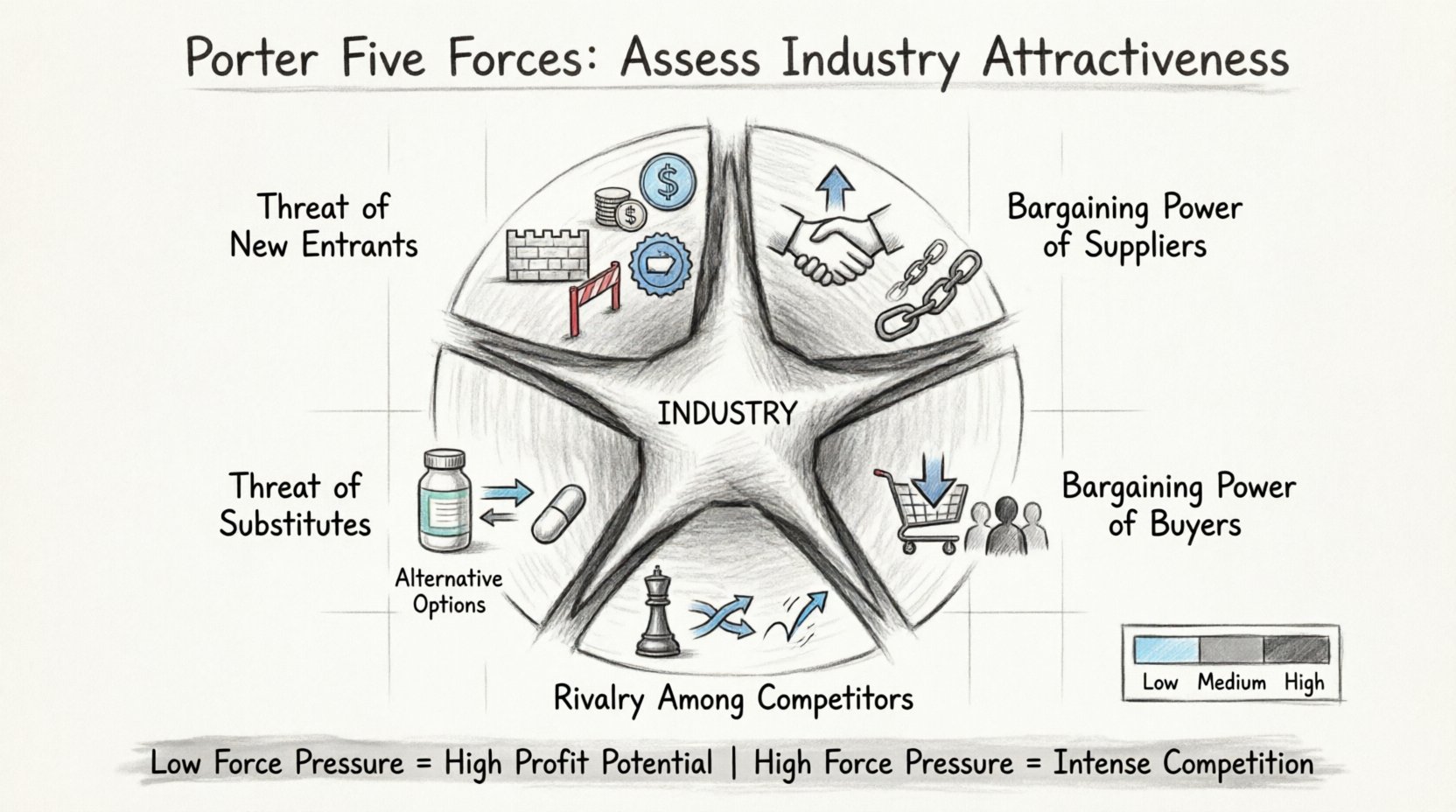
The Porter Five Forces model is a strategic tool used to analyze the competitive environment of an industry. It moves beyond simple competitor tracking to examine the underlying structural forces that determine industry profit potential. The core premise is that the five forces shape every industry and determine the intensity of competition and the profit potential.
When an industry is attractive, the five forces exert low pressure, allowing firms to earn high returns on capital. Conversely, when forces are strong, competition intensifies, and profitability declines. This framework does not look at a single company in isolation but rather the ecosystem in which it operates.
Key components of this analysis include:
- Competitive Rivalry: The intensity of competition among existing firms.
- Threat of New Entrants: How easy is it for new competitors to enter the market?
- Bargaining Power of Suppliers: Can suppliers dictate prices or terms?
- Bargaining Power of Buyers: Can customers drive prices down?
- Threat of Substitutes: Are there alternative products or services available?
🛡️ Force 1: Threat of New Entrants
This force examines how easy it is for new competitors to enter your market. If entry is easy, established companies face constant pressure to defend their market share. High barriers to entry protect incumbents, while low barriers invite disruption.
Several factors influence the threat of new entrants:
- Capital Requirements: Does starting a business here require significant investment? Industries like aerospace or telecommunications have high capital needs, deterring new players. Retail or service businesses often have lower barriers.
- Regulatory Barriers: Are there licenses, permits, or compliance standards required? Healthcare and pharmaceutical industries face strict regulations that limit entry.
- Access to Distribution Channels: Can new players get their products to customers? If existing firms have exclusive deals with distributors, newcomers struggle to reach the market.
- Economies of Scale: Do existing players benefit from lower costs due to volume? If a new entrant cannot match these cost efficiencies, they cannot compete on price.
- Brand Loyalty: Are customers attached to established brands? Strong brand recognition creates a psychological barrier for new entrants.
🚚 Force 2: Bargaining Power of Suppliers
Suppliers can influence the industry by raising prices or reducing the quality of goods and services. When suppliers are powerful, they can squeeze the profit margins of companies within the industry.
Assessing supplier power involves looking at:
- Number of Suppliers: If there are few suppliers, they hold more power. If the market is fragmented with many options, buyers have leverage.
- Switching Costs: How difficult is it to change suppliers? High switching costs lock buyers into current relationships, giving suppliers leverage.
- Uniqueness of Product: If a supplier provides a specialized component that is hard to replace, their power increases.
- Threat of Forward Integration: Can the supplier enter your industry and become a competitor? If they can, they may use this threat to negotiate better terms.
- Importance of Volume: If your purchases represent a significant portion of the supplier’s sales, you have more influence.
🛒 Force 3: Bargaining Power of Buyers
Buyers exert power by demanding lower prices or higher quality. When buyer power is high, companies must compete harder, often eroding profitability.
Key indicators of buyer power include:
- Concentration of Buyers: If a few large customers buy most of the product, they can dictate terms.
- Price Sensitivity: How sensitive are customers to price changes? If the product is a commodity, buyers will shop for the lowest price.
- Switching Costs: Can buyers easily switch to another provider? Low switching costs increase buyer power.
- Availability of Information: Do buyers know the costs and prices of competitors? Transparency increases their bargaining position.
- Threat of Backward Integration: Can the buyer enter your industry and become a supplier? This potential gives them leverage in negotiations.
🔄 Force 4: Threat of Substitutes
Substitutes are products or services from outside the industry that fulfill the same need. They limit the price a company can charge. If a substitute is cheaper or better, customers will switch.
Factors to consider include:
- Price-Performance Ratio: Does the substitute offer better value? For example, video conferencing substituted for some business travel.
- Switching Costs: Is it easy for customers to adopt the substitute? Low friction encourages substitution.
- Customer Preference: Are trends shifting towards the substitute? Changing consumer habits can make substitutes more attractive over time.
- Availability: How easy is it for customers to find the alternative? Ubiquity increases the threat.
⚔️ Force 5: Rivalry Among Existing Competitors
This force represents the intensity of competition among current players. High rivalry leads to price wars, advertising battles, and product launches, which can reduce industry profitability.
Drivers of rivalry include:
- Number of Competitors: A market with many similar firms tends to be more competitive.
- Industry Growth Rate: In a slow-growth market, companies fight for market share. In a growing market, they can all expand without conflict.
- Fixed Costs: High fixed costs often lead to price cutting to fill capacity.
- Product Differentiation: If products are undifferentiated, competition focuses on price.
- Exit Barriers: Is it hard to leave the industry? If firms cannot exit easily, they stay and compete aggressively even when profits are low.
📊 Comparing Industry Attractiveness
To visualize how these forces interact, consider the following comparison table. It illustrates how different force levels impact overall industry attractiveness.
| Force | Low Power/Threat | High Power/Threat |
|---|---|---|
| Threat of New Entrants | High barriers to entry | Low barriers to entry |
| Supplier Power | Many suppliers, low switching costs | Few suppliers, high switching costs |
| Buyer Power | Fragmented buyers, low price sensitivity | Concentrated buyers, high price sensitivity |
| Threat of Substitutes | High switching costs, poor alternatives | Low switching costs, good alternatives |
| Rivalry | Slow growth, high differentiation | Fast growth, commodity products |
📝 How to Conduct the Analysis
Implementing this framework requires a systematic approach. Follow these steps to assess your industry effectively.
1. Define the Scope
Clearly identify the industry and the specific market segment you are analyzing. The scope determines which competitors and forces are relevant.
2. Gather Data
Collect information on market size, growth rates, competitor strategies, and supplier relationships. Use industry reports, financial statements, and interviews.
3. Evaluate Each Force
Analyze each of the five forces individually. Ask specific questions for each area. Rate the intensity as Low, Medium, or High.
4. Synthesize Findings
Combine the individual assessments to form a view of the overall industry attractiveness. Identify where the greatest risks lie.
5. Develop Strategy
Use the insights to guide strategic decisions. This might involve choosing to enter a different market, investing in differentiation, or negotiating better supplier contracts.
⚠️ Limitations of the Framework
While powerful, the analysis has limitations that must be acknowledged.
- Static Nature: The model captures a snapshot in time. Industries change rapidly, and the forces may shift quickly.
- Complements: The original model does not explicitly account for complementary products. Partnerships can be just as important as competition.
- Globalization: Modern markets are interconnected. Local forces may be influenced by global dynamics not captured in a narrow analysis.
- Network Effects: In digital markets, network effects can create monopolies that the traditional model struggles to explain.
💡 Integrating with Other Tools
To get a complete picture, combine this analysis with other strategic tools.
- SWOT Analysis: Use the Five Forces to inform the Opportunities and Threats sections of a SWOT analysis.
- PESTLE Analysis: Combine with PESTLE to understand macro-environmental factors that influence the five forces.
- Value Chain Analysis: Use this to identify internal activities that can mitigate external pressures.
🗣️ Frequently Asked Questions
Q: How often should I perform this analysis?
Conduct a full review annually or whenever significant market changes occur, such as new regulations or disruptive technologies.
Q: Can I use this for internal business decisions?
Yes, it helps determine whether to invest in new product lines, enter new markets, or divest from current operations.
Q: Is this analysis suitable for startups?
Absolutely. Startups need to understand the competitive landscape before launching to ensure there is room for growth.
Q: Does it apply to service industries?
Yes. The forces apply to services as well, such as consulting, hospitality, and finance.
🏁 Final Thoughts
Strategic planning requires a deep understanding of the forces at play. The Porter Five Forces Analysis provides a structured way to evaluate these dynamics. By systematically assessing each force, organizations can identify risks and opportunities with greater clarity.
Remember that this is a starting point for discussion, not a definitive answer. Markets are dynamic, and the interplay between these forces evolves. Continuous monitoring and adaptation are essential for long-term success. Use this framework to inform your strategy, but remain flexible as conditions change.
Related posts:
 Porter Five Forces Analysis: A Step-by-Step Walkthrough for Business School Beginners
 Porter Five Forces Analysis: A Checklist for Evaluating Market Competition Accurately
 Porter Five Forces Analysis: How New Entrants Shape Industry Dynamics (And How to Predict Them)
 Porter Five Forces Analysis: A No-Jargon Guide for Strategy Course Beginners