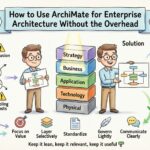


Enterprise architecture is often viewed through a lens of complexity. For leaders in technology and business, the goal is clarity. The ArchiMate framework provides a standardized language to describe, analyze, and visualize business and IT architecture. However, its reputation has grown alongside misconceptions. Many executives view it as a bureaucratic exercise or a purely technical artifact that disconnects from real-world value.
This guide cuts through the noise. It explores the practical utility of ArchiMate for organizational leaders, focusing on how it supports decision-making, reduces risk, and aligns strategy with execution. By addressing common myths and outlining concrete applications, this resource aims to provide a clear path forward without the fluff.
🧩 Understanding the Framework: A Practical Definition
ArchiMate is an open and independent modeling language. It allows organizations to model their architecture at various levels of abstraction. The primary purpose is not to create diagrams for the sake of diagrams, but to facilitate communication between business stakeholders and technical teams.
- Standardization: It uses a consistent vocabulary. Terms like “Business Process” or “Application Service” have specific meanings, reducing ambiguity.
- Integration: It bridges the gap between business strategy, business organization, business behavior, and the underlying technology.
- Visualization: Complex relationships become visible. Dependencies that were previously hidden in documentation become clear in a model.
Leaders do not need to be modelers themselves. However, understanding the structure helps in interpreting the outputs and ensuring they meet organizational needs.
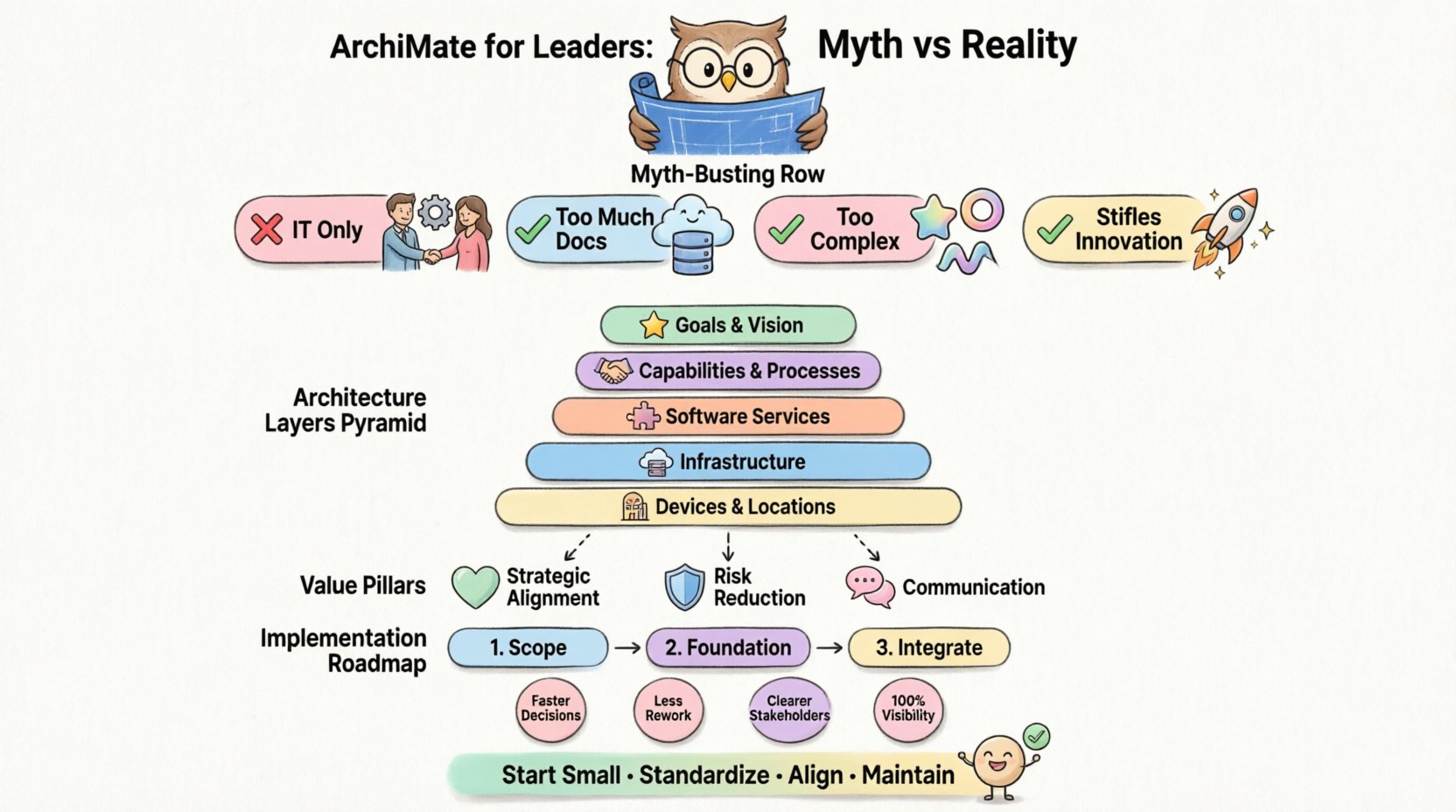
🚫 Myth-Busting: Separating Fact from Fiction
Several persistent beliefs surround the adoption of ArchiMate. These myths often deter investment in architecture capabilities. Below, we address the most common misconceptions and provide the reality behind each.
❌ Myth 1: It Is Only for IT Departments
Many assume ArchiMate is a tool for architects and developers. While it models technology layers, its core strength lies in the Business Layer.
- Reality: The framework starts with business strategy. It maps business capabilities to the services required to deliver value.
- Impact: IT becomes an enabler, not the owner, of the model. Business leaders define the capabilities, and IT defines the implementation.
- Benefit: This ensures technology investments directly support business goals, preventing siloed projects.
❌ Myth 2: It Creates Excessive Documentation
There is a fear that modeling requires hours of manual entry and results in documents that are outdated by the time they are published.
- Reality: The goal is a living model, not static paperwork. While models require maintenance, they replace fragmented spreadsheets and disconnected documents.
- Benefit: A centralized repository ensures everyone looks at the same version of the truth. Changes propagate through the model, showing impact instantly.
- Efficiency: Over time, maintenance costs drop as the model becomes the primary source of architectural truth.
❌ Myth 3: It Is Too Complex for Non-Technical Stakeholders
Executives often worry that the notation is too dense. They fear they cannot interpret the diagrams.
- Reality: ArchiMate supports abstraction. You can model at a high level without diving into technical details immediately.
- Strategy: Present different views to different audiences. Business leaders see capability maps; technical leads see application interfaces.
- Training: Basic literacy in the notation is enough for leaders to understand the relationships and flows.
❌ Myth 4: It Stifles Innovation Due to Rigidity
Skeptics believe that formal modeling slows down agile development and change.
- Reality: Architecture should guide change, not block it. ArchiMate helps identify dependencies before changes are made.
- Agility: By understanding the system landscape, teams can change components without breaking the whole.
- Speed: Reduced risk of rework leads to faster delivery. You avoid building on unstable foundations.
📊 The Layers of Architecture: A Visual Breakdown
To understand where value lies, it helps to visualize the standard layers. This structure ensures nothing is overlooked during planning.
| Layer | Focus Area | Key Question for Leaders |
|---|---|---|
| Strategy | Goals, Principles, Drivers | What are we trying to achieve? |
| Business | Capabilities, Processes, Organization | How do we deliver value? |
| Application | Applications, Software Services | What software supports the process? |
| Technology | Infrastructure, Networks, Hardware | Where does the software run? |
| Physical | Devices, Locations | Where is the hardware located? |
Leaders often focus on the bottom layers (Technology) while neglecting the top (Strategy). ArchiMate forces a top-down view, ensuring technology serves the business.
💼 Practical Value for Enterprise Leaders
Why invest time and resources into this framework? The value proposition is tangible when viewed through the lens of governance and risk management.
1. Strategic Alignment
Organizations often suffer from a disconnect between the boardroom and the data center. ArchiMate provides the connective tissue.
- Traceability: You can trace a business goal down to the specific application supporting it.
- Gap Analysis: Identify where capabilities are missing. If a goal requires a process that does not exist, the model highlights the gap.
- Investment Decisions: Stop funding projects that do not link back to a strategic objective.
2. Risk Reduction
Undocumented dependencies are a primary source of operational failure. When a server goes down or a license expires, the impact is often unknown.
- Impact Analysis: Before making a change, see what relies on the component being changed.
- Single Point of Failure: Identify critical paths in the architecture that pose a threat to continuity.
- Compliance: Map controls to the architecture to ensure regulatory requirements are met by design.
3. Communication Efficiency
Words are often interpreted differently by different people. Visual models reduce ambiguity.
- Common Language: Stakeholders stop arguing over definitions and start discussing relationships.
- Onboarding: New hires can understand the system landscape faster through documented models.
- Vendor Management: Clearly define boundaries and interfaces when working with external partners.
🚀 Implementation Strategy Without Hype
Adopting a framework is a journey, not an event. A phased approach ensures sustainability and avoids burnout.
Phase 1: Define Scope and Value
- Identify Pain Points: What is the specific problem you are solving? Is it cost transparency? Is it speed to market?
- Set Boundaries: Do not model everything at once. Start with a specific domain, such as a single business unit or product line.
- Secure Sponsorship: Ensure leadership understands the effort required and supports the initiative.
Phase 2: Build the Foundation
- Establish Standards: Define naming conventions and modeling rules. Consistency is key.
- Create Templates: Develop standard views for common scenarios (e.g., service delivery, integration).
- Tool Selection: Choose a platform that supports the notation without forcing a specific workflow. Focus on the data, not the UI.
Phase 3: Integrate into Processes
- Governance: Make model updates part of the change management process.
- Reviews: Hold regular architecture review boards to assess models and updates.
- Feedback Loops: Allow architects and developers to report inaccuracies and suggest improvements.
📈 Measuring Success and ROI
Without metrics, progress is invisible. Leaders need to know if the investment is paying off. Avoid vanity metrics like “number of diagrams.” Focus on outcomes.
| Metric | Why It Matters | Target |
|---|---|---|
| Decision Speed | Time taken to evaluate architectural impact | Reduce by 20% |
| Project Rework | Percentage of projects requiring significant changes due to architecture | Reduce by 15% |
| Stakeholder Clarity | Survey score on understanding of IT landscape | Increase by 25% |
| Dependency Visibility | Percentage of critical dependencies documented | 100% Coverage |
Tracking these metrics provides evidence of value. It shifts the conversation from “cost center” to “efficiency driver.”
🔍 Deep Dive: The Business Layer
For business leaders, the Business Layer is the most relevant section. It focuses on capabilities, value streams, and processes.
- Business Capabilities: What the organization can do (e.g., “Process Claims”, “Manage Customer Data”). These are stable compared to processes.
- Value Streams: How value is delivered to the customer. This connects capabilities to outcomes.
- Business Processes: The specific steps taken to execute a capability. These change more frequently.
Mapping capabilities to value streams reveals redundancy. If two departments have the same capability but different processes, standardization may be possible. If capabilities do not map to value streams, they may be unnecessary.
🔍 Deep Dive: The Technology Layer
The Technology Layer describes the infrastructure. While IT manages this, leaders need to understand the cost implications.
- Infrastructure Services: Network, storage, compute.
- Deployment Nodes: Where applications run.
- Physical Devices: Servers, routers, endpoints.
Understanding the relationship between applications and infrastructure helps in cloud migration decisions. You can see which applications are tightly coupled to specific hardware and which are portable.
🤝 Collaboration Across Disciplines
Enterprise architecture is not a solitary practice. It requires collaboration across multiple disciplines.
- Business Architects: Focus on the Business Layer. They ensure the organization can deliver its strategy.
- Application Architects: Focus on the Application Layer. They manage software portfolios.
- Infrastructure Architects: Focus on the Technology Layer. They manage the platform.
- Security Architects: Overlay security requirements across all layers.
ArchiMate provides the common syntax for these groups to talk to each other. Without it, business architects speak “process” and IT architects speak “server”. The framework bridges this vocabulary gap.
⚠️ Common Pitfalls to Avoid
Even with a solid plan, projects can fail. Awareness of common pitfalls helps mitigate risk.
- Perfectionism: Do not try to model the entire enterprise in the first year. Start small and expand.
- Lack of Maintenance: A model that is not updated is worse than no model. It creates false confidence. Commit to maintenance.
- Over-Modeling: Do not model every single relationship. Focus on the critical paths that drive value or risk.
- Ignoring People: Architecture is social as much as technical. Involve people in the design process to ensure adoption.
🔮 The Future of Enterprise Modeling
The landscape of architecture is evolving. Cloud, AI, and microservices are changing how systems are built. ArchiMate adapts to these changes.
- Agility: Modern models support iterative development rather than rigid waterfall planning.
- Automation: Models can drive code generation or configuration management in some contexts.
- Real-Time: The goal is to move from static documentation to dynamic, data-driven architecture views.
Leaders who understand the core principles of ArchiMate will be better positioned to navigate these shifts. The framework is not the technology; it is the thinking tool.
📝 Summary of Key Takeaways
- Focus on Value: Only model what drives business value or reduces risk.
- Start Small: Prove value in one domain before scaling.
- Standardize: Use a common language to improve communication.
- Maintain: Keep the model current to ensure accuracy.
- Align: Ensure every technical asset traces back to a business goal.
By treating ArchiMate as a strategic tool rather than a technical burden, leaders can unlock clarity in complex environments. The goal is not complexity for complexity’s sake. It is clarity for decision-making. When implemented correctly, the framework becomes invisible, supporting the organization’s growth without demanding constant attention.
Organizations that embrace this discipline gain a competitive advantage. They move faster because they understand their own landscape. They invest wisely because they see the full picture. This is the practical value of a mature architecture practice.