


Enterprise architecture (EA) frameworks provide structure to complex organizational landscapes. Among these, ArchiMate stands out as a standard for modeling and visualizing business and IT structures. However, practitioners often face a common challenge: the model becomes more complex than the reality it represents. This guide explores how to leverage ArchiMate effectively while minimizing unnecessary complexity and administrative burden. 🏗️
The goal is not to simplify the framework itself, but to apply it with precision. By focusing on value streams and essential relationships, you can maintain a living architecture that supports decision-making rather than hindering it. This approach requires discipline, clear scope, and a commitment to relevance over completeness.
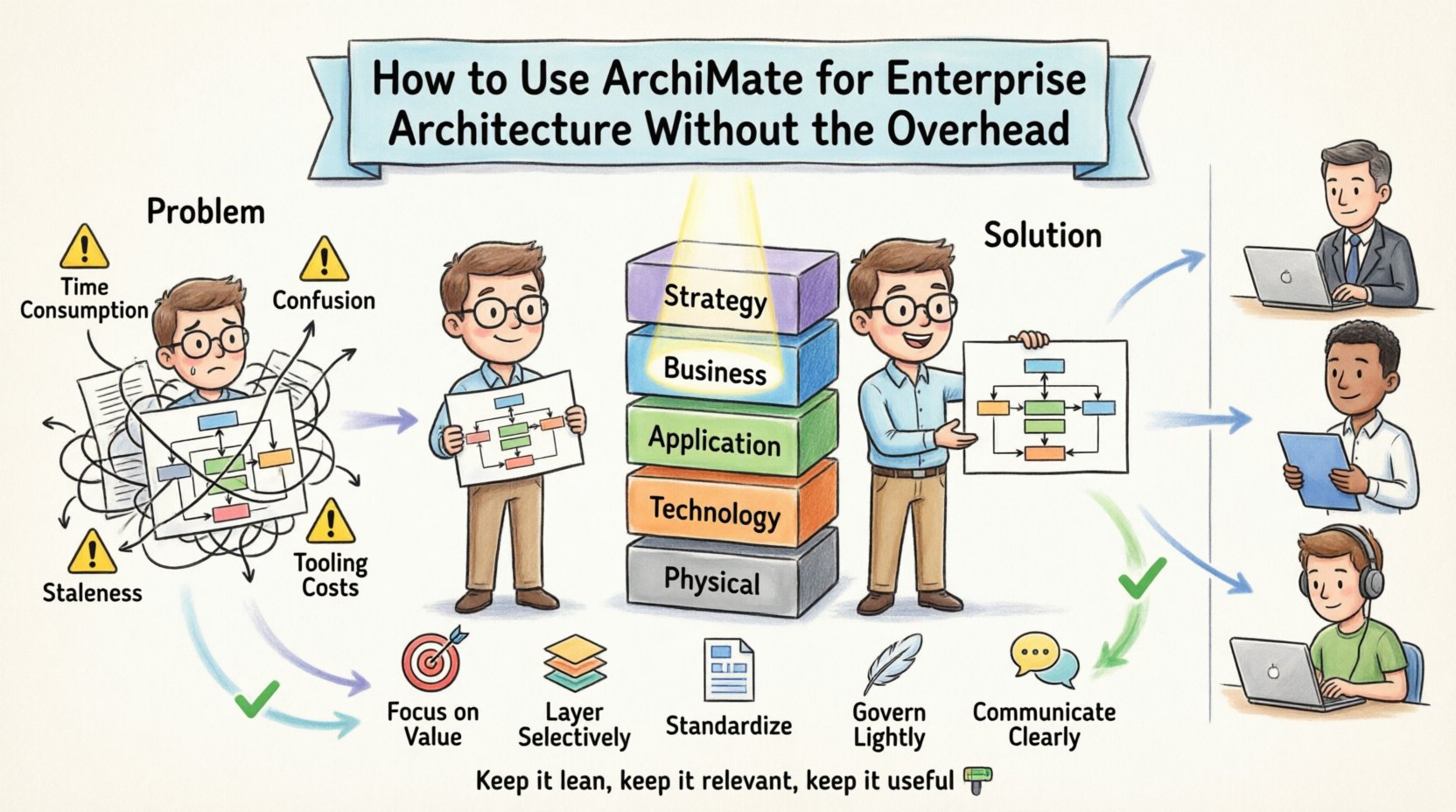
🧩 Understanding the Core Layers
ArchiMate divides architecture into specific layers. Each layer addresses a different aspect of the enterprise. To avoid overhead, you must understand which layers are actually necessary for your current context. Do not attempt to model every single layer in every diagram.
The standard layers include:
- Strategy Layer: Deals with drivers, goals, and principles.
- Business Layer: Covers processes, functions, and actors.
- Application Layer: Focuses on software components and services.
- Technology Layer: Addresses infrastructure and hardware.
- Physical Layer: Represents the actual hardware and environment.
When modeling, start with the Business Layer. This is where the value is created for the customer. Only drill down into Application or Technology layers if a specific business process requires technical justification. This top-down approach prevents premature optimization and reduces the volume of data you need to maintain. 📉
🛑 The Cost of Over-Engineering
Many organizations struggle with “Architecture Bloat.” This occurs when diagrams contain excessive detail that does not contribute to understanding or decision-making. Overhead manifests in several ways:
- Time Consumption: Maintaining models takes time away from actual architectural work.
- Confusion: Stakeholders struggle to find relevant information in dense diagrams.
- Staleness: Models become outdated quickly because the effort to update them is too high.
- Tooling Costs: Complex models often require expensive software licenses and training.
To mitigate this, you must establish a clear purpose for every diagram. If a diagram does not answer a specific question or support a specific decision, it should not exist. 🚫
⚖️ Strategies for Lean Modeling
Applying ArchiMate without the overhead requires a shift in mindset. It moves from “modeling everything” to “modeling what matters.” Here are practical strategies to achieve this.
1. Define Scope Rigorously
Before opening any modeling environment, define the boundaries. What business domain is this covering? What systems are in scope? What is the time horizon? A clear scope prevents scope creep, which is a primary driver of overhead.
- Start Small: Begin with a single value stream or process.
- Limit Actors: Do not list every individual user; group them into roles.
- Focus on Flow: Prioritize the flow of information and materials over static attributes.
2. Use Abstraction Levels Wisely
Not every stakeholder needs the same level of detail. A dashboard for executives requires high-level abstraction, while developers need specific interface definitions. Use the framework to create different views for different audiences without duplicating the underlying data.
| Audience | Focus | Detail Level |
|---|---|---|
| Executive Leadership | Strategic Alignment | High (Motivation Layer) |
| Business Managers | Process Efficiency | Medium (Business Layer) |
| IT Architects | System Integration | Low (Application/Tech Layer) |
3. Leverage Templates and Patterns
Recurring patterns exist in enterprise architecture. Instead of drawing the same structure repeatedly, create templates. This ensures consistency and reduces the time spent on repetitive drawing tasks.
- Standard Process Templates: Create a standard shape for common business functions.
- Integration Patterns: Define standard connectors for data flows.
- View Templates: Pre-define the layout for common diagram types.
4. Prioritize Relationships Over Elements
In many modeling exercises, too much attention is paid to the boxes (elements) and not enough to the lines (relationships). The relationships often carry the real architectural logic. Focus on defining how elements interact, rather than cataloging every attribute of the element itself. This reduces the cognitive load on the modeler and the reader. 🔗
🔄 Governance and Maintenance
A model is only useful if it is accurate. However, keeping a model accurate can be an overhead trap. To manage this, you need a lightweight governance process.
Version Control
Just like code, architecture models need versioning. However, avoid creating a new version for every minor change. Establish a release cycle. Minor updates can be grouped, while major structural changes trigger a new version.
Review Cycles
Schedule regular reviews, but keep them focused. Do not review the whole model every time. Review specific sections that have changed. This ensures that the model remains relevant without requiring a full audit.
- Quarterly Reviews: Check for alignment with strategic goals.
- Event-Driven Updates: Update models when a major project starts or ends.
- Stakeholder Validation: Ensure key business owners confirm the accuracy of their domains.
📊 Integration with Decision Making
The ultimate test of an architecture model is its utility. If it does not influence decisions, it is merely documentation. To ensure utility, link the model directly to decision points.
Impact Analysis
Use the model to answer “What happens if…” questions. When a business requirement changes, trace the impact through the layers. This demonstrates the value of the model without needing to maintain excessive detail.
Gap Analysis
Compare the “As-Is” state with the “To-Be” state. This highlights the gaps that need to be filled. By focusing only on the gaps, you avoid modeling the status quo in excessive detail.
Communication Tool
Use the diagrams as a communication bridge between business and IT. A clear diagram can replace pages of text. This saves time in meetings and reduces misunderstandings. 🤝
🚀 Measuring Success
How do you know if you are reducing overhead while maintaining value? Define metrics that reflect efficiency and utility.
- Model Update Time: How long does it take to update the model after a change?
- Diagram Readability: Do stakeholders understand the diagram without explanation?
- Decision Support: How often is the model cited in decision-making meetings?
- Stakeholder Satisfaction: Do business leaders find the architecture helpful?
🛡️ Common Pitfalls to Avoid
Even with a lean approach, certain traps exist. Be aware of these common mistakes to maintain efficiency.
- Tool Dependency: Do not let the capabilities of the software dictate the architecture. If the tool can do something, it does not mean you should do it.
- Perfectionism: Aim for “good enough” accuracy. Perfectionism leads to delays and stalled projects.
- Isolation: Do not build the model in a vacuum. Involve stakeholders early and often.
- Over-Naming: Avoid complex naming conventions that are hard to remember. Keep names descriptive but concise.
💡 Summary of Best Practices
To successfully use ArchiMate without the overhead, follow these core principles:
- Focus on Value: Only model what drives business value.
- Layer Selectively: Do not model every layer for every diagram.
- Standardize: Use templates and patterns to reduce repetition.
- Govern Lightly: Keep maintenance processes efficient and scheduled.
- Communicate Clearly: Use the model to explain, not just to record.
By adhering to these guidelines, you can build a robust enterprise architecture that serves the organization without becoming a bureaucratic burden. The framework is a tool for clarity, not a repository for data. Keep it lean, keep it relevant, and keep it useful. 🎯
🔍 Frequently Asked Questions
Is ArchiMate too complex for small teams?
No. Small teams can benefit from ArchiMate by limiting the scope. Focus on the Business Layer and key Application interactions. Avoid the Motivation layer unless strategic alignment is critical.
How do I handle legacy systems?
Model legacy systems as “black boxes” unless their internal behavior is critical to the current project. This reduces the need to understand and document every detail of older infrastructure.
Can I use ArchiMate without a tool?
Yes. The notation is standard and can be drawn using basic drawing tools. The key is adhering to the syntax and semantics, not the software used to create the diagram.
What is the most important layer?
The Business Layer is often the most important because it connects directly to value creation. However, the Motivation Layer provides the context for why changes are needed. Prioritize based on the current business need.
How often should the model be updated?
There is no fixed rule. Update it when significant changes occur in the business or technology landscape. Regular quarterly reviews help identify necessary updates without constant maintenance.
🌟 Final Thoughts
Enterprise architecture is an investment in clarity. By applying ArchiMate with a focus on lean principles, you ensure that this investment pays dividends. The overhead is not inherent to the framework; it is a result of how it is applied. With discipline and a clear strategy, you can harness the power of ArchiMate to navigate complexity without drowning in it. 🌊
Remember, the best model is the one that is actually used. Keep it simple, keep it accurate, and keep it aligned with your business goals.