

The modern enterprise landscape is no longer defined by a single office building or a fixed set of working hours. It is defined by connectivity, flexibility, and the ability to operate across borders and time zones. For Enterprise Architects, this shift presents a unique challenge: how to maintain rigor, clarity, and alignment when the team creating the architecture is physically dispersed. ArchiMate, as a standardized modeling language, offers a robust framework for this complexity. However, using ArchiMate effectively in a distributed environment requires deliberate adjustments to process, communication, and governance. This guide outlines the essential practices for leveraging ArchiMate within hybrid organizations, ensuring that your architectural artifacts remain valuable, understandable, and actionable regardless of location.
When teams are separated by geography, the risk of misinterpretation increases. A relationship drawn on a screen means little if the context is not shared. Therefore, the application of the ArchiMate framework must go beyond mere diagramming. It must become a communication protocol. By standardizing how views are constructed and how relationships are defined, organizations can reduce the cognitive load on stakeholders who may never meet face-to-face.
Establishing Foundational Standards 📐
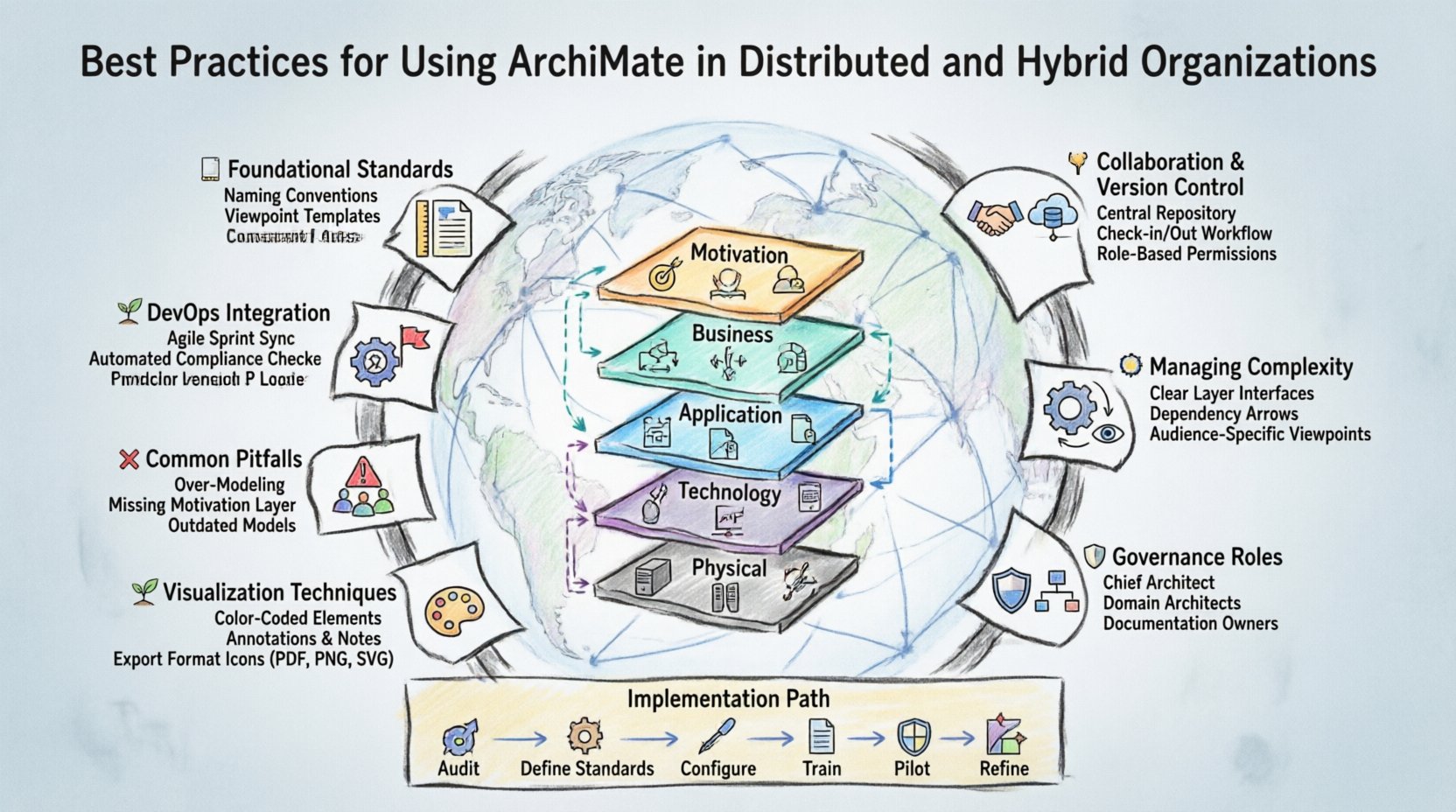
In a centralized environment, an architect might rely on tacit knowledge shared over coffee to decide how to model a specific business process. In a distributed setting, that shared context evaporates. This necessitates a strong, documented set of modeling standards. These standards act as the single source of truth for syntax, semantics, and visual representation.
- Define Naming Conventions: Every artifact, from a Business Actor to a Technology Node, must follow a strict naming convention. Ambiguity here leads to version control conflicts and confusion during reviews. For example, using “Procurement” vs. “Purchasing” for the same function creates fragmentation.
- Standardize Viewpoint Usage: ArchiMate offers various viewpoints tailored to specific concerns. Decide which viewpoints are mandatory for which layers. If the Technology Layer requires a deployment view, ensure every architect knows the standard layout before they begin.
- Constraint Definitions: Establish rules for when to use specific relationship types. Does a “serves” relationship imply a direct dependency, or is it sufficient to show a logical link? Clarifying this prevents cluttered diagrams that obscure the true flow of value.
Without these guardrails, distributed teams will inevitably drift into idiosyncratic modeling styles. This fragmentation makes it difficult to aggregate models into a coherent enterprise view later. Consistency is the currency of distributed architecture.
Collaboration and Version Control Strategies 🤝
Architecture is rarely a solo endeavor. It is a collaborative effort involving business leaders, IT specialists, and security teams. In a hybrid organization, this collaboration must be asynchronous yet synchronized. The tools used to store and edit ArchiMate models play a critical role in this ecosystem.
| Challenge | Distributed Solution |
|---|---|
| Simultaneous Editing | Implement a central repository with check-in/check-out mechanisms to prevent data loss. |
| Communication Context | Link model elements directly to discussion threads or documentation tickets. |
| Access Control | Role-based permissions ensure only authorized architects can modify core structural elements. |
| Review Cycles | Schedule regular synchronous review sessions for complex dependencies. |
Effective version control is not just about saving files; it is about managing the lifecycle of the model. When a change is proposed in a distributed team, the workflow must be clear. Who approves the change? How is the impact analyzed? ArchiMate models often serve as the basis for IT roadmaps. If the model is out of sync with reality due to poor collaboration practices, the roadmap becomes fiction.
Use automated validation features available in modeling platforms to catch errors before they propagate. If a relationship violates a rule defined in the standards, the system should flag it immediately. This reduces the need for manual peer review on basic syntax, allowing architects to focus on the logic of the architecture itself.
Managing Complexity Across Layers 🌐
One of the greatest strengths of ArchiMate is its layered structure: Motivation, Business, Application, Technology, and Physical. In a distributed organization, these layers often reside with different teams. The Business Architecture team might be in London, while the Application team operates from Bangalore and the Technology team from Tokyo. Bridging these gaps requires specific attention to interface management.
- Clear Interfaces: Define explicit interfaces between layers. A Business Process must clearly trigger a specific Application Service. Document these handoffs in the model to avoid assumptions about where responsibility lies.
- Dependency Mapping: Cross-layer dependencies are prone to failure in remote settings. A change in the Technology Layer might break a Business Process. Use ArchiMate relationships to visualize these impacts explicitly. If a dependency exists, it must be modeled.
- Viewpoints for Specific Audiences: Do not dump the entire model on a stakeholder. Create specific views for the Business Leadership that focus on the Motivation and Business layers, and separate views for Engineering that focus on Application and Technology. This keeps the cognitive load manageable.
When teams are co-located, informal conversations often resolve conflicts between layers. In a hybrid model, these conflicts must be surfaced through the model itself. Ensure that the model reflects the actual state of dependencies. If a Business Process relies on an Application that is being decommissioned, the model must show this risk clearly so that planners can react.
Governance and Roles in a Remote Context 🛡️
Governance structures often become looser in distributed environments. The lack of physical oversight can lead to deviations from the ArchiMate framework. To counter this, roles and responsibilities must be explicitly defined and enforced through the workflow.
- Chief Architect Oversight: A central authority figure is needed to validate the overall coherence of the architecture. This person ensures that local models align with the global strategy.
- Domain Architects: Empower domain architects to own specific areas of the model. They are responsible for the accuracy of their specific slice, whether that is Finance, HR, or Logistics.
- Documentation Owners: Assign ownership for the documentation associated with the model. An ArchiMate diagram is useless without the context of why the decisions were made. This context must be stored alongside the visual model.
Governance is not about policing; it is about enabling. By defining who can change what, you reduce the friction of collaboration. When a developer in one region needs to update a technology node, they should know exactly which process to follow. This clarity prevents the “shadow architecture” phenomenon where unofficial models exist alongside official ones.
Communication and Visualization Techniques 📊
Architecture is a visual discipline. However, visual communication suffers in text-heavy digital environments. When you cannot point at a screen and explain a diagram, the diagram must be self-explanatory. ArchiMate provides the vocabulary, but the delivery method matters.
- Contextual Annotations: Use notes and annotations liberally. A relationship arrow might be clear to an architect, but what does it mean to a stakeholder? Add text to explain the business implication.
- Color Coding: Establish a color standard for different states. Red might indicate a risk, green a stable component, and yellow a planned change. Consistent coloring allows stakeholders to scan the model quickly.
- Export Formats: Provide exports in formats suitable for different audiences. PDFs for static reports, images for presentations, and interactive views for technical teams. Ensure the export settings preserve the layering and grouping defined in the tool.
Visual consistency reduces the time spent interpreting the model. If every diagram looks different, stakeholders waste energy learning the style rather than understanding the content. Standardize fonts, line weights, and node shapes across the entire enterprise architecture repository.
Handling Common Pitfalls ❌
Distributed teams face specific risks when using ArchiMate. Recognizing these pitfalls early allows for proactive mitigation.
- Over-Modeling: It is easy to model every single detail in an attempt to be thorough. In a distributed setting, this creates maintenance nightmares. Focus on the critical paths and the current state. Model the future state only when the initiative is active.
- Ignoring the Motivation Layer: Many teams jump straight to Business Processes. However, ArchiMate includes the Motivation Layer (Goal, Principle, Requirement). In a hybrid org, understanding the “Why” is crucial. Aligning goals across time zones requires explicit modeling of the drivers behind the architecture.
- Lack of Contextual Updates: Models degrade quickly. If a distributed team does not have a process for updating the model alongside code or process changes, the architecture becomes a museum piece. Integrate model updates into the standard change management workflow.
- Time Zone Asymmetry: Real-time collaboration is difficult. Design the workflow to be asynchronous. Use comments and task assignments within the modeling environment so that work can continue without waiting for a synchronous meeting.
Integrating with DevOps and Agile 🚀
Modern organizations operate at the speed of software. Enterprise Architecture cannot be a slow, waterfalls process. ArchiMate models must integrate with Agile and DevOps practices to remain relevant.
- Feature Tracking: Link architectural elements to specific features or user stories in the project management system. This ensures that the architecture evolves with the product.
- Automated Compliance: Use the model to check for compliance rules automatically. If a new application is added, does it meet the security standards defined in the Technology Layer? Automation reduces the burden on architects.
- Feedback Loops: Create mechanisms for developers to flag architectural debt. If a team finds a constraint in the model that hinders delivery, they should have a path to update the model or request an exception.
This integration ensures that the architecture is not an abstract artifact but a living part of the delivery pipeline. It connects the strategic intent with the tactical execution, bridging the gap between the distributed strategy team and the local delivery teams.
Building a Culture of Architectural Clarity 🌱
Finally, the technology and processes described above are secondary to the culture of the organization. In a distributed environment, trust is built on clarity. When teams can see the impact of their work on the broader enterprise, they make better decisions.
- Training and Upskilling: Ensure all architects and key stakeholders understand the ArchiMate language. Misunderstanding a term like “serves” or “realizes” can lead to significant structural errors.
- Community of Practice: Create a virtual community where architects can share patterns and challenges. This mitigates the isolation of remote work and spreads best practices.
- Regular Audits: Conduct regular audits of the model to ensure it matches reality. This is not a punitive measure but a quality assurance step to maintain the integrity of the architecture.
When clarity becomes a cultural value, the tools become secondary. The goal is to enable every team member to understand how their contribution fits into the enterprise picture. ArchiMate provides the structure, but the organization provides the discipline.
Future-Proofing Your Architecture 📈
Technology landscapes shift rapidly. Hybrid work models are likely to persist and evolve. The architecture framework must be adaptable.
- Modularization: Design models to be modular. This allows teams to work on different parts of the architecture without creating merge conflicts.
- Extensibility: Allow the model to accommodate new layers or extensions as business needs change. Do not lock the model into a rigid structure that cannot grow.
- Data Portability: Ensure that the models can be exported and imported easily. Vendor lock-in in modeling tools can be a risk for long-term architecture management. Open standards help mitigate this.
By focusing on adaptability now, you ensure that the architecture remains a useful asset for years to come. The principles of ArchiMate are enduring, even if the specific technologies change.
Summary of Implementation Steps ✅
To summarize the practical application of these practices, consider the following implementation path:
- Audit Current State: Assess how the team is currently using ArchiMate. Identify gaps in standards and collaboration.
- Define Standards: Create the documentation for naming, viewpoints, and relationship rules.
- Configure Repository: Set up the modeling environment to enforce the standards and manage version control.
- Train the Team: Conduct workshops to ensure everyone understands the new processes and language.
- Pilot: Apply the new practices to a specific project or domain before rolling out enterprise-wide.
- Review and Refine: Gather feedback from the distributed teams and adjust the standards as needed.
Success in distributed architecture is not about perfect diagrams. It is about reliable information flow. When the model is accurate, accessible, and maintained, it serves as a bridge across the distance between teams. This bridge enables better decision-making, reduces risk, and aligns the organization toward common goals.
The complexity of hybrid organizations demands a disciplined approach to Enterprise Architecture. ArchiMate provides the vocabulary to describe that complexity. By applying the practices outlined in this guide, organizations can ensure that their architecture remains a strategic asset rather than a technical burden. The focus remains on clarity, consistency, and collaboration, ensuring that distance does not become a barrier to understanding.
Related posts:
 A Beginner’s Guide to ArchiMate: Understanding the Core Building Blocks
 Troubleshooting Your First ArchiMate Diagram: Tips for Clarity and Consistency
 Understanding ArchiMate Notation: A Visual Guide for Non-Technical Stakeholders
 Integrating ArchiMate with Your Existing Governance and Risk Processes