

In the dynamic environment of iterative development, the ability to adapt is a strength, but uncontrolled change is a weakness. Scope creep represents the gradual, often unnoticed expansion of project requirements beyond the original agreement. While Agile methodologies embrace change, they do not endorse chaos. Understanding how to manage these shifts without compromising delivery timelines or team morale is essential for sustainable success.
This guide provides a comprehensive look at identifying, preventing, and managing scope creep within iterative cycles. We will explore the structural mechanisms that protect the sprint goal, the communication patterns required to maintain alignment, and the data-driven approaches necessary to make informed decisions about feature additions.
🔍 Understanding Scope Creep in Agile Contexts
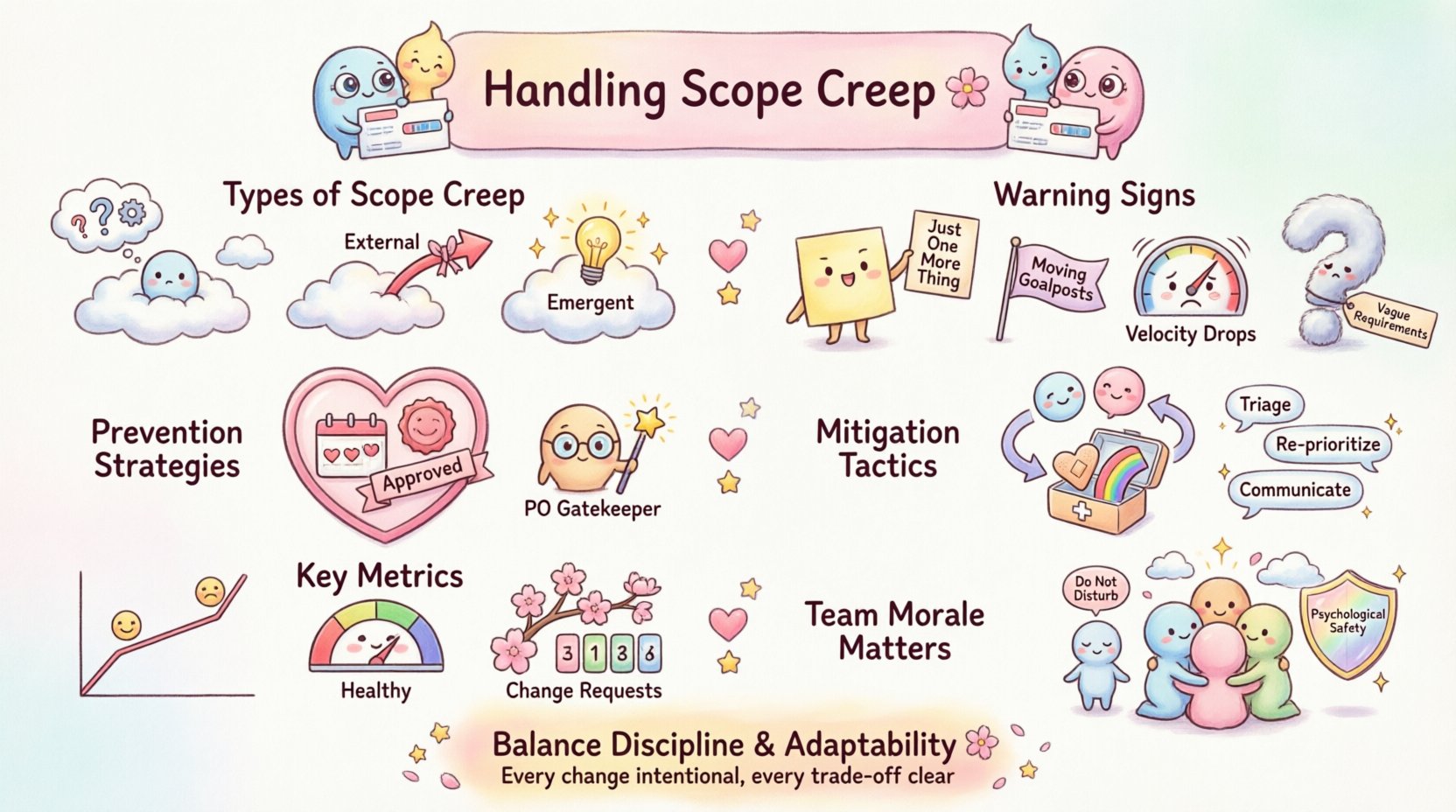
Scope creep is not merely about adding more features; it is about the erosion of the agreed-upon boundaries of a specific delivery cycle. In traditional waterfall models, scope is rigid. In Agile, scope is flexible, but it is not infinite. The tension lies between the business desire for new functionality and the team’s capacity to deliver quality work within a fixed timebox.
Internal Creep: Changes requested by the development team or stakeholders during the sprint that alter the definition of the work.
External Creep: Market shifts or competitor actions that prompt urgent pivots mid-cycle.
Emergent Creep: Discovering new requirements while working on existing tasks that were not apparent during planning.
When scope expands without a corresponding adjustment in resources or time, the result is often technical debt, reduced quality, or missed deadlines. The goal is not to say “no” to every request, but to ensure that every “yes” has a clear cost and trade-off.
🚩 Early Warning Signs of Scope Creep
Recognizing scope creep before it derails the iteration is crucial. Teams often overlook subtle indicators that suggest the boundaries are shifting. Vigilance is required from the Product Owner and the Development Team alike.
1. The “Just One More Thing” Pattern
When stakeholders introduce minor adjustments during sprint reviews or daily syncs without formal discussion, it signals a breakdown in change control. These small additions accumulate quickly, consuming capacity that was allocated for planned work.
2. Moving the Goalposts
If the Definition of Done is shifted to accommodate a new feature that was discovered halfway through the cycle, the original scope has been compromised. The criteria for completion must remain stable for the duration of the iteration.
3. Increasing Velocity Variance
Sudden drops in velocity often indicate that the team is working on unplanned items. If the team consistently finishes fewer stories than planned, it is a quantitative signal that scope is bleeding into the sprint.
4. Ambiguous Requirements
When stories are accepted into the backlog with vague acceptance criteria, they become susceptible to interpretation changes later. This ambiguity invites scope creep during refinement or development.
🛠️ Structural Strategies for Prevention
Prevention is more effective than cure. Establishing robust processes before work begins creates a framework that naturally resists unauthorized changes. These structural elements form the backbone of a controlled iterative environment.
1. Rigid Sprint Planning
The sprint planning session is the boundary line. Once the sprint begins, the commitment is made. The team selects items from the backlog based on their estimated capacity. This capacity is a hard constraint. Any new request must displace an existing commitment.
Capacity Planning: Account for holidays, meetings, and support tasks when calculating available hours.
Backlog Grooming: Ensure items entering the sprint are well-defined and estimated before planning starts.
Sprint Goal Integrity: Every task should contribute to the overarching Sprint Goal. If a new item does not support this goal, it should be questioned.
2. Formal Change Request Process
Even in Agile, changes need a formal path. A Change Request process does not need to be bureaucratic, but it must exist. This process ensures that the impact of a change is understood by all parties before implementation.
When a change is proposed mid-sprint:
Assess the impact on the current Sprint Goal.
Determine which existing item must be removed to accommodate the new work.
Get explicit agreement from the Product Owner and the Team lead.
Update the sprint board to reflect the swap.
3. The Product Owner as Gatekeeper
The Product Owner (PO) acts as the primary filter for incoming requirements. They are responsible for prioritizing the backlog and protecting the team from distractions. The PO must be willing to say “no” or “not now” to requests that do not align with the current priorities.
This role requires confidence. The PO understands that delaying a feature is better than delivering it late or poorly. They manage stakeholder expectations by explaining the trade-offs clearly.
🔄 Mitigation Tactics When Creep Occurs
Despite best efforts, scope creep will happen. The key is how the team reacts. Panic leads to poor decisions; structured response leads to recovery.
1. Immediate Triage
When a significant change is introduced, pause and assess. Do not allow the team to start working on it immediately. Schedule a specific meeting to discuss the implications. This pause prevents the “sunk cost” fallacy where teams feel compelled to finish the new work because they have already started it.
2. The Swap Mechanism
If the change is critical and must be included, a direct swap is necessary. If a new high-priority item enters the sprint, an item of equal complexity must be removed. This maintains the overall capacity and ensures the team does not burn out.
Example Scenario:
Current Work: Implementing user authentication (3 story points).
New Request: Fixing a critical bug in the payment module (3 story points).
Action: Remove the authentication task from the sprint and move it to the backlog. Swap the payment fix in.
3. Transparent Communication
Keep all stakeholders informed about the impact of the change. If the sprint goal is compromised, communicate this risk early. Stakeholders prefer to know that a deadline might slip than to be surprised by a failure at the end of the cycle.
📊 Impact Analysis Table
Use the following framework to evaluate potential scope changes. This table helps visualize the trade-offs involved in accepting new requirements.
Change Type | Impact on Sprint Goal | Required Action | Stakeholder Communication |
|---|---|---|---|
Minor Tweak | Low | Adjust task, no swap needed | Inform PO during daily sync |
Feature Addition | High | Remove existing story of equal size | Formal review with PO and Team |
Urgent Bug Fix | Medium | Pause current work, assess capacity | Notify all stakeholders immediately |
Requirement Shift | Critical | Cancel sprint, replan | Executive briefing required |
🗣️ Communication Frameworks
Effective communication reduces ambiguity, which is a primary driver of scope creep. Clear protocols ensure everyone understands what is in scope and what is not.
1. The Definition of Ready
Before a story enters the sprint, it must meet the Definition of Ready (DoR). This checklist ensures that requirements are clear, acceptance criteria are defined, and dependencies are identified. Stories that do not meet the DoR are not pulled into the sprint, preventing confusion later.
2. Stakeholder Workshops
Regular workshops allow stakeholders to voice their needs before they become urgent. By involving them in the planning process, you create a shared understanding of priorities. They become partners in managing scope rather than adversaries.
3. Visual Management
Use physical or digital boards to make scope visible. If a task is moved, the board reflects the change. Visual cues make it harder to sneak in changes without everyone seeing the shift in workload.
📈 Metrics to Monitor
Data provides the evidence needed to manage scope objectively. Relying on gut feelings can lead to bias. The following metrics help track scope stability.
Sprint Burndown: If the burndown line spikes upward mid-sprint, unplanned work has been added. This is a direct indicator of scope creep.
Change Request Rate: Track how many changes are requested per sprint. A high rate suggests issues with initial planning or backlog refinement.
Planned vs. Actual: Compare the estimated capacity against the actual work completed. Consistent overestimation indicates a lack of control over incoming changes.
Team Velocity Stability: High variance in velocity often correlates with scope instability. A stable velocity suggests a controlled environment.
🧠 The Human Element: Team Morale
Scope creep affects more than timelines; it affects the people. Constantly shifting targets lead to frustration and burnout. Teams need predictability to feel safe and productive.
1. Protecting Focus Time
Developers need uninterrupted time to solve complex problems. Frequent interruptions to discuss scope changes break their flow state. Establish “no-meeting” blocks or specific windows for change discussions to protect deep work.
2. Validating Effort
When scope is added without removing existing work, team members feel their effort is being devalued. Acknowledging the extra work and compensating through reduced scope in the next sprint validates their contribution.
3. Psychological Safety
Team members must feel safe to push back on unrealistic requests. If the culture punishes “no,” scope creep will flourish. Encourage a culture where raising concerns about capacity is seen as responsible behavior, not obstruction.
🔄 Retrospectives and Process Improvement
Every iteration provides an opportunity to learn. The retrospective is the forum for discussing scope management. Instead of blaming individuals, focus on the process.
What caused the creep? Was it unclear requirements? External pressure? A change in market conditions?
How did we handle it? Did we follow the change protocol? Did we communicate effectively?
What can we improve? Can we refine the Definition of Ready? Can we improve stakeholder education?
By treating scope creep as a systemic issue rather than a personal failure, the team can build better defenses over time. Continuous improvement is the antidote to recurring scope problems.
🛑 Final Thoughts on Control and Flexibility
Managing scope in iterative development is a balance between discipline and adaptability. It requires a team that understands the value of focus and a leadership structure that supports boundaries. By implementing clear change controls, maintaining transparent communication, and monitoring the right metrics, you can navigate the complexities of changing requirements without losing momentum.
The objective is not to freeze the project in time, but to ensure that every change is intentional. When stakeholders see that the team manages scope rigorously, they gain confidence in the delivery process. Trust is built through consistency, and consistency is built through controlled iteration.
Keep the focus on the Sprint Goal. Respect the team’s capacity. Communicate trade-offs clearly. These principles form the foundation of a healthy, productive Agile environment where value is delivered predictably and reliably.