


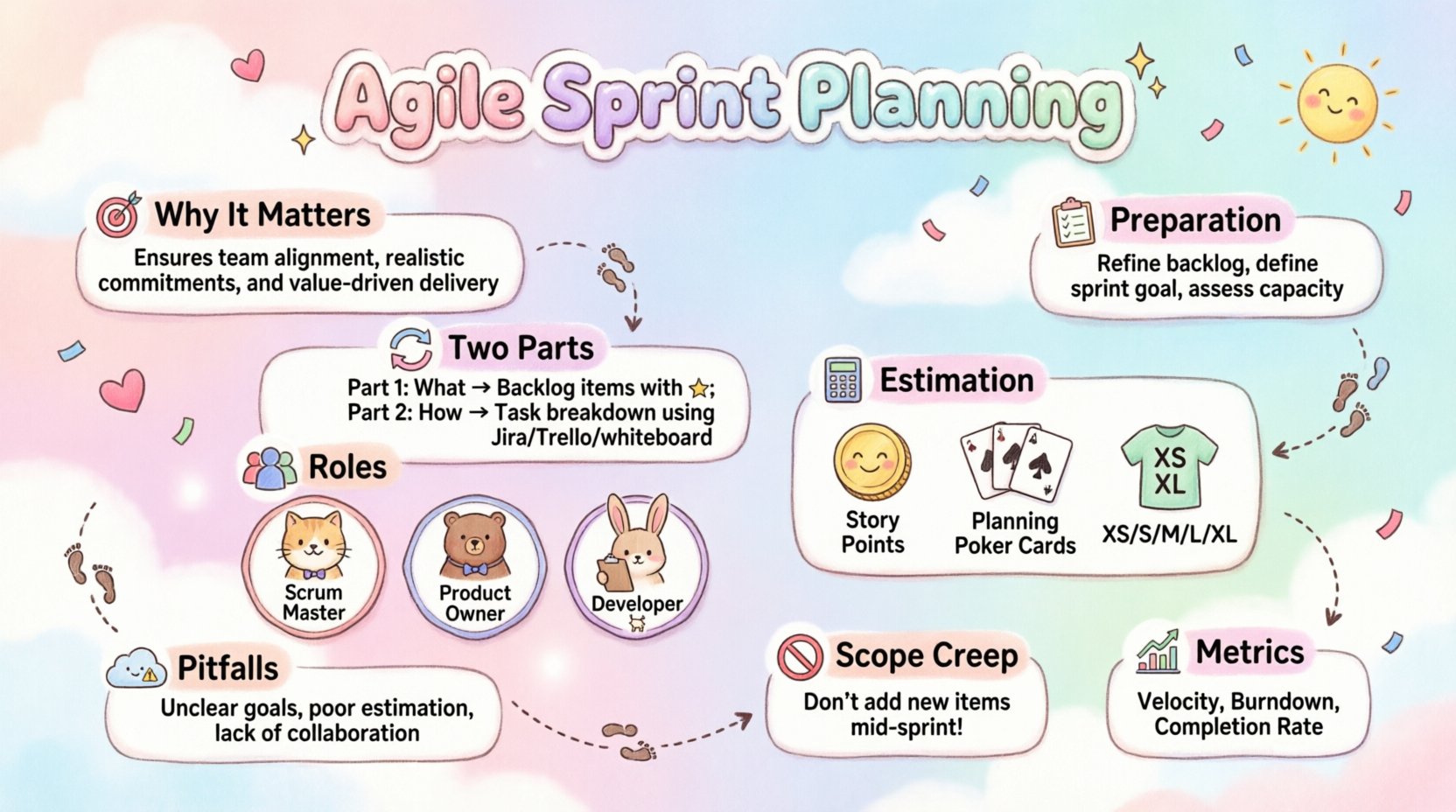
Agile Sprint Planning is the cornerstone of iterative development. It is where the abstract vision of a product roadmap transforms into concrete, actionable tasks for the upcoming cycle. For development teams, this session is not just a meeting; it is the alignment mechanism that ensures everyone understands what needs to be built, why it matters, and how the team intends to deliver it.
Effective planning reduces ambiguity, manages stakeholder expectations, and sets the stage for a predictable delivery rhythm. This guide explores the mechanics of running a productive sprint planning session without relying on specific tools or hype. It focuses on the human and procedural elements that drive success.
Why Sprint Planning Matters 🎯
Many teams treat sprint planning as a bureaucratic hurdle. However, skipping proper preparation often leads to mid-sprint confusion, scope creep, and team burnout. The primary purpose of this session is to answer two fundamental questions:
What can be accomplished? Selecting items from the product backlog that align with the current capacity and business value.
How will it get done? Breaking down selected items into specific technical tasks.
When done correctly, sprint planning creates a shared commitment. It moves the team from a state of uncertainty to a state of clarity. This clarity is essential for maintaining velocity and ensuring quality standards are met.
Preparation: The Foundation of Success 📋
The actual meeting is only a fraction of the work involved in sprint planning. The majority of value comes from activities that happen before the team gathers. Preparing effectively ensures the meeting time is spent on decision-making rather than information gathering.
1. Refining the Backlog
The product backlog must be in a state of readiness before planning begins. This process, often called backlog refinement, involves reviewing items to ensure they are clear. Key criteria for a ready item include:
Clear Acceptance Criteria: The conditions that must be met for the item to be considered complete.
Defined User Stories: Written from the perspective of the end-user, describing the value.
Estimates Available: The team should have already provided rough estimates or relative sizing.
Dependencies Resolved: Any external blockers or team dependencies should be identified early.
2. Defining the Sprint Goal
A sprint goal acts as the north star for the upcoming work. It is a short, concise statement that describes the value the team aims to deliver. Without a goal, the team might finish tasks that do not contribute to the broader objective. The goal should be negotiated between the product owner and the development team to ensure feasibility.
3. Assessing Team Capacity
Not every team member is available for the entire sprint. Holidays, vacations, and other project commitments must be accounted for. Capacity planning involves calculating the available hours per person and adjusting the workload accordingly. This prevents over-commitment and protects the team from burnout.
The Two Parts of the Session 🔄
Standard frameworks typically divide sprint planning into two distinct parts. While some teams blend these, keeping them separate helps maintain focus.
Part 1: What Can Be Done? 🧩
In this phase, the focus is on the what. The product owner presents the top priority items from the backlog. The team discusses these items to understand the scope. The discussion covers:
Clarifying requirements.
Identifying potential risks or technical challenges.
Ensuring alignment with the sprint goal.
The team selects the items they believe they can complete within the sprint timeframe. This selection is collaborative. If the team feels an item is too large, they negotiate to split it or defer it to a future cycle.
Part 2: How Will It Get Done? 🛠️
Once the scope is agreed upon, the focus shifts to the how. The development team breaks down the selected user stories into smaller technical tasks. This level of detail helps in understanding the effort required and assigning work.
Task breakdown should be granular enough to be completed within a day or two. This granularity allows for better tracking and early detection of issues. Tasks might include database schema changes, API development, frontend component creation, or test case writing.
Estimation Techniques 🧮
Estimating work is one of the most challenging aspects of planning. Teams often struggle with accuracy, but the goal is not perfection; it is relative sizing and shared understanding. Several techniques are commonly used.
1. Story Points
Story points measure the relative effort, complexity, and risk of a task, rather than time. This approach acknowledges that different tasks have different levels of difficulty. A team might assign 5 points to a simple task and 13 points to a complex one. This helps in calculating velocity over time.
2. Planning Poker
This is a consensus-based technique where team members vote on the effort required for a story. Everyone reveals their estimate simultaneously. If estimates vary widely, the team discusses the reasoning behind the outliers. This dialogue often reveals hidden assumptions or complexities.
3. T-Shirt Sizing
For high-level planning, teams may use sizes like Small, Medium, Large, and XL. This is useful when details are scarce. It allows the team to categorize work quickly without getting bogged down in specific numbers.
Comparison of Estimation Techniques | |||
Technique | Best Used For | Pros | Cons |
|---|---|---|---|
Story Points | Long-term velocity tracking | Focuses on effort, not time | Requires team calibration |
Hours | Short-term task assignment | Clear time commitment | Can lead to micromanagement |
T-Shirt Sizing | High-level roadmap planning | Fast and simple | Lacks precision |
Roles and Responsibilities 👥
Success in sprint planning depends on each role fulfilling their specific responsibilities. Clarity on who does what prevents friction during the session.
Product Owner: Responsible for the content of the backlog. They explain the value and priority of items. They are the primary source of truth regarding requirements.
Development Team: Responsible for the technical solution. They provide estimates, break down tasks, and commit to the work. They own the quality of the implementation.
Scrum Master: Facilitates the meeting. They ensure the process is followed, timeboxes are respected, and impediments are removed. They do not dictate the work.
Handling Scope Creep 🚫
One of the biggest threats to a sprint is scope creep. This occurs when new work is added to the sprint after it has started, without removing existing work. This disrupts the team’s focus and often leads to unfinished items.
To mitigate this, teams should adhere to a strict change management process during the sprint. If a critical issue arises, the team must evaluate if it displaces other work. If a new item is added, an equivalent item should be removed to maintain the sprint capacity. This preserves the integrity of the sprint goal.
Measuring Success and Velocity 📊
After the sprint planning, the team needs to track their performance. Velocity is a metric that indicates the amount of work a team can handle during a single sprint. It is calculated by summing the story points of completed items at the end of the sprint.
Velocity should not be used to compare teams. It is a planning tool for the specific team to predict their future capacity. Consistency in velocity helps in forecasting release dates more accurately.
Key Metrics to Monitor
Sprint Goal Achievement: Did the team achieve the primary objective?
Commitment vs. Completion: How much of the planned work was actually finished?
Carryover Work: How many items were moved to the next sprint?
Rework Rate: How many items required significant correction after initial completion?
Common Pitfalls and How to Avoid Them ⚠️
Even experienced teams face challenges during planning. Recognizing these patterns helps in continuous improvement.
1. Overcommitting
Teams often say yes to everything to please stakeholders. This leads to missed deadlines. To avoid this, always account for interruptions, bug fixes, and technical debt. Plan for 80% of available capacity to allow for unforeseen events.
2. Vague Tasks
If tasks are not specific, they cannot be estimated accurately. A task like “Fix login” is too vague. It should be “Implement OAuth2 authentication for mobile app”. Specificity reduces ambiguity and risk.
3. Ignoring Technical Debt
Planning only for new features leads to a fragile codebase. Teams should allocate a portion of the sprint to refactoring and maintenance. This ensures long-term sustainability.
4. Lack of Participation
If only the lead developer speaks, the team loses valuable insights. Ensure all members have a voice. Quiet team members may have important technical concerns that need to be raised early.
Post-Planning Review 🔄
The work does not end when the meeting concludes. The team must review the plan against reality as the sprint progresses. Daily stand-ups are the primary mechanism for this. If the plan becomes unviable, the team should communicate this early rather than waiting until the end of the sprint.
Transparency is key. If the team realizes they cannot finish a story, they should notify stakeholders immediately. This allows for better decision-making regarding scope or timeline adjustments.
Conclusion
Agile sprint planning is a discipline that requires practice and refinement. It is not about filling a calendar with tasks; it is about aligning the team around a shared objective. By focusing on preparation, clear communication, and realistic estimation, development teams can build a rhythm that delivers value consistently.
Remember that the process is a tool to support the team, not a constraint. Adapt the techniques to fit the team’s culture and the project’s needs. With patience and commitment to the process, sprint planning becomes a reliable engine for delivery.