
Introduction
In the modern business landscape, process documentation has long been a bottleneck. Traditional Business Process Model and Notation (BPMN) modeling requires significant manual effort, involving hours of workshops, meticulous drawing, and iterative revisions to ensure accuracy. This often leads to outdated diagrams that fail to reflect real-world operations.
However, the integration of Artificial Intelligence (AI) into process modeling is transforming this paradigm. By leveraging Natural Language Processing (NLP), AI tools can now convert unstructured business narratives into structured, standardized visual models. This transition from “chaos to clarity” not only accelerates documentation but also enhances strategic alignment by bridging the gap between high-level business concepts and granular technical requirements. This guide explores the five-step AI transformation workflow, its key benefits, and how it redefines BPMN modeling for today’s agile enterprises.
The AI Transformation Workflow: A Five-Step Path to Process Clarity
The core of AI-assisted BPMN modeling lies in a guided, intelligent workflow that automates the heavy lifting of diagram creation. Here is how the process unfolds:
1. Natural Language Input: Describe, Don’t Draw
Concept: Instead of starting with blank canvases and shape libraries, users begin by describing their business problem or process in plain English.
Example: A user inputs: “When a customer submits a loan application, the system checks their credit score. If the score is above 700, it goes to automatic approval. If below, it routes to a manual review by an underwriter.”
Impact: This eliminates the need for time-consuming manual drawing from scratch and reduces the barrier to entry for non-technical stakeholders.
2. Structured Analysis: From Narrative to Logic
Concept: The AI acts as an expert analyst, parsing the natural language input to generate two critical outputs:
-
A Structured Problem Statement: Clearly defining the scope and objectives.
-
A Sequential Interaction Story: A step-by-step narrative detailing actors, actions, and decision points.
Example: Based on the loan application input, the AI generates a story: “Actor: Customer → Action: Submit Application → System: Check Credit Score → Decision: Score > 700? → Yes: Auto-Approve → No: Route to Underwriter.”
Impact: Ensures logical consistency before any visual elements are created.
3. Instant Visualization: Automated Diagram Generation
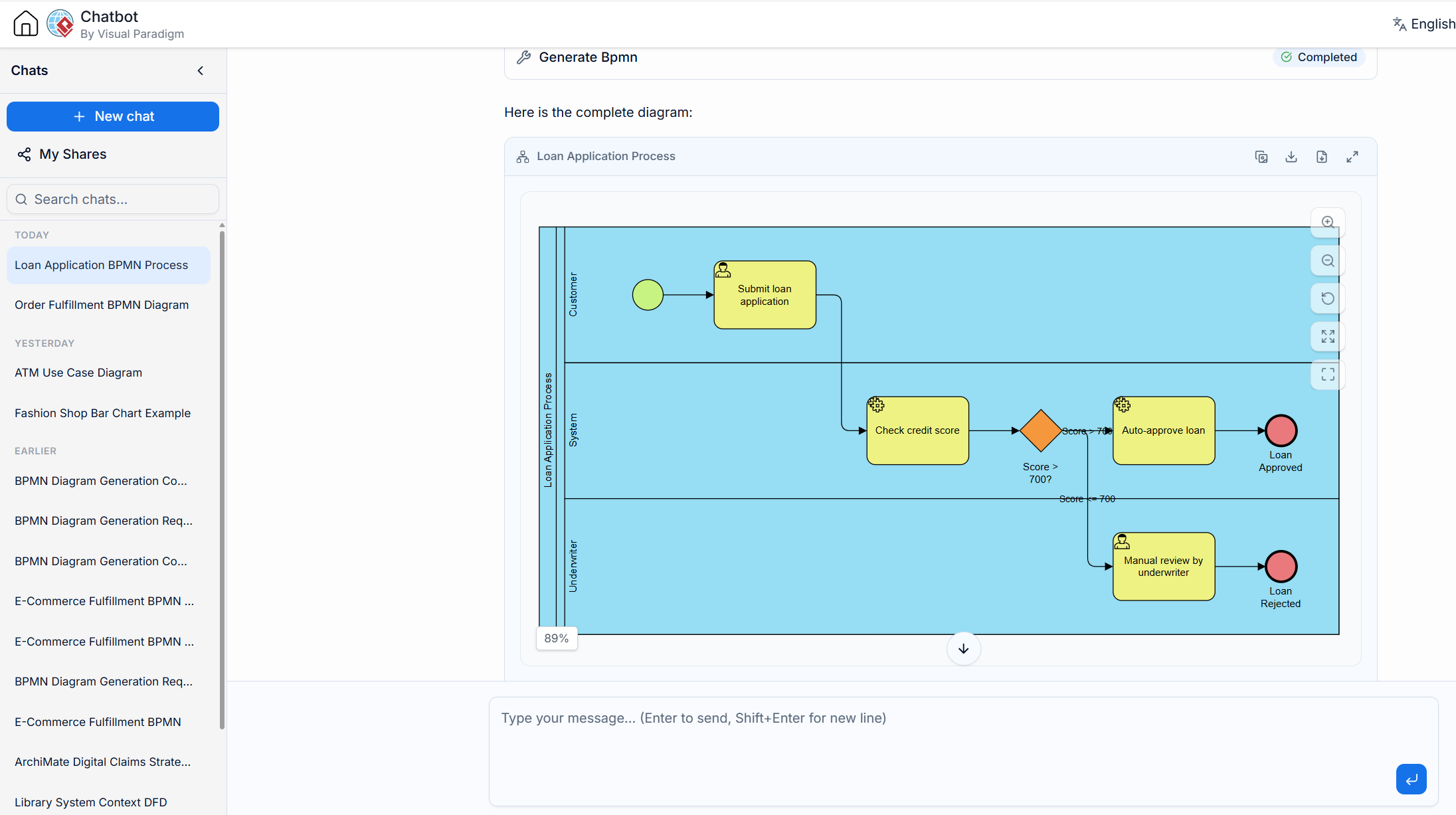
Concept: The tool automatically transforms the interaction story into a standardized diagram. This could be a high-level Stakeholder Interaction Diagram or a detailed, compliant BPMN 2.0 model.
Example: The AI generates a BPMN diagram with:
-
Start Event: Loan Application Received.
-
Service Task: Check Credit Score.
-
Exclusive Gateway: Score > 700?
-
User Task: Manual Review (assigned to Underwriter pool).
-
End Events: Approved / Rejected.
Impact: Delivers a clear, standardized visual map ready for stakeholder review in minutes, not hours.
4. Strategic Measurement: KPI Suggestions
Concept: Beyond visualization, the AI analyzes the workflow to suggest relevant Key Performance Indicators (KPIs) that help track process health.
Example: For the loan process, the AI suggests:
-
Average Time to Approval
-
Percentage of Applications Requiring Manual Review
-
Credit Check Error Rate
Impact: Transforms static diagrams into dynamic management tools focused on performance and optimization.
5. Actionable Insights and Reporting
Concept: With a single click, users can generate deep-dive analyses directly from the process model.
Example: The tool produces:
-
Implementation Plan: Steps to deploy the new automated credit check.
-
Risk Assessment: Identifies bottlenecks in manual underwriting.
-
Resource Plan: Estimates staffing needs for the underwriting team based on volume.
Impact: Accelerates decision-making by providing immediate, data-driven insights.
Key Benefits of AI-Powered BPMN Modeling
1. Acceleration
AI reduces the time from concept to compliant BPMN 2.0 layout from hours to minutes. Teams can prototype and validate processes rapidly, enabling faster iteration and deployment.
2. Iterative Logic Focus
By automating the mechanics of drawing shapes and connectors, AI allows stakeholders to focus their cognitive energy on what matters most: iterating and refining the logic of the process. This leads to more robust and well-thought-out workflows.
3. Bridging the Strategy-Execution Gap
AI simplifies the transition from high-level business strategy to granular technical requirements. By ensuring the business process accurately informs the final build, organizations reduce misalignment between business goals and IT implementation.
Conclusion
The integration of AI into BPMN modeling represents a significant leap forward in business process management. By automating the conversion of natural language descriptions into structured, visual models, organizations can achieve unprecedented speed, clarity, and strategic alignment. The five-step workflow—from natural language input to actionable insights—empowers teams to move beyond static documentation toward dynamic, performance-driven process optimization.
For organizations looking to adopt this transformative approach, Visual Paradigm offers a robust solution through its Intelligent BPM and Analysis Suite. Whether using Visual Paradigm Online (Combo Edition or higher) via the web, or Visual Paradigm Desktop (Professional Edition or higher with active maintenance) through the Tools > App menu, users can leverage these AI-powered capabilities to streamline their BPMN modeling efforts and drive business excellence.
Related posts:
 Review: Transforming Complex BPMN 2.0 Modeling with Visual Paradigm’s AI Generator
 5 Common BPMN Modeling Mistakes (And How to Avoid Them)
Mastering BPMN with Best Practices, AI, and Integrated Documentation
The Complete Guide: Integrating Visual Paradigm Flipbooks & Digital Bookshelves with OpenDocs
5 Common BPMN Modeling Mistakes (And How to Avoid Them)
Mastering BPMN with Best Practices, AI, and Integrated Documentation
The Complete Guide: Integrating Visual Paradigm Flipbooks & Digital Bookshelves with OpenDocs