
Introduction
Business Process Model and Notation (BPMN) has established itself as the undisputed global standard for business process modeling. Yet, as the discipline matures, organizations are discovering a critical truth: compliance with notation standards alone does not guarantee success. Poor modeling practices frequently result in complex, incomprehensible diagrams that fail to gain stakeholder buy-in or drive operational improvement. Process modeling must evolve from an intuitive “art” reserved for thought leaders into a rigorous scientific approach grounded in proven best practices.
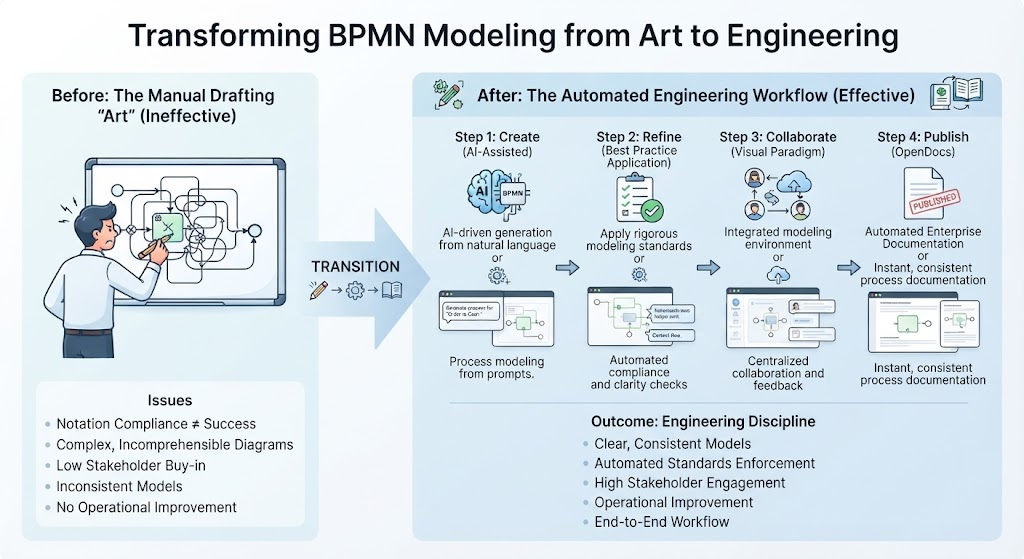
This comprehensive guide synthesizes essential BPMN concepts with industry-standard modeling practices. Furthermore, it demonstrates how to operationalize these standards using a modern toolchain—Visual Paradigm, AI, and OpenDocs—to transform process modeling from a manual drafting exercise into an automated, end-to-end enterprise engineering workflow.
Part 1: Key Concepts of BPMN
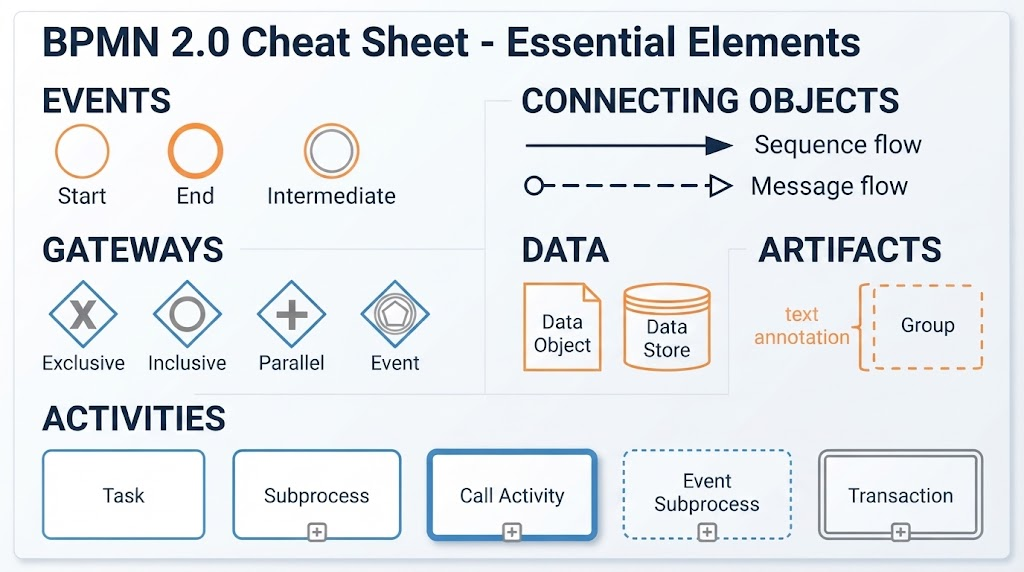
BPMN uses a standardized graphical notation to represent business processes. To build effective models, one must understand the four primary categories of elements:
1. Flow Objects
These are the primary building blocks that define process behavior.
-
Events: Represented by circles, these denote something that happens during the process.
-
Start Events: Define how a process instance begins (e.g., message received, timer triggered).
-
Intermediate Events: Occur between the start and end (e.g., delay, escalation).
-
End Events: Define how a process instance concludes.
-
-
Activities: Represented by rounded rectangles, these indicate work performed.
-
Tasks: Atomic, indivisible units of work.
-
Sub-processes: Compound activities containing other flows, used for hierarchical zooming.
-
-
Gateways: Represented by diamonds, these control flow divergence and convergence.
-
Exclusive (XOR): Only one outgoing path is taken.
-
Parallel (AND): All outgoing paths are taken simultaneously.
-
Inclusive (OR): One or more paths are taken based on conditions.
-
Complex: Handles advanced splitting/merging logic.
-
2. Connecting Objects
These elements link flow objects to create the process structure.
-
Sequence Flow: Solid lines showing the chronological order of activities.
-
Message Flow: Dashed lines representing messages exchanged between separate participants/pools.
-
Association: Dotted lines linking artifacts (data, text) to flow objects.
3. Swimlanes
Used to organize responsibilities and categorize activities.
-
Pools: Represent major participants in a collaboration (e.g., “Customer,” “Fulfillment Company”).
-
Lanes: Sub-divisions within a pool representing specific roles, departments, or systems (e.g., “Sales Dept,” “Automated System”).
4. Artifacts
Supplementary elements that provide context without altering flow logic.
-
Data Objects: Show data required or produced by activities.
-
Groups: Visual clustering of elements for readability.
-
Annotations: Textual notes for modeler commentary.
Part 2: BPMN Best Practices
Adhering to best practices ensures models are understandable, consistent, and actionable.
1. Process Scope
-
Define the 5 Ws: Clearly identify Who, What, When, Where, and Why. The diagram captures the “How,” while supporting documentation captures the rest.
-
Discrete Instances: Ensure every process instance is distinct, identifiable, and countable.
-
Explicit Events: Never use implicit starts or ends. Always model specific Start Events (triggers) and End Events (outcomes, including failure states).
2. Diagram Layouts
-
One-Page Top Level: The primary diagram should fit on a single page. Use Sub-processes to manage complexity through hierarchical zooming.
-
Multiple Visualizations: Create tailored views: a Summary Diagram (collapsed sub-processes) for executives and a Verbose Diagram (expanded with data objects) for developers.
-
Neatness and Flow: Maintain consistent left-to-right sequence flows and top-to-bottom vertical flows. Avoid crossed lines to enhance readability.
-
Highlight the “Happy Path”: The most common scenario should be visually prominent and easy to trace.
-
Externalize Business Rules: Use Business Rule Tasks to extract complex logic from the diagram, keeping the flow concise.
3. Process Partitioning and Structure
-
Hierarchical Modeling: Build multi-layered models. Use Sub-processes to divide processes into logical phases and Call Activities to reuse standardized fragments.
4. Gateways
-
Explicit Splits and Merges: Always use Gateways to visualize decision points and merges. Never merge flows implicitly.
-
Match Gateway Types: A Parallel split must be closed by a Parallel merge; an Exclusive split by an Exclusive merge.
-
Pre-Gateway Activities: Place the activity determining the condition immediately before a diverging gateway to allow for interruption if needed.
-
Abstract Complexity: Consolidate daisy-chained gateways into a single Business Rule Task where appropriate.
5. Collaborations
-
Pool Naming: Pools should represent distinct interacting entities, not just internal process names.
-
Consistent Message Flows: If modeling external interactions, show all message flows consistently across all model levels.
6. General Considerations
-
Visible Logic & Exceptions: Label clearly and use boundary events to explicitly model exception handling.
-
Validation: Models must be syntactically valid. Use automated validation tools and peer reviews.
-
Consistent Formatting: Standardize fonts, colors, and sizing to prevent visual noise.
Part 3: Practical Example – “Customer Order Fulfillment”
The following example applies these concepts and best practices to a standard Order Fulfillment process.
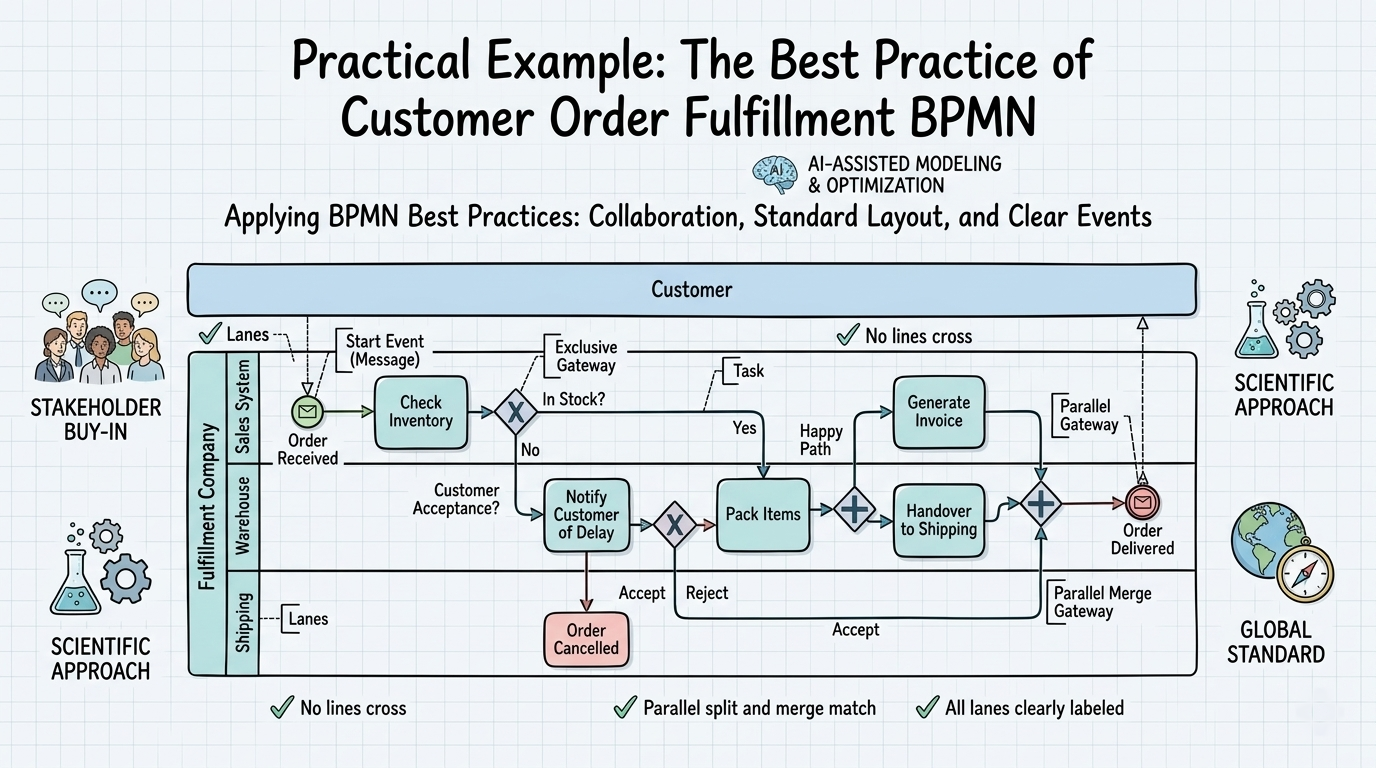
1. Scope & Collaboration:
-
Who: Customer and Fulfillment Company.
-
Setup: Two Pools (“Customer”, “Fulfillment Company”) with Lanes for “Sales System”, “Warehouse”, and “Shipping”.
2. Layout & The Happy Path:
-
Left-to-right flow. The Happy Path (Order → In Stock → Pack → Ship) runs straight across the middle. Exception paths branch downward.
3. Events & Gateways:
-
Start Event: “Order Received” (Message Start Event).
-
Activity: “Check Inventory”.
-
Exclusive Gateway (XOR): Splits based on stock status.
-
In Stock: Leads to “Pack Items”.
-
Out of Stock: Leads to “Notify Customer of Delay”.
-
-
Parallel Gateway (AND): After packing, splits flow to simultaneously “Generate Invoice” and “Handover to Shipping”.
4. End Events:
-
Success: “Order Delivered” (Message End Event).
-
Failure: “Order Cancelled” (If delay is rejected).
5. Validation & Formatting:
-
No crossed lines. Parallel split matched by Parallel merge. Clear lane labeling.
Part 4: Tooling Execution (Visual Paradigm + AI + OpenDocs)
Implementing best practices efficiently requires modern tooling. The Visual Paradigm ecosystem integrates three pillars to automate enterprise process engineering.
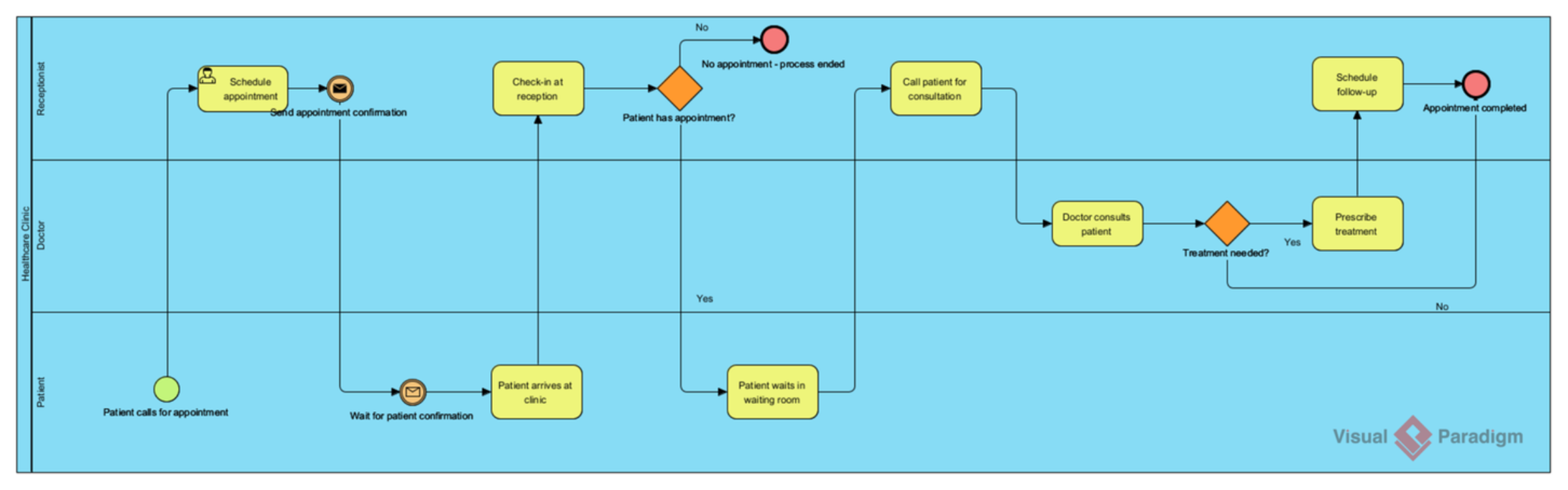
1. Visual Paradigm (The Modeling Engine)
-
Strict BPMN Compliance: Enforces syntax rules, preventing invalid connections.
-
Validation Engine: Highlights structural flaws and routing errors before peer review.
-
Diagram Navigation: Supports hierarchical modeling via double-click zoom into sub-processes.
-
Formatting & Styling: Centralized themes ensure consistent formatting across all diagrams.
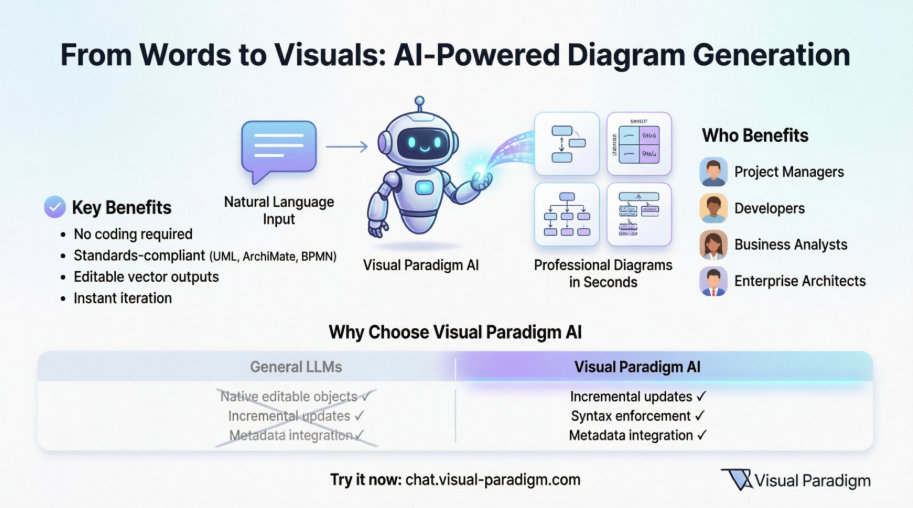
2. Visual Paradigm AI (The Accelerator)
-
Text-to-Diagram Generation: Converts plain-text descriptions into compliant BPMN drafts instantly.
-
Auto-Layout & Routing: AI algorithms route flows to avoid crossings and enforce clean layouts.
-
Intelligent Suggestions: Analyzes diagrams to suggest optimizations, such as abstracting complex gateway clusters.
-
Conversational Refinement: Allows incremental modifications via natural language chat commands.
3. OpenDocs (The Knowledge & Documentation Hub)
-
Capturing the 5 Ws: Documents scope (Who, What, When, Where, Why) linked directly to BPMN diagrams.
-
Managing Multiple Visualizations: Auto-generates Summary and Verbose documentation views from a single source-of-truth model.
-
Business Rules Management: Details and version-controls rules externalized into Business Rule Tasks.
-
Peer Review & Collaboration: Centralized platform for commenting, approving, and tracking changes to both docs and diagrams.
-
Live Sync Pipeline: Automatically syncs diagram revisions to documentation, signaling when updates are available.
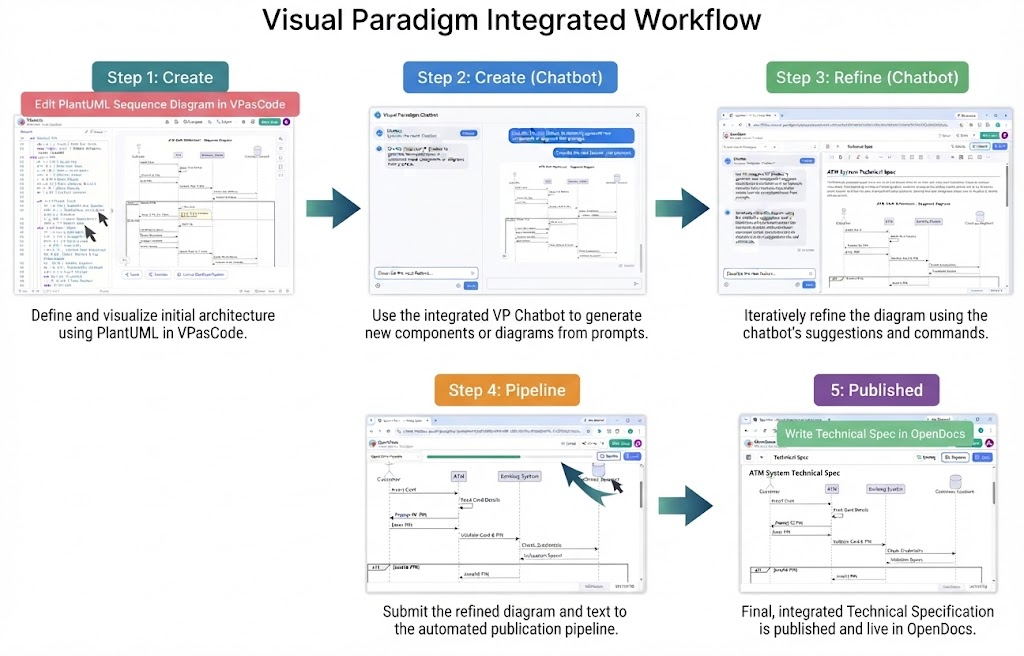
The Integrated Workflow: Create → Refine → Pipe → Publish
The integration follows a streamlined operational pipeline:
-
Generate: Use the VP AI Chatbot to convert operational narratives into BPMN drafts.
-
Refine: Iteratively improve the model via chat commands or manual editing until compliance targets are met.
-
Send to Pipeline: Export the validated diagram to the OpenDocs Pipeline with version comments.
-
Embed: Insert the artifact into OpenDocs documentation pages via the Pipeline selector.
-
Maintain: Re-send updated diagrams to trigger live sync indicators in OpenDocs for one-click revision swaps.
Conclusion
Business process modeling is a critical discipline bridging business strategy and IT execution. By strictly adhering to BPMN best practices—focusing on clear scope, neat layouts, explicit events, and consistent formatting—organizations can create models that stakeholders actually understand and support.
However, adherence to best practices is significantly amplified by modern tooling. By leveraging Visual Paradigm for rigorous syntactic compliance, AI to accelerate creation and ensure visual cleanliness, and OpenDocs to manage the surrounding business context and living documentation, teams can elevate process modeling from an inconsistent art to a mature, highly effective science. This integrated approach not only improves diagram quality but also transforms process models into sustainable corporate knowledge assets.
Related posts:
 From Cloud Diagrams to Live Documentation: My Hands-On Review of Visual Paradigm Online’s OpenDocs Integration
From Code to Community: How Visual Paradigm Pipeline Powers Agile IT Teams’ Collaborative Knowledge Hub
From Cloud Diagrams to Live Documentation: My Hands-On Review of Visual Paradigm Online’s OpenDocs Integration
From Code to Community: How Visual Paradigm Pipeline Powers Agile IT Teams’ Collaborative Knowledge Hub
 5 Common BPMN Modeling Mistakes (And How to Avoid Them)
From Chaos to Clarity: A Comprehensive Guide to AI-Powered BPMN Modeling
5 Common BPMN Modeling Mistakes (And How to Avoid Them)
From Chaos to Clarity: A Comprehensive Guide to AI-Powered BPMN Modeling