
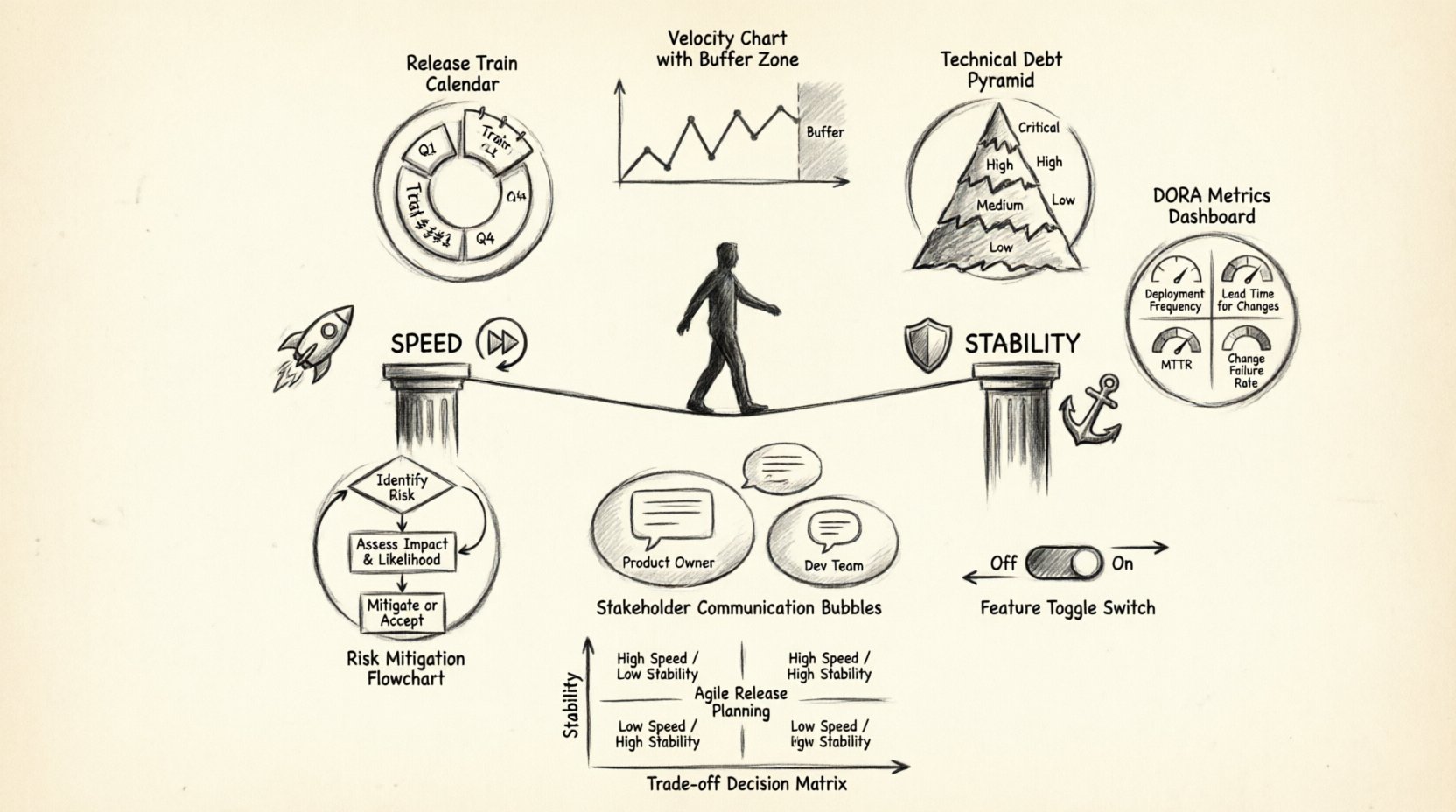
In the world of software delivery, teams often find themselves walking a tightrope. On one side, there is the urgent demand for speed—getting features to market faster than the competition. On the other side, there is the critical need for stability—ensuring the product remains robust, reliable, and maintainable. This tension is at the heart of Agile Release Planning.
Many organizations struggle with this balance. They rush releases and face technical debt that slows them down later. Or they play it too safe, moving so slowly that they lose market relevance. The goal is not to choose one over the other, but to integrate them into a sustainable rhythm.
Understanding the Core Tension ⚖️
Speed and stability are not mutually exclusive, but they do compete for resources. When you push for faster delivery, you often cut corners on testing or documentation. When you prioritize stability, you might invest heavily in refactoring, delaying new features.
To manage this effectively, teams must understand the dynamics at play:
Velocity vs. Quality: High velocity without quality leads to instability. High quality without velocity leads to stagnation.
Technical Debt: Every shortcut taken for speed adds to the debt. If not paid down, interest payments slow future work.
Stakeholder Expectations: Business leaders want features now. Engineering leaders want a stable platform.
Customer Trust: Frequent bugs erode trust. Slow updates frustrate users waiting for new capabilities.
Effective release planning acknowledges these trade-offs explicitly. It treats stability as a feature, not an afterthought.
Defining the Release Goal 🎯
Before diving into the timeline, the team must agree on what the release is meant to achieve. A vague goal leads to scope creep. A clear goal anchors the planning process.
1. Value-Driven Objectives
Instead of asking “what features do we want?”, ask “what value do we want to deliver?”.
Reduce customer support tickets by 20%.
Enable a new payment method to capture market share.
Improve system latency by 15%.
2. Success Criteria
Define what success looks like before work begins. This includes:
Performance benchmarks met.
Zero critical bugs at launch.
Documentation updated and accessible.
Training materials ready for support staff.
3. Scope Boundaries
Decide what is in and what is out of scope. A release is not a bucket for everything that needs fixing. Be ruthless about prioritization.
The Planning Cadence 📅
Agile release planning does not happen in a vacuum. It requires a rhythm that allows for adaptation while maintaining predictability.
1. Release Train Timing
Many teams use fixed iterations, often called Release Trains. This creates a predictable heartbeat for the organization.
Fixed Duration: Every release is 2 weeks or 4 weeks long. This helps teams plan capacity.
Fixed Date: The release date is set in advance. This allows marketing and sales to prepare.
Flexible Scope: If work cannot be completed, it moves to the next train. The date stays fixed.
2. Iterative Planning
Planning is not a one-time event. It happens at multiple levels:
Release Planning: Occurs every 6-8 weeks. Focuses on high-level goals and major features.
Sprint Planning: Occurs every 1-2 weeks. Focuses on task execution and immediate delivery.
Backlog Refinement: Occurs weekly. Ensures items are ready for future sprints.
Capacity Planning & Velocity 📊
Estimating how much work can fit into a release is the most common challenge. Relying on hope is a strategy for failure. Relying on data is a strategy for success.
1. Historical Velocity
Use past performance to forecast future capacity. Look at the average story points completed over the last three releases.
Consistency: If velocity fluctuates wildly, the team needs to stabilize their process first.
Buffer: Never plan for 100% capacity. Plan for 80% to account for unplanned work, bugs, and interruptions.
2. Capacity Factors
Not all time is equal. Account for the following when calculating capacity:
Holidays and Leave: Team members will be away.
Meetings: Stand-ups, retrospectives, and planning consume time.
Support Work: Maintenance and production issues require attention.
Learning: New team members need ramp-up time.
Managing Technical Debt 🛠️
Stability suffers when technical debt accumulates. Release planning must explicitly allocate resources to debt reduction.
1. The Debt Taxonomy
Not all debt is created equal. Categorize it to prioritize effectively:
Critical: Security vulnerabilities or system instability. Must be fixed immediately.
High: Code that blocks new features or slows development. Fix within the next release.
Medium: Refactoring for readability. Schedule during slower periods.
Low: Cosmetic improvements. Address when time permits.
2. The 20% Rule
Many teams adopt a rule where 20% of capacity is dedicated to non-feature work. This ensures stability is maintained while features are delivered.
Refactoring code.
Updating dependencies.
Improving test coverage.
Automating manual processes.
3. Definition of Done
Strengthen the Definition of Done (DoD) to prevent debt from entering the codebase. The DoD should include:
Code reviewed by peers.
Automated tests passing.
Performance thresholds met.
Security scan cleared.
Documentation updated.
Risk Management 🎲
Every release carries risk. Identifying and mitigating these risks is part of the planning process.
1. Risk Identification
Hold a risk workshop before finalizing the release plan. Ask:
What dependencies exist on other teams?
Are there third-party services we rely on?
Is the technology stack mature enough?
What happens if the deployment fails?
2. Mitigation Strategies
For each identified risk, define a mitigation plan:
Avoid: Change the plan to eliminate the risk.
Transfer: Outsource the risky component if possible.
Reduce: Implement controls to lower the impact.
Accept: Acknowledge the risk and prepare a contingency.
3. Feature Toggles
Use feature toggles to decouple deployment from release. This allows code to be deployed but hidden from users until it is ready. This reduces risk and allows for faster deployment cycles.
Metrics That Matter 📈
How do you know if you are balancing speed and stability? Use metrics to guide decisions, not to punish teams.
1. Speed Metrics
Lead Time: Time from idea to production.
Deployment Frequency: How often code goes to production.
Throughput: Number of features delivered per release.
2. Stability Metrics
Change Failure Rate: Percentage of deployments causing failure.
Mean Time to Recovery (MTTR): How fast the team recovers from a failure.
Bug Escape Rate: Number of bugs found in production vs. testing.
3. The DORA Metrics
The DevOps Research and Assessment (DORA) metrics provide a standard for high-performing teams. They focus on:
Deployment Frequency.
Lead Time for Changes.
Time to Restore Service.
Change Failure Rate.
Stakeholder Communication 🗣️
Planning fails if stakeholders are not aligned. Communication must be transparent and consistent.
1. Release Notes
Write clear release notes that explain what changed and why. This reduces confusion and support calls.
Highlight new features.
List known issues.
Explain deprecated functionality.
2. Demo Sessions
Hold regular demo sessions for stakeholders. This builds trust and provides early feedback before the final release.
3. Escalation Paths
Define who to contact if things go wrong. Stakeholders should know how to reach the right people during a crisis.
Handling Change 🔄
Plans change. Scope creep is inevitable. The key is managing change without derailing the release.
1. Change Control Board
Establish a small group responsible for approving changes to the release scope. This prevents random additions from derailing the plan.
2. Freeze Periods
Implement a code freeze before the release date. No new features are added during this time. Only critical fixes are allowed.
3. Cut-Off Points
Define a hard cut-off point for feature acceptance. Anything not ready by this date moves to the next release.
Team Culture & Psychology 🧠
Technical processes matter, but culture matters more. The team environment dictates how well the plan is executed.
1. Psychological Safety
Team members must feel safe to admit mistakes. Hiding bugs leads to larger issues later. Encourage a blameless culture.
2. Cross-Functional Collaboration
Break down silos. Developers, testers, and operations should work together from the start of the planning phase.
3. Continuous Improvement
Use retrospectives to improve the planning process itself. Ask:
Did we estimate accurately?
Were dependencies identified?
Did we maintain stability?
Trade-Off Decision Matrix 📋
Use this table to help decide when to prioritize speed over stability, or vice versa.
Scenario | Priority | Action |
|---|---|---|
Security Vulnerability | Stability | Pause feature work. Fix immediately. |
Market Opportunity Window | Speed | Deploy minimal viable product. Monitor closely. |
System Instability | Stability | Reduce scope. Focus on refactoring. |
Compliance Deadline | Speed | Allocate extra resources. Accept higher risk temporarily. |
Customer Complaints | Stability | Prioritize bug fixes over new features. |
Building the Roadmap 🗺️
The release plan feeds into the broader roadmap. The roadmap sets the direction, while the release plan sets the steps.
1. Theme-Based Planning
Group work by themes rather than specific features. This allows flexibility in execution while maintaining strategic alignment.
2. Time-Boxing
Assign time boxes to themes. If a theme takes longer than expected, move to the next one rather than extending the release indefinitely.
3. Visualization
Use visual tools to track progress. Gantt charts or Kanban boards help everyone see the status of the release.
Post-Release Review 🔍
The work does not end at launch. A review ensures the team learns from the experience.
1. Success Measurement
Compare actual results against the success criteria defined in the beginning.
Did we hit the velocity target?
Was the stability maintained?
Did stakeholders approve the outcome?
2. Lessons Learned
Document what went well and what didn’t. Store this knowledge for the next planning cycle.
3. Celebration
Recognize the team’s effort. Celebrating wins reinforces positive behaviors and boosts morale.
Common Pitfalls to Avoid ⚠️
Even with a solid plan, teams can stumble. Watch out for these common traps.
Over-Planning: Spending too much time planning and not enough time doing.
Under-Planning: Starting work without a clear plan leads to chaos.
Ignoring Context: Planning without understanding the team’s current capacity.
Bulletproofing: Trying to predict the future perfectly instead of adapting to reality.
Blame: Assigning blame when estimates are wrong instead of analyzing the process.
Final Thoughts on Balance 🌟
Agile release planning is a dynamic activity. It requires constant adjustment and communication. There is no perfect formula, but there are proven patterns that help teams succeed.
By treating stability as a core requirement and managing technical debt proactively, teams can deliver value consistently. By communicating clearly and measuring outcomes, organizations can maintain trust.
The goal is a sustainable pace. This allows the team to keep improving without burning out or breaking the product. It is a marathon, not a sprint.