

In the fast-paced world of product development, it is easy to fall into the trap of measuring progress by the number of features shipped. Teams often celebrate when a list of requirements is ticked off. However, shipping features does not guarantee success. A product can be full of tools and functions and still fail to meet user needs or drive business growth. The shift from output to outcome requires a fundamental change in how we define and write our work. We need to move away from feature lists and start writing user stories that prioritize value.
This guide explores how to craft stories that focus on the why behind the work, ensuring every line of code serves a purpose. We will look at practical frameworks, common pitfalls, and strategies to align your backlog with genuine user value.
Understanding the Core Problem: The Feature Trap 📋
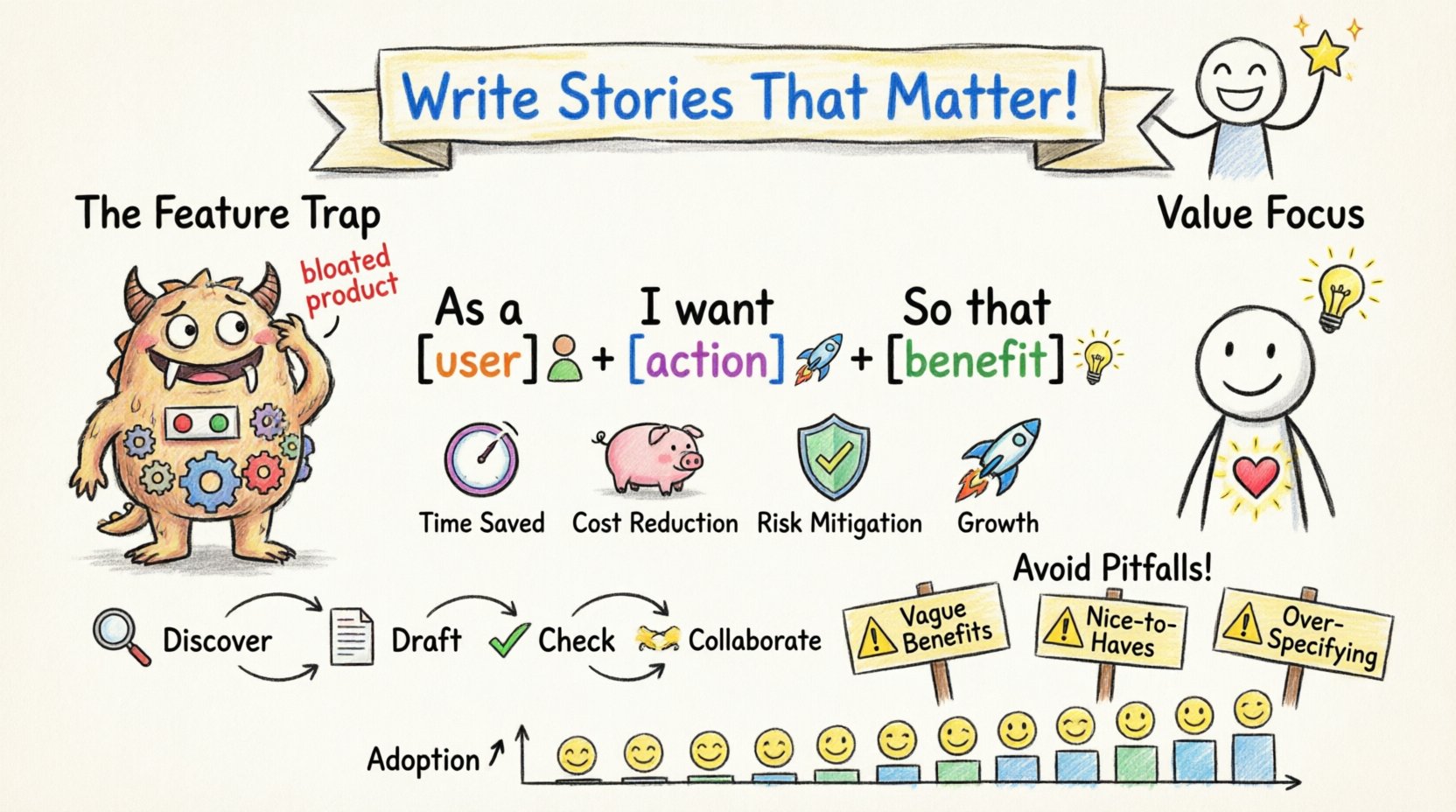
Many development teams operate under the assumption that more features equal a better product. This mindset leads to feature creep, where the product becomes bloated and difficult to use. When stakeholders ask for a specific button, a dashboard, or an integration, it is tempting to accept that request as a requirement.
However, a feature is merely a mechanism. It is the tool used to achieve something. A user story that describes a feature often lacks context about the benefit it provides.
Why Feature Lists Fail
- Lack of Context: Developers build the function but miss the intent.
- Difficulty in Prioritization: How do you compare a login button to a color change? Both are features, but they offer different values.
- Wasted Effort: Building a feature that no one uses is a direct cost to the business.
- User Confusion: Too many features can overwhelm users, reducing adoption.
To solve this, we must reframe the conversation. Instead of asking “What should we build?”, we ask “What problem are we solving?” and “What value does this deliver?”.
Defining Value in User Stories 💡
Value is not just revenue. In the context of user stories, value is the benefit gained by the user or the business when the story is completed. This benefit can be:
- Time Saved: Reducing the steps to complete a task.
- Cost Reduction: Lowering operational expenses or maintenance costs.
- Risk Mitigation: Improving security or compliance.
- Revenue Growth: Increasing conversion rates or average order value.
- Engagement: Increasing user retention or satisfaction.
A value-driven story connects the user need to the business outcome. It answers the question: “If we do this, what happens?”
Feature-Centric vs. Value-Centric Stories
Visualizing the difference is crucial for your team. The table below highlights the structural and strategic differences between the two approaches.
| Aspect | Feature-Centric Story | Value-Centric Story |
|---|---|---|
| Focus | The output or functionality | The outcome or benefit |
| Question | “What does it do?” | “Why do we need it?” |
| Acceptance Criteria | Technical specifications (e.g., “Button is red”) | User experience results (e.g., “User feels confident clicking”) |
| Prioritization | Based on urgency or request | Based on impact and effort ratio |
| Value | Low (often assumed) | Explicit and measurable |
The Anatomy of a Value-Driven Story 🛠️
A standard user story follows the format: As a [user], I want [action], so that [benefit]. To prioritize value, the benefit section must be the most detailed and critical part of the card. It cannot be vague.
1. The Actor (As a…)
Be specific about who the user is. “A user” is too broad. “A returning customer” or “An admin managing accounts” provides better context.
2. The Action (I want…)
Keep this brief. This is the mechanism, not the goal. Avoid over-specifying the solution here. Let the design and development team figure out the best way to achieve the action.
3. The Benefit (So that…)
This is where the value lives. Do not stop at “so that I can save time.” Be precise. “So that I can process refunds in under two minutes” or “So that I can reduce error rates by 10%.”
Step-by-Step Guide to Writing Value Stories
Transforming your backlog requires a disciplined process. Here is a practical workflow to ensure your stories are value-aligned.
Step 1: Discovery and Validation 🔍
Before writing a single story, validate the problem. Do not assume the problem exists. Talk to users, analyze support tickets, and review analytics. If you cannot find evidence of the problem, the value proposition is weak.
- Check Data: Is there a drop-off point in the funnel?
- Interview Users: Ask them about their pain points directly.
- Review Metrics: Are current KPIs indicating a need for change?
Step 2: Drafting with Intent 📝
When drafting the story, force yourself to articulate the value in the So that clause. If you cannot articulate the value, the story might not belong in the backlog.
Bad Example:
- As a user, I want a dark mode, so that I can change the theme.
Good Example:
- As a night-shift developer, I want a dark mode, so that I can reduce eye strain and maintain focus during late hours.
Step 3: Defining Value-Based Acceptance Criteria ✅
Acceptance criteria often drift into technical details. Shift this focus to outcomes. How do we know the value was delivered?
- Functional: The feature works as intended.
- Value-Based: The user completes the task faster. The user understands the action immediately. The error rate is reduced.
Step 4: Refinement and Collaboration 🤝
Use refinement sessions to challenge the value. Ask questions like:
- “Is this the best way to solve the problem?”
- “Can we get this value with less effort?”
- “What happens if we don’t build this?”
This collaborative environment ensures that the team understands the why, not just the what.
The Cost of Features: A Financial Perspective 💰
Every feature has a cost. It is not just the development time. It includes:
- Development Cost: Time spent designing and coding.
- Maintenance Cost: Future support, bug fixes, and updates.
- Cognitive Load: Complexity added for the user.
- Opportunity Cost: Time not spent on higher-value work.
When you prioritize value, you are essentially calculating the return on investment (ROI) for each story. A story with high value and low cost is a priority. A story with low value and high cost should be cut or re-evaluated.
Common Pitfalls to Avoid ❌
Even with the best intentions, teams often slip back into feature-centric thinking. Be vigilant against these common traps.
1. The “Nice to Have” Trap
Features that are convenient but not necessary often clutter the backlog. If a feature is merely a luxury, it should be deprioritized in favor of core value drivers.
2. Vague Benefit Statements
Phrases like “improve user experience” or “increase efficiency” are too vague. They do not provide a clear signal for prioritization. Use numbers and specific scenarios.
3. Ignoring Technical Debt
Value isn’t always user-facing. Sometimes the value is internal. Refactoring code or improving infrastructure reduces risk and speeds up future delivery. This is value, even if the user doesn’t see it directly.
4. Over-Specifying Solutions
If the story dictates exactly how the solution should be built, it limits the team’s ability to find the most efficient way to deliver the value. Focus on the problem, not the solution.
Measuring the Impact 📊
How do you know your value-driven approach is working? You need to track metrics that align with the value stated in your stories.
Adoption Rates
Are users actually using the new functionality? High adoption indicates the value proposition resonated.
Task Completion Time
Did the story achieve the goal of saving time? Measure the time taken to complete the task before and after.
User Satisfaction (CSAT/NPS)
Do users feel better about the product? Surveys can provide qualitative data on whether the pain points were addressed.
Retention Metrics
Does the feature help keep users around longer? Churn reduction is a strong indicator of delivered value.
Handling Stakeholder Requests
Stakeholders often come with feature requests. “We need a chatbot.” “We need a mobile app.” Your job is to translate these into value stories without dismissing the request.
The Translation Technique
When a stakeholder asks for a feature, dig deeper.
- Listen: Accept the request without judgment.
- Question: “What problem does this solve for the customer?”
- Reframe: “So you want to reduce support ticket volume? Let’s look at stories that achieve that, not just building a chatbot.
This approach keeps the conversation focused on outcomes. You might find that a chatbot isn’t the right solution, but a knowledge base update is. The goal remains the same: value delivery.
The Role of Epics and Themes
Value stories are often grouped into larger initiatives. Epics and themes help organize these stories without losing the focus on value.
Themes
Themes are broad categories based on value, not functionality. Instead of “Frontend Work” or “Backend Work,” use themes like “Checkout Optimization” or “User Onboarding.”
Epics
An epic is a large body of work that delivers a significant value proposition. It should be broken down into stories that each contribute to the epic’s value. If an epic cannot be broken down into value stories, it might be too vague.
Practical Example: The Checkout Flow
Let’s look at a real-world scenario involving a shopping cart checkout process.
Scenario A: Feature List
- Add a guest checkout option.
- Allow credit card storage.
- Add a shipping calculator on the cart page.
- Display trust badges near the button.
Analysis: This is a list of features. It does not explain why. Does guest checkout reduce friction? Does trust badges increase conversion? We don’t know.
Scenario B: Value-Driven Stories
- As a first-time shopper, I want to purchase without creating an account, so that I can complete my order quickly without commitment anxiety.
- As a returning customer, I want to see my saved payment methods, so that I can checkout in under 30 seconds.
- As a price-sensitive buyer, I want to see shipping costs before entering payment info, so that I can avoid cart abandonment due to unexpected fees.
Analysis: Each story here has a clear user, a clear action, and a clear value. The team can now prioritize based on which value reduces abandonment the most.
Integrating Value into Your Workflow
To make this a habit, you must embed value checks into your existing workflow.
1. Backlog Grooming
During grooming, review the So that clause. If it is missing or weak, send the story back for refinement.
2. Sprint Planning
When selecting stories for a sprint, ask the team: “Which of these delivers the most value to our users right now?”
3. Retrospectives
Discuss whether the delivered stories actually provided the expected value. Did the data match the hypothesis?
The Psychology of Value
Understanding human psychology is key to writing good value stories. Users do not buy features; they buy solutions to problems. They buy the feeling of safety, the relief of frustration, or the joy of achievement.
When you write a story, put yourself in the user’s shoes. Imagine their frustration. Imagine their relief when the problem is solved. This empathy is the foundation of value.
Empathy Mapping
Use empathy mapping techniques during story creation.
- Says: What does the user say about their problem?
- Thinks: What are they worried about?
- Does: What actions do they currently take to cope?
- Feels: What is their emotional state?
This exercise reveals the emotional value of your product, which is often more powerful than functional value.
Conclusion on Value Prioritization
Writing user stories that prioritize value over feature lists is a shift in mindset. It requires discipline, curiosity, and a commitment to user needs. It moves the team from being order-takers to being problem-solvers.
By focusing on the why, you ensure that every sprint brings you closer to a product that people actually want to use. You reduce waste, increase satisfaction, and align your technical work with business goals.
Start today. Review your current backlog. Look for the stories that lack a clear value proposition. Ask the hard questions. Refine the stories. And watch as your product development becomes more focused and effective.
Frequently Asked Questions
Q: Can technical tasks be value stories?
A: Yes. If a technical task reduces risk or improves future velocity, it delivers value. Frame it as “As a developer, I want to refactor X, so that we can deploy updates twice as fast next month.”
Q: What if I don’t know the value upfront?
A: If you do not know the value, the story is a hypothesis. Create a small experiment or a spike to learn more. Do not commit to a full build until the value is validated.
Q: How do I handle conflicting values?
A: Some stories may offer speed while others offer security. Use data to determine which value is more critical for your current users. Sometimes you must balance trade-offs explicitly.
Q: Does this slow down development?
A: Initially, it might take more time to write and refine. However, it prevents building the wrong things. Over time, it speeds up delivery by reducing rework and ensuring the right features are built first.
Related posts:
 The Complete Checklist for Writing High-Quality User Stories in Agile Teams
 Q&A: Answering the Top 10 Confusing Questions About User Stories for New Agilites
 How to Write User Stories That Cut Down on Clarification Meetings by Half
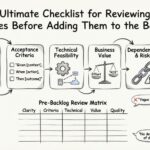 The Ultimate Checklist for Reviewing User Stories Before Adding Them to the Backlog