


Agile development relies heavily on the quality of the work entering the sprint. When teams rush into planning without proper preparation, the result is often confusion, scope creep, and stalled progress. User Story Refinement, often called grooming, is the critical process that bridges the gap between a raw idea and a deliverable feature. This guide explores the mechanics of preparing stories effectively, ensuring your team moves from uncertainty to execution with confidence.
Refinement is not a one-time event; it is a continuous activity. It involves breaking down epics, clarifying requirements, and estimating effort. By investing time here, you reduce friction during the actual sprint execution. Let’s dive into the strategies that transform vague requests into actionable tasks.
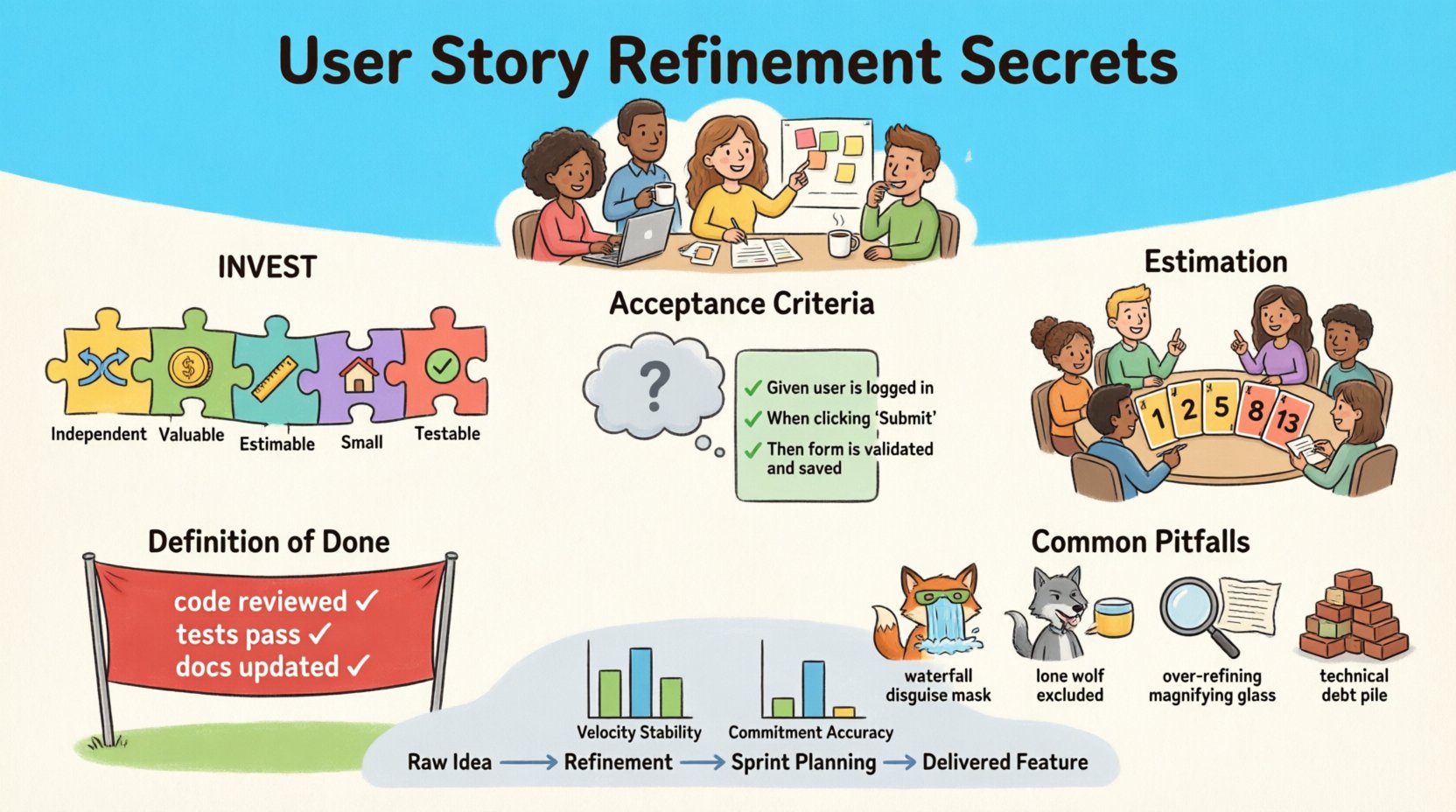
Why Refinement Matters 🧠
Many teams treat the backlog as a dumping ground for ideas. However, a backlog that is not groomed becomes a graveyard of unfinished work. Refinement serves several vital functions:
- Clarity: It ensures everyone understands what needs to be built and why.
- Predictability: Accurate estimates allow for better forecasting of delivery dates.
- Focus: It helps prioritize high-value items over low-impact tasks.
- Efficiency: Reduces the time spent asking questions during the sprint itself.
Without this preparation, developers may build the wrong thing, or testers may miss critical edge cases. The cost of fixing a requirement error is significantly higher after code has been written. Therefore, treating refinement as a core competency is essential for high-performing teams.
The INVEST Model Explained 📋
To ensure a user story is ready for development, it should generally adhere to the INVEST criteria. This acronym acts as a checklist for story quality. If a story fails one of these points, it may need more work before planning.
Independent
Stories should be as standalone as possible. While dependencies exist in complex systems, a story should ideally be shippable on its own. If Story A cannot be tested without Story B, consider if they should be merged or if the dependency can be removed.
Valuable
Every story must deliver value to the end user or the business. Ask: “Who benefits from this?” If the answer is unclear, the story might be technical debt or an internal task masquerading as a feature. User value drives the decision to build.
Estimable
The team must have enough information to estimate the effort required. If the requirements are too vague, the team cannot provide a number. This often requires breaking the story down further or conducting spike tasks to research technical feasibility.
Small
Stories should be small enough to be completed within a single sprint. Large stories often hide risks and complexities. If a story is too big, it is likely a project, not a story. Break it down until it fits the timebox.
Testable
You must be able to verify if the story is complete. This means defining clear acceptance criteria. If you cannot write a test case for it, the story is not well-defined.
Crafting Rock-Solid Acceptance Criteria ✅
Acceptance criteria are the boundary conditions that determine when a story is done. They are the contract between the product owner and the development team. Without them, “done” becomes subjective.
Best Practices for Criteria
- Use Given/When/Then: This format (often associated with Behavior Driven Development) clarifies the context, action, and expected result.
- Be Specific: Avoid words like “fast” or “user-friendly.” Use metrics instead, such as “loads in under 2 seconds.”
- Cover Edge Cases: Consider what happens if the input is wrong, or the network fails.
- Keep it Concise: Bullet points are often better than paragraphs for readability.
Example: Login Functionality
Consider the difference between a vague requirement and a refined one.
| Aspect | Vague Requirement | Refined Requirement |
|---|---|---|
| Function | User can log in. | User enters email and password to access the dashboard. |
| Validation | Check inputs. | System rejects invalid emails with an error message. |
| Security | Keep it safe. | Passwords are hashed before storage; session expires after 30 minutes of inactivity. |
| Error Handling | Handle errors. | Display “Invalid credentials” if login fails. Do not reveal if the email exists. |
Notice how the refined version removes ambiguity. This allows the developer to write code that matches expectations and the tester to verify the behavior objectively.
Estimation Without Guesswork 📊
One of the most common friction points in refinement is sizing the effort. Teams often struggle with whether to use hours or story points. Story points are generally preferred because they measure complexity, effort, and risk, rather than just time.
Factors Influencing Size
- Volume of Work: How many lines of code or screens are involved?
- Complexity: Is the logic straightforward or convoluted?
- Uncertainty: Has the team done similar work before?
Relative Sizing
Instead of calculating absolute time, compare stories to a baseline. If a simple “change text color” story is a 1, a “add payment gateway” story might be an 8. This relative comparison helps the team understand scale without getting bogged down in exact hours.
The Planning Poker Concept
While specific tools vary, the collaborative sizing method remains consistent. Team members reveal their estimates simultaneously to avoid anchoring bias. If everyone agrees, the story is sized. If there is a wide variance, the team discusses the reasoning. This discussion is often more valuable than the number itself, as it surfaces hidden assumptions.
The Definition of Done (DoD) 🏁
A story is not done when the code is written. It is done when it meets the Definition of Done. The DoD is a shared checklist that applies to every story in the backlog. It ensures quality and consistency.
Typical DoD Checklist
- Code is written and peer-reviewed.
- Unit tests pass.
- Integration tests pass.
- Acceptance criteria are met.
- Documentation is updated.
- Deployed to the staging environment.
Without a DoD, a story might be “finished” from a developer perspective but still require QA or documentation before it is usable. Aligning on this standard prevents technical debt from accumulating sprint after sprint.
Common Refinement Pitfalls ⚠️
Even experienced teams fall into traps during the refinement process. Recognizing these patterns helps you avoid them.
1. The “Waterfall in Disguise”
Refinement should not turn into a full requirements specification session. If you spend weeks defining every detail before coding, you lose agility. Leave some room for adaptation during the sprint.
2. Excluding the Team
Product owners often refine stories alone. This is a mistake. Developers and testers bring technical context that the product owner might miss. Involving the whole team ensures the story is technically feasible.
3. Over-Refining
Not every story needs to be perfect immediately. Focus on the stories coming in the next sprint. Stories further out in the backlog only need a high-level view. Spending too much time on distant work is wasted effort.
4. Ignoring Technical Debt
Refinement should also include non-functional requirements. If the system is slow or hard to maintain, it affects future velocity. Regularly discuss technical debt alongside feature work to ensure the codebase remains healthy.
Building a Sustainable Rhythm 🔄
Refinement works best when it becomes a habit. Instead of a massive weekly meeting, consider shorter, focused sessions. Some teams dedicate 10% of the sprint to refinement. Others hold daily 15-minute syncs to pull items forward.
Roles in Refinement
- Product Owner: Defines the “What” and “Why.” Brings user feedback and business value.
- Developers: Define the “How.” Identify technical risks and effort.
- QA/Testers: Define the “Verification.” Ensure testability and edge cases.
When these roles collaborate early, the sprint planning meeting becomes a confirmation of plans rather than a negotiation of scope.
Metrics That Matter 📈
How do you know if your refinement is working? Look at these indicators:
- Commitment Accuracy: Are you delivering what you promised at the start of the sprint?
- Carryover: Are stories frequently moving from one sprint to the next?
- Question Density: Are developers asking fewer clarifying questions during development?
- Velocity Stability: Is the team’s output consistent over time?
If carryover is high, your stories might be too big or poorly defined. If velocity is erratic, your estimates might be inconsistent. Use these signals to adjust your refinement process.
Handling Technical Dependencies 🔗
Real-world software involves dependencies between services or teams. These can stall progress if not managed.
- Map Dependencies Early: Identify them during refinement.
- Mock Interfaces: Use mocks to allow work to continue without the dependency.
- Communicate: Ensure the dependent teams are aware of the timeline.
Ignoring dependencies often leads to idle time. Proactive management keeps the flow steady.
Final Thoughts on Preparation 💡
Preparation is the backbone of successful delivery. User Story Refinement is not just about writing tickets; it is about aligning the team, understanding the value, and reducing risk. By following these practices, you create an environment where development flows smoothly.
Remember that refinement is a skill that improves with practice. Start by focusing on the INVEST model and acceptance criteria. As the team matures, incorporate relative sizing and a strict Definition of Done. The goal is not perfection, but continuous improvement in how work moves from idea to reality.
When your team enters sprint planning with a clear, vetted backlog, the energy shifts from confusion to execution. This is the hallmark of a mature agile practice. Keep refining, keep collaborating, and keep delivering value.
Related posts:
 5 Common Mistakes in User Story Writing That Stall Product Development
 How to Turn Vague Stakeholder Ideas into Actionable User Stories in One Meeting
 The Art of User Story Mapping: A Beginner’s Walkthrough for Visualizing Product Backlogs
 How to Write User Stories That Prioritize Value Over Feature Lists