

In the fast-paced world of software delivery, the friction between product requirements and engineering execution is often the biggest bottleneck. One of the primary sources of this friction is the user story. When a story is vague, incomplete, or poorly structured, it does not just slow down development; it introduces ambiguity that leads to rework, technical debt, and frustration on both sides.
This guide explores the mechanics of writing high-quality user stories. We will move beyond the basic “As a… I want… So that…” template to understand the deeper mechanics that make a story actionable, testable, and valuable. By aligning product intent with engineering reality, teams can streamline their workflow and reduce the cognitive load on developers.
🧩 Understanding the Core Purpose
A user story is not merely a task description. It is a placeholder for a conversation. Its primary function is to shift the focus from specifications to value. When developers read a story, they need to understand the why behind the work, not just the what. Without this context, engineers may build the correct feature but fail to solve the actual user problem.
- Value Driven: Every story must deliver tangible value to a user or the business.
- Collaborative: It serves as a prompt for discussion between product, design, and engineering.
- Testable: It must have clear criteria for success that can be verified.
When these elements are missing, the story becomes a ticket rather than a narrative. Developers prefer narratives because they allow them to use their judgment to solve problems creatively, rather than following rigid, potentially flawed instructions.
📏 The INVEST Model
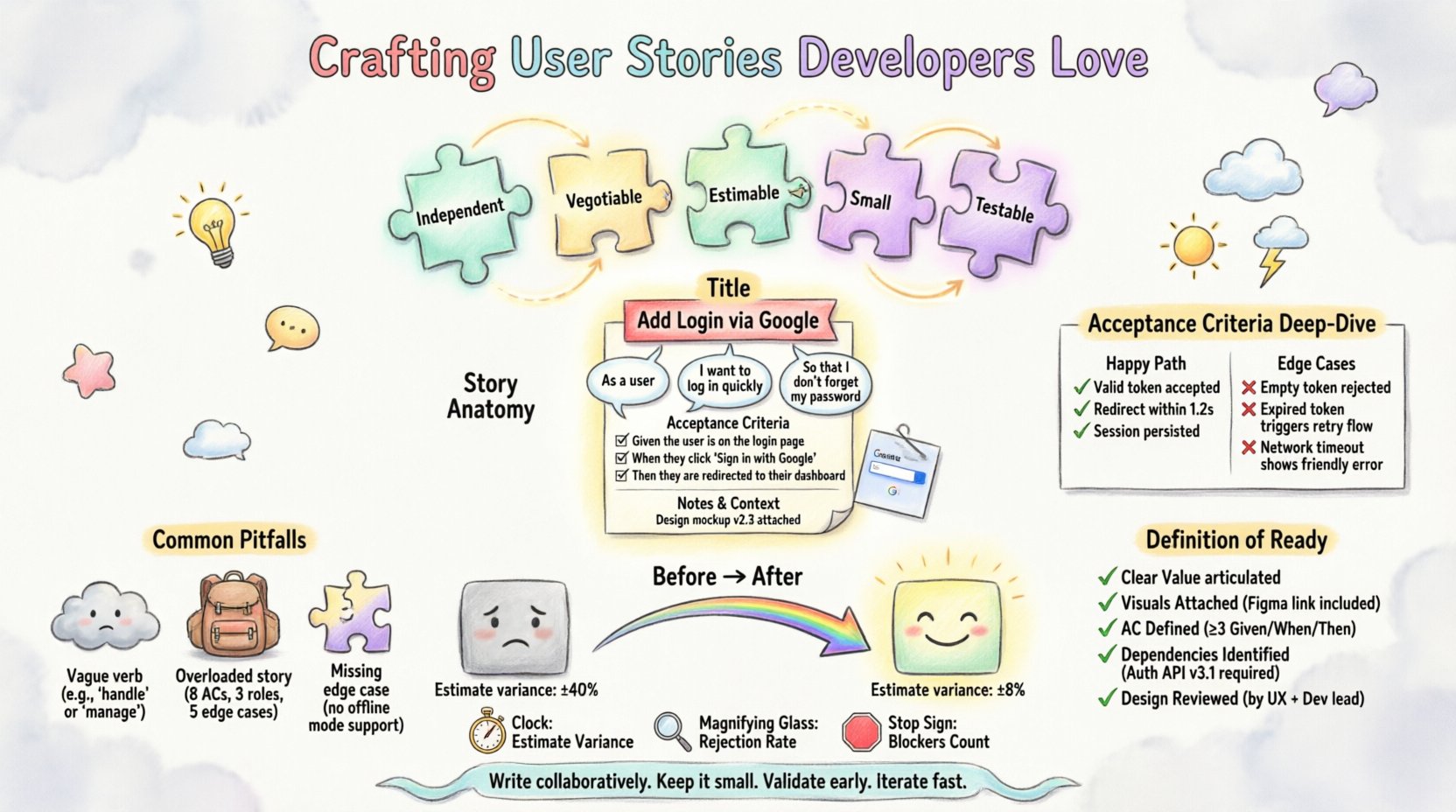
To ensure a story is viable for development, it should generally adhere to the INVEST model. This acronym serves as a checklist for quality. Ignoring any of these components often leads to stories that are too difficult to estimate or implement.
1. Independent
Stories should stand alone as much as possible. High coupling between stories creates bottlenecks. If Story B cannot start until Story A is finished, they should ideally be merged or the dependency managed explicitly. Independent stories allow teams to prioritize work flexibly.
2. Negotiable
The details of a story are not set in stone. The title and description provide the scope, but the implementation details are open for discussion. This allows developers to propose better technical solutions that achieve the same user value.
3. Valuable
Every story must deliver value. If a story is purely internal technical work without direct user impact, it should be framed differently (e.g., as a technical task) or justified by its contribution to system stability.
4. Estimable
Developers must be able to estimate the effort required. If a story is too vague or relies on unknown technologies, it cannot be estimated. Break it down until the uncertainty is reduced to a manageable level.
5. Small
A story should be small enough to be completed within a single sprint. Large stories (often called epics) should be broken down into smaller, vertical slices of functionality. This reduces risk and increases the frequency of delivery.
6. Testable
This is critical. If you cannot define how to verify the story is done, it is not ready. Testability ensures that the definition of done is objective, removing subjective arguments about whether the work is complete.
🛠️ The Anatomy of a Developer-Friendly Story
A robust user story contains specific sections that guide the engineering process. Each section serves a distinct purpose in reducing ambiguity.
1. The Title
The title should be concise and descriptive. It acts as the headline in the backlog. Avoid generic titles like “Fix Login”. Instead, use “Allow users to reset password via email”. This immediately clarifies the scope.
2. The Description
Use the standard format, but ensure it is fleshed out:
- As a: Identify the persona clearly. Avoid generic terms like “User”. Use “Premium Subscriber” or “Guest Checkout”.
- I want to: Describe the action. Use active verbs.
- So that: Explain the benefit. This is the most important part for developers to understand the goal.
3. Acceptance Criteria (AC)
Acceptance Criteria are the conditions that must be met for the story to be accepted. They define the boundaries of the story. There are two main approaches:
- Bullet Points: Simple lists of conditions.
- Scenario-Based (Gherkin): Using Given/When/Then syntax to describe behavior.
Why AC Matters: Developers use AC to write unit tests. Product Managers use AC to verify the build. It is the contract of completion.
4. Notes and Context
Include links to design mockups, API documentation, or existing code references. If there are edge cases that are tricky, document them here. This prevents the developer from having to guess or stop to ask questions repeatedly.
🧪 Deep Dive: Acceptance Criteria
Many teams underestimate the importance of Acceptance Criteria. Poor AC leads to the “I thought it worked that way” syndrome. Here is how to write effective criteria.
Do Include:
- Happy Paths: The standard flow where everything works as expected.
- Edge Cases: What happens if the input is empty? What if the network fails? What if the limit is reached?
- Non-Functional Requirements: Performance thresholds, security constraints, or accessibility standards.
Do Not Include:
- Implementation Details: Do not specify which database table to update or which library to use. Let the developer decide.
- Assumptions: If you assume a feature exists, verify it in the AC or note it in the context.
Example Scenario:
Scenario: User submits a contact form.
- Given the user is on the contact page
- When the user fills in all required fields and clicks submit
- Then the form data is sent to the server
- And a success message is displayed
- And the user is redirected to the homepage
Notice how this describes behavior, not code. It gives the developer freedom to implement the success message via a modal, a toast notification, or a new page, as long as the user perceives success.
🚫 Common Pitfalls and How to Avoid Them
Even experienced teams make mistakes when writing stories. Recognizing these patterns helps teams improve their backlog health.
1. The “As a Developer” Story
Stories should almost always be from the perspective of the end user. If the story is “As a developer, I want to refactor the code”, it is a technical task, not a user story. While technical debt reduction is vital, it should be framed as enabling future value (e.g., “Allow users to load reports faster by optimizing the query”).
2. Missing Edge Cases
Developers are often blamed for bugs that were never mentioned in the story. If a story does not mention what happens during a network timeout, the developer might not implement a retry mechanism. Explicitly stating negative scenarios in the AC prevents this.
3. Vague Verbs
Avoid words like “improve”, “optimize”, or “fix”. These are subjective. Instead, use “reduce load time by 2 seconds”, “increase success rate to 99%”, or “correct the error message display”. Quantifiable metrics remove ambiguity.
4. Overloading the Story
Combining multiple user needs into one story creates complexity. If a story requires changes to the database, the API, and the UI, it is likely too big. Break it down into smaller vertical slices.
🤝 Collaboration: The Definition of Ready
Writing a story is only half the battle. The team must agree on what constitutes a “Ready” story before it enters development. This is often captured in a Definition of Ready (DoR). A story should not be estimated or worked on until it meets these criteria.
| Criterion | Description |
|---|---|
| Clear Value | The “So that” section explains the business value. |
| Visuals Attached | Design mockups or wireframes are linked. |
| AC Defined | Acceptance Criteria are written and agreed upon. |
| Dependencies Identified | External APIs or third-party services are known. |
| Design Reviewed | Engineering has reviewed the design for feasibility. |
Implementing a DoR saves time during the sprint. It prevents developers from pulling a story only to realize halfway through that they lack the information to proceed.
🔄 Example Transformation: Bad to Good
Reviewing the difference between a weak story and a strong story highlights the principles discussed above.
| Aspect | ❌ Weak Story | ✅ Strong Story |
|---|---|---|
| Title | Fix search | Enable fuzzy search for product names |
| Persona | As a user | As a shopper looking for specific items |
| Benefit | To find things | So that I can find products even with typos |
| Criteria | Make it work better | Given a typo in the search query, show relevant results within 1 second |
| Details | None | Link to search algorithm documentation included |
The strong story provides context, constraints, and clear success metrics. The developer knows exactly what to build and how to verify it.
📈 Measuring Story Health
How do you know if your stories are improving? Look at the flow of work. If teams are constantly blocked waiting for clarification, your stories are likely incomplete. If there is a high rate of rework or bug reports immediately after a story is marked done, the acceptance criteria were insufficient.
Key Metrics to Watch:
- Estimate Variance: Are stories consistently taking longer than planned? This may indicate hidden complexity or vague stories.
- Rejection Rate: How often is a story returned from QA due to unclear requirements?
- Blocker Frequency: How many times did a developer have to stop work to ask a question about a story?
Tracking these metrics helps product and engineering teams identify where the friction lies. If the variance is high, it might be time to invest more time in refinement before the sprint starts.
🧠 The Psychology of the Developer
Understanding why developers prefer clear stories requires empathy. Development is a cognitive load-heavy activity. Every ambiguity forces a mental context switch. When a developer encounters a vague requirement, they must pause to hypothesize. This breaks their flow state.
Clear stories respect the developer’s time and expertise. They signal that the product side has done the thinking work, allowing the engineering side to focus on the solution work. This partnership builds trust. When engineers trust the clarity of the requirements, they are more likely to take ownership of the implementation and suggest improvements.
🛡️ Handling Technical Debt
Not every story is a new feature. Sometimes the work is maintaining the system. How do you write a story for technical debt?
Avoid writing “Fix legacy code”. Instead, frame it around the value it unlocks for the system or the user.
- Bad: “Refactor the payment module”.
- Good: “Reduce payment processing errors by decoupling the legacy validation logic”.
By linking technical work to a measurable outcome, you justify the effort and ensure it is prioritized correctly against new features.
🔍 Refinement Strategies
Refinement is the ongoing process of improving stories before they are pulled into a sprint. It is not a one-time event. Effective refinement sessions involve:
- Questioning: Ask “What if the user does X?” to uncover edge cases.
- Splitting: If a story feels too big, break it into smaller parts immediately.
- Visualizing: Draw the flow on a whiteboard or digital board together.
- Verifying: Read the AC aloud to ensure it sounds testable.
Investing 10-20% of sprint capacity in refinement pays dividends in velocity and quality during the execution phase.
📝 Summary of Best Practices
To summarize, crafting user stories that resonate with developers requires discipline and clarity. It is about creating a bridge between intent and execution. By focusing on value, defining clear acceptance criteria, and collaborating early, teams can reduce waste and increase delivery speed.
- Focus on the “So That” to ensure value is clear.
- Write Acceptance Criteria that are testable and specific.
- Include context, design links, and edge cases.
- Avoid technical implementation details in the story description.
- Use the INVEST model to validate story quality.
- Collaborate during refinement to define “Ready”.
When these practices are adopted, the friction between product and engineering diminishes. The backlog becomes a reliable source of truth, and development becomes a smooth, predictable process. This alignment is the foundation of a high-performing engineering organization.
Related posts:
 The Complete Checklist for Writing High-Quality User Stories in Agile Teams
 Q&A: Answering the Top 10 Confusing Questions About User Stories for New Agilites
 Stop Wasting Time on Bad User Stories: A Practical Tutorial for Beginners
 How to Use User Stories to Align Engineering, Design, and Product Teams Effectively