

Software development often begins with a vision that is broad, ambitious, and inherently complex. Stakeholders present a high-level goal, such as “improve customer onboarding” or “enhance payment security.” These statements are not actionable by a development team on their own. They are requirements, but they are not yet user stories. The gap between a vague business need and a deployable feature is filled with decomposition.
Breaking down complex requirements is a critical skill for product managers, business analysts, and agile practitioners. Without this skill, teams face scope creep, missed deadlines, and confusion. When a requirement is too large, it becomes an epic. When it is too vague, it becomes a technical debt trap. The goal is to transform ambiguity into clarity, ensuring every piece of work delivers specific value.
This guide outlines a practical, repeatable process for deconstructing complex inputs into actionable user stories. We will explore the mechanics of decomposition, the INVEST criteria, acceptance criteria formulation, and collaboration techniques. By the end, you will have a structured approach to handling even the most tangled requirements.
🧩 Understanding the Core Challenge
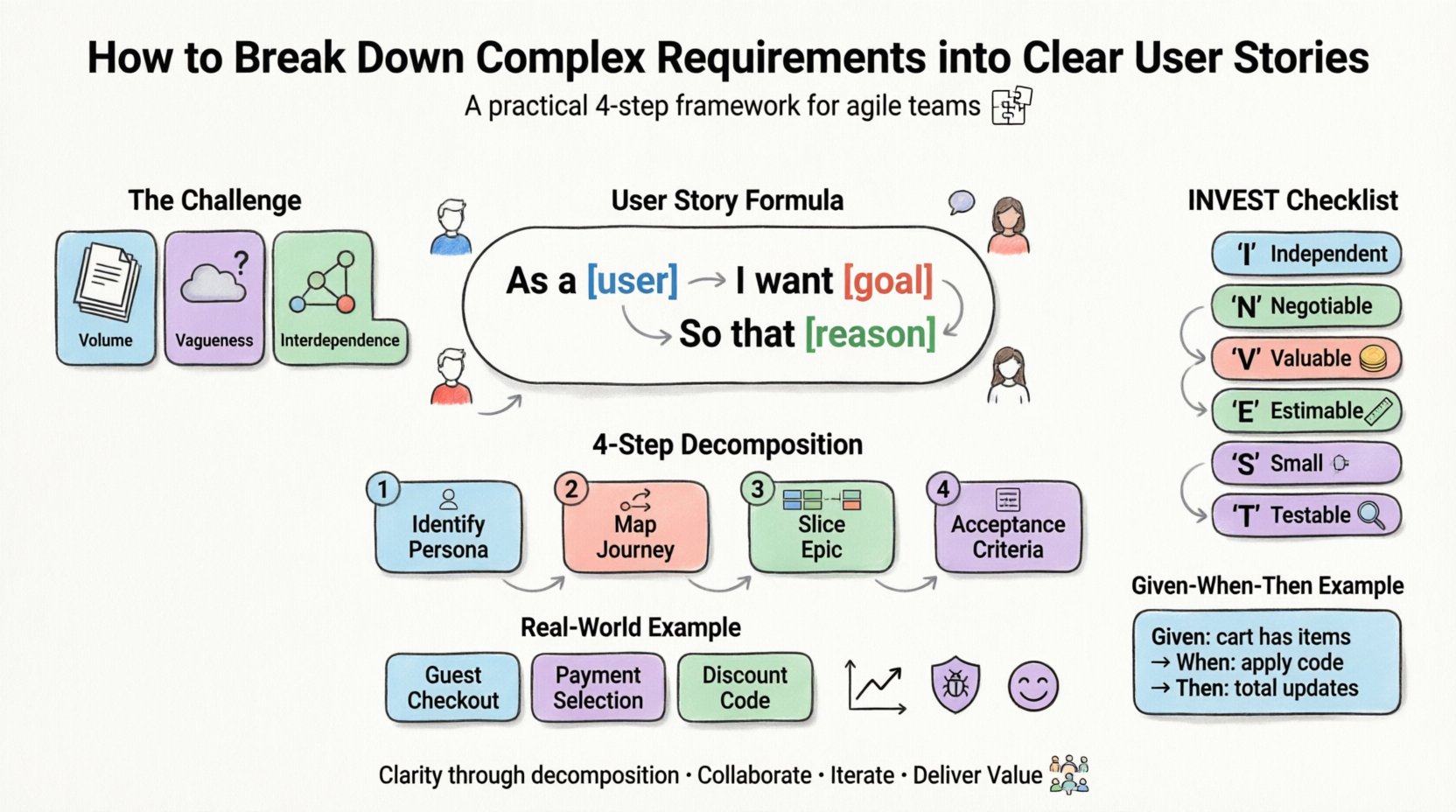
Complex requirements often suffer from three main issues:
- Volume: Too much information to process at once.
- Vagueness: Lack of specific details on who, what, or why.
- Interdependence: Multiple features that rely on one another, creating hidden dependencies.
When a team attempts to build a “big requirement” as a single unit, the risk of failure increases exponentially. The system becomes monolithic, testing becomes difficult, and feedback loops slow down. Decomposition solves this by slicing the work into smaller, independent chunks that can be delivered, tested, and validated in isolation.
📝 The Anatomy of a User Story
Before breaking down a requirement, we must understand the target format. A standard user story follows a simple structure:
As a [type of user],
I want [some goal],
So that [some reason].
This template forces the writer to identify the persona, the action, and the value. It shifts the focus from features to user needs. However, this template is just the header. The substance lies in the details that follow.
🛠️ Step-by-Step Decomposition Framework
Transforming a complex requirement into stories requires a systematic approach. Follow this workflow to ensure nothing is missed.
1. Identify the User Persona
Every requirement serves someone. If you cannot name the person who benefits from the feature, the requirement might be internal technical work disguised as a user story. List all potential users involved in the scenario.
- Primary User: The person directly interacting with the feature.
- Secondary User: The person who benefits indirectly.
- System/Admin: The person managing the feature backend.
2. Map the User Journey
Draw a linear path from the user’s starting point to the desired outcome. Identify every step the user takes. Each step represents a potential story.
- Step 1: User lands on the page.
- Step 2: User selects an option.
- Step 3: System processes the request.
- Step 4: User receives confirmation.
3. Slice the Epic
An epic is a collection of stories that cannot be delivered individually. You need to slice this epic horizontally or vertically.
- Horizontal Slicing: Delivering a thin layer of functionality across the entire stack (e.g., a basic “Add to Cart” button, then later the “Checkout” button).
- Vertical Slicing: Delivering a full slice of functionality from the UI to the database (e.g., a simple “Login” feature that works end-to-end, even if it lacks social login).
4. Define Acceptance Criteria
A story is not complete until the conditions for satisfaction are clear. Acceptance criteria define the boundaries of the story. They answer the question: “How do we know this is done?”
📊 The INVEST Criteria Checklist
Once you have a draft story, verify it against the INVEST model. This ensures the story is independent, negotiable, valuable, estimable, small, and testable.
| Criterion | Definition | Example Check |
|---|---|---|
| Independent | Can this story be developed without another story? | Yes, the login story does not depend on the profile edit story. |
| Negotiable | Are the details open for discussion? | Yes, the implementation method is not specified, only the outcome. |
| Valuable | Does this deliver value to the user? | Yes, it allows the user to secure their account. |
| Estimable | Can the team size the effort? | Yes, the complexity is understood. |
| Small | Can it be completed in one sprint? | Yes, estimated at 3 story points. |
| Testable | Can we write a test for it? | Yes, we can verify the error message appears. |
📋 Writing Effective Acceptance Criteria
Acceptance criteria are the guardrails of your development process. They prevent the “it works on my machine” syndrome by defining success objectively.
1. Use the Given-When-Then Format
This structure aligns with behavior-driven development (BDD) principles. It is readable by non-technical stakeholders.
- Given: The initial context or state.
- When: The action taken by the user.
- Then: The expected outcome.
2. Include Negative Scenarios
Do not just write the happy path. Explicitly state what happens when things go wrong.
- Example: “When the user enters an invalid email, the system displays a red error message.”
- Example: “When the connection is lost, the system prompts the user to retry.”
3. Define Constraints
Specify limits that must be respected, such as performance or security.
- Performance: “The page must load within 2 seconds.”
- Security: “Passwords must be hashed before storage.”
⚠️ Common Pitfalls and How to Avoid Them
Even experienced teams make mistakes during decomposition. Recognizing these patterns early saves time and prevents rework.
1. The “Technical Story” Trap
Writing stories like “Update database schema” is not a user story. It is a task. If the user does not care about the schema, it is not a story. Reframe it to focus on the outcome.
| Bad Example | Better Example |
|---|---|
| Refactor the payment module. | As a user, I want to pay using Apple Pay so I can checkout faster. |
| Add caching to the API. | As a user, I want search results to appear instantly so I don’t wait. |
2. Ignoring Dependencies
If Story A cannot start until Story B is finished, they are not independent. This creates bottlenecks. Try to decouple them or schedule them carefully.
3. Over-Slicing
Breaking a feature into stories that are too small can lead to overhead. If a story takes 30 minutes to complete, it might be too granular. Aim for stories that take a few hours to a few days.
4. Missing Edge Cases
Assuming everything will go smoothly is a recipe for bugs. Always ask: “What if the data is missing?” or “What if the user cancels?”
🤝 Collaboration Strategies for Decomposition
Decomposition is rarely a solitary activity. It benefits from diverse perspectives. Here is how to structure the work.
1. The Three Amigos
This practice involves three roles discussing a story before work begins:
- Business Analyst: Clarifies the “Why” and the requirements.
- Developer: Clarifies the “How” and technical feasibility.
- QA Engineer: Clarifies the “Testability” and edge cases.
2. Story Mapping Workshops
Use a physical or digital wall to map out user activities horizontally and stories vertically. This visualizes the release plan and helps prioritize.
- Top Row: User Activities (High level).
- Vertical Columns: Releases or Iterations.
- Stories: Specific tasks within activities.
3. Backlog Refinement Sessions
Hold regular meetings dedicated solely to breaking down upcoming work. Do not mix this with sprint planning. Refinement prepares the backlog; planning selects the work.
💻 Real-World Scenario: E-Commerce Checkout
Let us apply this to a complex requirement: “Build a Checkout System.”
Initial Requirement
“Users need to be able to buy products online, pay securely, and receive confirmation. The system must handle multiple payment methods and discounts.” This is too large for one sprint.
Decomposed User Stories
- Story 1: Guest Checkout
As a guest, I want to enter my shipping details so I can complete a purchase without creating an account. - Story 2: Payment Method Selection
As a user, I want to select between Credit Card and PayPal so I can use my preferred payment method. - Story 3: Discount Code Application
As a user, I want to enter a promo code so I can save money on my order. - Story 4: Order Confirmation Email
As a user, I want to receive an email after paying so I have a record of my transaction. - Story 5: Tax Calculation
As a system, I want to calculate tax based on location so the user pays the correct amount.
Acceptance Criteria Example (Story 3)
- Given: I am on the checkout page with items in my cart.
- When: I enter a valid discount code and click apply.
- Then: The total price updates to reflect the discount.
- And: A message confirms the code was successful.
- When: I enter an expired discount code.
- Then: The system displays an error message stating the code is invalid.
🔄 Maintenance and Refinement
Decomposition is not a one-time event. As development progresses, requirements often evolve. A story that seemed clear at the start might reveal new complexities during implementation.
- Revisit Stories: If a story stalls, break it down further.
- Update Criteria: If new edge cases are found, add them to the acceptance criteria.
- Retire Stories: If a requirement changes, mark the story as obsolete to avoid wasted effort.
🛡️ Ensuring Quality Without Hype
There is no magic tool that writes perfect stories for you. The quality of the output depends on the rigor of the process. Avoid shortcuts like copying previous stories or assuming the team knows what you mean. Explicit is better than implicit.
Documentation should be living. Keep the description and criteria in the same place as the work item. This ensures that context travels with the code. When a developer starts the work, the criteria should be the first thing they read.
📈 Measuring Success
How do you know if your decomposition is working? Look for these indicators:
- Velocity Stability: The team completes stories consistently without major overruns.
- Defect Rate: Fewer bugs are reported during testing because requirements were clear.
- Stakeholder Satisfaction: Delivered features match the expected business value.
- Flow Efficiency: Stories move from “To Do” to “Done” without getting blocked by ambiguity.
🧭 Final Thoughts on Requirement Clarity
Complex requirements are inevitable in software engineering. They represent the ambition of the business and the complexity of the problem domain. The skill lies not in avoiding complexity, but in managing it. By slicing work into small, valuable, and testable units, teams can navigate uncertainty with confidence.
Focus on the value delivered to the user. Ensure every story has a clear owner, a clear goal, and a clear definition of done. Use the INVEST model as a compass. Collaborate with your peers to validate assumptions. And remember, clarity is a continuous practice, not a destination.
When you approach decomposition with discipline and empathy for the user, the process becomes smoother. The team spends less time asking “what should I build?” and more time building the right thing. This is the foundation of effective agile delivery.
Related posts:
 The Complete Checklist for Writing High-Quality User Stories in Agile Teams
 Deep Dive into the INVEST Model: The Secret Framework for Better User Stories
 Stop Wasting Time on Bad User Stories: A Practical Tutorial for Beginners
 How to Use User Stories to Align Engineering, Design, and Product Teams Effectively