

Writing effective user stories is a foundational skill for anyone stepping into product management. It is the bridge between vague ideas and tangible development work. Without clear communication, teams build the wrong features, stakeholders lose trust, and resources get wasted. This guide provides a structured approach to crafting stories that deliver value, ensure clarity, and align engineering efforts with business goals.
What is a User Story? 🧩
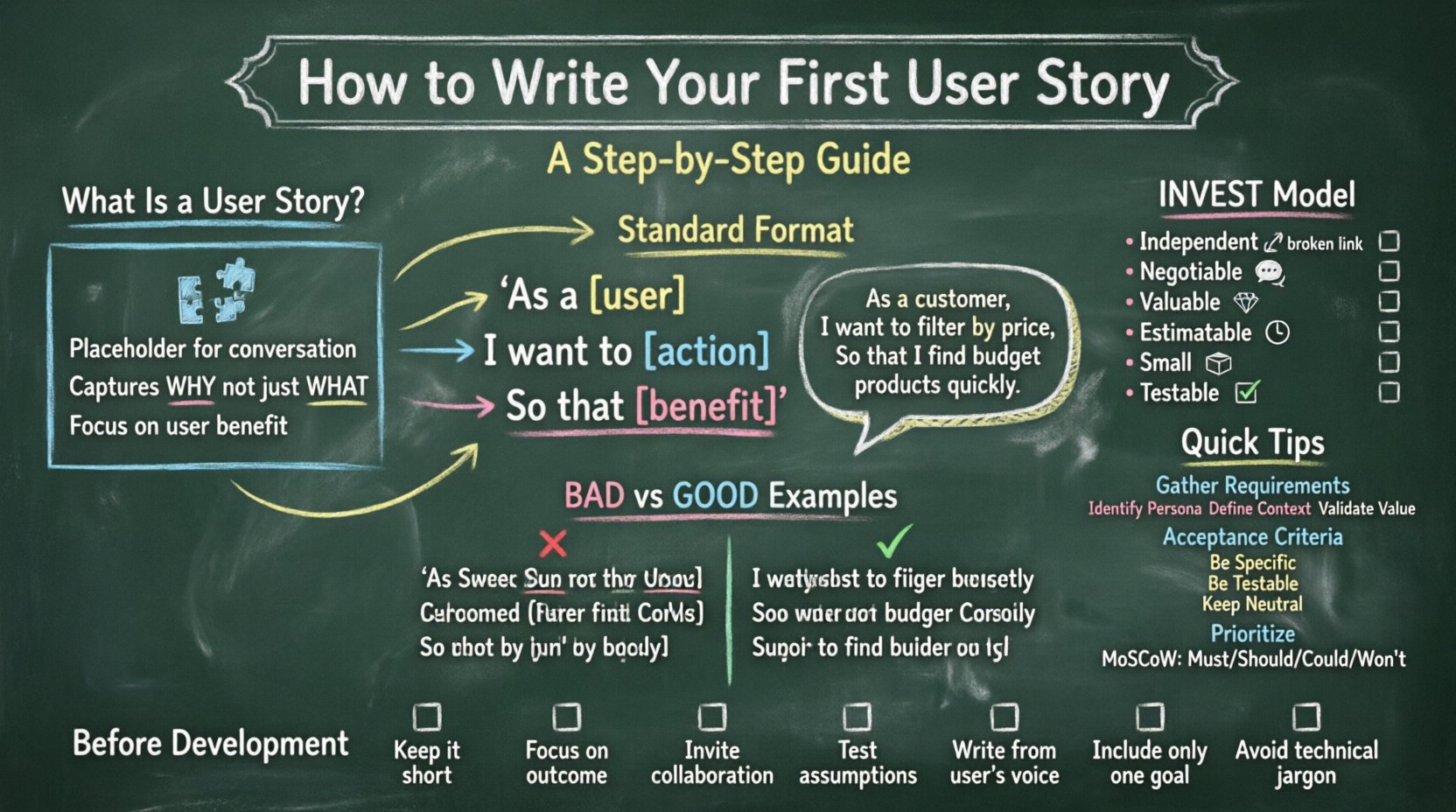
A user story is a simple, concise description of a feature told from the perspective of the person who desires the new capability, usually a user or customer. It is not a specification document. It is a placeholder for a conversation. The goal is to capture the why, not just the what.
When you write a story, you are defining a unit of value. It allows the team to estimate effort, plan sprints, and track progress. It shifts the focus from technical implementation to user benefit.
Why This Matters
- Clarity: Reduces ambiguity for developers and designers.
- Focus: Keeps the team aligned on the specific outcome.
- Collaboration: Encourages discussion rather than assumption.
- Value: Ensures every line of code serves a user need.
The Standard Format 📄
While flexibility exists, the industry standard follows a specific template. This structure ensures consistency across your backlog. Every story should answer three questions: Who, What, and Why.
As a [type of user],
I want to [perform an action],
So that [receive a benefit].
Breaking Down the Template
- As a: Identifies the persona. This defines who is experiencing the problem. Is it an admin? A guest? A premium subscriber?
- I want to: Describes the functionality or action. This is the solution mechanism.
- So that: States the value proposition. This is the outcome or benefit realized.
Consider this example:
- As a customer,
I want to filter search results by price range,
So that I can find products within my budget quickly.
The INVEST Model ✅
Not every idea is a valid user story. To ensure quality, use the INVEST model as a checklist. This acronym helps you validate the structure and utility of your stories before they reach the development queue.
| Principle | Description | Check |
|---|---|---|
| Independent | Stories should not rely on other stories to be delivered. | Can this be built alone? |
N
| Details are discussed, not fully specified upfront. |
Is there room for conversation? |
|
| Valuable | Must deliver value to the user or business. | Does this solve a problem? |
E
| The team must be able to guess the effort required. |
Can we estimate this? |
|
| Small | Should fit within a single iteration or sprint. | Is the scope manageable? |
| Testable | Must have clear criteria to verify completion. | How do we know it works? |
Gathering the Requirements 🗣️
Before writing a single word, you need to understand the problem space. You cannot write a story in a vacuum. This phase involves research and discovery.
1. Identify the Persona
Who are you building for? Create or reference user personas. These are archetypes representing your user base. Knowing their motivations, pain points, and technical proficiency helps you tailor the story.
- Research methods: User interviews, surveys, support ticket analysis, and usage data.
- Key question: What is the current friction point for this user?
2. Define the Context
Understand where this feature fits in the broader product. Does it connect to existing data? Does it replace a manual process? Context prevents silos and ensures integration.
3. Validate the Value
Ask why this feature is needed. If you cannot articulate the benefit, do not write the story. The “So that” section is critical here. If it is not valuable, it should not be built.
Drafting Acceptance Criteria 🎯
Acceptance criteria are the conditions that a software product must satisfy to be accepted by a user, customer, or stakeholder. They define the boundaries of the story. Without them, “done” is subjective.
Guidelines for Criteria
- Be Specific: Avoid vague terms like “fast” or “easy.” Use metrics where possible.
- Be Testable: A tester should be able to read the criteria and write a test case.
- Keep it Neutral: Focus on behavior, not implementation details.
Example Criteria
- The system validates that the email field contains an @ symbol.
- The button changes color to green upon successful submission.
- The page loads within 2 seconds on a standard connection.
- Error messages appear immediately if the password is too short.
Prioritization Strategies 📊
You will have more stories than time. Prioritization ensures you build the most important things first. Here are common methods to rank your backlog.
1. MoSCoW Method
| Category | Meaning |
|---|---|
| Must Have | Non-negotiable requirements. Without these, the product fails. |
| Should Have | Important but not vital. Can be delayed if necessary. |
| Could Have | Desirable features. Add only if time permits. |
| Won’t Have | Excluded for the current timeframe. |
2. Value vs. Effort
Plot your stories on a matrix. Place high value, low effort items at the top. These are your quick wins. High effort, low value items should be avoided or re-evaluated.
3. Impact vs. Risk
Consider the risk of not building the feature. High impact and high risk items often require immediate attention to prevent negative outcomes.
Common Mistakes to Avoid ⚠️
Even experienced practitioners make errors. Being aware of common pitfalls helps you maintain high standards.
1. Writing for Developers
Avoid technical jargon in the story title or description. Write for the end-user. Technical details belong in the acceptance criteria or a separate technical task.
2. Too Much Detail
The story is a placeholder for conversation. If you write a 10-page document, you have discouraged collaboration. Keep the story concise and invite questions.
3. Ignoring Edge Cases
Don’t just write the happy path. Consider what happens when the network fails, or the user enters invalid data. These edge cases should be part of the criteria.
4. One Big Story
Epics are large bodies of work that need to be broken down. Do not try to build an entire login system in one story. Break it down into smaller, testable units.
Refinement and Collaboration 🔁
Writing the story is just the beginning. The refinement process, often called grooming, is where the story gains clarity.
The Refinement Session
Hold regular meetings with your engineering team. Walk through the stories together.
- Ask questions: “How would you implement this?” “What are the risks?”
- Estimate: Use story points or hours to gauge complexity.
- Split: If a story is too big, break it into smaller chunks immediately.
Feedback Loop
After the story is built, review it with the team. Did the outcome match the “So that” statement? If not, update your process. Continuous improvement is key.
Examples: Good vs. Bad Stories 📝
Comparing examples highlights the difference between vague requests and actionable stories.
| Bad Example | Why It Fails | Good Example |
|---|---|---|
| Add a dark mode. | Who cares? What is the value? Technical only. | As a night-owl user, I want a dark mode theme, so that I can read content without eye strain in low light. |
| Fix the search bug. | Which bug? Who is affected? Unclear scope. | As a shopper, I want search results to show relevant products, so that I can find items I am looking for quickly. |
| Make the dashboard faster. | “Faster” is not measurable. No user perspective. | As a data analyst, I want the dashboard to load in under 3 seconds, so that I can make timely decisions. |
Final Thoughts on Communication 💬
The best user story is one that sparks the right conversation. It is a tool for empathy. When you write a story, you are stepping into the user’s shoes. You are advocating for their experience.
Do not treat this as a bureaucratic task. Treat it as a strategic exercise. Every story you write should move the product forward. If it does not, question its existence.
Remember:
- Keep it short and focused.
- Focus on the outcome, not the output.
- Invite collaboration early.
- Test your assumptions.
By following these steps and adhering to the principles outlined, you will build a backlog that drives results. You will move from guessing to knowing. You will create products that people actually want to use.
Checklist for New Product Managers 📋
Before moving a story to development, run this checklist:
- ☐ Does it follow the “As a… I want… So that…” format?
- ☐ Is the persona clearly defined?
- ☐ Is the value proposition clear?
- ☐ Are acceptance criteria specific and testable?
- ☐ Is the story independent of others?
- ☐ Has the team estimated the effort?
- ☐ Does it fit within the current sprint capacity?
This discipline ensures quality. It saves time in the long run by preventing rework. It builds trust between product, engineering, and stakeholders. Start small, iterate often, and keep the user at the center of every decision.
Related posts:
 User Story Best Practices: The Hidden Rules Every Beginner Product Manager Must Follow
 Troubleshooting Blurry Acceptance Criteria: How to Fix Your User Stories Before Coding Starts
 Future Outlook: How User Stories Are Evolving with AI and Modern Product Teams
 User Story Refinement Secrets: How to Prepare Stories for Sprint Planning Like a Pro