


Strategic analysis is the backbone of sound business decision-making. Among the many frameworks available, Michael Porter’s Five Forces Analysis remains one of the most widely taught tools in business schools and corporate strategy departments. However, despite its popularity, there is a significant gap between understanding the theory and applying it correctly. Many students and junior analysts treat this model as a mechanical checklist rather than a dynamic diagnostic tool. This approach often leads to superficial insights that fail to capture the true competitive landscape.
This guide addresses the specific misconceptions surrounding Porter’s Five Forces. We will explore what is often misunderstood, why those errors occur, and how to apply the framework with precision. By correcting these common pitfalls, you can move from rote memorization to genuine strategic insight.
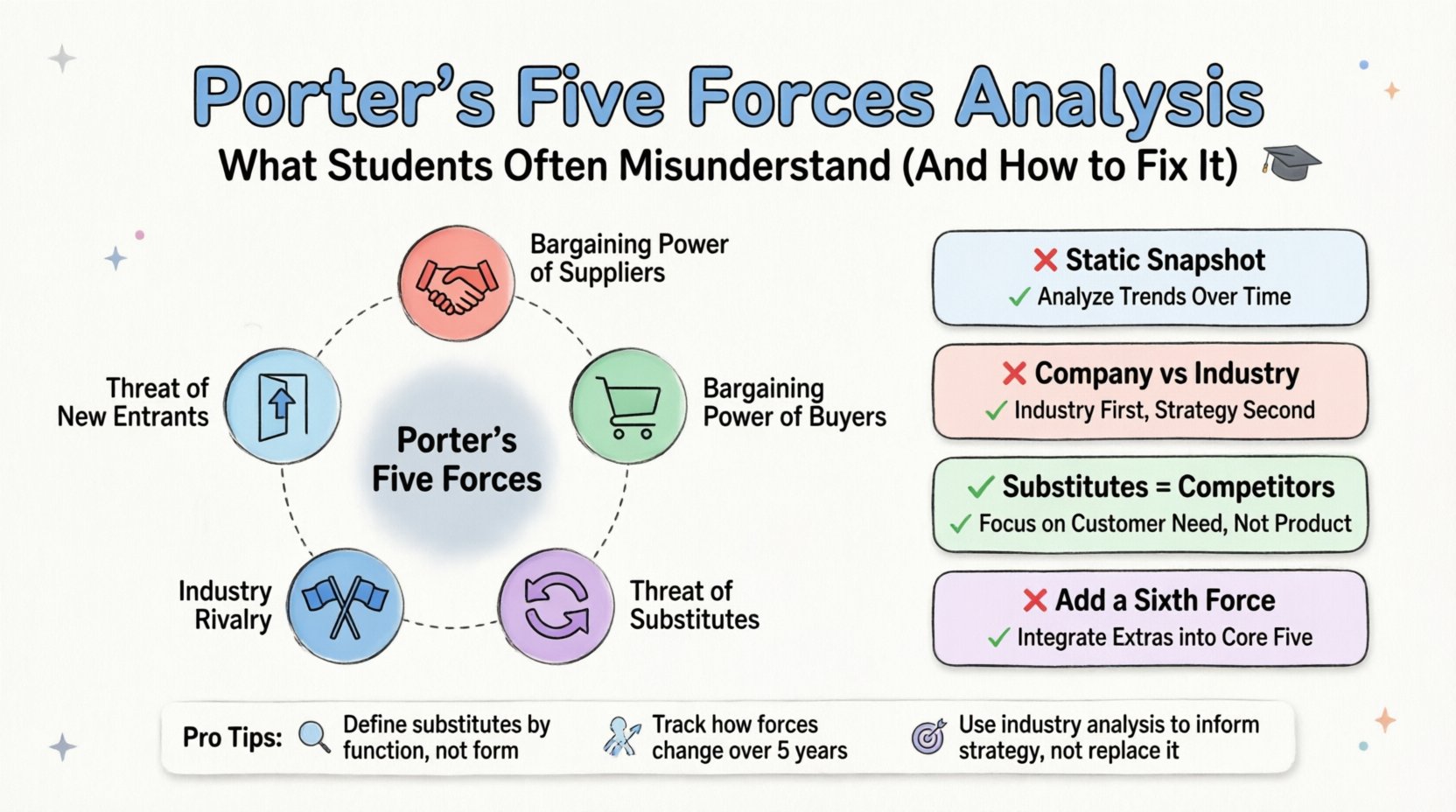
Understanding the Core Framework 🧩
Before addressing errors, it is essential to define the tool clearly. The Five Forces framework assesses the intensity of competition and the profitability of an industry. Developed by Michael Porter in 1979, it suggests that the profit potential of an industry is determined by five specific forces:
- Threat of New Entrants: How easy is it for new competitors to enter the market?
- Bargaining Power of Suppliers: How much control do suppliers have over prices and terms?
- Bargaining Power of Buyers: How much pressure can customers exert on prices?
- Threat of Substitute Products or Services: Can customers easily switch to alternative solutions?
- Rivalry Among Existing Competitors: How intense is the competition between current players?
When these forces are strong, industry profitability tends to be low. When they are weak, profitability is generally higher. The goal is not just to list these forces, but to understand their interactions and dynamics.
Common Misconception 1: Treating the Analysis as Static 📉
One of the most frequent errors in student projects is treating the Five Forces as a snapshot in time. Students often collect data for a specific year and present the analysis as if it will remain valid indefinitely. This is a critical oversight. Markets are fluid. Technologies change, regulations shift, and consumer behaviors evolve.
Why this matters:
- A static analysis ignores the trajectory of the industry.
- It fails to account for emerging trends that could alter the forces within months.
- It leads to recommendations that are obsolete by the time they are implemented.
The Fix:
Instead of a single snapshot, conduct a temporal analysis. Ask how each force has changed over the last five years and project how it might change in the next five. For example, in the airline industry, fuel prices and labor regulations can shift the threat of entry and bargaining power of suppliers rapidly. Always include a discussion on the drivers of change for each force.
Common Misconception 2: Confusing Industry with Company Strategy 🏢
Students often blur the line between industry-level analysis and company-level strategy. The Five Forces framework is designed to analyze the industry, not a specific firm. It tells you where the money is, not necessarily how a specific company should earn it. However, many assignments conclude with specific company strategies without first establishing the industry context.
Why this matters:
- Industry analysis provides the context for strategy, not the strategy itself.
- Jumping to specific tactics (like “lower prices”) without understanding the force structure is risky.
- It confuses the external environment with internal capabilities.
The Fix:
Structure your work in two distinct phases. First, complete the Five Forces analysis to determine the attractiveness of the industry. Second, once you understand the industry structure, discuss how a firm might position itself. For instance, if the threat of substitutes is high, the strategy might involve increasing switching costs, but this must be derived from the analysis, not assumed.
Common Misconception 3: The Substitute Confusion 🔀
This is perhaps the most pervasive error. Students frequently confuse substitutes with competitors. In this framework, competitors sell the same product in the same way. Substitutes solve the same problem in a different way. A coffee shop competes with other coffee shops. However, it also competes with energy drinks, tea, or even a nap, because all of these solve the problem of “needing energy or a break”.
Why this matters:
- Underestimating substitutes leads to pricing power errors.
- It narrows the scope of the market incorrectly.
- It ignores cross-industry competition.
The Fix:
Focus on the customer need, not the product category. Ask: “What is the fundamental job the customer is hiring the product to do?” If you are analyzing the movie theater industry, the substitute is not just another theater; it is streaming services, video games, or home entertainment systems. Define the substitute by the function it fulfills for the consumer.
Common Misconception 4: Ignoring the “Sixth Force” 🎲
Some students have heard of a “Sixth Force” and believe it is an official part of Porter’s original model. In reality, Porter himself did not include a sixth force. The idea of a sixth force (often cited as “Complements” or “Government”) is a later addition by other strategists. While these factors are important, presenting them as part of the standard Five Forces framework can lead to confusion and grade penalties in academic settings.
Why this matters:
- It shows a lack of familiarity with the original academic framework.
- It dilutes the focus on the core five drivers.
- It may be seen as trying to over-complicate a simple model.
The Fix:
Stick to the original five. If you believe government regulation or complementary products are critical, discuss them within the relevant existing force. For example, government regulation often affects the “Threat of New Entrants” (via licensing) or “Bargaining Power of Suppliers”. Complementary products usually fit into the “Threat of Substitutes” or enhance the value of the main product. Keep the model clean and adhere to the established structure.
Deep Dive: Fixing Each Force Analysis 🛠️
To ensure accuracy, let us break down each force with specific indicators that students often miss.
1. Threat of New Entrants 👶
Students often focus solely on capital requirements. While money is important, barriers to entry are multifaceted.
- Switching Costs: If a customer finds it hard to switch, entry is harder.
- Economies of Scale: Does production volume lower costs significantly?
- Access to Distribution Channels: Can new players get their product to shelves?
- Government Policy: Are there licensing or patent restrictions?
2. Bargaining Power of Suppliers ⚖️
It is a common mistake to assume suppliers are powerful simply because they are large. Power depends on concentration and differentiation.
- Supplier Concentration: Are there few suppliers or many?
- Uniqueness of Input: Is the input generic or specialized?
- Threat of Forward Integration: Could the supplier become a competitor?
- Importance of Volume: Does the supplier rely heavily on this industry?
3. Bargaining Power of Buyers 🛒
Buyer power is often equated with price sensitivity. However, it is also about information and switching.
- Concentration of Buyers: Are there few large buyers or many small ones?
- Product Differentiation: Is the product commoditized or unique?
- Price Sensitivity: Does the product represent a large portion of their budget?
- Switching Costs: How easy is it for them to leave?
4. Threat of Substitutes 🔄
As mentioned, this is about function, not form. The price-performance ratio is key.
- Relative Price: Is the substitute cheaper or more effective?
- Switching Cost to Substitute: How much effort does the customer need to change?
- Buyer Propensity to Substitute: Are customers open to trying new solutions?
5. Rivalry Among Existing Competitors ⚔️
Rivalry is not just price wars. It is about the structural conditions of the industry.
- Number of Competitors: Is the market fragmented or concentrated?
- Industry Growth: Is the pie growing or static?
- Fixed Costs: Are there high costs that pressure companies to fill capacity?
- Exit Barriers: Is it hard to leave the industry (leading to desperate fighting)?
Comparison Table: Misconception vs. Reality 📋
| Concept | Common Student Error | Correct Approach |
|---|---|---|
| Time Horizon | Treats analysis as a single point in time. | Analyze trends and future drivers of change. |
| Substitutes | Confuses substitutes with direct competitors. | Focus on the customer need being fulfilled. |
| Industry Level | Applies forces directly to company tactics. | Use forces to assess industry attractiveness first. |
| Data Sources | Relies on anecdotal evidence or one report. | Use diverse sources (financials, interviews, news). |
| Force Count | Adds a “Sixth Force” arbitrarily. | Integrate external factors into the existing five. |
How to Gather Data Without Software Tools 📝
You do not need expensive software to conduct a robust Five Forces analysis. The quality of the insight depends on the depth of your research, not the tool used.
1. Financial Reports
Publicly traded companies release annual reports (10-K in the US). These documents often contain sections on “Risk Factors” and “Industry Overview”. These are goldmines for understanding supplier power and competitive rivalry.
2. Industry Associations
Most industries have trade associations. They publish white papers, market statistics, and regulatory updates. These provide unbiased data on market size and growth.
3. News and Trade Publications
Regularly reading industry-specific news helps track the “dynamic” aspect of the analysis. Look for mergers, new product launches, or labor disputes.
4. Customer Reviews
For buyer power and substitutes, read customer reviews on platforms like Trustpilot or Amazon. Look for complaints about price, quality, or switching to competitors.
5. Expert Interviews
If possible, speak with people working in the industry. They can provide context on switching costs and supplier relationships that reports might not reveal.
Structuring Your Final Report 📄
To ensure your work is clear and authoritative, follow a logical structure. Do not simply list the five forces. Synthesize the information.
- Executive Summary: Briefly state the industry and the overall profitability outlook.
- Industry Overview: Define the scope and key players.
- Force Analysis: Dedicate a section to each of the five forces with evidence.
- Interaction of Forces: Explain how one force affects another (e.g., high supplier power might increase rivalry).
- Strategic Implications: Summarize what the industry structure means for a new entrant or existing player.
Final Thoughts on Strategic Rigor 🧠
Mastering the Five Forces is not about memorizing definitions. It is about developing a disciplined way of thinking about competition. When you avoid the common traps of static thinking, substitute confusion, and scope creep, your analysis becomes a reliable asset.
Remember that this framework is a starting point, not the end of the story. It sets the stage for understanding where value is created and captured in an industry. By applying the fixes outlined above, you move from a superficial checklist to a deep strategic understanding. This level of rigor is what distinguishes good analysis from great strategy.
Related posts:
 Porter Five Forces Analysis Explained: How to Assess Industry Attractiveness in 10 Minutes
 Porter Five Forces Analysis: How to Apply It to Your Next Business Case Study
 Porter Five Forces Analysis: How New Entrants Shape Industry Dynamics (And How to Predict Them)
 Porter Five Forces Analysis: A No-Jargon Guide for Strategy Course Beginners