


Business strategy students often encounter Porter’s Five Forces Analysis as a foundational tool during their early studies. However, the transition from textbook theory to practical application frequently creates confusion. Many learners treat the framework as a rigid checklist rather than a dynamic lens for understanding industry structure. This guide addresses the specific confusion points surrounding the model, debunks common myths, and provides a clear, authoritative path to using the framework effectively without relying on software or jargon.
Understanding the competitive landscape is critical for any strategic decision-making process. Whether you are analyzing a startup environment or evaluating an established corporation, the forces at play determine profitability and long-term viability. This article breaks down the mechanics, clarifies misconceptions, and offers a structured approach to industry analysis.
📜 Origins and Purpose of the Framework
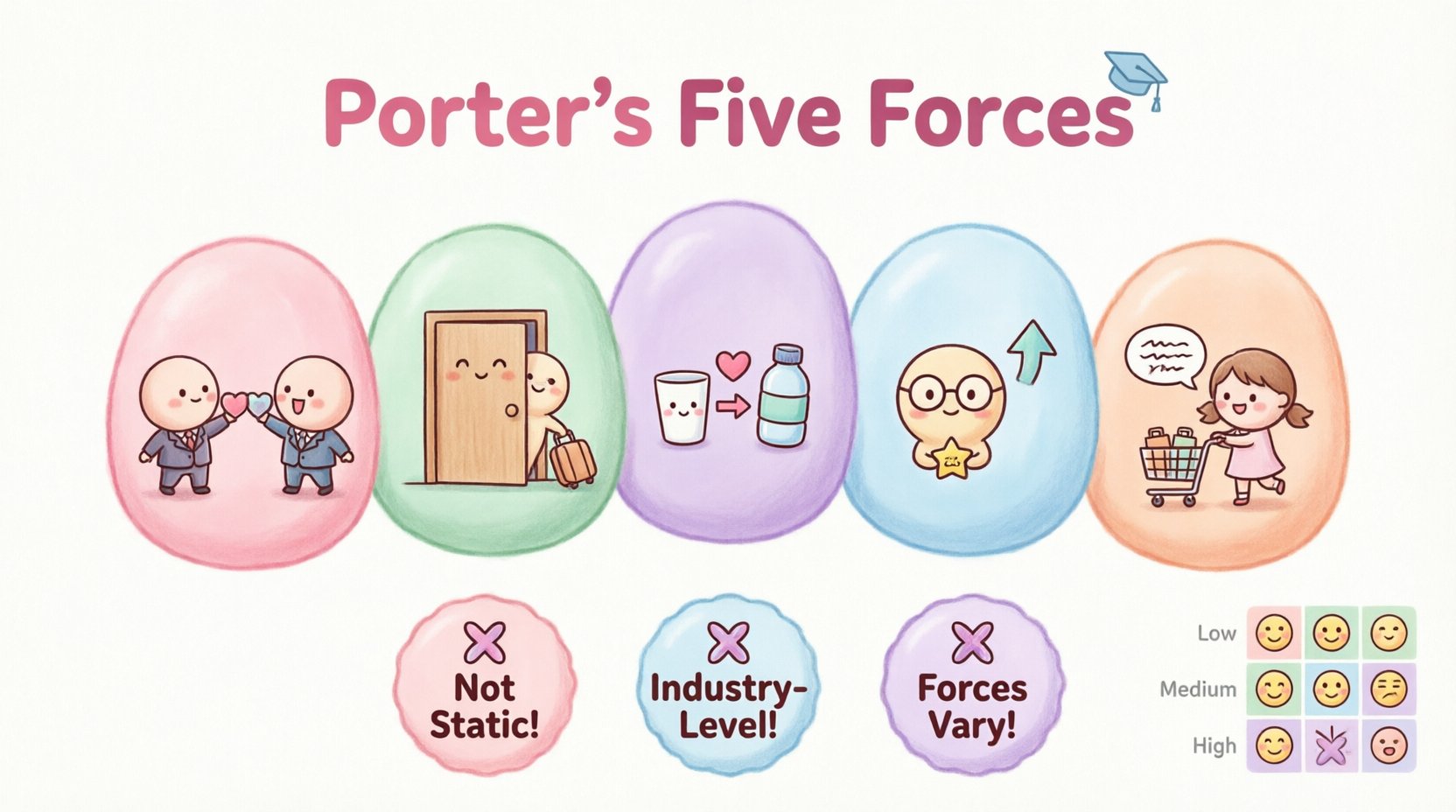
Developed by Michael Porter in 1979, this analytical tool was designed to categorize the external factors that influence an industry’s profitability. Before this model, strategic thinking often focused heavily on internal capabilities without sufficient regard for the market environment. Porter shifted the focus outward, arguing that the structure of the industry itself is the primary determinant of competitive intensity and profitability.
The core premise is simple: the five forces determine the profit potential of an industry. If the forces are strong, profits are squeezed. If the forces are weak, companies can earn higher returns. It is not a tool for predicting specific market movements but rather for assessing the structural attractiveness of a sector.
- Year of Publication: 1979 in the Harvard Business Review.
- Primary Focus: Industry-level analysis, not company-specific operations.
- Goal: To identify where power lies in a business situation.
- Outcome: A strategic assessment of long-term attractiveness.
⚖️ The Five Forces Explained
To apply this framework correctly, one must understand the specific nature of each force. It is common to confuse “substitutes” with “competitors,” or to underestimate the power of suppliers. Below is a detailed breakdown of each component.
1. Rivalry Among Existing Competitors
This force represents the intensity of competition among current players in the market. High rivalry leads to price wars, aggressive advertising, and increased innovation costs, all of which can erode profit margins.
Factors that increase rivalry include:
- Number of Competitors: Many equally balanced firms lead to instability.
- Industry Growth: Slow growth forces companies to fight for market share.
- Fixed Costs: High fixed costs encourage price cutting to cover overhead.
- Differentiation: Low differentiation makes products commodities, driving price competition.
- Exit Barriers: High costs to leave the industry trap competitors in a declining market.
Example: The airline industry often exhibits high rivalry. Fuel costs are high, planes are expensive (fixed costs), and tickets are largely undifferentiated. This results in thin margins and constant price competition.
2. Threat of New Entrants
New competitors bring new capacity and a desire to gain market share. They often start by undercutting prices, which puts pressure on existing players. The threat depends on the barriers to entry.
Key barriers include:
- Capital Requirements: High investment needs deter entry.
- Regulation: Government policies can block or allow entry.
- Brand Loyalty: Strong existing brands make it hard for newcomers.
- Switching Costs: If customers find it hard to change, new entrants struggle.
- Access to Distribution: Difficulty securing shelf space or channels.
Example: The commercial aircraft manufacturing sector has very low threat of new entrants due to the massive capital required and the long certification processes involved.
3. Threat of Substitute Products
Substitutes are not just direct competitors; they are different products that solve the same underlying problem. This force limits the price customers are willing to pay.
Considerations for substitution:
- Price-Performance Trade-off: If a substitute offers better value, customers will switch.
- Switching Costs: Low costs to switch increase the threat.
- Buyer Propensity: How likely are customers to consider alternatives?
Example: For the coffee industry, energy drinks or tea are substitutes. For the film photography industry, digital cameras and smartphones were the ultimate substitutes that disrupted the entire business model.
4. Bargaining Power of Suppliers
Suppliers can raise prices or reduce the quality of goods and services. This power is highest when suppliers are concentrated or when there are few substitutes for their inputs.
High supplier power indicators:
- Few Suppliers: Concentration in the supply chain.
- Uniqueness of Product: No alternative source for the input.
- Threat of Forward Integration: Suppliers might decide to make the product themselves.
- Importance to Buyer: If the input is critical to the buyer’s business.
Example: In the smartphone industry, suppliers of specific advanced chips or display technology often hold significant power because their technology is unique and essential.
5. Bargaining Power of Buyers
Buyers can demand lower prices or higher quality. High buyer power squeezes industry margins.
High buyer power indicators:
- Concentration: Few buyers purchasing large volumes.
- Price Sensitivity: Buyers are very focused on cost.
- Low Switching Costs: Buyers can easily move to a competitor.
- Threat of Backward Integration: Buyers might decide to make the product themselves.
Example: Large retailers like Walmart have immense power over their suppliers because they purchase such vast quantities that they can dictate terms.
🧨 Myth-Busting Common Misconceptions
Students often stumble because they apply the framework incorrectly. The following section addresses the most persistent myths that lead to flawed analysis.
Myth 1: It Is a Static Snapshot
The Myth: The Five Forces analysis provides a permanent view of an industry.
The Reality: Industries are dynamic. Technology, regulation, and consumer behavior change constantly. A force that is weak today might be strong tomorrow. For instance, the threat of new entrants in the taxi industry was low for decades until ride-sharing apps changed the barrier to entry.
- Always consider the timeline of your analysis.
- Look for trends that might shift the balance of power.
- Update the assessment regularly.
Myth 2: It Applies to Single Companies Only
The Myth: You can use this tool to analyze a specific company’s internal strategy.
The Reality: This is an industry-level tool. It helps you understand the environment the company operates in. It does not account for internal strengths like brand equity or management quality. To get a full picture, you must pair this with an internal analysis.
Myth 3: High Force Equals Low Profit
The Myth: If rivalry is high, no company can make money.
The Reality: High rivalry drives efficiency. Companies that manage costs better or differentiate more effectively can still thrive in competitive environments. The framework tells you the *potential* for industry profit, not the specific profit of a firm.
Myth 4: All Forces Carry Equal Weight
The Myth: You must analyze all five forces with the same level of detail.
The Reality: In many industries, one or two forces dominate. In the software industry, the threat of substitutes and rivalry are often more critical than supplier power. Prioritize the forces that actually impact your specific context.
🛠️ How to Conduct a Five Forces Assessment
Applying this framework requires a systematic approach. Follow these steps to ensure a robust analysis.
- Define the Industry Scope: Be specific. Are you looking at the “Beverage Industry” or “Premium Sparkling Water Market”? The scope determines the forces you will see.
- Gather Data: Collect information on market size, competitor numbers, supplier concentration, and customer demographics.
- Assess Each Force: Rate each force as Low, Medium, or High based on the factors discussed above.
- Identify Key Drivers: Determine which specific variables are driving the intensity of each force.
- Synthesize Findings: Combine the ratings to form a conclusion about industry attractiveness.
When assessing, do not rely on assumptions. Use available data, public reports, and industry knowledge. If you are unsure about a factor, note it as a risk rather than a certainty.
🚫 Limitations and Contextual Boundaries
Every tool has boundaries. Acknowledging them prevents overconfidence in the analysis. The Porter model has specific blind spots that students must recognize.
- Focuses on Competition, Not Cooperation: The model assumes competition is zero-sum. In reality, companies often collaborate on standards or research.
- Ignores Complements: Products that add value to your product (like apps for a phone) are not explicitly covered, though they influence value.
- Lacks Macro Context: It does not account for political or environmental trends. For that, you need PESTEL analysis.
- Static Nature: As mentioned, it struggles to capture rapid technological disruption.
- Internal Blind Spot: It ignores what the company is actually capable of doing.
Recognizing these limitations allows you to use the framework as part of a broader toolkit rather than the sole source of truth.
🔗 Integrating with Other Strategic Tools
To create a comprehensive strategic picture, combine the Five Forces with other established models. This triangulation provides a more complete view of the business environment.
SWOT Analysis
Use the Five Forces to inform the “Opportunities” and “Threats” sections of a SWOT analysis. The internal “Strengths” and “Weaknesses” come from a separate internal review.
PESTEL Analysis
Use PESTEL to understand the macro-environmental factors (Political, Economic, Social, Technological, Environmental, Legal) that might shift the Five Forces over time.
Value Chain Analysis
While Five Forces looks outward, the Value Chain looks inward. Combining them helps you see where you can add value to defend against the external forces.
📊 Industry Attractiveness Matrix
Understanding the intensity of these forces helps categorize the overall attractiveness of a market. The table below summarizes how force intensity correlates with profitability.
| Force Intensity | Impact on Profitability | Strategic Implication |
|---|---|---|
| Low | High | Attractive. Focus on growth and market share capture. |
| Medium | Moderate | Manageable. Focus on differentiation and efficiency. |
| High | Low | Unattractive. Focus on cost leadership or exit strategy. |
When all five forces are high, the industry is considered structurally unattractive. This does not mean no profit is possible, but it means profits will be volatile and lower than the average.
💡 Final Thoughts on Strategic Thinking
Porter’s Five Forces Analysis remains a cornerstone of strategic study because it forces you to look beyond the company’s walls. However, its value depends entirely on the quality of the analysis behind it. Avoid treating it as a mechanical exercise. Engage with the data. Question the assumptions. Recognize that industries evolve.
For students, the goal is not to memorize the five names but to understand the economic logic behind them. Why does supplier power increase when there are fewer alternatives? Why does rivalry intensify when growth slows? Answering these “why” questions is where true strategic insight begins.
Use this framework to build a narrative about the industry. Let the data drive the story. By understanding the myths and the mechanics, you can navigate complex business environments with clarity and precision.
Related posts:
 Porter Five Forces Analysis: Common Mistakes New Strategy Students Make (And How to Avoid Them)
 Porter Five Forces Analysis: What Students Often Misunderstand (And How to Fix It)
 Porter Five Forces Analysis: A Best Practices Guide for Business School Assignments
 Porter Five Forces Analysis: Why the Framework Matters Even in Disruptive Markets