


Business landscapes shift rapidly. What defined an industry yesterday might be obsolete tomorrow. Strategic planning requires more than a static snapshot; it demands a dynamic view of competitive pressures. Porter Five Forces Analysis provides a robust framework for understanding the intensity of competition and the underlying profitability of a market. However, the real value lies not just in assessing the current state, but in identifying weak signals that indicate emerging threats.
This guide details how to utilize this model to detect risks early. By focusing on the nuances of each force, organizations can pivot before external factors erode their market position. We will explore the mechanics of the framework, specific indicators for each force, and methodologies for continuous monitoring without relying on proprietary tools.
Understanding the Core Framework 🔍
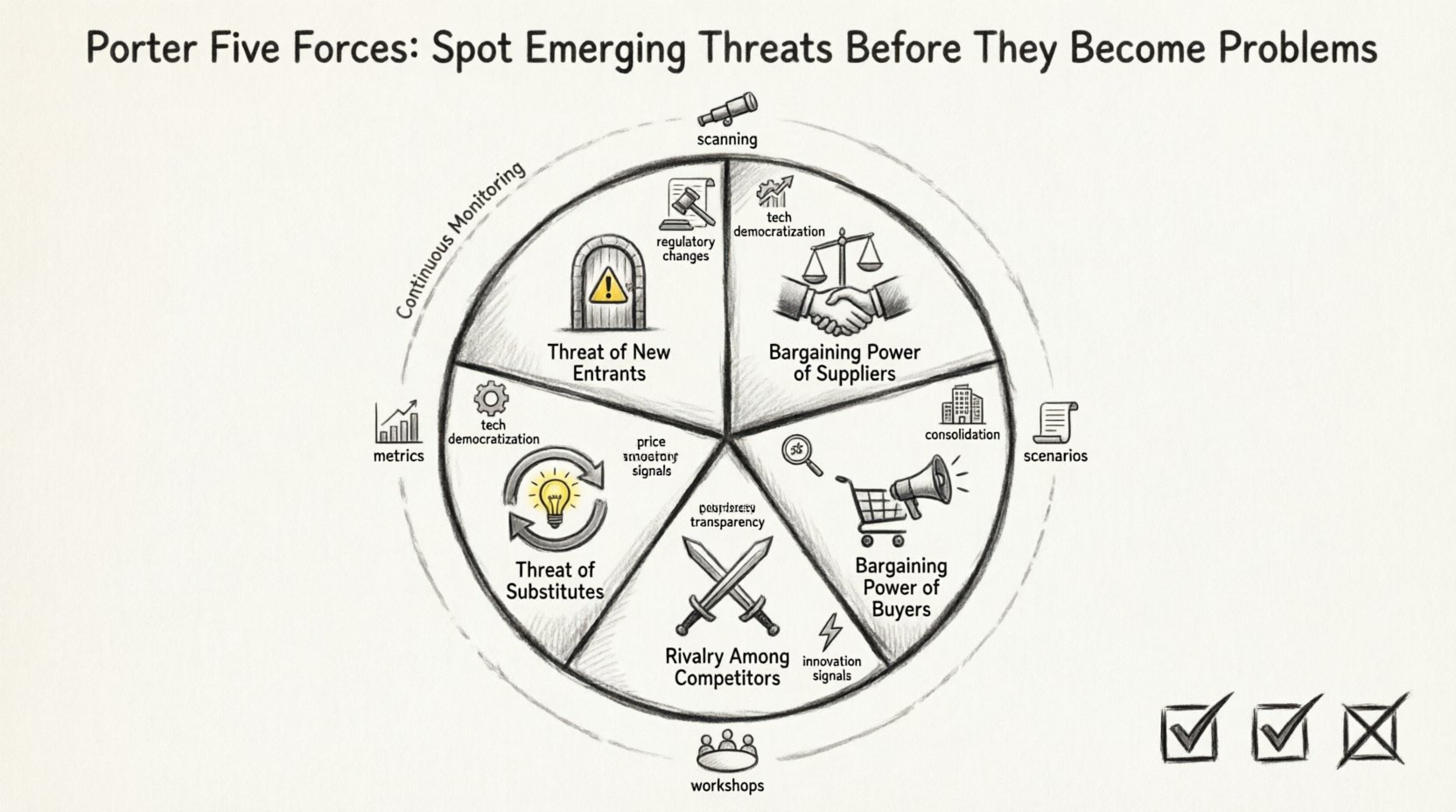
Developed by Michael Porter, this model evaluates five specific forces that shape every market and determine the profit potential of an industry. These forces dictate the competitive intensity and attractiveness of a market. A thorough analysis reveals where power lies. It helps identify where profits are likely to be squeezed.
When applied correctly, this analysis moves beyond simple competitor tracking. It examines structural factors that influence pricing power and cost structures. The goal is to understand the rules of the game before the game changes.
- Threat of New Entrants: How easy is it for new competitors to enter the market?
- Bargaining Power of Suppliers: How much control do suppliers have over prices?
- Bargaining Power of Buyers: How much control do customers have over prices?
- Threat of Substitute Products: How likely are customers to switch to alternatives?
- Rivalry Among Existing Competitors: How intense is the current competition?
Most organizations assess these forces once or twice a year. To spot emerging threats, this assessment must become a continuous process. You must look for changes in the structural drivers of each force.
Force 1: Threat of New Entrants 👥
New competitors can disrupt market equilibrium instantly. They bring fresh capital, innovative technologies, or different business models. The barrier to entry determines how protected an industry is.
Key Indicators of Emerging Entrants
- Regulatory Changes: Look for shifts in government policy that lower compliance costs. Deregulation often invites new players.
- Technology Democratization: Tools that were once expensive are now accessible. Cloud infrastructure, for example, lowered the cost of starting a software company.
- Supply Chain Access: If suppliers begin selling directly to consumers, the channel barrier collapses.
- Brand Loyalty Erosion: If customer retention rates drop, the barrier to acquiring users weakens.
Monitoring these indicators requires looking outside your direct industry. A company from a different sector might apply its technology to your space. This is often called cross-industry disruption.
Strategic Implications
If entry barriers are lowering, you must increase your own barriers. This could mean investing in proprietary technology, securing exclusive partnerships, or building a stronger brand identity. It is not about stopping competition, but about making the cost of entry prohibitive for those who lack scale or unique assets.
Force 2: Bargaining Power of Suppliers ⚖️
Suppliers control the input costs. When they have power, they can raise prices or reduce quality, squeezing your margins. High supplier power usually exists when there are few providers, high switching costs, or unique materials.
Identifying Supplier Shifts
- Consolidation: Watch for mergers and acquisitions among suppliers. Fewer suppliers mean less competition and more leverage.
- Vertical Integration: If a supplier decides to enter your market, they become both a partner and a competitor.
- Input Scarcity: Monitor raw material availability. Shortages can give suppliers immediate pricing power.
- Alternative Sources: If you rely on a single source, your risk is high. Diversification reduces supplier leverage.
Emerging threats often come from suppliers who control a critical intellectual property or a scarce resource. In the semiconductor industry, for instance, access to advanced manufacturing nodes became the primary source of supplier power.
Management Strategies
Reduce dependency. Develop relationships with multiple vendors. Invest in backward integration if feasible. Negotiate long-term contracts that lock in pricing. The objective is to balance the relationship so that cooperation remains profitable for both parties.
Force 3: Bargaining Power of Buyers 🛒
Buyers demand lower prices and higher quality. Their power increases when they are concentrated, purchase in large volumes, or face low switching costs. When buyers hold power, they can force prices down to the cost of production.
Signals of Rising Buyer Power
- Price Transparency: Information technology makes price comparison instant. Customers can find the best deal in seconds.
- Standardization: If products become commodities, buyers choose based on price alone.
- Backward Integration: Large customers may decide to manufacture the product themselves.
- Reduced Differentiation: If your product looks like everyone else’s, buyers have no reason to stay loyal.
Digital platforms have significantly amplified buyer power. Aggregators allow customers to compare thousands of options simultaneously. This shifts the balance of power away from the seller.
Countermeasures
Build switching costs. This can be achieved through integrated systems, training, or data storage. Create unique value that cannot be easily replicated. Focus on customer service and support to deepen the relationship. Loyalty programs can also help retain high-value clients.
Force 4: Threat of Substitute Products 🔄
Substitutes are not direct competitors but offer a different solution to the same problem. They limit the price you can charge. If a substitute is cheaper or better, customers will switch.
Detecting Substitute Risks
- Technological Innovation: New technologies often create substitutes. Digital cameras replaced film. Streaming replaced DVDs.
- Changing Consumer Habits: Shifts in lifestyle can render products obsolete. Health consciousness reduced demand for sugary drinks.
- Price-Performance Ratio: If a substitute offers better performance for the same price, it is a major threat.
- Regulatory Shifts: Laws can make traditional products less attractive compared to green alternatives.
Substitutes are often invisible until they are too late. Companies often focus on direct competitors and miss the threat from a completely different industry.
Response Tactics
Innovate continuously. Do not rely on the current product lifecycle. Monitor adjacent industries for breakthrough technologies. Differentiate your offering so deeply that the substitute does not solve the core need as effectively.
Force 5: Rivalry Among Existing Competitors 🥊
Competitive rivalry drives down prices and increases spending on marketing. Intense rivalry occurs when there are many competitors, slow industry growth, or high fixed costs.
Warning Signs of Intensifying Rivalry
- Capacity Expansion: If competitors are building new factories or facilities, supply may outstrip demand.
- Price Wars: Frequent discounting indicates a fight for market share.
- Increased Marketing Spend: Higher ad budgets suggest a struggle for attention.
- Product Proliferation: Too many similar products indicate a lack of differentiation.
Growth is the best antidote to rivalry. In a growing market, everyone can gain share without stealing from others. In a stagnant market, every win is a loss for someone else.
Navigating Competitive Intensity
Focus on differentiation. Avoid competing solely on price. Find niche segments where you can dominate. Collaborate on industry standards where possible to reduce friction. Strategic alliances can help manage shared risks.
Comparative Analysis of Threat Indicators 📊
To effectively monitor these forces, you need a structured approach. The table below summarizes the primary drivers and specific warning signs for each force.
| Force | Primary Driver | Emerging Threat Indicator | Strategic Action |
|---|---|---|---|
| New Entrants | Barriers to Entry | Lowered regulatory hurdles or tech costs | Build scale and proprietary assets |
| Suppliers | Input Control | Supplier consolidation or vertical integration | Diversify sourcing and negotiate contracts |
| Buyers | Price Sensitivity | Increased price transparency and switching tools | Enhance switching costs and loyalty |
| Substitutes | Alternative Solutions | Innovation in adjacent sectors or habits | Innovate and monitor non-direct competitors |
| Rivalry | Market Competition | Capacity expansion and price wars | Focus on differentiation and niche markets |
Methodology for Continuous Monitoring 📈
One-time analysis is insufficient. The environment changes. You need a system to track these forces over time.
1. Establish Key Metrics
Define what success looks like for each force. Track supplier concentration ratios, customer churn rates, and competitor pricing trends. Quantitative data provides an objective view of shifts.
2. Scan External Data Sources
- Industry Reports: Regularly review trade publications and analyst reports.
- Patent Filings: Monitor intellectual property to spot technological shifts.
- Job Postings: Hiring trends can reveal strategic pivots by competitors.
- Social Listening: Customer sentiment on social media can reveal dissatisfaction or demand for alternatives.
3. Scenario Planning
Develop multiple future scenarios. Ask “What if” questions. What if a new technology disrupts our supply chain? What if a new regulation changes our cost structure? Prepare contingency plans for these scenarios.
4. Cross-Functional Workshops
Bring together teams from sales, product, and strategy. Different perspectives reveal different threats. Sales teams hear customer complaints first. Product teams see technological gaps. Strategy teams see macro trends.
Common Pitfalls in Analysis 🚫
Even with a strong framework, mistakes happen. Avoid these common errors to ensure accuracy.
- Static Thinking: Assuming the industry structure will remain constant. It rarely does.
- Internal Bias: Focusing only on internal capabilities rather than external realities.
- Ignoring Complements: Products that increase the value of your own are just as important as substitutes.
- Over-reliance on History: Past performance does not guarantee future results in a volatile market.
- Complexity Paralysis: Over-complicating the model. Keep it simple and actionable.
Implementation Checklist ✅
Use this checklist to ensure your analysis is comprehensive.
- [ ] Define the scope of the industry and market boundaries.
- [ ] Gather data on current competitive landscape.
- [ ] Assess the power of each of the five forces.
- [ ] Identify weak signals for each force.
- [ ] Evaluate the impact of potential threats on profitability.
- [ ] Develop strategic responses for high-risk areas.
- [ ] Schedule regular review cycles (quarterly or semi-annually).
- [ ] Communicate findings to key stakeholders.
Frequently Asked Questions ❓
How often should I perform a Five Forces Analysis?
Conduct a full analysis annually. However, monitor key indicators quarterly. Rapidly changing industries may require monthly checks on specific forces like technology or rivalry.
Can this analysis be used for startups?
Yes. Startups face high entry barriers and intense competition. Understanding supplier and buyer power is crucial for survival and fundraising.
What if the forces are weak?
If all forces are weak, the industry is highly profitable. This attracts new entrants. Your strategy should focus on defending your position and building barriers to prevent erosion of that profit.
Does this model apply to digital businesses?
Absolutely. Digital markets have unique dynamics regarding network effects and switching costs. The framework adapts by focusing on data access and platform dynamics.
How do I measure the intensity of a force?
Use a scale from Low to High. Base this on factors like concentration ratios, switching costs, and differentiation levels. Document the reasoning for each rating to ensure consistency.
Final Thoughts on Strategic Vigilance 🧭
Strategic foresight is not about predicting the future with certainty. It is about preparing for multiple possibilities. By applying the Porter Five Forces Analysis with a focus on emerging threats, you gain a significant advantage.
Stay alert to structural changes. Monitor the drivers of each force. Act before the market shifts against you. This proactive approach ensures long-term sustainability and resilience in a competitive environment.
Regular review of these dynamics keeps your strategy aligned with reality. It transforms planning from a theoretical exercise into a practical tool for survival and growth. Stay engaged with the market. Adapt quickly. Lead the industry.
Related posts:
 What Is Porter Five Forces Analysis? A Simple Breakdown for Strategy Students
 Porter Five Forces Analysis: A Myth-Buster Guide for Students Confused by the Framework
 Porter Five Forces Analysis: Understanding Competitive Rivalry in Real Business Contexts
 Porter Five Forces Analysis: How to Avoid Overgeneralization in Your Industry Assessments