


Understanding the competitive landscape is a fundamental skill for any business student or strategist. One of the most enduring tools for this purpose is the Porter Five Forces Analysis. This framework helps organizations assess the attractiveness of an industry and the potential for profitability. By examining the competitive dynamics, students can learn how external pressures shape strategic decisions. The analysis provides a structured way to look beyond internal capabilities and understand the broader market environment.
This guide will walk you through the origins, components, and practical applications of the framework. We will explore each force in detail, discussing what drives them and how they interact. Whether you are analyzing a startup or an established corporation, this model offers a clear lens for viewing competition. Let us dive into the mechanics of industry analysis.
The Origin of the Framework 📜
Michael Porter, a professor at Harvard Business School, introduced this model in 1979. He published an article titled How Competitive Forces Shape Strategy in the Harvard Business Review. The goal was to move away from simplistic views of competition. Instead of just looking at direct rivals, Porter argued that five specific forces determine the intensity of competition and the overall profitability of an industry.
Before this model, many analysts focused heavily on internal company metrics. Porter shifted the focus to the external environment. He posited that the structure of the industry itself dictates the rules of the game. A company can be well-managed, but if the industry structure is unfavorable, profits will remain low. This insight remains a cornerstone of strategic management education today.
Understanding the Five Forces 🔍
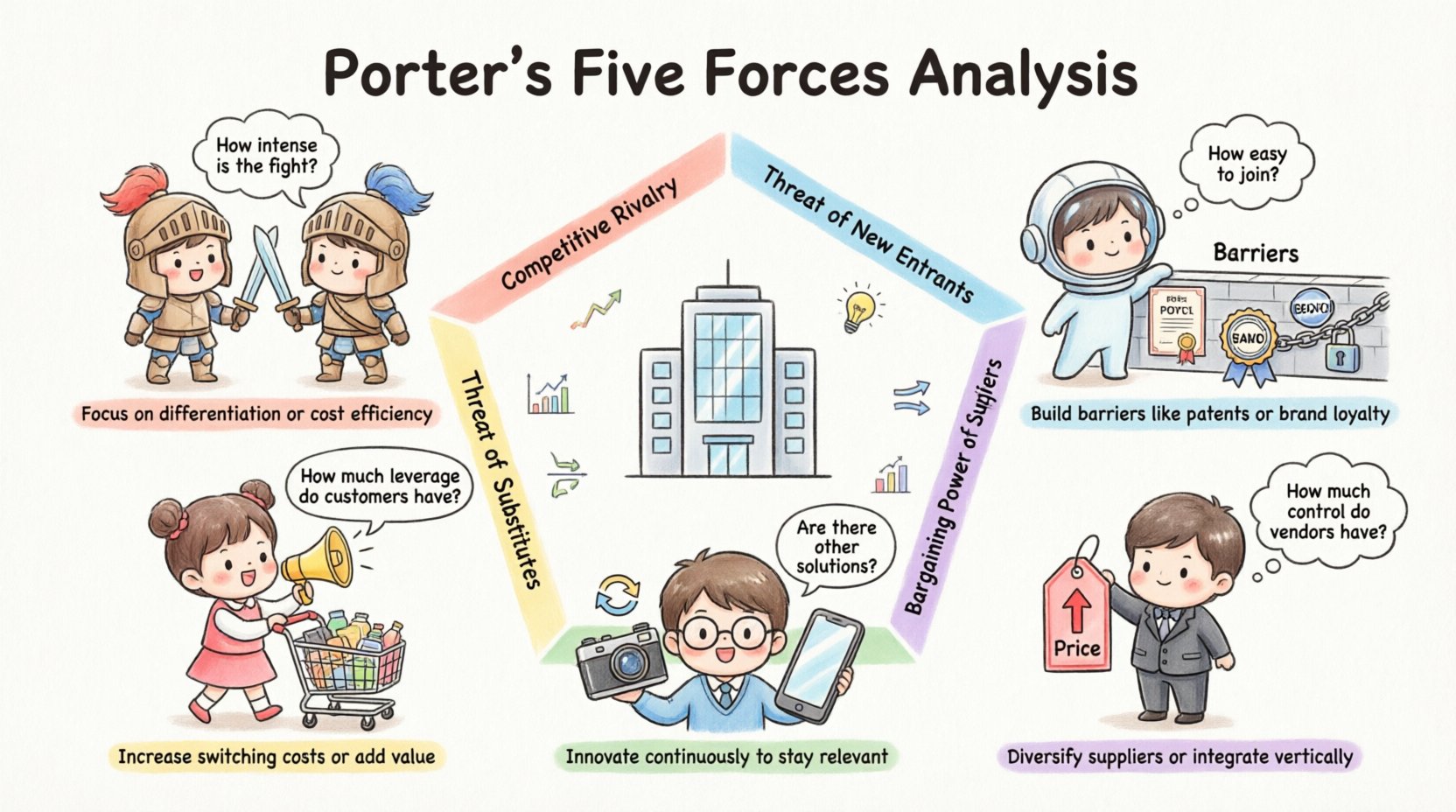
The core of the model consists of five distinct forces. Each force represents a different source of pressure on a company. To conduct a proper analysis, you must evaluate the strength of each force within your target industry. The stronger the force, the less profitable the industry tends to be. Here is a breakdown of each component.
1. Competitive Rivalry 🥊
This force looks at the intensity of competition among existing firms. High rivalry often leads to price wars, aggressive advertising, and increased innovation costs. When companies fight for market share, margins often shrink. Understanding the drivers of rivalry is crucial for predicting industry behavior.
- Number of Competitors: A market with many small players often has lower rivalry than one with a few giants. However, if giants are fighting, the pressure is immense.
- Industry Growth Rate: Slow growth forces companies to steal market share from each other. Fast growth allows everyone to expand without conflict.
- Product Differentiation: If products are identical, price becomes the main factor. High differentiation reduces price sensitivity.
- Exit Barriers: If it is hard to leave the industry, companies stay and compete fiercely even when unprofitable.
When rivalry is high, companies must focus on cost leadership or differentiation to survive. They cannot simply rely on market trends to boost profits. Strategic choices become more critical.
2. Threat of New Entrants 🚀
This force assesses how easy it is for new companies to enter the market. If entry is easy, new competitors can quickly erode profits. High barriers to entry protect existing firms. These barriers act as a shield against outside competition.
Several factors influence this threat:
- Capital Requirements: Industries needing huge upfront investment (like manufacturing or telecom) have lower entry threats.
- Regulatory Hurdles: Licenses, patents, and government policies can block new players.
- Switching Costs: If customers face high costs to switch providers, new entrants struggle to attract them.
- Access to Distribution: If existing firms control key distribution channels, new players find it hard to reach customers.
For strategy students, analyzing entry barriers helps identify which industries offer sustainable advantages. A business with high barriers is generally safer from disruption.
3. Bargaining Power of Suppliers 💼
Suppliers can drive up prices or reduce the quality of goods and services. When supplier power is high, it squeezes the industry from the bottom. Companies must manage these relationships carefully to protect margins.
Key indicators of supplier power include:
- Supplier Concentration: If there are few suppliers for a critical input, they hold significant leverage.
- Uniqueness of Product: If a supplier offers a unique component, buyers have no alternatives.
- Switching Costs: Changing suppliers might require retooling or retraining staff, making buyers dependent.
- Threat of Forward Integration: If suppliers can make the product themselves, they become competitors.
Industries with fragmented supplier bases often have lower bargaining power dynamics. Conversely, industries relying on specialized raw materials face higher risks.
4. Bargaining Power of Buyers 🛒
Buyers exert pressure by demanding lower prices or higher quality. When buyer power is high, companies cannot easily pass on costs. This force is the opposite of supplier power. It focuses on the customer side of the equation.
Buyer power increases when:
- Volume of Purchase: Large buyers can demand discounts due to their size.
- Number of Buyers: Fewer buyers mean more power for each individual customer.
- Standardized Products: If the product is a commodity, buyers can easily switch.
- Price Sensitivity: If the product is a significant cost to the buyer, they will shop around aggressively.
Understanding buyer power helps firms decide where to focus their marketing and sales efforts. It also informs pricing strategies in B2B versus B2C contexts.
5. Threat of Substitute Products 🔄
Substitutes are products from outside the industry that solve the same problem. For example, a substitute for tea is coffee. If a substitute is cheaper or better, customers will switch. This force limits the price ceiling an industry can charge.
Factors influencing substitutes include:
- Price-Performance Ratio: If substitutes offer better value, the threat is high.
- Switching Costs: Low switching costs make it easier for customers to try alternatives.
- Buyer Propensity to Substitute: Some customers are naturally open to trying new solutions.
- Innovation: Technological advancements often create new categories that render old ones obsolete.
Companies must monitor the broader market for emerging technologies. Often, the biggest threat does not come from direct competitors but from entirely new ways of solving a problem.
Visualizing the Forces 📊
To make the analysis clearer, here is a summary table comparing the five forces and their primary strategic implications.
| Force | Key Question | Strategic Implication |
|---|---|---|
| Competitive Rivalry | How intense is the fight among current players? | Focus on differentiation or cost efficiency. |
| New Entrants | How easy is it for others to join? | Build barriers like patents or brand loyalty. |
| Supplier Power | How much control do vendors have? | Diversify suppliers or integrate vertically. |
| Buyer Power | How much leverage do customers have? | Increase switching costs or add value. |
| Substitutes | Are there other ways to solve the need? | Innovate continuously to stay relevant. |
How to Conduct the Analysis 📝
Applying this framework requires a systematic approach. You cannot simply guess the strength of each force. Data collection and logical deduction are necessary. Follow these steps to perform a robust analysis.
- Define the Industry: Be specific about the market boundaries. Are you looking at the entire tech sector or just mobile apps? Scope matters.
- Gather Data: Collect information on market size, growth rates, and competitor activities. Use public reports and industry publications.
- Evaluate Each Force: Score each force as High, Medium, or Low based on the factors discussed earlier.
- Analyze Interactions: Forces do not exist in isolation. For example, high buyer power might force companies to innovate faster, increasing rivalry.
- Develop Strategy: Use the findings to identify opportunities for advantage. Where can you position yourself to mitigate the strongest threats?
This process turns abstract concepts into actionable intelligence. It moves the conversation from opinion to evidence-based strategy.
Strategic Implications 💡
Once the analysis is complete, the results inform specific strategic choices. Companies generally aim to position themselves where the forces are weakest. Alternatively, they may try to influence the forces themselves.
Influencing the Forces:
- A firm might lobby for regulations that raise barriers to entry.
- A company could form alliances to reduce supplier power.
- Marketing efforts can be used to lower buyer price sensitivity.
Positioning:
- Choose an industry where the overall structure supports profitability.
- Focus on a niche where the forces are less intense.
- Build a business model that is resilient to industry shifts.
Strategic planning is not just about reacting to these forces. It is about navigating them. A well-placed strategy can turn a difficult industry into a profitable one.
Limitations to Consider ⚠️
While powerful, this model is not perfect. It is important to understand its boundaries. Blindly applying the framework without context can lead to flawed conclusions.
- Static Nature: The model is often viewed as a snapshot. Industries change rapidly, and the forces shift over time.
- Complementary Products: The original model did not fully account for complementors. Products that enhance each other (like software and hardware) are vital in modern ecosystems.
- Internal Factors: It focuses on the external environment. Internal culture and capabilities are equally important for success.
- Dynamic Markets: In digital economies, boundaries between industries are blurred. A tech company might compete with a media company.
Students should use this tool alongside other frameworks like PESTEL or SWOT. Combining external and internal analyses provides a complete picture.
Frequently Asked Questions ❓
Here are common questions regarding the application of this model.
Is this framework still relevant today?
Yes, the core logic remains valid. However, it requires adaptation for the digital age. Platform ecosystems and network effects add new layers to the analysis.
How often should I update the analysis?
It depends on the industry velocity. In stable industries, a review every few years is sufficient. In tech sectors, annual or even quarterly reviews may be necessary.
Can a company change the forces?
Absolutely. Large firms often shape their industry through innovation, mergers, and lobbying. They do not just accept the forces; they influence them.
What is the difference between rivalry and substitutes?
Rivalry involves direct competitors selling similar products. Substitutes involve different products solving the same need. Both limit pricing power, but they come from different directions.
Final Thoughts on Industry Analysis 🎓
Mastery of competitive analysis is a journey, not a destination. The Porter Five Forces Analysis provides a solid foundation for understanding market dynamics. It forces students and professionals to look beyond their own organization and see the wider ecosystem.
By systematically evaluating rivalry, entry threats, supplier and buyer power, and substitutes, you gain clarity on where value is created and captured. This clarity leads to better decision-making. Whether you are launching a venture or managing an existing portfolio, this tool is essential.
Remember that context is key. The forces vary by industry and geography. Always tailor your analysis to the specific situation. With practice, you will develop an intuition for how these pressures interact. This skill is invaluable in the world of business strategy.
Related posts:
 Porter Five Forces Analysis: A Beginner’s Quick Start Guide to Understanding Industry Competition
 Porter Five Forces Analysis: Why It’s Still Relevant in Today’s Fast-Changing Markets
 Porter Five Forces Analysis: A Deep Dive into Supplier Power and Its Strategic Implications
 Porter Five Forces Analysis: Troubleshooting When Your Analysis Feels Off Target