


Understanding Porter Five Forces Analysis is a cornerstone of modern business strategy education. Many students encounter this model during their academic journey and find it abstract or difficult to apply to real-world scenarios. This guide addresses the most common questions regarding the Five Forces Framework, breaking down complex concepts into actionable insights.
Developed by Michael Porter in 1979, this tool helps organizations analyze the competitive intensity and attractiveness of a market. It moves beyond simple competitor tracking to examine the structural drivers of profitability. By answering specific questions, this article aims to clarify how to use the model effectively without relying on jargon or hype.
❓ What Exactly Is the Porter Five Forces Model?
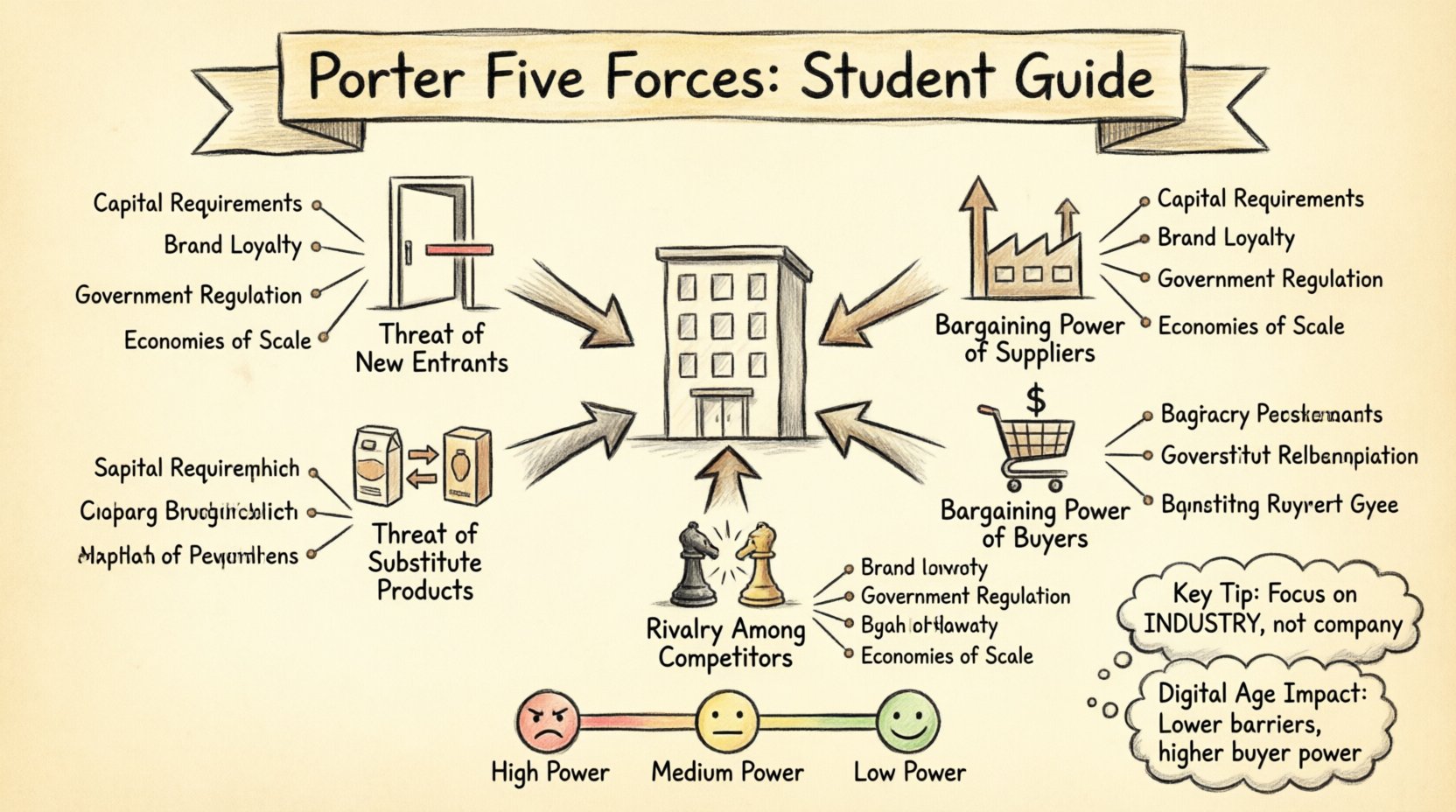
The Porter Five Forces framework is a method for analyzing the competitive environment of a business. It suggests that five key forces determine the competitive intensity and attractiveness of a market. These forces collectively determine the profit potential of an industry.
Students often confuse this with SWOT analysis. While SWOT looks at internal strengths and weaknesses, the Five Forces focus strictly on the external environment. It provides a structured way to assess where power lies in a business situation.
The Core Components
- Threat of New Entrants: How easy is it for new competitors to enter your market?
- Bargaining Power of Suppliers: How much control do suppliers have over prices?
- Bargaining Power of Buyers: How much control do customers have over prices?
- Threat of Substitute Products: Are there alternative products that can replace yours?
- Rivalry Among Existing Competitors: How intense is the competition between current players?
❓ Why Do Students Struggle with This Framework?
The difficulty often stems from trying to apply the model too rigidly. It is not a checklist to be completed mechanically. Instead, it is a lens through which to view market dynamics. Here are the common pain points:
- Confusing Industry with Company: Students often analyze a specific company’s strategy rather than the industry structure. The model focuses on the industry.
- Static View: Markets change. A force that is weak today might be strong tomorrow. Students fail to account for dynamic shifts.
- Lack of Data: Without real-world data, it is hard to judge power levels. Qualitative assessment is required when quantitative data is missing.
- Overcomplication: Trying to measure every single factor leads to paralysis. Focus on the most significant drivers.
❓ How Do I Analyze the Threat of New Entrants?
This force asks: How easy is it for a new competitor to start doing business in this industry? If barriers to entry are low, profits tend to be lower because new players can quickly enter and drive prices down.
Key Indicators to Look For
- Capital Requirements: Does the industry require massive investment to start? High capital needs discourage entry.
- Regulatory Barriers: Are there licenses, patents, or government restrictions?
- Switching Costs: If a customer switches to a new entrant, is there a penalty or high cost?
- Access to Distribution Channels: Can a new player get their product to shelf space or online visibility easily?
- Brand Identity: Is there strong brand loyalty that makes it hard for a newcomer to gain traction?
Example: In the airline industry, the threat of new entrants is low due to high capital requirements for aircraft and strict safety regulations. In contrast, the threat in the food truck industry is high due to low startup costs.
❓ What Determines the Bargaining Power of Suppliers?
This force examines the leverage suppliers have over the industry. If suppliers have high power, they can raise prices or reduce quality, squeezing industry profits.
Signs of High Supplier Power
- Supplier Concentration: If there are few suppliers and many buyers, suppliers hold the power.
- Unique Products: If the supplier offers a unique component that cannot be easily replaced.
- Switching Costs: If switching suppliers requires expensive retooling or retraining.
- Threat of Forward Integration: Can the supplier become a competitor themselves? This creates leverage.
- Importance of Volume: If the industry is not a significant customer for the supplier, the supplier has more power.
❓ How Can I Assess the Bargaining Power of Buyers?
This force looks at the leverage customers have. Powerful buyers can demand lower prices or higher quality services, reducing profitability for the industry.
Factors Influencing Buyer Power
- Number of Buyers: Few buyers purchasing large volumes increase their power.
- Standardized Products: If products are undifferentiated, buyers can easily switch to a competitor.
- Price Sensitivity: If the product is a major cost for the buyer, they will shop around aggressively.
- Threat of Backward Integration: Can the buyer make the product themselves?
- Information Availability: If buyers know the market price perfectly, they can negotiate better deals.
❓ What Distinguishes Substitutes from Competitors?
This is a frequent point of confusion. Competitors offer the same product in a different brand (e.g., Coke vs. Pepsi). Substitutes offer a different solution to the same problem (e.g., Coke vs. Water).
Identifying Substitute Products
- Performance-Price Ratio: Does the substitute offer better value?
- Switching Cost for the Customer: Is it easy for the customer to switch to the substitute?
- Trend Adoption: Is there a growing trend toward the substitute technology?
For example, in the telecommunications industry, traditional landlines faced a high threat of substitution from mobile phones and VoIP services. This fundamentally changed the industry structure.
❓ How Intense Is the Rivalry Among Existing Competitors?
This is the core of the model. It asks how aggressively companies fight for market share. High rivalry leads to price wars, advertising battles, and new product introductions, which eat into profits.
Drivers of Competitive Rivalry
- Number of Competitors: Many competitors of equal size lead to intense rivalry.
- Industry Growth: In a stagnant market, companies fight for existing share. In a growing market, they fight for future share.
- Fixed Costs: High fixed costs create pressure to fill capacity, leading to price cuts.
- Differentiation: If products are identical, price becomes the main differentiator, increasing rivalry.
- Exit Barriers: If it is hard to leave the industry (due to specialized assets), companies stay and fight rather than exit.
❓ How Do I Structure a Five Forces Report?
When presenting this analysis, clarity is key. Avoid dense paragraphs. Use visual aids and structured data to communicate findings.
Recommended Structure
- Executive Summary: Briefly state the overall attractiveness of the industry.
- Force Analysis: Dedicate one section to each of the five forces.
- Evidence: Provide data or examples supporting the rating (High, Medium, Low).
- Implications: Explain what this means for strategy (e.g., “High supplier power suggests we should seek alternative vendors”).
❓ What Are the Limitations of the Model?
No framework is perfect. Acknowledging limitations shows critical thinking.
- Static Nature: It captures a snapshot in time. It does not account for rapid technological disruption well.
- Focus on Industry: It does not account for internal company capabilities (resources, culture).
- Globalization: Modern markets are interconnected. A local analysis might miss global supply chain dynamics.
- Complementors: The original model does not explicitly include partners who make the product more valuable (e.g., app developers for smartphones).
❓ How Has the Digital Age Changed the Five Forces?
The internet has altered the dynamics of several forces significantly.
- Lower Entry Barriers: E-commerce allows new entrants to start with less capital than brick-and-mortar stores.
- Increased Buyer Power: Price comparison tools give buyers perfect information.
- Substitution Accelerated: Digital solutions can replace physical goods instantly (e.g., streaming vs. DVD rental).
- Global Rivalry: Competitors are no longer just local; they are global.
❓ How Do I Rate Each Force?
Assigning a rating helps visualize the overall landscape. Use a simple scale.
| Force | High Power (Negative) | Medium Power | Low Power (Positive) |
|---|---|---|---|
| Threat of New Entrants | Easy to enter, low barriers | Mixed barriers | High capital, strict regulation |
| Supplier Power | Few suppliers, unique product | Moderate concentration | Many suppliers, commoditized |
| Buyer Power | Large volume, low switching cost | Mixed concentration | Many small buyers, high differentiation |
| Threat of Substitutes | Cheap, better alternative exists | Some alternatives | Expensive, poor performance alternative |
| Rivalry Among Competitors | Price wars, many equal players | Stable competition | Monopoly or Oligopoly |
❓ Can This Model Be Used for Non-Profit Organizations?
Yes, though the definition of “profit” shifts to “sustainability” or “impact.” Non-profits still face competition for donors, funding, and talent. They still face substitute services (other charities) and supplier power (vendors for office supplies or program delivery). The logic remains applicable.
❓ How Does This Connect to Strategic Planning?
Once the analysis is complete, the results inform strategic choices. The goal is to position the company where the forces are weakest.
- Defensive Strategy: Build barriers against new entrants.
- Offensive Strategy: Exploit weak supplier power to negotiate lower costs.
- Differentiation: Reduce buyer power by creating unique value.
- Innovation: Create products that make substitutes obsolete.
❓ What Are Common Mistakes in Student Assignments?
To score well, avoid these pitfalls.
- Generic Statements: Avoid saying “Competition is high.” Say “Competition is high due to low switching costs and price sensitivity.”
- Ignoring the Industry: Do not talk about the company’s internal marketing team. Focus on the external market.
- Forced Ratings: Do not rate every force as “Medium.” Justify why it is high or low.
- Missing the Big Picture: Ensure the conclusion summarizes how the forces interact to create the overall industry profit potential.
❓ Is the Model Still Relevant Today?
Yes. While technology changes, the economic principles remain. Profitability is still determined by the structure of the industry. The digital economy has simply shifted where the power lies, not removed the need to analyze it.
❓ How Should I Present This to a Professor?
Clarity and logic are paramount. Ensure your arguments flow logically from evidence to conclusion.
- Use Visuals: A diagram of the five forces pointing at the center (the firm) is standard and helpful.
- Cite Sources: If you use data, reference credible industry reports.
- Be Concise: Use bullet points to break down complex arguments.
- Focus on Insight: The professor wants to see that you understand why a force is strong, not just that it is strong.
❓ Summary of Key Takeaways
To master this framework, focus on the following principles:
- Structure Matters: The industry structure drives profitability more than the company’s internal operations.
- Power is Relative: Power is not absolute; it depends on the specific relationship between the firm and the force.
- Dynamics Change: Regularly update the analysis as market conditions shift.
- Actionable Insights: The analysis should lead to a specific strategic recommendation.
By understanding these nuances, students can move beyond rote memorization to genuine strategic thinking. The Porter Five Forces Analysis remains a vital tool for anyone looking to understand how business value is created and captured in a competitive environment.
❓ Final Thoughts on Application
When you apply this to your next case study, start by defining the industry boundaries clearly. Who are the customers? What is the product? Once defined, map the forces. Be critical of your assumptions. Ask yourself if the data supports the conclusion. This rigorous approach will distinguish your work from standard textbook answers.
Related posts:
 Porter Five Forces Analysis: A Beginner’s Quick Start Guide to Understanding Industry Competition
 Porter Five Forces Analysis: A Component Breakdown for Undergrads Learning Strategy
 Porter Five Forces Analysis: How to Spot Emerging Threats Before They Become Problems
 Porter Five Forces Analysis: A Future Outlook on Its Relevance in Digital Markets