


Strategic planning requires a clear view of the competitive landscape. One of the most critical components of this view is understanding the threat of substitute products. Within the framework of Porter’s Five Forces, this element often dictates long-term profitability more than direct rivalry does. When customers have viable alternatives that satisfy the same need, pricing power diminishes. Companies that ignore this dynamic risk obsolescence.
This guide explores the mechanics of substitution within market strategy. We examine how to identify substitutes, evaluate their threat level, and formulate responses that protect market share. By understanding these forces, organizations can build resilience against industry shifts.
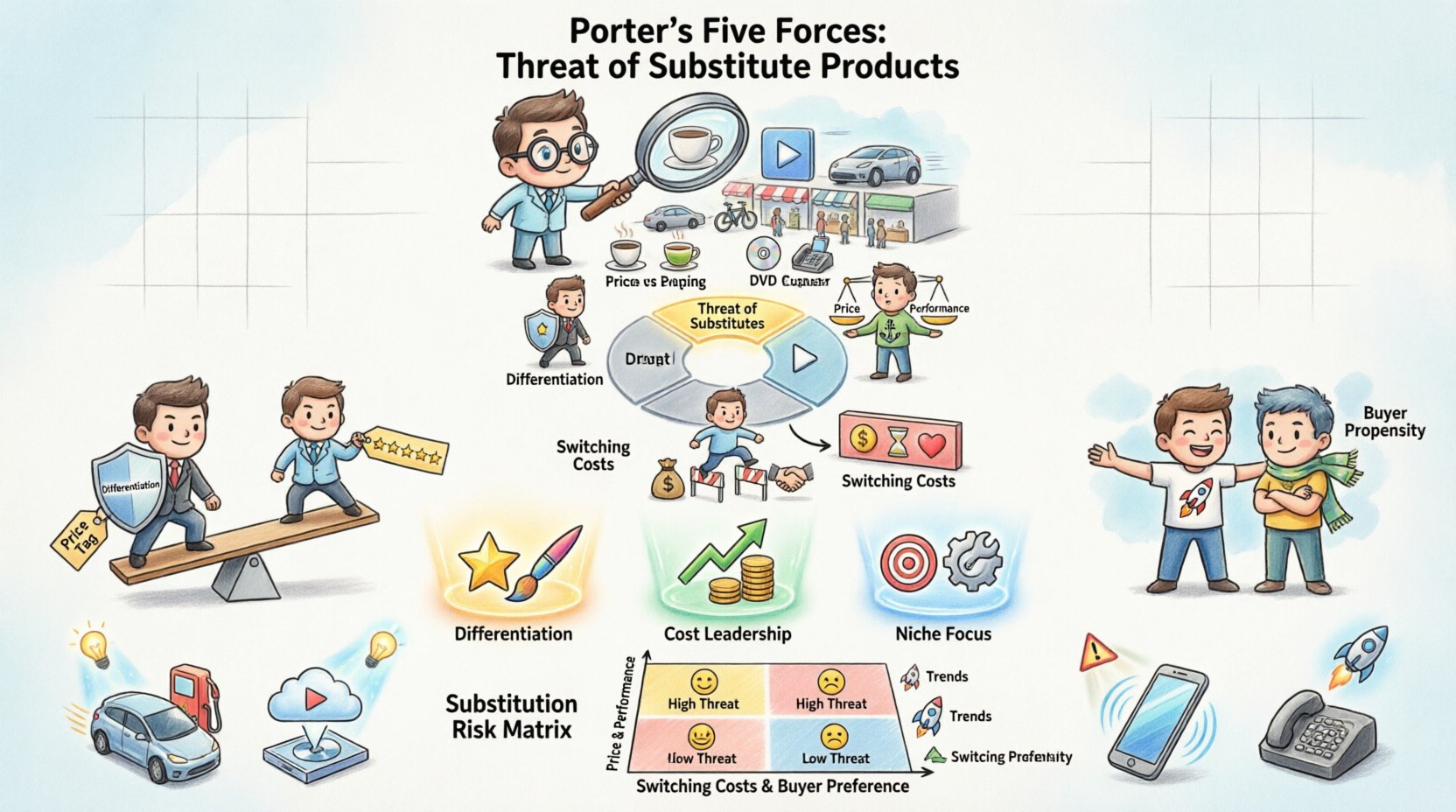
Understanding the Threat of Substitutes 🧐
A substitute product is not merely a competitor. It is a product from a different industry that fulfills the same function or satisfies the same customer need. For example, butter and margarine are substitutes within the same category. However, butter and olive oil might also be seen as substitutes in certain dietary contexts. The key distinction is the need being met, not the specific product type.
When analyzing substitutes, the goal is to determine the price-performance trade-off. If a substitute offers similar performance at a lower price, or significantly better performance at a similar price, the threat is high. This dynamic creates a ceiling on prices that companies can charge without losing customers.
- Functionality: Does the alternative achieve the same result?
- Price Sensitivity: Are customers willing to switch for a better deal?
- Switching Costs: How difficult is it for a customer to change solutions?
Many industries fail because they focus solely on direct competitors. They watch their rivals closely but miss the disruptive entrants from adjacent sectors. Digital photography did not primarily compete with film cameras; it competed with the convenience of instant sharing and editing. Understanding this broader context is essential for accurate analysis.
Key Drivers of Substitution Risk 📉
Several economic and behavioral factors influence the likelihood that customers will switch to a substitute. Recognizing these drivers allows strategists to assess risk accurately.
1. Relative Price-Performance
This is the most direct driver. If a substitute becomes cheaper or performs better, the threat escalates. Technological advancements often drive this. As technology improves, the cost of alternatives drops while performance rises. This trend accelerates substitution.
2. Switching Costs
Switching costs are the barriers a customer faces when moving to a different product. These can be financial, procedural, or psychological.
- Financial: The cost of purchasing the new equipment or service.
- Procedural: Time required to learn a new system or integrate it.
- Relational: The loss of established relationships or loyalty rewards.
High switching costs protect incumbents. Low switching costs invite substitution. Companies often invest in increasing switching costs to create a moat around their business model.
3. Buyer Propensity to Substitute
Different customers have different tolerances for risk and change. Some are early adopters who constantly seek new solutions. Others are conservative and prefer the status quo. Analyzing the specific customer segment is vital. A strategy that works for a price-sensitive segment may fail for a loyalty-driven segment.
Strategic Responses to Substitution 🛡️
Once the threat is identified, the organization must decide how to respond. There is no single solution, as the approach depends on the industry structure and the company’s resources.
Differentiation Strategies
Creating a unique value proposition reduces the appeal of substitutes. If a product is perceived as distinct, price comparisons become less relevant. Differentiation can be achieved through:
- Brand Reputation: A strong brand builds emotional loyalty.
- Service Quality: Superior support adds value beyond the physical product.
- Innovation: Continuous improvement keeps the product ahead of alternatives.
Cost Leadership
If substitution is driven primarily by price, lowering costs can neutralize the threat. By achieving a lower cost structure, a company can match substitute prices while maintaining margins. This requires operational efficiency and scale.
Focus and Niche Markets
Serving a specific niche can reduce exposure to broad substitution threats. Specialized needs are harder to fulfill with generic alternatives. By catering to a narrow audience, the organization becomes indispensable to that group.
Interaction with Other Forces ⚖️
The threat of substitutes does not exist in isolation. It interacts with the other four forces in Porter’s model. Understanding these interactions provides a complete picture of industry profitability.
- Rivalry Among Existing Competitors: High substitution threat usually intensifies rivalry. Competitors fight harder for market share when customers have easy exit options.
- Bargaining Power of Buyers: Substitutes increase buyer power. If customers know they can switch easily, they demand lower prices.
- Bargaining Power of Suppliers: If a substitute relies on the same raw materials, supplier power increases. Conversely, if the substitute uses different inputs, this force is less relevant.
These forces create a complex web. A reduction in the threat of substitutes can sometimes allow competitors to focus more on price wars, increasing rivalry. Therefore, the analysis must be holistic.
Building a Substitution Risk Matrix 📋
To manage this risk, organizations can use a matrix to categorize substitutes based on their threat level. This helps prioritize resources and strategic efforts.
| Factor | High Threat Indicator | Low Threat Indicator |
|---|---|---|
| Price Ratio | Substitute is significantly cheaper | Substitute costs more |
| Performance | Substitute offers better features | Substitute is inferior |
| Switching Costs | Low barriers to change | High training or integration costs |
| Buyer Preference | Customers seek variety | Customers prefer loyalty |
| Trends | Substitute is gaining market share | Substitute is stagnant |
Using this matrix helps teams visualize where the vulnerabilities lie. It moves the conversation from abstract concepts to concrete data points.
Industry Examples and Case Studies 🏭
Real-world examples illustrate how substitution shapes industries over time.
The Automotive Industry
Traditional internal combustion engine vehicles face a growing threat from electric vehicles (EVs). This is not just a fuel switch; it represents a shift in technology, infrastructure, and ownership models. Companies that failed to adapt to the EV transition faced significant market share losses. The substitute here was enabled by battery technology improvements and regulatory changes.
The Entertainment Sector
Streaming services replaced physical media like DVDs. The substitute offered convenience, lower cost per unit, and instant access. Physical retailers that clung to their inventory models without adapting to digital distribution saw revenue decline rapidly. The need was entertainment; the delivery method changed.
The Telecommunications Market
Mobile phones replaced landlines for voice communication. Later, VoIP services replaced traditional mobile voice plans. Each shift required infrastructure investment. Companies that viewed themselves as voice providers rather than connectivity providers struggled to pivot. The substitute changed the underlying technology while keeping the core function intact.
Common Pitfalls in Analysis ❌
Conducting this analysis is not always straightforward. Several errors can lead to incorrect conclusions.
- Defining the Industry Too Narrowly: If you define your industry too tightly, you miss substitutes from adjacent sectors. Broaden the definition to focus on customer needs.
- Ignoring Latent Needs: Customers may not know they have an alternative until they see it. Look for unmet needs that substitutes could address.
- Overestimating Loyalty: Customers claim loyalty but act on price. Data often reveals higher substitution rates than surveys suggest.
- Static Analysis: Substitution threats change over time. A threat that is low today might be high in five years due to technological progress.
Avoiding these pitfalls ensures the analysis remains relevant and actionable. Continuous monitoring is better than a one-time report.
Future Trends in Substitution 🚀
The landscape of substitution is evolving. Several trends are shaping the future of competitive analysis.
Platform Economies
Platforms aggregate services, making it easier for substitutes to emerge. An app store ecosystem allows small players to disrupt established markets quickly. The barrier to entry lowers, increasing the frequency of substitution events.
Convergence
Industries are converging. Technology, media, and telecommunications are blending. This convergence creates new substitutes that did not exist previously. A smartwatch can now perform functions previously reserved for a phone or a fitness tracker.
Data-Driven Customization
Personalization reduces the value of generic substitutes. When a product adapts to individual user data, it becomes harder to replace with a generic alternative. This creates a new form of differentiation based on data utility.
Frequently Asked Questions ❓
What counts as a substitute?
A substitute is any product or service that satisfies the same customer need, even if it comes from a different industry. For example, coffee and tea both satisfy the need for a caffeine beverage, making them substitutes.
How often should this be reviewed?
Substitution threats evolve rapidly in technology-driven sectors. A review should happen annually at minimum, or whenever a major technological breakthrough occurs in the market.
Can high switching costs eliminate the threat?
High switching costs reduce the threat but do not eliminate it. If the substitute offers a massive advantage in price or performance, customers will absorb the switching costs. However, it buys time for the incumbent to adapt.
Does this apply to B2B markets?
Yes. B2B buyers also seek efficiency and cost reduction. If a new technology offers a better workflow, it will substitute the old one regardless of the business context. However, B2B switching costs are often higher due to integration complexity.
Final Thoughts on Market Resilience 🧱
Integrating the analysis of substitute products into strategic planning is non-negotiable for long-term survival. It forces organizations to look beyond their immediate competitors and consider the broader ecosystem. By understanding the drivers of substitution, companies can build defenses that are not just reactive but proactive.
The goal is not to predict the future with certainty, but to prepare for multiple scenarios. Whether through differentiation, cost leadership, or niche focus, the strategy must align with the reality of market alternatives. Those who acknowledge the threat of substitutes early gain a significant advantage in shaping their own future.
Continued vigilance is required. Markets shift, technologies mature, and customer expectations evolve. Keeping a close eye on the substitute landscape ensures that the organization remains relevant and profitable.
Related posts:
 Porter Five Forces Analysis: A Step-by-Step Walkthrough for Business School Beginners
 Porter Five Forces Analysis: A Checklist for Evaluating Market Competition Accurately
 Porter Five Forces Analysis: How New Entrants Shape Industry Dynamics (And How to Predict Them)
 Porter Five Forces Analysis: Applying It to Tech, Retail, and Healthcare Industries