

In the modern business landscape, organizations face a constant pressure to innovate rapidly while maintaining structural stability. This dynamic creates a tension between traditional Enterprise Architecture (EA) methods and Agile development practices. Enterprise Architecture often implies heavy upfront planning, whereas Agile emphasizes iterative delivery and adaptability. To navigate this complexity, frameworks that bridge these gaps are essential. ArchiMate provides a standardized modeling language that supports this integration effectively.
This guide explores how ArchiMate functions within Agile Enterprise Architecture frameworks. We will examine the core layers, the strategic benefits of combining these methodologies, and practical approaches to implementation without relying on specific software tools. The goal is to establish a clear understanding of how architectural governance can coexist with rapid development cycles.
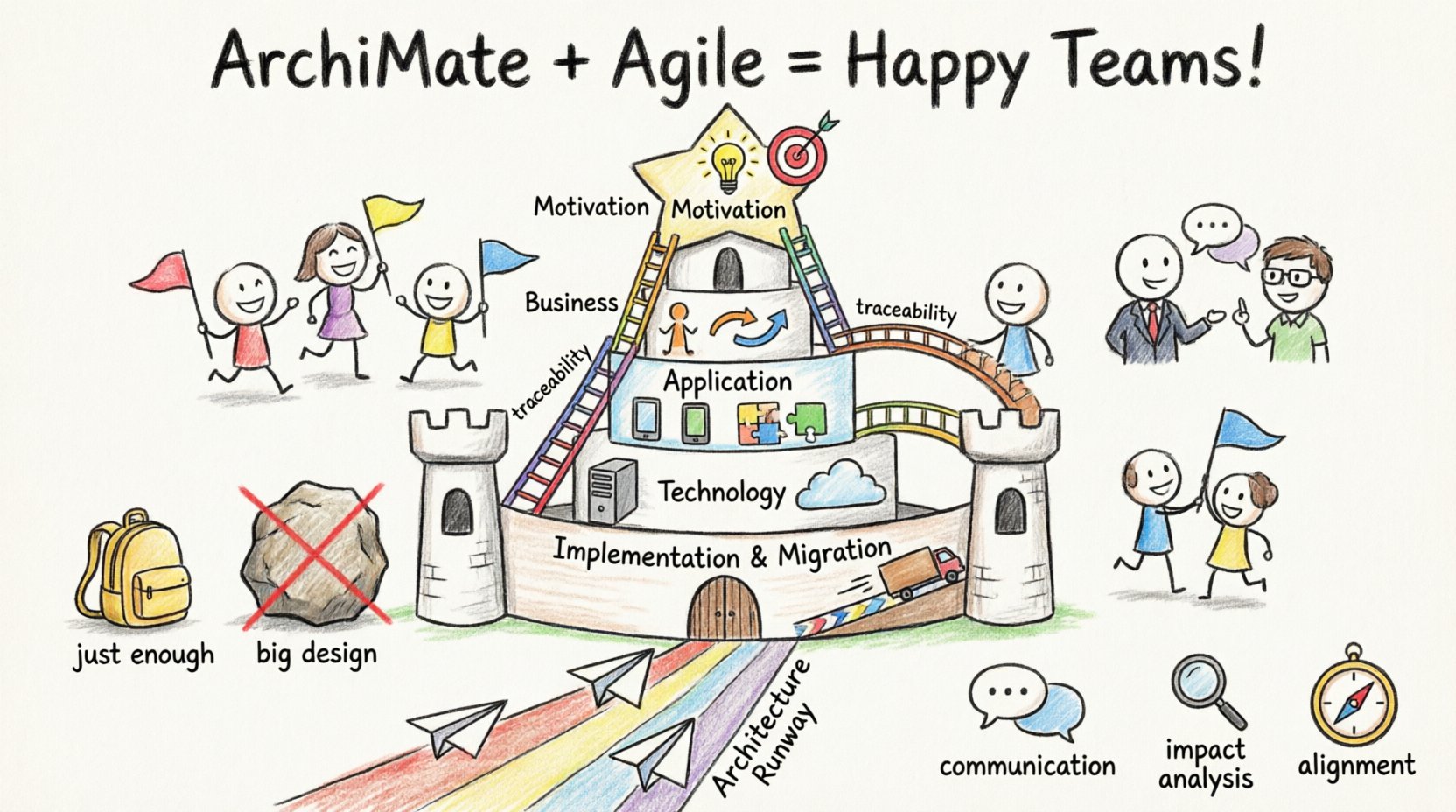
Understanding ArchiMate Fundamentals 🧠
ArchiMate is an open and independent modeling language for Enterprise Architecture. It is designed to describe, analyze, and visualize business and IT architecture. Unlike proprietary tools, ArchiMate is a standard specification maintained by The Open Group. It provides a common vocabulary for stakeholders across the organization, ensuring that architects, business leaders, and developers speak the same language.
The language is structured around several key layers that represent different aspects of the enterprise:
- Business Layer: Focuses on business processes, organizational structures, and roles. It defines what the organization does.
- Application Layer: Represents the software applications that support the business processes. It details the functional capabilities of the IT systems.
- Technology Layer: Describes the infrastructure, hardware, and network resources that host the applications.
- Motivation Layer: Captures the strategic drivers, such as goals, principles, and requirements, that drive the architecture.
- Implementation & Migration Layer: Handles the planning of changes and the transition from a current state to a target state.
Each layer uses specific concepts and relationships. For instance, a business process realizes a business function, which is used by an application function, which is installed on a technology node. This clear definition of relationships allows for impact analysis. If a technology component changes, architects can trace the ripple effect up through the application and business layers.
The Agile Enterprise Architecture Challenge 🤔
Agile methodologies prioritize customer feedback, iterative progress, and flexibility. Teams work in sprints, delivering small increments of value frequently. Traditional EA often relied on Big Design Up Front (BDUF), where detailed diagrams were created before development began. This approach can slow down Agile teams who need immediate answers to questions about dependencies and standards.
The conflict arises when:
- Architects produce documentation that is outdated by the time it is reviewed.
- Teams make architectural decisions that are not visible to the broader organization.
- Business goals are not effectively communicated to technical teams.
Agile Enterprise Architecture seeks to resolve this by making architecture an enabling function rather than a bottleneck. It requires documentation that is lean, just-in-time, and integrated into the workflow. ArchiMate supports this by allowing models to be granular. Architects do not need to model the entire enterprise at once. They can focus on specific domains or capabilities relevant to a specific release.
Integrating ArchiMate into Agile Workflows 🔄
Integrating a formal modeling language like ArchiMate into an Agile environment requires a shift in mindset. The modeling is not a separate activity but part of the development lifecycle. Here is how the integration typically functions:
1. Just Enough Modeling
Instead of creating comprehensive blueprints, teams create models that address immediate questions. This is often referred to as “just enough architecture.” The focus is on clarity and utility rather than completeness. A model might be created to clarify a complex dependency before a sprint begins, and then updated only if the scope changes.
2. Architecture Runway
The concept of an architecture runway suggests that the architecture must provide enough stable foundation for the next set of features. ArchiMate helps define this runway. By modeling the target state, teams understand the technical constraints and opportunities. This prevents the accumulation of technical debt that often occurs in fast-paced environments.
3. Traceability
One of the strongest features of ArchiMate is traceability. In an Agile setting, user stories often link to business capabilities. ArchiMate allows these stories to be linked to the underlying business processes and technical components. This ensures that every line of code serves a defined business purpose. It connects the “why” (motivation layer) to the “what” (business layer) and the “how” (application/technology layers).
Key ArchiMate Layers for Agile Teams 📊
Not all layers are equally relevant to every Agile team. Different teams focus on different aspects of the architecture. Understanding which layers to prioritize helps streamline communication.
- Motivation Layer: Essential for product owners and business architects. It ensures the team understands the value proposition. Goals and principles guide decision-making without dictating every step.
- Business Layer: Critical for business analysts. It maps processes to capabilities. When a new feature is requested, this layer helps assess if it fits the current process flow.
- Application Layer: The primary concern for development teams. It defines the services and components. ArchiMate concepts like Application Services and Application Functions help define interfaces and contracts.
- Technology Layer: Relevant for DevOps and infrastructure teams. It ensures that the deployment environment supports the application architecture.
Strategic Benefits of this Combination 📈
Combining ArchiMate with Agile EA offers distinct advantages over using either approach in isolation. These benefits extend beyond documentation to actual business value.
Improved Communication
Visual models reduce ambiguity. When a business stakeholder and a developer look at an ArchiMate diagram, they share a common reference point. This reduces the back-and-forth of clarification emails and meetings. The standardized notation removes the need for custom glossaries.
Enhanced Impact Analysis
When a requirement changes, architects can quickly identify affected components. Without a model, this requires manual tracing through code or documentation. With ArchiMate, relationships are explicit. This supports risk management and change control processes.
Better Alignment
Agile teams often lose sight of the big picture. ArchiMate keeps the strategic context visible. It ensures that local optimizations do not contradict global architecture principles. This alignment is crucial for long-term scalability.
Implementation Patterns and Practices 🛠️
There is no single way to implement this combination. Organizations must adapt the approach to their specific maturity levels. Below is a comparison of common approaches.
| Approach | Characteristics | Best For |
|---|---|---|
| Centralized Modeling | Architects create all models. Teams consume them. | Highly regulated industries where consistency is critical. |
| Distributed Modeling | Teams create their own models for their domain. | Highly autonomous teams with mature architectural skills. |
| Hybrid Approach | Core standards modeled centrally, implementation details modeled locally. | Most organizations seeking balance between control and agility. |
| Implicit Modeling | Models are generated from code or requirements automatically. | Organizations focused on automation and CI/CD pipelines. |
For many organizations, the Hybrid Approach offers the best balance. It allows the central architecture team to define the boundaries and standards while empowering product teams to make detailed design decisions. This reduces the burden on the central team and keeps the models relevant.
Addressing Common Challenges ⚠️
Despite the benefits, integrating these frameworks presents hurdles. Acknowledging these challenges early helps in planning mitigation strategies.
- Tooling Complexity: While ArchiMate is a standard, the tools used to create models can be complex. Teams need training to avoid creating models that are technically correct but hard to understand.
- Maintenance Overhead: Models decay over time. If a model is not updated, it becomes a liability. Agile practices require regular refactoring, which should apply to architecture documentation as well.
- Skill Gaps: Not every developer is trained in EA concepts. Cross-functional training is necessary. Business analysts and architects need to work closely with developers to translate concepts.
- Governance vs. Speed: Too much governance slows down delivery. Too little leads to chaos. The goal is lightweight governance. Checkpoints should be placed at major milestones rather than every sprint.
The Evolution of Architecture Documentation 📝
The nature of documentation is changing. In the past, documents were static PDFs stored in repositories. In an Agile EA context, documentation is dynamic.
ArchimMate models can be viewed as living artifacts. They are updated continuously as the system evolves. This shift requires a cultural change. Documentation is no longer seen as a deliverable at the end of a project but as a continuous activity throughout the lifecycle.
This approach supports the concept of the “Single Source of Truth.” Instead of maintaining separate spreadsheets, diagrams, and code comments, the architecture model becomes the central reference. This reduces redundancy and ensures consistency across the organization.
Future Outlook for Enterprise Architecture 🚀
The future of EA lies in integration with the broader DevOps ecosystem. Architecture models will increasingly be linked to CI/CD pipelines. When a build fails due to a dependency issue, the model can highlight the specific architectural constraint that was violated.
Furthermore, the use of metadata and tagging within models will allow for better searchability and filtering. Teams will not need to see the entire enterprise model to find the information relevant to their work. Filtering capabilities will allow for context-aware views.
As organizations become more digital-first, the need for clear architecture definitions grows. The complexity of microservices and cloud-native architectures requires precise documentation to manage interdependencies. ArchiMate provides the structure needed to handle this complexity without imposing rigid constraints.
Summary of Key Takeaways ✅
To summarize, the integration of ArchiMate into Agile Enterprise Architecture frameworks is a strategic decision that pays off in clarity and alignment. It bridges the gap between business strategy and technical execution.
Key points to remember include:
- Standardization: ArchiMate provides a common language that reduces ambiguity.
- Flexibility: It supports both high-level strategy and low-level implementation details.
- Traceability: It connects business goals to technical components.
- Agility: It supports iterative modeling rather than heavy upfront planning.
- Collaboration: It improves communication between business and IT stakeholders.
Organizations adopting this approach should focus on culture and process as much as technology. Training, lightweight governance, and continuous updates are vital for success. By treating architecture as a value-adding service rather than a compliance exercise, teams can achieve both speed and stability.