


Understanding the competitive landscape is essential for any organization aiming for sustainable growth. Before committing resources to a new strategy or product launch, leaders must grasp the underlying dynamics that shape profitability. This is where the Porter Five Forces Analysis comes into play. Developed by Michael Porter in 1979, this framework provides a structured approach to evaluating the intensity of competition within a specific industry.
Many business plans fail not because the product is flawed, but because the market environment was misjudged. By analyzing the five distinct forces that influence an industry, you can identify where power lies and where risks exist. This guide walks you through the components of the framework, how to apply them, and how to use the insights for strategic decision-making.
What Is the Porter Five Forces Framework? 🧩
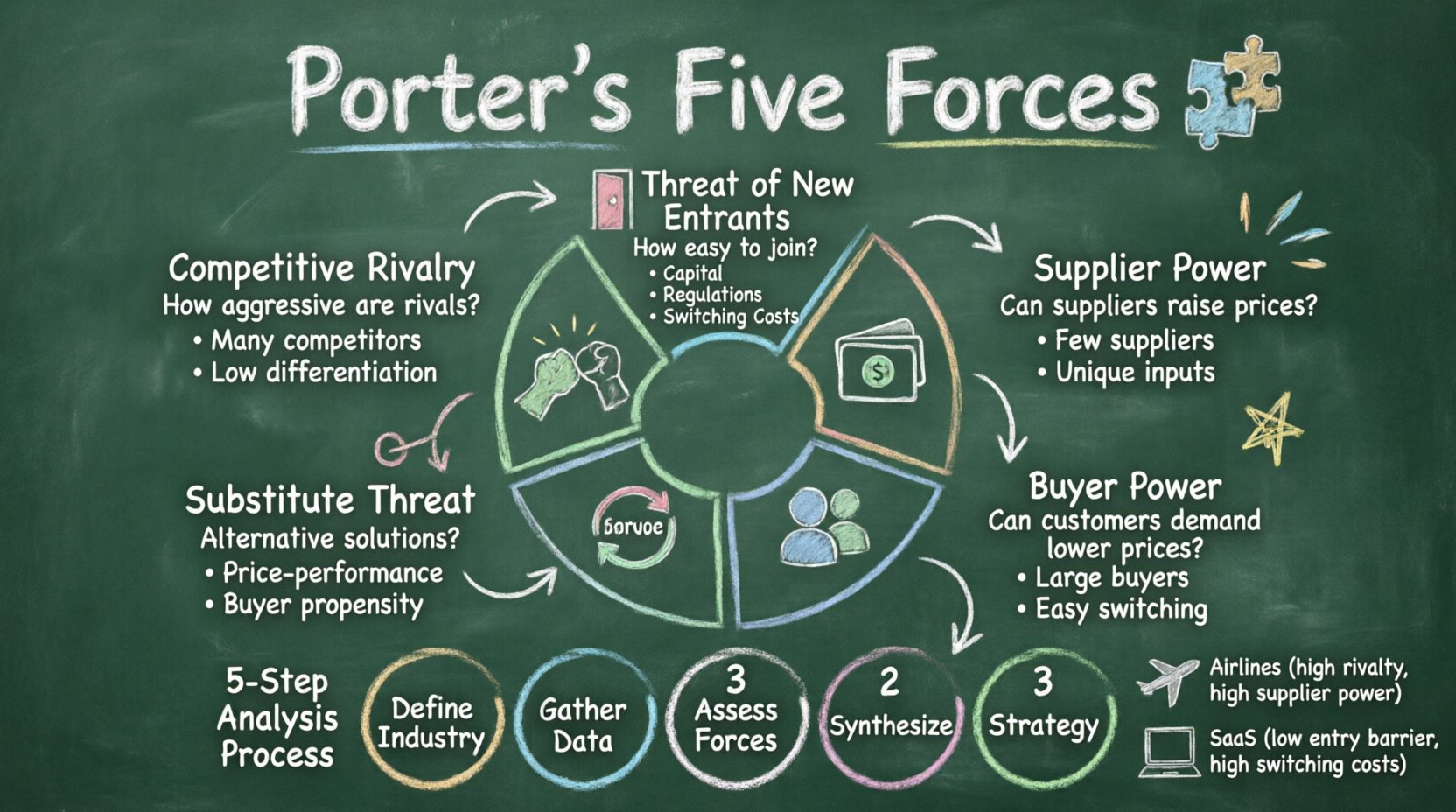
The Porter Five Forces model is a tool used to assess the attractiveness and long-term profitability of an industry. It moves beyond simple competitor analysis to look at the broader structural factors that determine how much value companies can capture. The core premise is that the five forces collectively determine the intensity of competition and the ultimate profit potential of a market.
When these forces are strong, industry profitability tends to be lower. When they are weak, companies have more room to generate margins. The framework breaks down into five specific categories:
- Threat of New Entrants: How easy is it for new competitors to enter the market?
- Bargaining Power of Suppliers: How much control do suppliers have over input costs?
- Bargaining Power of Buyers: How much influence do customers have over pricing?
- Threat of Substitute Products: Are there alternative solutions that customers can switch to?
- Rivalry Among Existing Competitors: How intense is the competition between current players?
Each force represents a different source of competitive pressure. A comprehensive analysis requires looking at all five simultaneously to get a complete picture of the industry structure.
1. Threat of New Entrants 🚪
This force examines the barriers to entry that protect existing companies from new competitors. If barriers are low, new players can easily enter the market, driving down prices and increasing competition. If barriers are high, incumbent firms can maintain their market share and profitability.
Key Drivers of Entry Barriers
Several factors determine how difficult it is for a new competitor to join the fray:
- Capital Requirements: Industries requiring significant investment in machinery, technology, or inventory create high barriers. For example, manufacturing or telecommunications are capital intensive.
- Regulatory Policies: Government licenses, patents, and compliance standards can restrict entry. Healthcare and pharmaceutical sectors often have strict regulatory hurdles.
- Switching Costs: If customers face high costs to switch from an incumbent to a new entrant, the barrier is effectively raised. This often occurs in enterprise software or specialized industrial equipment.
- Access to Distribution Channels: If existing players control the primary distribution networks, new entrants struggle to get their products to customers.
- Economies of Scale: Large incumbents often produce at a lower unit cost than smaller startups, making it hard for new entrants to compete on price.
When assessing this force, ask yourself: How much money is needed to start? How hard is it to get approval? Can new players reach customers as easily as the current leaders?
2. Bargaining Power of Suppliers 💼
Suppliers can drive up prices or reduce quality, squeezing industry profits. This force analyzes how much leverage suppliers hold over the companies in the industry. High supplier power means suppliers can dictate terms, forcing companies to absorb higher costs.
Indicators of High Supplier Power
- Supplier Concentration: If there are few suppliers relative to the number of buyers, suppliers have more power. A monopoly or oligopoly in the supply chain creates significant leverage.
- Uniqueness of Inputs: If the materials or components are unique or highly specialized, buyers cannot easily switch to other sources.
- Switching Costs: If changing suppliers requires expensive retooling or retraining, the buyer is locked in.
- Threat of Forward Integration: If suppliers have the ability to start producing the final product themselves, they hold a powerful threat over buyers.
Consider a scenario where a single company controls the supply of a critical raw material. They can raise prices, and the downstream manufacturers have no choice but to accept the increase. Conversely, if there are hundreds of generic suppliers, the power shifts to the buyers.
3. Bargaining Power of Buyers 👥
Customers can demand lower prices or higher quality, reducing margins. This force evaluates the leverage buyers have to negotiate terms. When buyer power is high, companies must fight harder to retain customers and protect profitability.
Indicators of High Buyer Power
- Concentration of Buyers: If a few large customers account for most of the sales, they can dictate terms. Large retail chains, for instance, often demand lower prices from suppliers.
- Availability of Information: If buyers know exactly what competitors charge, they can easily shop around.
- Low Switching Costs: If it is easy for customers to switch to a competitor, they will do so if they find a better deal.
- Price Sensitivity: If the product represents a significant portion of the buyer’s costs, they will scrutinize price changes closely.
- Threat of Backward Integration: If buyers can produce the product themselves, they hold leverage over suppliers.
Understanding buyer power helps companies decide where to position their product. If buyers are powerful, differentiation and brand loyalty become critical strategies to reduce price sensitivity.
4. Threat of Substitute Products 🔄
Substitutes are products from other industries that solve the same problem for the customer. This force looks at the likelihood that customers will switch to a different solution entirely. High substitution threat caps the prices a company can charge.
Differentiating Substitutes from Competitors
Competitors offer similar products within the same industry. Substitutes offer a different solution to the same need. For example, a substitute for a coffee shop is not another coffee shop, but an energy drink or tea.
- Price-Performance Trade-off: If a substitute is cheaper and offers acceptable performance, the threat is high.
- Switching Costs: If customers face barriers to switching to the substitute, the threat is lower.
- Buyer Propensity to Substitute: Some customers are naturally open to trying new technologies, while others prefer tradition.
In the transportation industry, the threat of substitutes includes not just other car companies, but public transit, bicycles, and ride-sharing services. Ignoring these external alternatives can lead to a strategic blind spot.
5. Rivalry Among Existing Competitors 🥊
This is often the most visible force. It refers to the intensity of competition between current players in the industry. High rivalry leads to price wars, advertising battles, and constant innovation, all of which can erode profits.
Factors Influencing Competitive Rivalry
- Number of Competitors: More competitors usually mean more rivalry, especially if they are of similar size.
- Industry Growth Rate: In slow-growth industries, companies fight for market share. In fast-growth industries, they can expand without stealing share from others.
- Product Differentiation: If products are commoditized, competition is based primarily on price.
- Exit Barriers: If it is difficult or expensive to leave the industry, companies will stay and fight even when profits are low.
- Fixed Costs: High fixed costs encourage companies to cut prices to utilize capacity, fueling price wars.
Industries like airlines or budget retail often experience intense rivalry due to high fixed costs and low differentiation. In contrast, luxury markets or niche B2B sectors may experience less direct price competition.
Comparing the Five Forces at a Glance ⚖️
To make this information easier to digest, the table below summarizes the core aspect of each force and the strategic question you should ask.
| Force | Focus Area | Key Strategic Question |
|---|---|---|
| New Entrants | Barriers to Entry | How easy is it for others to join? |
| Suppliers | Input Costs | Can suppliers raise prices? |
| Buyers | Pricing Power | Can customers demand lower prices? |
| Substitutes | Alternative Solutions | Can customers solve this problem differently? |
| Rivalry | Competition Intensity | How aggressive are current competitors? |
How to Conduct a Five Forces Analysis 🛠️
Applying this framework requires a methodical approach. It is not enough to guess; you need data and observation. Follow these steps to conduct a thorough analysis.
Step 1: Define the Industry
Clarity is crucial. Define the scope of the industry you are analyzing. Is it the global automotive industry, or just electric SUVs in North America? A narrow definition yields different insights than a broad one. Be specific about the product and the customer segment.
Step 2: Gather Data
Collect information from various sources. This includes industry reports, financial statements of competitors, supplier contracts, and customer feedback. Do not rely on a single source. Look for trends over time rather than snapshots.
Step 3: Assess Each Force
For each of the five forces, rate the intensity as Low, Medium, or High. Justify your rating with the data you gathered. For example, if supplier power is high, cite the lack of alternative vendors or the uniqueness of the component.
Step 4: Synthesize the Findings
Combine the assessments to understand the overall attractiveness of the industry. If three forces are high and two are low, the industry is likely difficult to profit from. Identify which forces offer the greatest threat and which offer opportunities.
Step 5: Develop Strategic Responses
Use the insights to shape your strategy. If buyer power is high, focus on brand loyalty. If supplier power is high, look for vertical integration or alternative sourcing. If rivalry is intense, consider differentiation or niche targeting.
Real-World Application Examples 🌍
Theory becomes clear when applied to real scenarios. Let’s look at how this framework helps analyze different sectors.
Example 1: The Airline Industry
The airline industry is notorious for thin profit margins. Using the framework reveals why:
- High Rivalry: Many carriers compete on price for the same routes.
- High Supplier Power: Aircraft manufacturers (like Boeing and Airbus) are limited in number, giving them leverage on pricing.
- High Threat of Substitutes: For short distances, trains or buses are viable alternatives.
- High Barrier to Entry: Capital costs and regulatory licenses are significant hurdles.
This analysis explains why airlines must constantly optimize costs and why consolidation often occurs to reduce rivalry.
Example 2: The Software Industry (SaaS)
Software as a Service presents a different profile:
- Low Barrier to Entry: Developing software is cheaper than manufacturing hardware.
- High Switching Costs: Once a company adopts a specific system, moving to another is difficult due to data migration and training.
- High Rivalry: Many players offer similar features.
- Low Supplier Power: Cloud infrastructure is commoditized with many providers.
Here, the strategy shifts to locking in customers through network effects and ecosystem integration rather than just competing on features.
Limitations and Considerations ⚠️
While powerful, the Porter Five Forces model is not a crystal ball. It has limitations that savvy strategists must acknowledge.
- Static Nature: The framework is a snapshot in time. Industries change rapidly, and forces can shift quickly due to technology or regulation.
- Focus on Profitability: It focuses heavily on financial returns, potentially overlooking social impact or employee welfare.
- Ignores Complements: It does not explicitly account for products that add value to the main product (complements), which can be a significant driver of demand.
- Assumes Perfect Information: It assumes companies have full knowledge of the forces, which is rarely true in practice.
- Does Not Account for Strategy: It analyzes the environment but does not prescribe specific actions beyond general directions.
To mitigate these limitations, use the Five Forces in conjunction with other tools like SWOT analysis or PESTLE analysis. This provides a more rounded view of the strategic situation.
Integrating Analysis into Strategic Planning 📝
Conducting the analysis is only half the battle. The real value comes from integrating the findings into your long-term planning process.
- Resource Allocation: Direct resources away from areas where forces are strong and toward areas where you have an advantage.
- Risk Management: Use the analysis to anticipate risks. If supplier power is increasing, diversify your supply chain now.
- Mergers and Acquisitions: M&A can change the balance of forces. Buying a supplier can reduce supplier power. Buying a competitor can reduce rivalry.
- Value Proposition: Align your value proposition with the forces. If buyers are powerful, offer superior service. If substitutes are a threat, innovate to stay ahead.
Common Pitfalls to Avoid 🚫
Even experienced analysts make mistakes when applying this framework. Watch out for these common errors.
- Ignoring the Macro Environment: Focusing only on the five forces without considering broader economic or political shifts.
- Overgeneralizing: Applying industry-wide trends to a specific niche without checking if they apply.
- Static Thinking: Assuming the forces will remain constant over the next 5 to 10 years.
- Skipping Data Collection: Relying on intuition rather than hard data leads to biased assessments.
- Focusing Only on Competitors: The model is about industry structure, not just direct rivals. Neglecting suppliers or substitutes is a common oversight.
Final Thoughts on Strategic Clarity 🔍
Strategic planning is about making informed choices in an uncertain world. The Porter Five Forces Analysis provides a lens to see that uncertainty more clearly. It helps you understand where value is created and where it is destroyed.
By systematically evaluating the threat of new entrants, supplier power, buyer power, substitutes, and rivalry, you gain a deeper understanding of the competitive landscape. This understanding allows you to position your organization to defend against threats and capitalize on opportunities.
Remember that this is a tool for thinking, not a rigid formula. Use it to spark discussion, challenge assumptions, and guide decision-making. When combined with deep market research and a clear vision for the future, it becomes an invaluable asset for sustainable business growth.
Start your analysis today. Define your industry, gather your data, and map out the forces. The insights you gain will form the foundation of a robust and resilient strategy.
Related posts:
 Porter Five Forces Analysis: A Real-World Case Study for MBA Students
 Porter Five Forces Analysis: What Students Often Misunderstand (And How to Fix It)
 Porter Five Forces Analysis: A Best Practices Guide for Business School Assignments
 Porter Five Forces Analysis: Why the Framework Matters Even in Disruptive Markets