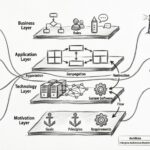


Enterprise architecture demands precision. It requires more than just drawing diagrams; it requires a structured approach to understanding complex organizational landscapes. At the core of this discipline lies the ArchiMate framework. While many practitioners focus on specific modeling elements, the true power of ArchiMate often resides in its layered structure. For a senior architect, understanding these layers is not merely about compliance with a standard; it is about ensuring alignment, clarity, and strategic coherence across the entire enterprise.
This guide explores the ArchiMate layers in depth. We will examine how each layer functions, how they interact, and why this separation is critical for high-level architectural governance. By the end, you will see how these layers serve as the backbone for effective decision-making and risk management.
Understanding the Architecture Landscape 🌍
Before dissecting the layers, it is essential to recognize the challenge senior architects face. Organizations are multifaceted. Business goals must translate into technical capabilities. A change in a business process might ripple through applications, impacting the underlying infrastructure. Without a structured view, these connections are often opaque.
ArchiMate addresses this complexity through abstraction. It separates concerns into distinct layers. This separation allows architects to model specific domains without losing sight of the broader context. It prevents the common pitfall of getting lost in technical details while ignoring business strategy, or conversely, defining business goals without understanding the technical feasibility.
The Core Layers: Business, Application, and Technology 🧩
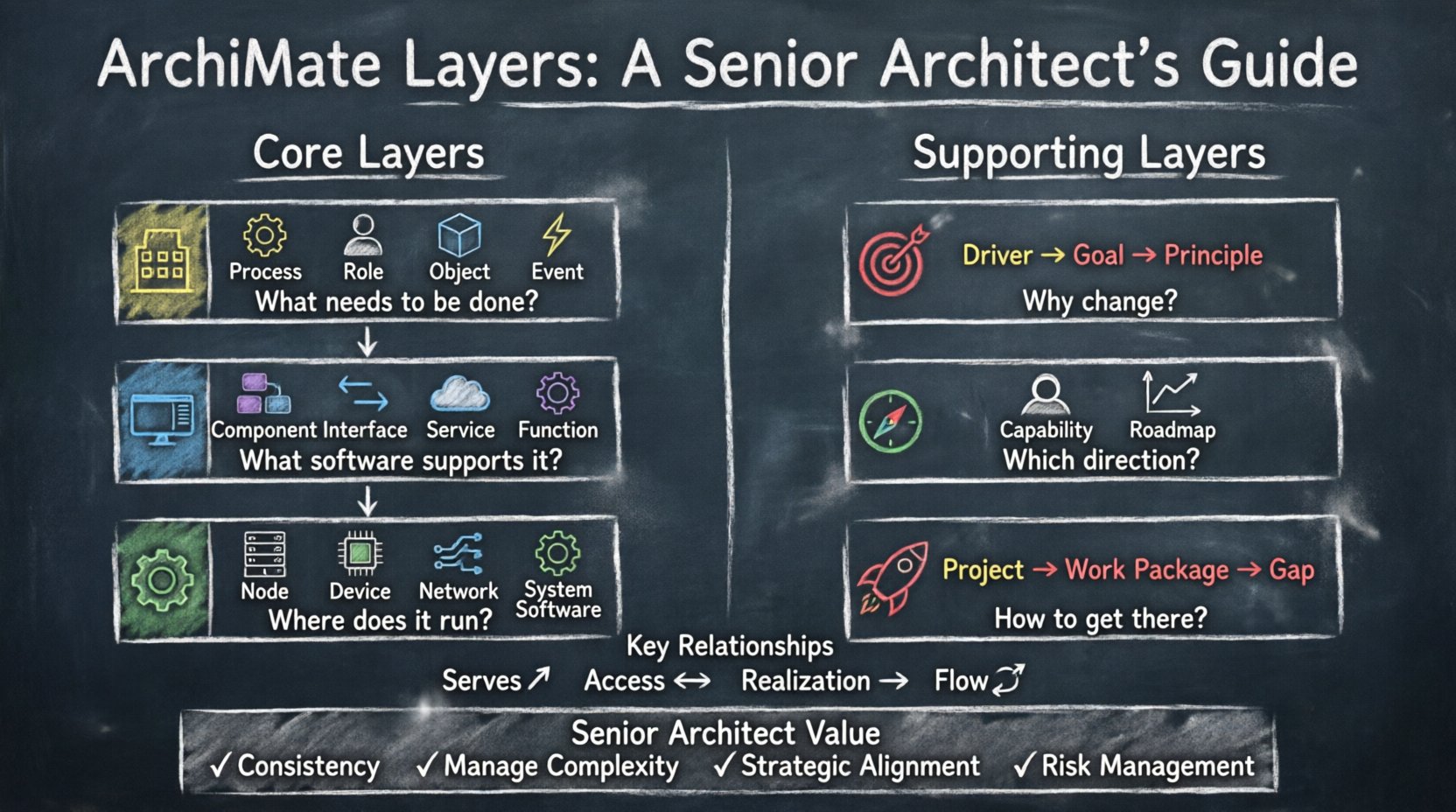
The foundation of the ArchiMate framework consists of three core layers. These layers represent the primary domains of an enterprise. They are distinct yet interconnected.
1. The Business Layer 🏢
The Business layer represents the organization itself. It describes what the organization does, how it operates, and who is involved. This layer is crucial for senior architects because it anchors the model in reality.
- Business Processes: The activities and flows that create value. For example, an order fulfillment process.
- Business Roles: The actors or responsibilities within the organization. This includes departments, job titles, or specific functions.
- Business Objects: The data or entities that are managed by the processes, such as a customer record or a product.
- Business Events: Triggers that initiate a process, such as a customer placing an order.
For a senior architect, the Business layer is the source of truth for requirements. When a new strategic initiative is launched, it usually originates here. Modeling this layer ensures that technical solutions are directly tied to organizational value.
2. The Application Layer 💻
Application layer sits below the Business layer. It represents the software systems that support the business processes. This layer focuses on functionality rather than the hardware or code implementation.
- Application Components: Modular units of software that provide specific functionality, such as a billing engine or a user authentication service.
- Application Interfaces: The points of interaction between applications, often defined by APIs or service contracts.
- Application Services: The services provided by an application component to the outside world.
- Application Function: The specific capability an application provides, often a subset of a business process.
Senior architects use this layer to manage technical debt and integration complexity. It answers questions like: Which systems support which processes? Where are the single points of failure? How do applications communicate?
3. The Technology Layer ⚙️
The Technology layer represents the physical and logical infrastructure. It describes the hardware, networks, and environments where applications run.
- Node: A computational resource, such as a server, cloud instance, or device.
- Device: A physical resource, such as a laptop, router, or sensor.
- Communication Path: The network connection between nodes or devices.
- System Software: Operating systems, databases, or middleware that manage the hardware.
This layer is often the domain of infrastructure architects, but senior architects must understand it to assess risk and capacity. It ensures that business processes are not just theoretically possible but technically supported.
Comparison of Core Layers
| Layer | Focus | Key Question | Example Element |
|---|---|---|---|
| Business | Organization & Value | What needs to be done? | Customer Onboarding Process |
| Application | Software Functionality | What software supports it? | CRM System |
| Technology | Infrastructure | Where does it run? | Cloud Server Cluster |
The Supporting Layers: Motivation, Strategy, and Implementation 📊
While the core layers describe the state of the enterprise, the supporting layers explain the why and the how of change. These layers are vital for senior architects who are responsible for transformation programs.
4. The Motivation Layer 🎯
The Motivation layer captures the drivers behind architectural decisions. It provides the context for why a change is necessary.
- Driver: A factor that influences the organization, such as a new regulation or market pressure.
- Goal: A desired state that the organization wants to achieve, derived from drivers.
- Principle: A rule or guideline that constrains or directs action, such as “Buy before Build”.
- Assessment: A measure of how well a capability meets a goal or principle.
Without the Motivation layer, architecture becomes a static catalog. With it, the architecture becomes a strategic tool. It allows architects to trace a technical requirement back to a business driver. This traceability is essential for justifying investment and prioritizing work.
5. The Strategy Layer 🧭
The Strategy layer bridges the gap between high-level motivation and the concrete implementation. It defines the direction the enterprise is taking.
- Strategy: The overall plan or approach to achieve goals.
- Capability: The ability of an organization to perform a certain activity.
- Principle: Repeated here to enforce consistency across the model.
This layer helps senior architects manage the roadmap. It defines which capabilities need to be built or retired. It ensures that the technology and application layers are evolving in a way that supports the strategic vision.
6. The Implementation & Migration Layer 🚀
Change does not happen instantly. This layer models the journey from the current state to the target state.
- Work Package: A grouping of related projects or initiatives.
- Project: A temporary endeavor undertaken to create a unique product or service.
- Assignment: Linking a work package or project to a specific capability or process.
- Gap: The difference between the current state and the target state.
For a senior architect, this layer is critical for program management. It ensures that the roadmap is realistic. It highlights dependencies between projects and identifies the critical path for delivery.
Cross-Layer Relationships: The Connective Tissue 🔗
The layers are not silos. The true value of ArchiMate emerges when relationships are defined between them. These relationships allow architects to analyze the impact of change.
Key Relationships
- Serves: One element provides functionality to another. For example, a Technology Node serves an Application Component.
- Access: One element accesses the data of another. Common between Application and Business layers.
- Assignment: A resource is assigned to perform a function. For example, a Business Role is assigned to a Business Process.
- Realization: An element realizes another. For example, an Application Component realizes a Business Process.
- Flow: Information or material flows between elements.
Understanding these relationships allows for impact analysis. If a business process changes, which applications are affected? If a server fails, which services are disrupted? This connectivity is what transforms a diagram into a living model.
The Senior Architect’s Responsibility 👔
Why do these layers matter specifically to a senior architect? The role extends beyond modeling. It involves governance, alignment, and communication.
1. Ensuring Consistency 🛡️
Different teams often speak different languages. Developers talk about code; business leaders talk about revenue. The ArchiMate layers provide a common vocabulary. A senior architect must ensure that definitions in the Business layer are consistent with the capabilities in the Application layer. Inconsistencies lead to confusion and rework.
2. Managing Complexity 🧠
Enterprises are too large to model in one view. The layers allow for abstraction. A senior architect can present the Business layer to the board, the Application layer to the CTO, and the Technology layer to the infrastructure team. Each group sees the information relevant to them, while the senior architect maintains the holistic view.
3. Strategic Alignment 🤝
The Motivation and Strategy layers ensure that every technical investment has a purpose. A senior architect must constantly ask: “Does this project support our strategic goals?” If the answer is no, the model should reflect that disconnect. This prevents budget waste and ensures resources are directed toward high-value initiatives.
4. Risk Management 🚨
By modeling the Technology layer and its connections to the Application layer, senior architects can identify single points of failure. They can see where a network outage might halt a critical business process. This visibility is crucial for business continuity planning and disaster recovery.
Common Challenges in Layer Modeling ⚠️
While the framework is robust, practitioners often encounter difficulties. Recognizing these pitfalls is part of the senior architect’s expertise.
Over-Modeling
Trying to model every single detail leads to a massive, unmaintainable repository. Senior architects must know when to stop. Focus on the elements that drive decisions. Leave out the trivial details that do not impact the architecture.
Layer Silos
Teams often work in isolation. The Business team models their processes without consulting IT. The IT team builds applications without understanding the business rules. This creates gaps. The senior architect must facilitate cross-functional workshops to ensure the layers are integrated.
Static Models
Architecture is dynamic. A model that is not updated becomes obsolete quickly. Senior architects must establish governance processes that ensure the model evolves alongside the enterprise. This includes version control and change management.
Tool Dependency
It is tempting to rely entirely on the modeling tool for validation. However, the tool is just a storage mechanism. The value lies in the thinking. Senior architects should focus on the logic and relationships rather than the visual aesthetics of the diagram.
Best Practices for Implementation ✅
To leverage the layers effectively, follow these guidelines.
- Start with Motivation: Define the goals and drivers before modeling the capabilities. This ensures alignment.
- Iterate: Build the model in iterations. Start with high-level layers and add detail as needed.
- Define Viewpoints: Create specific views for different stakeholders. A developer needs a different view than a CFO.
- Use Standard Relationships: Stick to the defined relationship types to maintain consistency.
- Review Regularly: Schedule architecture review boards to validate the model against reality.
Future-Proofing the Architecture 🌐
Technology evolves rapidly. Cloud computing, AI, and microservices are changing the landscape. Does the layered approach still hold? Yes. The layers provide stability amidst change.
As new technologies emerge, they typically fit into the Technology or Application layers. The Business layer remains relatively stable. By maintaining the separation, senior architects can adopt new technologies without disrupting the business model. This flexibility is key to long-term success.
Furthermore, the Motivation layer allows architects to adapt to changing market conditions. If a new driver emerges, the strategy can shift, and the implementation plan can be updated accordingly. The layered structure supports this adaptability.
Final Thoughts on Architectural Maturity 📈
Maturity in enterprise architecture is not about the volume of diagrams. It is about the quality of insights. The ArchiMate layers provide the structure needed to generate those insights. They force the architect to think about the relationships between business, application, and technology.
For the senior architect, these layers are more than a standard. They are a framework for thinking. They help in navigating complexity, managing risk, and driving strategic value. By mastering the interplay between these layers, architects can lead their organizations through transformation with confidence and clarity.
The journey from concept to implementation is long. The layers act as the map. They guide the team through the unknown, ensuring that every step taken is aligned with the destination. This is why they matter.
Key Takeaways 📝
- The Core Layers (Business, Application, Technology) define the structural domains of the enterprise.
- The Supporting Layers (Motivation, Strategy, Implementation) provide context and direction for change.
- Cross-layer relationships are essential for impact analysis and traceability.
- Senior architects use these layers to ensure consistency, manage risk, and align technology with business strategy.
- Effective modeling requires balance, iteration, and regular review to remain relevant.