

Marketing success often hinges on a simple yet overlooked truth: the difference between generic broadcasting and personalized engagement lies in understanding the path your customers take. When data sits in isolation, it remains noise. However, when that data is contextualized within the customer journey, it transforms into a strategic asset capable of driving measurable results.
This guide explores how to leverage deep insights from customer journey mapping to build campaigns that resonate. By shifting focus from broad demographics to specific behavioral patterns, organizations can deliver the right message at the right moment. We will examine the mechanics of aligning marketing efforts with user intent, ensuring resources are not wasted on audiences who are not ready to engage.
Understanding the Data Landscape 🔍
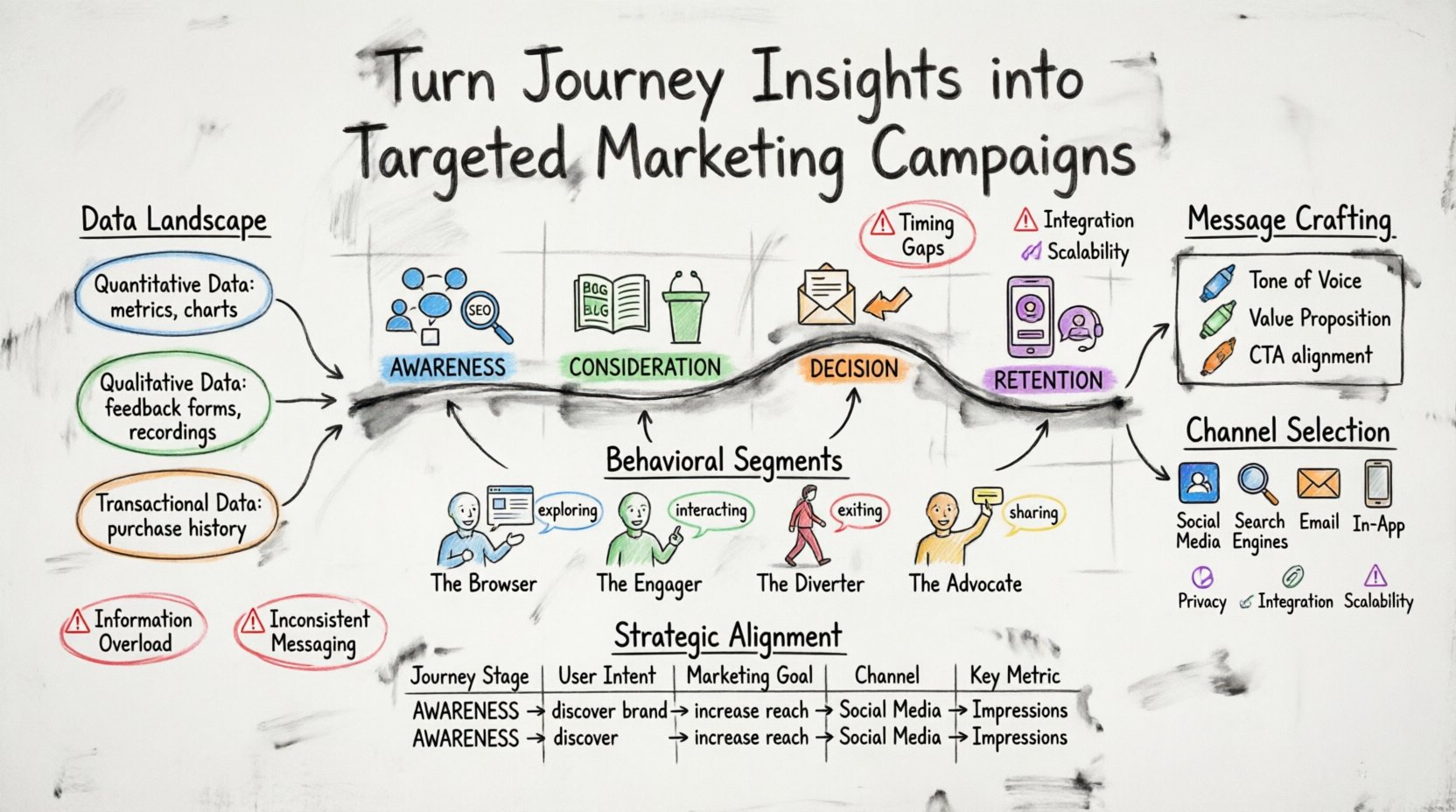
Before constructing a campaign, one must grasp the nature of the data available. Customer journey insights are not merely a collection of page views or email open rates. They represent a narrative of intent. To utilize them effectively, marketing teams must categorize information into actionable segments.
- Quantitative Data: This includes metrics such as time spent on site, click-through rates, and funnel drop-off points. These numbers indicate what is happening.
- Qualitative Data: Feedback forms, session recordings, and support tickets reveal why users behave the way they do.
- Transactional Data: Purchase history and average order value provide context regarding the user’s economic relationship with the brand.
Combining these data types creates a holistic view. A user who spends ten minutes on a pricing page but does not convert provides a different signal than a user who browses a blog post for thirty seconds. The former suggests high intent but potential friction; the latter suggests low interest or early-stage discovery.
Mapping the Touchpoints 🧭
Customer touchpoints are every interaction a user has with your brand. These range from social media ads to customer support calls. Mapping these points allows marketers to identify where the journey stalls and where momentum builds.
To map this effectively, consider the following stages:
- Awareness: The user realizes they have a problem. Marketing here focuses on education and brand visibility.
- Consideration: The user evaluates solutions. Marketing shifts to comparison and proof of value.
- Decision: The user is ready to act. Marketing provides incentives and removes friction.
- Retention: The user has purchased. Marketing focuses on loyalty and advocacy.
Each stage requires a distinct approach. A campaign designed for the Awareness stage will fail if used during the Decision stage because the messaging is too broad. Conversely, pushing a discount code during Awareness can devalue the brand before the user understands the product.
Segmenting Audiences Based on Behavior 👥
Traditional segmentation relies on static attributes like age, location, or job title. While useful, behavioral segmentation offers deeper insight. It groups users based on their actions rather than who they are.
Here are key behavioral segments to target:
- The Browser: Users who explore content but do not commit. They need nurturing content that builds trust without pressure.
- The Engager: Users who interact with content (comments, shares, clicks). They are primed for direct calls to action.
- The Diverter: Users who leave at a specific step. Analyzing why they left can reveal product or process issues that need fixing before retargeting.
- The Advocate: Users who have purchased and shared feedback. They should be targeted for referral programs and case studies.
By defining these segments, marketing teams can tailor the frequency and tone of their communications. Sending a promotional email to a “Diverter” might increase churn. Sending a helpful guide to a “Browser” moves them toward engagement.
Crafting the Message 📝
Once segments are defined, the content strategy must align with the specific needs of that group. The message should not just be about the product; it should be about the user’s current state.
Alignment Strategies
- Tone of Voice: Early-stage users prefer educational and neutral tones. Late-stage users appreciate directness and clarity.
- Value Proposition: Highlight features that solve the specific pain point identified in their journey stage.
- Call to Action (CTA): Ensure the CTA matches the readiness level. “Learn More” works for consideration; “Start Free Trial” works for decision.
For example, if a user has viewed three product comparison pages, the next email should not be a general brand story. It should address the specific criteria they were comparing, such as pricing tiers or integration capabilities. This demonstrates that the brand is listening.
Channel Selection 📱
Delivering the right message requires placing it where the user is present. Different journey stages correlate with different channels.
- Social Media: Effective for Awareness. Content here is often visual and shareable.
- Search Engines: Critical for Consideration. Users searching for specific solutions indicate high intent.
- Email: Ideal for Retention and Decision. Direct communication allows for personalized follow-ups.
- In-App: Powerful for Retention and Activation. Notifications can guide users to features they haven’t discovered yet.
Using the wrong channel can dilute the impact. A complex technical discussion is lost in a 30-second video ad, just as a promotional offer is ignored in a technical support forum. Aligning channel choice with user intent ensures the message is received, not ignored.
Measuring and Iterating 📈
Launching a campaign is only the beginning. Continuous optimization is required to maintain relevance. Metrics must be tied back to the journey stages to determine true performance.
Key performance indicators (KPIs) should vary by stage:
- Awareness KPIs: Impressions, reach, and social shares.
- Consideration KPIs: Time on page, scroll depth, and content downloads.
- Decision KPIs: Conversion rate, cost per acquisition, and demo requests.
- Retention KPIs: Churn rate, lifetime value, and net promoter score.
Regular analysis allows teams to pivot quickly. If a specific email sequence shows a high drop-off rate at the second email, the content or timing needs adjustment. If a landing page converts well for one segment but poorly for another, the messaging should be split-tested.
Strategic Alignment Table 📊
The following table summarizes how journey insights translate into specific marketing actions. Use this as a reference when planning quarterly campaigns.
| Journey Stage | User Intent | Marketing Goal | Recommended Channel | Key Metric |
|---|---|---|---|---|
| Awareness | Discovering a problem | Generate interest | Social Media, SEO | Reach / Impressions |
| Consideration | Evaluating solutions | Educate & Build Trust | Blog, Email, Webinars | Engagement Rate |
| Decision | Ready to purchase | Remove Friction | Retargeting, Direct Email | Conversion Rate |
| Retention | Using the product | Encourage Loyalty | In-App, Customer Support | Retention Rate |
| Advocacy | Sharing the brand | Drive Referrals | Referral Programs, Social | Referral Volume |
Overcoming Common Friction Points 🛑
Even with a solid strategy, friction can derail a campaign. Identifying and resolving these points is essential for maintaining flow.
1. Information Overload
Users often feel overwhelmed by too many options. Simplifying the choice architecture can improve conversion. Instead of presenting five similar products, guide the user toward the top three recommendations based on their history.
2. Inconsistent Messaging
If the ad promises one thing and the landing page delivers another, trust is broken. Ensure copy and visual assets remain consistent across all touchpoints. This consistency reinforces the brand promise.
3. Timing Gaps
Waiting too long to respond to a signal can result in lost interest. Automation helps here. If a user abandons a cart, a timely reminder can recover the sale without feeling intrusive.
The Role of Technology 🤖
While human strategy drives the plan, technology facilitates execution. Data platforms allow for the aggregation of signals from various sources. This aggregation creates a single view of the customer.
However, technology should not dictate the strategy. It should enable it. The focus remains on the human experience. Does the technology make the journey smoother, or does it add complexity? The answer determines the success of the campaign.
Key considerations for infrastructure include:
- Data Privacy: Ensure all data collection complies with regulations. Trust is a currency that, once spent, is hard to regain.
- Integration: Systems must talk to each other. Silos prevent a unified view of the journey.
- Scalability: As the audience grows, the infrastructure must handle increased volume without degrading performance.
Building a Culture of Insight 🧠
Finally, turning insights into campaigns requires a cultural shift. Marketing cannot operate in a vacuum. Sales, product, and support teams must share insights.
- Sales Feedback: Sales teams hear objections directly. This information should inform marketing content to address those objections early.
- Product Usage: Product teams know which features are used most. Marketing can highlight these features to drive adoption.
- Support Tickets: Support teams know where users get stuck. Content can be created to prevent these issues from occurring.
This cross-functional collaboration ensures that the journey map is accurate and up-to-date. A static map becomes obsolete quickly as products evolve and market conditions shift. Dynamic collaboration keeps the strategy relevant.
Final Thoughts on Execution ✅
The path from insight to campaign is not linear. It requires iteration, testing, and a willingness to adapt. Success is not defined by a single viral moment but by the consistent delivery of value at every touchpoint.
By focusing on the customer journey, marketing moves from being a cost center to a strategic driver. The goal is to reduce noise and increase signal. When every interaction feels relevant to the user, engagement naturally follows.
Start by auditing your current data sources. Identify the gaps in your journey map. Then, select one segment to test your new approach on. Measure the results, learn from them, and expand. This methodical approach builds sustainable growth over time.
Remember, the customer is not a target to be hit. They are a partner in a journey. Treat them with that respect, and the campaigns will reflect that depth. The insights are there. The task is to listen and act.