

In the fast-paced environment of software development and product management, time is a non-renewable resource. The daily standup meeting, often referred to as the daily scrum, is a critical touchpoint designed to maximize the efficiency of that resource. However, experience shows that this ceremony frequently devolves into status reporting sessions or unstructured problem-solving debates, draining energy rather than restoring it.
To function correctly, this ritual must serve as a synchronization mechanism. It is not a management reporting tool, nor is it a place to solve every technical debt issue encountered. The primary goal is to identify impediments and ensure every team member understands the collective progress toward the sprint goal. When executed with discipline and intent, the standup transforms from a routine obligation into a powerful engine for team alignment and focus. This guide outlines the structural and behavioral requirements to achieve that state.
🎯 Defining the True Purpose
Many teams misunderstand the fundamental objective of the daily standup. It is easy to fall into the trap of treating it as a mandatory meeting where individuals report to a lead. This hierarchy is antithetical to self-organizing teams. Instead, the meeting exists for peers to synchronize with one another.
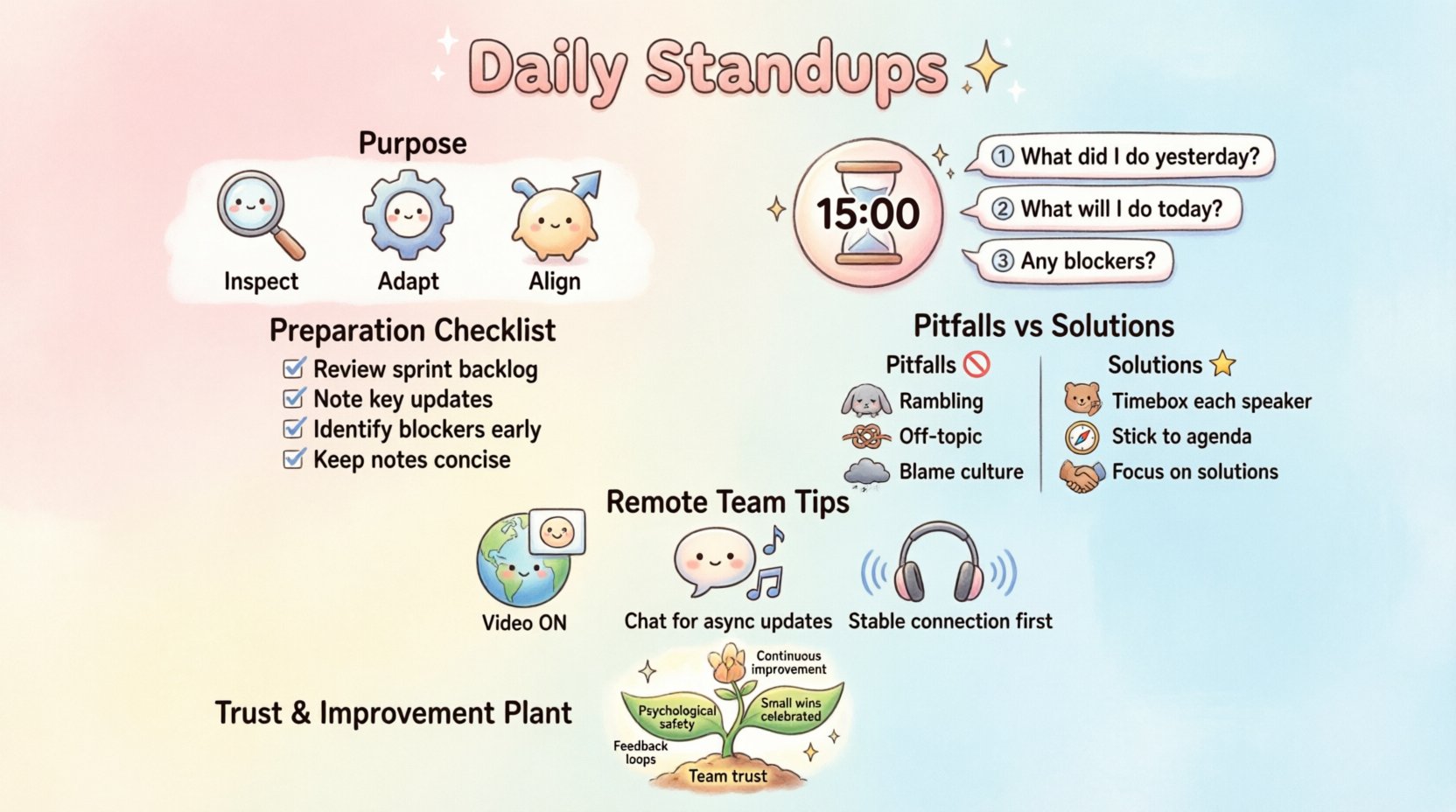
Inspection: The team inspects the work done in the previous 24 hours.
Adaptation: The team adapts the plan for the next 24 hours based on current realities.
Alignment: Everyone understands what others are working on to prevent duplicate effort.
When the focus shifts from “what I did” to “what we are doing,” the dynamic changes. The conversation moves away from individual accountability under scrutiny and toward collective ownership. This subtle shift reduces anxiety and encourages collaboration. Team members begin to see their work as interconnected threads rather than isolated tasks.
📋 Preparation and Context
A meeting without context is a meeting without direction. The value of the standup is often determined before the timer starts. Teams that arrive unprepared waste valuable minutes searching for information or clarifying status updates that should have been visible.
Preparation involves maintaining a visible state of work. Whether using a physical board or a digital equivalent, the status of every item in the current iteration should be up to date. This ensures that when a team member steps up to speak, the context is already established for the group.
Review the Board: Before the meeting, each member should look at the task list and move items to reflect their actual status.
Identify Blockers: If a task is stuck, the reason should be documented or noted so it can be raised immediately if needed.
Review Goals: Briefly recall the sprint objective. This keeps the conversation anchored to the bigger picture.
This preparation allows the meeting itself to remain short. If the information is already available, the discussion focuses on coordination and risk management rather than data retrieval. This discipline is essential for maintaining the timebox.
⏱️ The Meeting Structure
Timeboxing is the single most effective tool for controlling meeting duration. A strict limit of 15 minutes is the industry standard. This constraint forces participants to be concise and prioritize the most critical information. If a meeting runs longer, it signals that the agenda or the structure needs adjustment.
The structure should follow a consistent pattern to reduce cognitive load. Participants often answer three core questions:
What did I complete since the last meeting?
What will I work on before the next meeting?
Are there any impediments stopping me?
While these questions are classic, they should not be treated as a rigid script. The goal is to convey the same information, not to recite a mantra. If a team member has completed nothing, they should explain why. If they have completed everything, they should explain what comes next. The third question is the most vital, as it highlights where the team needs to intervene.
Discussions regarding specific technical solutions should be discouraged during the standup. If two developers start debating the architecture of a feature, the facilitator must intervene. These conversations belong in a separate working session, often called a “parking lot” discussion, held immediately after the standup with only the relevant parties.
🌐 Managing Distributed Teams
Remote and hybrid work environments introduce new challenges to synchronization. Distance can create information silos where updates are missed or misinterpreted. Visual cues that are present in a physical room are lost in a video call.
To mitigate this, teams must adapt their communication channels. Video should be enabled whenever possible to capture non-verbal cues. Audio-only calls often lead to disengagement. However, camera fatigue is real, so flexibility is necessary.
Shared Virtual Board: Use a shared workspace where status updates are visible in real-time.
Chat Integration: Allow team members to post updates in a dedicated channel if they cannot attend the video call.
Time Zone Awareness: Rotate meeting times if the team spans multiple zones to ensure fairness.
For distributed teams, the standup often becomes a recording mechanism. If a member cannot attend, a voice note or text update should be posted in the team channel. This ensures the information is captured and reviewed by the rest of the group. It is crucial to maintain the rhythm even if the format shifts.
🚧 Common Pitfalls and Practical Solutions
Even experienced teams encounter friction in their daily routines. Recognizing these patterns early allows for correction before they become habits. The following table outlines common issues and the actions required to resolve them.
Pitfall | Impact | Solution |
|---|---|---|
Deep Dive Discussions | Time is wasted on detailed problem solving. | Park the topic for a separate meeting with only relevant members. |
One-Way Reporting | Team members speak to a manager, not peers. | Arrange seating or camera view in a circle to encourage peer-to-peer eye contact. |
Long Delays | Meetings start late, eating into the timebox. | Enforce a strict start time; latecomers do not change the schedule. |
Vague Updates | Updates like “working on it” provide no value. | Require specific completion percentages or tangible deliverables. |
Passive Silence | Team members disengage and stop listening. | Rotate the facilitation role to keep ownership distributed. |
🔄 Continuous Improvement
The process of running a standup is not static. It requires regular reflection and adjustment. If the meeting is consistently running over time, or if team members express frustration, the team must investigate the root cause. This is not a sign of failure but an opportunity to refine the workflow.
Retrospectives provide a formal space to discuss the health of the standup. However, minor adjustments can be made at any time. If the team decides to switch from standing to sitting, or to move the meeting to a different time, they should do so with a clear hypothesis about the expected outcome.
For example, a team might hypothesize that moving the standup to the morning will improve focus. They can test this for two weeks and then review the data. Did the meetings become shorter? Did the number of blockages decrease? If the data supports the change, the new practice becomes the standard. If not, revert to the previous method.
📊 Tracking Outcomes
How do you know the standup is effective? There are no complex metrics required, but observing the flow of work provides clear indicators. Look for the resolution of impediments. If blockers are identified in the standup and resolved quickly afterward, the process is working.
Another indicator is the flow of information. If a developer knows what their teammate is doing without asking, the synchronization is high. If there is frequent confusion about dependencies or overlapping work, the standup is not providing enough visibility.
Impediment Resolution Time: How long does it take to unblock a task after it is raised?
Meeting Duration: Does the meeting stay within the timebox?
Team Satisfaction: Do team members feel the meeting is useful or burdensome?
These metrics should be reviewed periodically. If the meeting duration increases, investigate the cause. Is there too much work? Are there too many interruptions? If team satisfaction drops, consider changing the format or the frequency.
🔍 The Role of the Facilitator
While Scrum Master roles vary, someone must guide the meeting to ensure it stays on track. This does not necessarily mean a dedicated manager. The facilitation role can be rotated among team members. This rotation builds leadership skills and ensures everyone understands the responsibility of keeping the team aligned.
The facilitator’s job is not to lead the discussion but to protect the timebox. They must gently steer conversations back to the main topic if they drift. They must ensure every voice is heard, especially the quieter members of the team. If a member has not spoken, the facilitator should invite them to share their update.
Facilitation also involves managing the energy of the room. A standup should be energetic and focused. If the energy is low, the facilitator can use a brief opening question to engage the group. If the energy is high but chaotic, they must bring it back to order. This balance is critical for maintaining a productive rhythm.
🛠️ Integrating with Other Practices
The standup does not exist in a vacuum. It connects with other agile practices such as backlog refinement, sprint planning, and retrospectives. The information gathered in the standup often feeds directly into these other ceremonies.
For instance, if a task is consistently delayed, it might indicate a need for better estimation in the planning phase. If blockers are frequent, it might indicate a need for better resource allocation in the refinement phase. The standup acts as the early warning system for the rest of the project lifecycle.
Teams should also integrate the standup with their tooling. If a task status is updated in the tool, the standup update should reflect that. This reduces the duplication of effort. However, do not rely solely on tools. The human conversation adds context that tools cannot capture. A status of “In Progress” might mean different things to different people. The verbal confirmation clarifies the ambiguity.
🧱 Building a Culture of Trust
Ultimately, the effectiveness of the standup depends on the culture of the team. If team members fear punishment for delays, they will hide problems. If they fear judgment for asking questions, they will remain silent. Trust is the foundation that allows the standup to function as a tool for improvement rather than a tool for control.
Leadership must model vulnerability. When a manager or lead admits they are blocked or unsure, it gives permission for the rest of the team to do the same. This openness accelerates problem-solving and strengthens relationships. When the standup becomes a safe space for honest communication, the team becomes more resilient.
Respect for time is also a cultural norm. If the team respects the 15-minute limit, it shows they value each other’s time. This respect extends to the preparation and the follow-up actions. If a blocker is raised, it must be addressed. If it is ignored, the team loses faith in the process.
🚀 Moving Forward
Implementing an effective daily standup requires commitment. It is not a quick fix. It demands consistent effort to maintain the discipline of preparation, timeboxing, and focus. However, the payoff is significant. Teams that master this routine report higher morale, better collaboration, and faster delivery.
Start small. Focus on the timebox and the preparation. Once those are stable, refine the content and the facilitation. Over time, the standup will naturally evolve to fit the team’s unique needs. The goal is not to follow a rigid rulebook but to create a rhythm that supports the work.
By treating the standup as a vital synchronization point rather than a bureaucratic hurdle, teams can unlock their true potential. The focus shifts from individual tasks to collective outcomes. The result is a team that moves in unison, capable of navigating complexity with clarity and confidence.