

Conflict is an inevitable part of human interaction, especially within high-performing groups striving for complex goals. In the context of Agile development, disagreement is not a sign of failure; rather, it is often a signal of deep engagement with the work. When teams push boundaries to deliver value, friction naturally occurs around priorities, technical approaches, and resource allocation. The goal is not to eliminate conflict but to facilitate its resolution in a way that strengthens the team and improves the product.
Agile methodologies emphasize individuals and interactions over processes and tools. This focus places the burden of communication squarely on the people involved. When disagreements arise, the mechanism for handling them must be rooted in respect, transparency, and a shared commitment to the team’s mission. This guide explores the mechanics of navigating conflict within an Agile environment, providing practical frameworks for understanding, addressing, and resolving disputes without relying on external software or rigid hierarchies.
Understanding the Nature of Conflict in Agile 🧩
To resolve conflict effectively, one must first understand its source. In many traditional settings, conflict is viewed as a disruption to be suppressed. In Agile, it is viewed as a source of innovation. When team members challenge the status quo, they are often identifying risks or opportunities that others have missed.
Types of Conflict
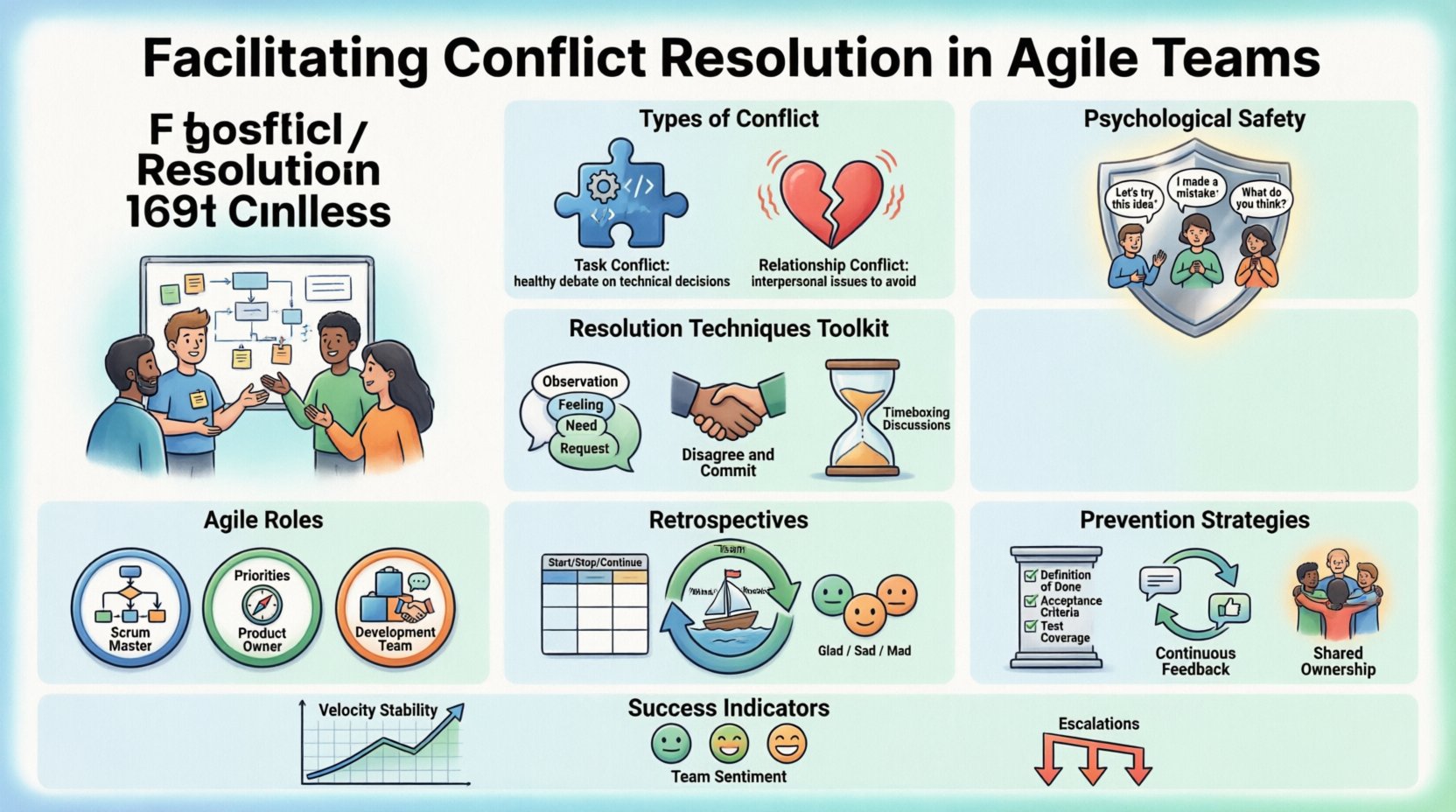
Not all disagreements are created equal. Distinguishing between the types of conflict helps determine the appropriate response strategy. Generally, conflicts fall into two primary categories:
Task Conflict: Disagreements about the content of the work. This involves technical decisions, design choices, or feature prioritization. Task conflict is often healthy and can lead to better solutions if managed constructively.
Relationship Conflict: Disagreements based on interpersonal incompatibilities. This involves personality clashes, perceived slights, or trust issues. Relationship conflict is almost always detrimental to team velocity and morale.
Agile teams must strive to maximize task conflict while minimizing relationship conflict. The challenge lies in ensuring that the former does not devolve into the latter.
The Foundation: Psychological Safety 🛡️
Before any resolution technique can be applied, the environment must support open dialogue. Psychological safety is the shared belief that the team is safe for interpersonal risk-taking. In a psychologically safe team, members feel comfortable admitting mistakes, asking questions, and proposing controversial ideas without fear of punishment or humiliation.
Indicators of Psychological Safety
Teams with high psychological safety exhibit specific behaviors that facilitate easier conflict resolution:
Open Admission of Errors: When a mistake happens, the focus is on fixing the process, not blaming the person.
Active Listening: Team members listen to understand, not just to reply.
Vulnerability: Leaders admit when they do not know the answer.
Questioning Authority: Junior members feel empowered to challenge senior members on technical grounds.
Without this foundation, conflict resolution becomes a political exercise rather than a problem-solving activity. If team members fear retaliation for speaking up, disagreements will fester until they become toxic.
Conflict Resolution Techniques 🛠️
When friction occurs, having a toolkit of resolution methods is essential. These techniques focus on communication and process rather than software features. The following methods are proven to de-escalate tension and find common ground.
1. Non-Violent Communication (NVC)
Non-Violent Communication is a structured approach to speaking and listening that focuses on needs rather than judgments. It involves four steps:
Observation: State the facts without evaluation. Instead of saying “You are lazy,” say “I noticed the task was not completed by the deadline.”
Feeling: Express how the observation affects you. “I feel concerned about the schedule.”
Need: Identify the underlying need. “I need to ensure we can deliver value to the customer on time.”
Request: Ask for a specific action. “Could we agree to a daily check-in until the task is done?”
Using NVC shifts the conversation from personal attacks to shared needs, making it easier to find a solution.
2. The Disagree and Commit Model
Decision-making can often be a source of conflict. The “Disagree and Commit” principle allows team members to express strong dissent during the discussion phase. Once a decision is made, everyone commits to executing it fully, even if they initially disagreed. This prevents paralysis while ensuring all voices were heard.
3. Timeboxing Discussions
Endless debate is a common trap. When a conflict arises, set a specific time limit for the discussion. If agreement is not reached within the timebox, the issue is escalated or put on hold for a later review. This prevents conflict from consuming the entire sprint.
Roles in Conflict Resolution 🎭
Different roles within an Agile framework have distinct responsibilities when conflict arises. Understanding these boundaries helps prevent role confusion from becoming a source of friction.
The Scrum Master
The Scrum Master acts as a facilitator rather than a manager. Their primary duty during conflict is to ensure the process is followed and that communication channels remain open. They do not dictate the solution but guide the team toward it. They are responsible for removing impediments that are blocking progress due to interpersonal issues.
The Product Owner
The Product Owner owns the “what” and the “why.” Conflict regarding priorities often lands here. The Product Owner must remain decisive but transparent. They must explain the reasoning behind priorities to help the team understand the business context, reducing friction caused by perceived arbitrariness.
The Development Team
The Development Team owns the “how.” Conflict regarding technical implementation is their domain. They must self-organize to resolve technical disagreements. If they cannot agree, they may need to seek a consensus through prototyping or spike work to gather data before deciding.
Structuring the Conversation: A Comparison Table
To better understand how to handle different scenarios, consider the following comparison of conflict types and recommended handling strategies.
Conflict Scenario | Underlying Cause | Recommended Approach | Goal |
|---|---|---|---|
Disagreement on Technical Architecture | Different views on scalability or maintainability | Technical Spike or Proof of Concept | Data-driven decision |
Disagreement on Sprint Goals | Misalignment on capacity or complexity | Review Velocity and Capacity | Realistic Commitment |
Interpersonal Friction | Communication style mismatch or past issues | Private Mediation or Retrospective | Restored Trust |
Prioritization Dispute | Conflicting stakeholder needs | Product Owner Facilitation | Business Value Alignment |
Utilizing Retrospectives for Resolution 🔄
The Retrospective is the dedicated space for addressing team dynamics. It is the most effective tool for resolving recurring conflicts. However, it is often misused. To use it effectively for conflict resolution, specific tactics should be employed.
Safe Format Selection
Standard formats may not work for deep-seated issues. Consider using specific retrospective formats:
The Start, Stop, Continue: Simple and effective for behavioral changes.
The Sailboat: Visualizes what is propelling the team forward (wind) and what is holding it back (anchors).
The Glad, Sad, Mad: Allows team members to express emotions safely regarding a specific event.
Handling Sensitive Topics
If a conflict is sensitive, it should not always be aired in the full group immediately. The Scrum Master may need to hold private sessions before bringing the topic to the whole team. This ensures that the team does not feel ambushed and that the discussion remains productive.
Prevention: Building a Resilient Culture 🌱
While resolution is necessary, prevention is superior. Building a culture that anticipates and mitigates conflict requires intentionality. Several practices can be adopted to reduce the frequency and intensity of disputes.
Clear Definitions of Done
Ambiguity is a breeding ground for conflict. When the team does not agree on what “finished” means, expectations clash. Establishing a Definition of Done that is specific and measurable ensures everyone pulls in the same direction.
Continuous Feedback Loops
Don’t wait for the end of a sprint to address issues. Short feedback loops allow small disagreements to be caught and resolved before they escalate. Daily interactions should include open channels for raising concerns.
Shared Ownership
When everyone owns the code and the product, the narrative shifts from “my work” to “our work.” Shared ownership reduces territorial behavior and encourages collaboration when problems arise.
Escalation and External Help 🆘
Not all conflicts can be resolved internally. There are times when the team lacks the perspective or authority to move forward. Recognizing when to escalate is a skill in itself.
When to Escalate
Resource Constraints: If the conflict is about lack of tools or people that the team cannot fix.
Values Violation: If the conflict involves harassment or discrimination.
Strategic Misalignment: If the team is working on the wrong things due to organizational changes.
External Mediation
In some cases, an external mediator may be necessary. This could be a senior leader from another department or an organizational coach. Their neutrality can help break deadlocks that internal members cannot resolve.
Long-Term Team Health 🏥
Conflict resolution is not a one-time fix. It is part of the ongoing maintenance of a high-functioning team. Teams that navigate conflict well become more resilient. They learn their own patterns and develop internal mechanisms for handling stress.
Measuring Success
How do you know if conflict resolution is working? Look for these indicators over time:
Velocity Stability: Disagreements are not causing unpredictable drops in delivery speed.
Team Sentiment: Retrospective feedback indicates higher satisfaction and lower stress.
Reduced Escalation: Fewer issues need to be raised to management.
Final Thoughts on Team Dynamics 💡
Building an Agile team is a journey of continuous improvement. Conflict is a natural byproduct of people working together on complex problems. By treating conflict as data rather than a problem to be hidden, teams can unlock deeper insights and stronger relationships. The focus remains on the work and the people, ensuring that the process supports the mission.
Remember that the Scrum Master is there to serve the team, not to control them. The Product Owner is there to provide direction, not to dictate every step. The Developers are there to build quality solutions, not just to follow orders. When these roles interact with clarity and respect, conflict becomes a tool for growth rather than an obstacle to success.
Implement these strategies consistently. Encourage open dialogue. Prioritize psychological safety. And remember that a team that argues well is often a team that thinks deeply. With the right approach, conflict resolution becomes a core competency that drives the entire organization forward.