

In the modern digital landscape, the complexity of enterprise systems continues to grow at an unprecedented pace. Organizations are navigating a maze of legacy infrastructure, cloud migrations, and shifting business strategies. Without a standardized language to describe this complexity, alignment between business goals and IT execution often becomes fragmented. This is where the ArchiMate framework proves its value. It provides a neutral, structured approach to modeling enterprise architecture, ensuring that every stakeholder, from the C-suite to engineering teams, speaks the same language.
Adopting a structured architectural standard is not merely a technical exercise; it is a strategic necessity. When enterprises lack a clear visualization of how their business capabilities map to the applications and technology supporting them, they risk investing in solutions that do not deliver expected value. This guide explores the critical reasons why your enterprise needs an ArchiMate framework today, examining its layers, benefits, and role in sustainable transformation.
Understanding the Core Purpose of Enterprise Architecture 🧩
Enterprise Architecture (EA) serves as the blueprint for an organization’s structure. It defines how business processes, information systems, and technology infrastructure interact. However, EA can often feel abstract and disconnected from day-to-day operations. The ArchiMate framework addresses this by offering a visual modeling language that bridges the gap between strategy and execution.
Unlike proprietary methods, ArchiMate is an open standard managed by The Open Group. This ensures longevity and compatibility across different tools and methodologies. The framework allows architects to create models that are:
Consistent: Using a unified notation reduces ambiguity.
Comprehensive: Covering all aspects from strategy to infrastructure.
Interoperable: Compatible with other standards like TOGAF.
When an organization implements this framework, it moves away from siloed documentation. Instead, it creates a living repository of knowledge that evolves alongside the business. This is crucial for maintaining agility in a market that changes rapidly.
The Three Core Layers of the Framework 📚
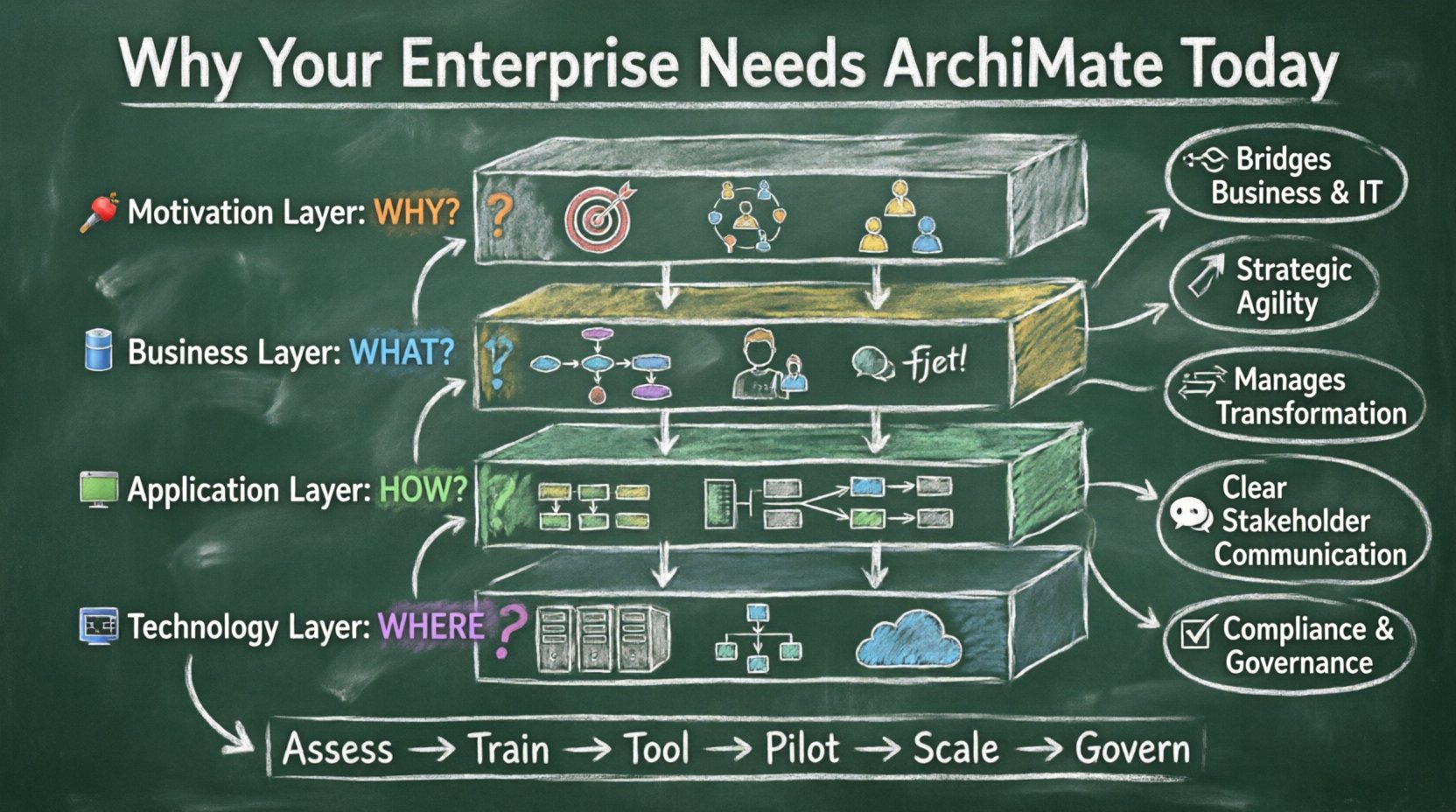
One of the primary strengths of ArchiMate is its layered structure. This separation of concerns allows different teams to focus on their specific domains while understanding how they connect. The framework is generally divided into three main layers, plus a specialized motivation layer.
1. The Business Layer 🏢
The business layer represents the organization from a business perspective. It focuses on:
Business Processes: The activities that create value for customers.
Business Functions: The capabilities required to execute processes.
Business Roles: The people or groups performing activities.
Business Objects: The data entities used within processes.
By modeling this layer, leaders can identify bottlenecks in workflows before technology is even considered. It ensures that IT investments directly support business capabilities.
2. The Application Layer 💻
This layer describes the software applications that support the business processes. It includes:
Application Services: Functions provided by applications to the business.
Application Components: Modular parts of software systems.
Application Interfaces: Points of interaction between applications.
Mapping the application layer helps in understanding software dependencies. It reveals where technical debt accumulates and where consolidation can reduce costs.
3. The Technology Layer 🖥️
The technology layer represents the physical and logical infrastructure. It covers:
System Software: Operating systems and middleware.
Network: Connectivity and communication paths.
Hardware: Physical devices and servers.
Deployment Nodes: Where software is executed.
Visualizing the technology layer is essential for infrastructure planning. It helps in assessing scalability, security risks, and the impact of cloud migration strategies.
4. The Business Motivation Layer 🎯
Beyond the three technical layers, the framework includes a business motivation layer. This is often overlooked but is critical for alignment. It models:
Goals: What the organization wants to achieve.
Principles: Rules that guide decision-making.
Requirements: Needs that must be met.
Stakeholders: Who is affected by the changes.
This layer connects the “why” to the “how.” It ensures that every technical decision traces back to a specific business objective.
Layer | Focus Area | Key Question Answered |
|---|---|---|
Business Motivation | Strategy & Drivers | Why are we doing this? |
Business | Capabilities & Processes | What do we do? |
Application | Software & Services | How do we support it? |
Technology | Infrastructure & Hardware | Where is it hosted? |
Bridging the Gap Between Business and IT 🤝
One of the most persistent challenges in large organizations is the disconnect between business units and IT departments. Business leaders often struggle to articulate requirements in technical terms, while IT teams may build solutions that do not solve the actual business problem. The ArchiMate framework acts as a translation layer.
By using a common modeling language, stakeholders can visualize the impact of changes. For example, if the business wants to enter a new market, the architecture model can show:
Which business processes need to change.
Which applications must be modified or replaced.
Which infrastructure resources need to be scaled.
This transparency reduces friction. Decisions are no longer based on assumptions but on visible, modeled relationships. It fosters a culture of collaboration where IT is seen as a strategic partner rather than a utility provider.
Driving Strategic Alignment and Agility 🚀
Agility is not just about moving fast; it is about moving in the right direction. In a volatile market, strategies change frequently. An architecture framework allows organizations to pivot without rebuilding everything from scratch.
When you have a clear model of your current state, you can design a target state that aligns with new goals. This capability is vital for:
Scenario Planning: Simulating the impact of different strategies before implementation.
Resource Allocation: Directing budget to the areas that drive the most value.
Risk Management: Identifying single points of failure in the architecture.
Furthermore, this alignment helps in prioritization. When multiple projects compete for resources, the architecture model provides the evidence needed to decide which projects support the core strategy and which are distractions.
Managing Complexity in Digital Transformation 🔄
Digital transformation initiatives often fail because they attempt to change too many things at once. The sheer complexity of integrating legacy systems with modern cloud services creates a web of dependencies that is hard to manage. The ArchiMate framework helps break this complexity down into manageable chunks.
It enables architects to define migration paths. Instead of a “big bang” approach, organizations can plan incremental transitions. The framework supports:
Gap Analysis: Identifying the differences between the current state and the target state.
Transformation Roadmaps: Sequencing initiatives to minimize disruption.
Dependency Mapping: Understanding what must be ready before another project can start.
This structured approach to transformation reduces the risk of project failure. It ensures that the organization moves forward with a clear understanding of the dependencies and the sequence of execution.
Enhancing Communication Across Stakeholders 🗣️
Effective communication is the backbone of successful enterprise architecture. Different stakeholders require different views of the architecture. Executives need high-level strategy views, while developers need detailed component diagrams.
The framework supports the creation of multiple viewpoints from a single model. This means:
Consistency: All views are derived from the same source of truth.
Customization: Information is tailored to the audience’s needs.
Clarity: Visual models are easier to understand than lengthy documents.
When stakeholders can see the architecture visually, misunderstandings decrease. Questions about system interactions or process flows can be answered by referencing the model. This reduces the time spent in meetings explaining basic concepts and allows for deeper strategic discussions.
Standardizing Governance and Compliance 📋
In regulated industries, compliance is not optional. Organizations must adhere to standards regarding data security, data residency, and operational resilience. An architectural framework provides the structure needed to embed these requirements into the design.
By modeling compliance requirements as part of the architecture, organizations can:
Trace Requirements: Link specific regulations to specific systems or processes.
Audit Readiness: Generate reports that show adherence to standards.
Automate Checks: Integrate governance rules into the architecture lifecycle.
This proactive approach prevents compliance issues from becoming reactive crises. It ensures that security and regulatory considerations are baked into the architecture from the beginning, rather than added as an afterthought.
Integration with Other Architecture Frameworks 🔄
The ArchiMate framework is designed to be interoperable. It does not exist in isolation. It works seamlessly with the TOGAF (The Open Group Architecture Framework) methodology. While TOGAF provides the process for creating architecture, ArchiMate provides the language for representing it.
This integration offers several advantages:
Methodology Support: TOGAF ADM cycles can use ArchiMate models as deliverables.
Best Practices: Leverages the combined knowledge of both frameworks.
Flexibility: Allows organizations to adopt the parts of the methodology that fit their culture.
Other frameworks, such as ITIL for IT service management or COBIT for governance, also complement the architectural view. This holistic ecosystem ensures that architecture is not an island but part of a broader management strategy.
Practical Steps for Adoption 🛠️
Implementing the framework requires a planned approach. It is not something that happens overnight. The following steps outline a typical adoption path:
Assessment: Evaluate the current maturity of architecture practices within the enterprise.
Training: Ensure key personnel understand the concepts and notation.
Tooling: Select software that supports the modeling language (without being tied to a specific vendor).
Pilot: Start with a specific domain or project to demonstrate value.
Scale: Expand the modeling efforts to cover more of the enterprise.
Governance: Establish review processes to maintain model quality.
Patience is key during this process. The goal is to build a culture of architectural thinking, not just to produce diagrams.
Overcoming Common Implementation Challenges ⚠️
Even with a clear plan, organizations face hurdles when adopting this framework. Awareness of these common pitfalls helps in mitigating them.
Over-Modeling: Creating too many details too quickly can slow down progress. Focus on the essential relationships first.
Lack of Buy-in: If leadership does not support the initiative, it will struggle. Communicate the business value clearly.
Maintenance: Models become outdated if not maintained. Integrate updates into the change management process.
Complexity: Do not try to model the entire enterprise at once. Start with a specific business capability.
Addressing these challenges early ensures a smoother transition. It is better to have a simple, maintained model than a complex, obsolete one.
Future-Proofing Your Architecture 🛡️
Technology trends such as artificial intelligence, blockchain, and the Internet of Things are reshaping the business landscape. An architecture framework provides the stability needed to adapt to these changes.
By maintaining a clear view of the current state, organizations can assess the impact of new technologies. They can determine:
Which systems need to be upgraded.
Where new capabilities can be integrated.
What risks are associated with adopting new tech.
This forward-looking perspective ensures that the enterprise remains competitive. It allows for strategic investment in technology that drives long-term value rather than short-term fixes.
Final Thoughts on Architectural Maturity 📊
The decision to adopt the ArchiMate framework is a commitment to clarity and alignment. It represents a shift from reactive problem-solving to proactive design. While the journey requires investment in time and training, the return on investment is significant.
Organizations that embrace this standard gain a competitive edge. They can respond to market changes faster, reduce technical debt, and ensure that IT investments align with business goals. In an era defined by complexity, the ability to model and understand the enterprise architecture is not just an advantage; it is a requirement for survival.
As you consider your next steps, remember that the framework is a tool to enable better decisions. It does not make the decisions for you, but it provides the map you need to navigate the future with confidence.