

The landscape of software development has shifted dramatically over the last few years. The traditional office model, where teams sat in pods and collaborated face-to-face, is no longer the only way to build high-quality products. Today, distributed teams are the norm rather than the exception. This shift requires a deliberate approach to Agile methodologies. Simply moving stand-up meetings to video calls does not make a team Agile. True remote Agile requires a rethinking of communication, trust, and workflow.
This guide outlines the essential practices for maintaining velocity, quality, and team cohesion when your developers are scattered across different time zones and locations. We will explore how to build a culture that thrives without physical proximity and how to adapt Agile ceremonies for a digital-first environment. 🚀
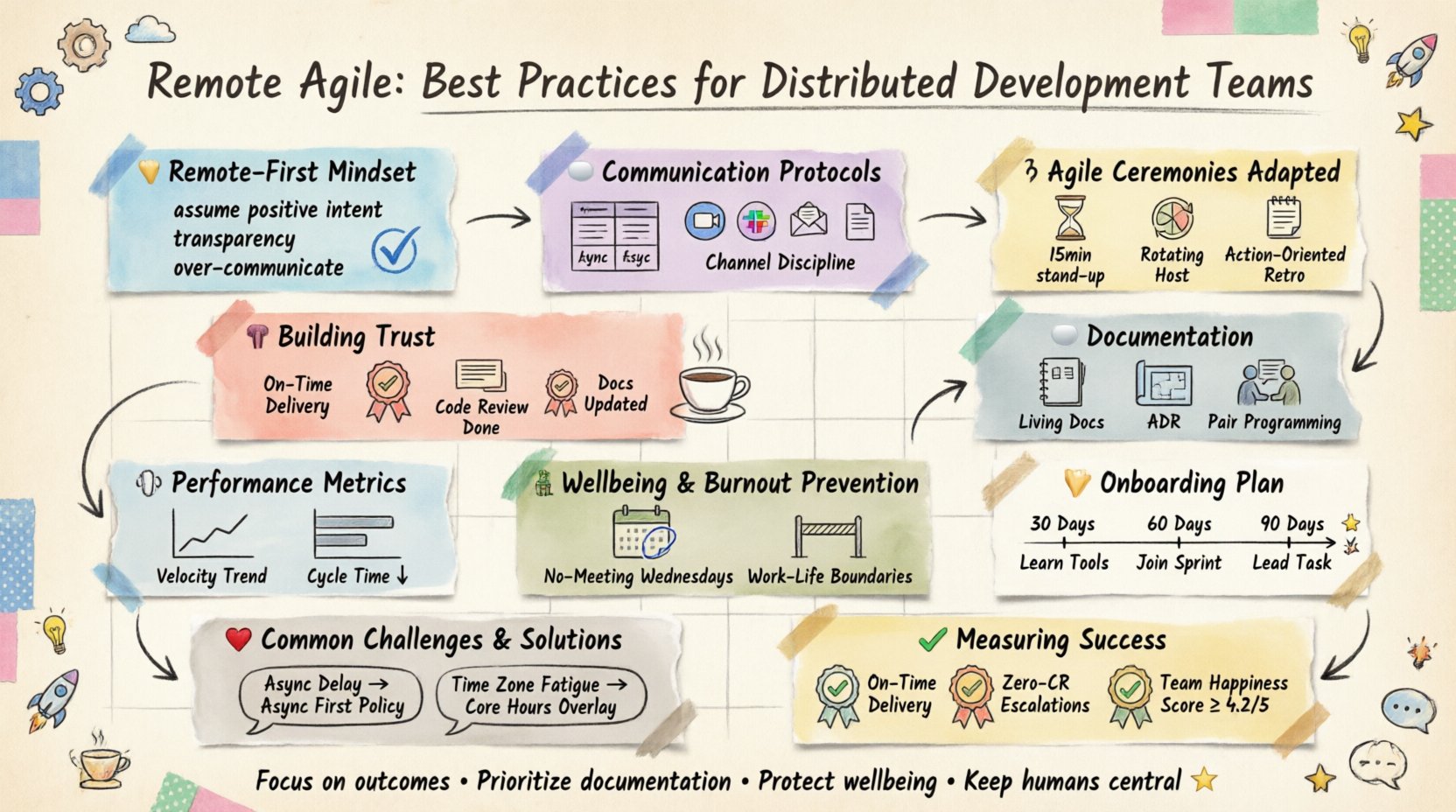
1. Establishing a Remote-First Mindset 🧠
Before discussing tools or ceremonies, the team must adopt a specific mindset. In a collocated environment, context is often absorbed passively by overhearing conversations or seeing someone struggle with a problem. In a remote setting, context must be made explicit. Every piece of information, decision, or change in direction needs to be documented and communicated deliberately.
Assume Positive Intent: Without tone of voice or body language, text can easily be misinterpreted. When a message seems blunt, assume the sender is being direct, not rude.
Default to Transparency: Decisions made in private channels create silos. Move discussions to public channels where the whole team can see the rationale behind choices.
Over-Communicate: What feels like too much information in an office often feels like too little remotely. Repeat critical updates in multiple formats.
This mindset shift is the foundation. Without it, the mechanics of Agile will crumble under the weight of miscommunication. 🏗️
2. Communication Protocols for Distributed Groups 🗣️
Effective communication in a distributed team is not about talking more; it is about talking with the right intent and through the right channel. We must distinguish between synchronous and asynchronous communication to prevent fatigue and ensure deep work time is protected.
Synchronous vs. Asynchronous Balance ⚖️
Synchronous communication happens in real-time (e.g., video calls, live chat). Asynchronous communication happens with a delay (e.g., email, documentation, ticket comments). A healthy remote team maximizes async to allow for deep work and minimizes sync to prevent context switching.
Communication Type | Best Used For | Frequency |
|---|---|---|
Asynchronous | Updates, documentation, code reviews, non-urgent questions | Daily / Ongoing |
Synchronous | Brainstorming, conflict resolution, team bonding, complex planning | Weekly / As Needed |
Channel Discipline 📢
Having too many places to look for information leads to missed messages. Teams should establish clear rules for where information lives.
Instant Messaging: Use for quick questions, urgent alerts, and social interaction. Do not use for long-form discussion or decision making.
Documentation: Use for architectural decisions, onboarding guides, and project requirements. If it is not written down, it does not exist.
Project Management: Use for tracking tasks, status, and bugs. Do not discuss task status outside of this system.
Email: Use for formal announcements or external communication.
By enforcing these boundaries, developers can focus on their work without constant interruptions. This leads to higher quality output and reduced burnout. 💻
3. Adapting Agile Ceremonies for Time Zones 🕒
Standard Agile ceremonies are designed for a team in the same room. When distributed, these events often become burdensome rather than helpful. We must adapt them to respect time zones and ensure they provide value.
Stand-Up Meetings 🌅
The daily stand-up should not be a status report for a manager. It is a synchronization event for peers. In a remote setting, video calls can be draining if they last longer than 15 minutes.
Duration: Keep it strictly to 15 minutes. Use a timer.
Format: If time zones are widely spread, consider a text-based stand-up. Team members post updates in a dedicated channel at a time that works for them.
Focus: Focus on blockers. Do not go into technical deep dives during the stand-up. Move those conversations to a separate room or chat thread.
Planning and Review 📅
These sessions require more cognitive load. They are better suited for synchronous meetings, but they must be scheduled carefully.
Rotation: If the team spans multiple time zones, rotate the meeting time. Do not always make one region stay up late.
Preparation: The Product Owner or Lead must prepare the agenda and user stories before the meeting. The meeting is for discussion and estimation, not reading requirements.
Recording: If a team member cannot attend due to time zone conflicts, record the session or provide a detailed summary immediately after.
Retrospectives 🔄
Retrospectives are vital for continuous improvement. However, they are often difficult to facilitate remotely.
Psychological Safety: Ensure everyone feels safe to speak up. Anonymity tools for feedback can help in the beginning.
Structure: Use structured formats like “Start, Stop, Continue” to keep the conversation focused.
Action Items: Assign owners to every action item. Remote teams often struggle to follow through on agreements made in meetings without clear ownership.
4. Building Trust Without Face-to-Face Interaction 🤝
Trust is the currency of Agile. In a remote environment, you cannot build trust by simply seeing someone every day. You must build it through reliability and transparency.
Reliability over Availability
Managers often mistake being online for being productive. In remote Agile, the focus must shift to output. Did the work get done? Was the quality high? Did the team meet the commitment?
Outcome-Based Goals: Measure success by the value delivered, not the hours logged.
Respect Boundaries: Do not expect immediate responses at all hours. Honor off-hours and vacation time.
Virtual Social Interaction
In an office, people bond over coffee or lunch. Remote teams need to create these moments intentionally.
Virtual Coffee: Schedule optional 15-minute chats where work talk is forbidden.
Channel for Life: Create channels for pets, hobbies, or local news to humanize the team.
Onboarding Buddies: Assign a mentor to new hires to help them navigate the culture, not just the code.
5. Documentation and Knowledge Sharing 📚
In a physical office, knowledge is often tribal. If a senior developer leaves, the knowledge leaves with them. In a remote environment, this is a critical risk. Documentation is not optional; it is the infrastructure of the team.
Living Documentation
Documentation should not be a static PDF that gets outdated. It must live alongside the code and be updated as part of the Definition of Done.
Architecture Decision Records (ADR): Document why technical decisions were made so future developers understand the context.
API Specs: Ensure interfaces are clearly defined and accessible.
Runbooks: Create guides for common operational tasks like deployments or troubleshooting.
Knowledge Sharing Sessions
Encourage team members to teach each other. This reduces the bus factor and spreads expertise.
Tech Talks: Host weekly or bi-weekly sessions where a team member presents a new technology or concept.
Pair Programming: Use screen sharing to pair program remotely. This is excellent for mentoring and knowledge transfer.
Code Reviews: Treat code reviews as a learning opportunity, not just a gatekeeping mechanism. Comment generously and explain the “why” behind suggestions.
6. Managing Performance and Accountability 📊
Managing performance remotely can feel daunting for leaders. Without the ability to see someone working, it is easy to feel disconnected. However, Agile relies on self-organization and accountability.
Clear Expectations
Every team member should know exactly what is expected of them. Ambiguity is the enemy of remote performance.
Role Clarity: Ensure everyone knows their responsibilities and how they contribute to the team’s goals.
Definition of Done: Agree on what “finished” means. This prevents the feeling that work is never truly complete.
Regular Check-ins: Have 1:1 meetings focused on support and growth, not just status updates.
Metrics that Matter
Track metrics that indicate health and flow, not surveillance.
Velocity: Use this to predict capacity, not to judge performance.
Cycle Time: Measure how long it takes to move a ticket from start to finish.
Bug Rate: Track the quality of work delivered.
7. Ensuring Team Wellbeing and Preventing Burnout 🔋
Remote work blurs the line between home and office. This can lead to working longer hours and struggling to disconnect. Burnout is a significant risk for distributed Agile teams.
Boundaries are Essential
Teams must actively create boundaries to protect their mental health.
End of Day Rituals: Have a specific action that signals the end of the workday, such as closing all tabs or turning off notifications.
No-Meeting Days: Designate days where no synchronous meetings are allowed to allow for deep focus work.
Respect Time Zones: Avoid scheduling meetings that require someone to join at unreasonable hours.
Encourage Breaks
Agile promotes sustainable pace. This means taking breaks and resting.
Walk and Talk: Encourage team members to take walking calls when possible.
Wellbeing Check-ins: Make space in meetings to ask “How is everyone doing?” and listen to the answer.
8. Onboarding and Integration for New Hires 👋
Onboarding a remote developer is significantly harder than onboarding a collocated one. They miss out on the informal learning that happens in the hallway.
Structured Onboarding Plan
Do not leave onboarding to chance. Create a 30-60-90 day plan.
Week 1: Focus on setup, access, and culture. Assign a buddy.
Week 2-4: Focus on small, low-risk tasks to build confidence.
Month 2-3: Focus on independent work and deeper integration into the team.
Access and Environment
Ensure all tools and accounts are ready before the start date. Nothing kills momentum like waiting for access.
Hardware: Ship laptops and equipment early.
Accounts: Provision all necessary software access in advance.
Documentation: Provide a welcome guide that covers the tech stack and team processes.
9. Overcoming Common Challenges in Distributed Scrum 🛑
Even with best practices, challenges will arise. Here is how to handle the most common issues.
Issue: Communication Silos
Solution: Rotate facilitation roles. Ensure decisions are made in public channels. Encourage cross-team collaboration.
Issue: Time Zone Fatigue
Solution: Limit synchronous meetings. Rely on documentation and async updates. Rotate meeting times fairly.
Issue: Lack of Visibility
Solution: Use dashboards to track progress. Make status updates visible in the project management tool. Avoid micromanagement.
Issue: Isolation
Solution: Invest in virtual social events. Encourage 1:1 chats. Ensure team members feel heard and valued.
10. Measuring Success in a Remote Environment 📈
How do you know if your remote Agile team is working well? Look beyond the numbers. Success is a combination of delivery metrics and team health.
Delivery Consistency: Are we meeting our commitments regularly?
Quality: Is the defect rate low? Is technical debt being managed?
Team Happiness: Are team members reporting satisfaction? Is turnover low?
Collaboration: Are team members helping each other, or working in isolation?
Use retrospective feedback to gauge these areas. If the numbers look good but the team is unhappy, the remote setup is failing, even if the code is shipping. 🏆
Conclusion: The Path Forward 🛣️
Remote Agile is not a destination; it is a continuous journey of adaptation. It requires discipline, empathy, and a commitment to clear communication. By focusing on outcomes over output, prioritizing documentation, and protecting team wellbeing, distributed teams can achieve the same, if not better, results than collocated ones.
The future of software development is flexible. Teams that master the art of remote collaboration will be the ones that attract the best talent and build the most resilient products. Start small, iterate on your processes, and keep the human element at the center of your Agile practice. 🌟