

In the modern business landscape, the gap between high-level strategy and day-to-day work can be the difference between success and stagnation. Many organizations adopt Agile practices to improve speed and flexibility, yet often fail to ensure that the work being delivered actually moves the needle on business objectives. This disconnect creates a scenario where teams are busy, but not necessarily effective. To truly thrive, a clear line of sight must exist from the executive vision down to the individual tasks completed within a sprint. This guide explores how to bridge that gap effectively.
Understanding the Strategic Gap 🧩
It is common for companies to have a clear vision for the next year, while the development teams focus solely on the next two weeks. This fragmentation leads to what is often called the “strategy execution gap.” When business goals are not translated into actionable items, resources are wasted on features that do not contribute to the core mission. The cost of this misalignment is significant, manifesting in delayed time-to-market, reduced customer satisfaction, and increased operational friction.
Agile execution is not just about delivering code faster. It is about delivering the right value. When alignment is missing, teams may optimize for velocity without regard for impact. For example, a team might complete all their sprint commitments, but if those commitments were not prioritized based on current market needs, the outcome is an accumulation of technical debt and unused features. The goal is to ensure that every story, every epic, and every release supports a specific business outcome.
Consider the following scenarios where alignment fails:
- Top-Down Mandates: Leadership sets a goal, but the team interprets it differently due to a lack of context.
- Siloed Teams: Different departments work in isolation, creating features that do not integrate well or serve a unified purpose.
- Shifting Priorities: Frequent changes to the roadmap without understanding the downstream impact on the backlog.
- Missing Feedback Loops: Stakeholders are not involved in reviews, so the final product does not meet user needs.
Addressing these issues requires a structured approach to planning and communication. It involves creating a framework where strategy informs execution, and execution informs strategy through feedback.
Building a Shared Vision 👁️
The foundation of alignment is a shared understanding of the destination. Every member of the organization, from the boardroom to the development floor, should understand the “why” behind the work. This vision should not be a static document locked in a drawer. It must be a living concept that guides decision-making.
To build this vision, organizations should focus on:
- Clear Mission Statements: Define what the organization aims to achieve in the long term.
- Strategic Themes: Identify key areas of focus that support the mission. These themes act as pillars for the roadmap.
- Objective Setting: Use frameworks like OKRs (Objectives and Key Results) to make goals measurable and time-bound.
- Visual Management: Use boards and dashboards to make the progress toward goals visible to everyone.
When the vision is clear, teams can make better autonomous decisions. If a team member encounters a blocker or a choice between two tasks, they can refer back to the strategic theme to determine which path offers the most value. This reduces the need for micromanagement and empowers the workforce.
Translating Objectives into Agile Artifacts 📝
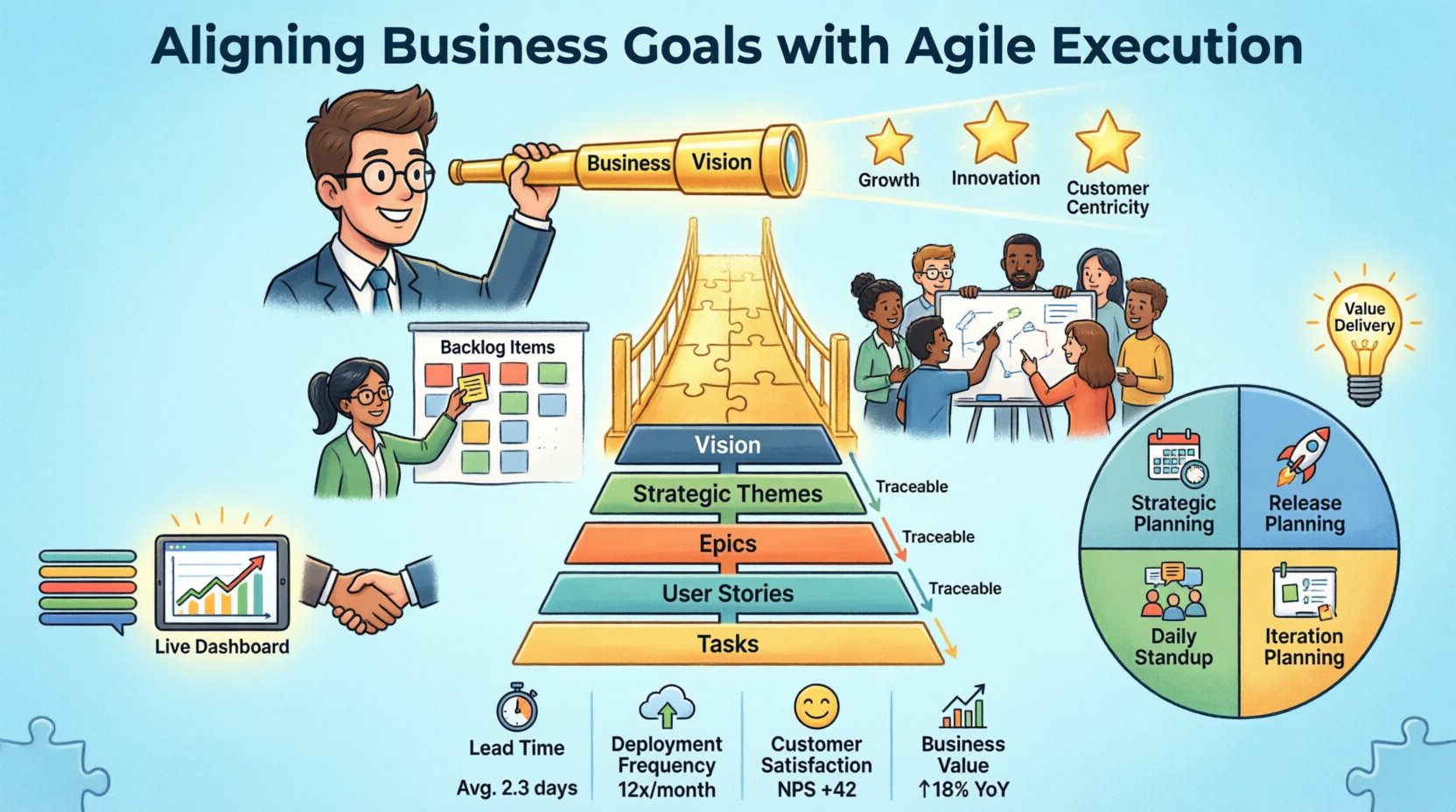
Once the strategy is defined, it must be broken down into manageable pieces. In Agile, this is done through a hierarchy of artifacts. This hierarchy acts as a translation layer, converting abstract business goals into concrete work items.
The Hierarchy of Work
Understanding the structure of work helps in maintaining alignment at every level. The typical structure includes:
- Vision: The long-term aspiration of the product or organization.
- Themes: High-level categories of work that align with strategic goals.
- Epics: Large bodies of work that span multiple iterations and contribute to a theme.
- Stories: User-facing features or capabilities that deliver value within a single iteration.
- Tasks: Technical or functional steps required to complete a story.
Each level in this hierarchy should trace back to the one above it. A task should support a story. A story should contribute to an epic. An epic should advance a theme. A theme should achieve a strategic objective. This traceability ensures that no effort is expended in a vacuum.
Backlog Refinement and Prioritization
The product backlog is the single source of truth for what needs to be built. To keep it aligned with business goals, it requires regular refinement. This process involves reviewing items, clarifying requirements, and adjusting priorities based on new information.
During refinement sessions, stakeholders should be invited to discuss the business value of upcoming items. Questions to ask include:
- How does this item support our current strategic theme?
- What is the expected return on investment?
- Is this still relevant given the current market conditions?
- Does this block any other critical work?
Prioritization frameworks help in ranking these items. Techniques such as Weighted Shortest Job First (WSJF) or Value vs. Effort matrices allow teams to objectively decide what to work on next. The goal is always to maximize value delivery while minimizing waste.
The Planning Hierarchy in Action 📊
Planning in Agile is not a one-time event. It happens at multiple levels and frequencies. This iterative planning ensures that the plan remains flexible yet aligned.
| Planning Level | Frequency | Focus | Key Participants |
|---|---|---|---|
| Strategic Planning | Annual / Quarterly | Setting vision and high-level goals | Executives, Product Owners, Stakeholders |
| Release Planning | Quarterly / Bi-Annual | Defining milestones and feature sets | Product Owners, Team Leads, Architects |
| Iteration Planning | Every 1-2 Weeks | Selecting stories for the sprint | Development Team, Product Owner |
| Daily Standup | Daily | Tracking progress and removing blockers | Development Team |
By adhering to this hierarchy, organizations ensure that short-term actions are always checking in with long-term goals. If a strategic goal changes, it ripples down through the release plan and the iteration plan, allowing for rapid adaptation without losing direction.
Communication and Transparency 🗣️
Alignment cannot exist without communication. Information must flow freely between leadership, management, and execution teams. Transparency builds trust and allows everyone to understand the context of their work.
- Regular Syncs: Hold regular meetings between business leaders and product teams. These should not be status updates but strategic discussions.
- Open Dashboards: Use visual tools to show progress against goals. Everyone should be able to see the current state of the roadmap.
- Stakeholder Involvement: Invite stakeholders to review sessions and planning meetings. Their feedback ensures the product remains relevant.
- Documentation: Maintain clear documentation of goals, decisions, and rationale. This serves as a reference point for future decisions.
When communication is open, misunderstandings are caught early. Teams do not have to guess what the business wants; they are told. Similarly, leadership understands the constraints and realities of the development process. This mutual understanding fosters a collaborative environment.
Measuring Value Delivery 📈
How do you know if you are aligned? You measure it. Traditional metrics like lines of code or story points can be misleading if they do not reflect business value. It is crucial to shift the focus to outcome-based metrics.
Key metrics to track include:
- Lead Time: How long does it take from idea to production?
- Deployment Frequency: How often do you release value?
- Change Failure Rate: How often do releases cause issues?
- Customer Satisfaction: How do users rate the product?
- Business Value Delivered: Revenue growth, cost reduction, or market share gained.
By tracking these metrics, organizations can verify if their execution is actually achieving the business goals. If the metrics show high velocity but low customer satisfaction, the alignment is broken. The team is moving fast, but in the wrong direction.
Common Obstacles and Solutions 🛑
Even with the best intentions, obstacles arise. Recognizing these patterns early allows teams to address them before they become systemic issues.
| Obstacle | Impact | Solution |
|---|---|---|
| Micromanagement | Reduces team autonomy and morale | Empower teams to decide how to achieve goals |
| Frequent Scope Changes | Causes confusion and delays | Establish a change control process and protect sprint goals |
| Lack of Context | Teams build the wrong features | Share business strategy and market data regularly |
| Isolated Teams | Creates silos and integration issues | Implement cross-functional collaboration practices |
| Focus on Output over Outcome | Teams optimize for completion, not value | Shift KPIs to measure business impact |
Solving these issues requires a commitment to continuous improvement. Retrospectives should not just focus on team dynamics but also on alignment and strategic fit. Ask the team: “Did our work this sprint contribute to the bigger picture?”
Scaling Alignment Across Teams 🌐
As organizations grow, they often move from a single team to a program or portfolio level. Scaling alignment introduces complexity. Multiple teams must coordinate their efforts to ensure they do not step on each other’s toes while working toward the same goal.
- Common Roadmap: Maintain a unified roadmap that shows how all teams contribute to the overall strategy.
- Integration Points: Clearly define how different teams’ work integrates. Dependencies must be managed proactively.
- Communities of Practice: Encourage knowledge sharing across teams to reduce duplication and spread best practices.
- Program Increment Planning: Use planning events that bring all teams together to synchronize their work.
Scaling does not mean losing the agility of the small team. It means applying the principles of alignment and transparency at a larger scale. The goal is to create a system where the whole is greater than the sum of its parts.
Frequently Asked Questions ❓
How often should business goals be reviewed?
Business goals should be reviewed at least quarterly. This allows the organization to adapt to market changes without losing sight of the long-term vision. However, tactical priorities may need to shift more frequently based on feedback.
What if the team disagrees with the business goal?
Disagreement is healthy if it is based on data or technical constraints. Teams should voice concerns early. The goal is to find a solution that satisfies both the business need and the technical reality. Open dialogue is key.
Can we change goals mid-sprint?
Generally, no. Sprints are designed to be stable periods of focus. Changing goals mid-sprint disrupts the team’s flow and reduces predictability. If a critical change is needed, it should be discussed with the team, and the sprint goal may need to be adjusted formally.
How do we handle technical debt in relation to goals?
Technical debt should be treated as a risk to the business goal. If it threatens delivery speed or quality, it must be addressed. Allocate capacity in the backlog to pay down debt alongside feature work. This ensures the long-term health of the product supports the strategy.
Aligning business goals with Agile execution is a continuous journey. It requires discipline, communication, and a willingness to adapt. When done correctly, it transforms the organization into a cohesive unit capable of delivering value with speed and precision.