

In the fast-paced world of Agile development, the backlog is more than a list of tasks. It is a strategic asset that guides the team toward measurable outcomes. However, a backlog without clear order is merely a wish list. It creates noise, dilutes focus, and risks delivering features that do not move the needle for the business or the user. Effective backlog prioritization is the mechanism that transforms a collection of ideas into a roadmap for value.
This guide explores the core methodologies used to order work. We will look at how to weigh effort against impact, manage conflicting stakeholder demands, and maintain a healthy balance between new features and technical maintenance. The goal is not to create a perfect list, but to create a dynamic system that adapts to change while consistently delivering the highest value.
Why Prioritization Matters in Agile 🧭
Agile frameworks operate on the premise of iterative delivery. Work is done in cycles, and the team must decide what to pull into the next cycle. Without a rigorous prioritization process, several issues arise:
Resource Wastage: Time spent on low-value items reduces capacity for high-impact work.
Stakeholder Frustration: If business leaders do not see their top requests addressed, trust erodes.
Team Burnout: Constant context switching and unclear direction lead to fatigue.
Missed Opportunities: Market windows close. Delaying critical features can result in lost revenue or market share.
Prioritization is an ongoing conversation. It requires data, collaboration, and the courage to say no. It is not a one-time activity at the start of a project. It is a continuous practice that evolves as market conditions and internal capabilities shift.
Core Frameworks for Backlog Ordering 🛠️
Several structured approaches exist to help teams make objective decisions. Each method has specific use cases depending on the team’s size, the maturity of the product, and the type of work being undertaken. Below are the most widely adopted techniques.
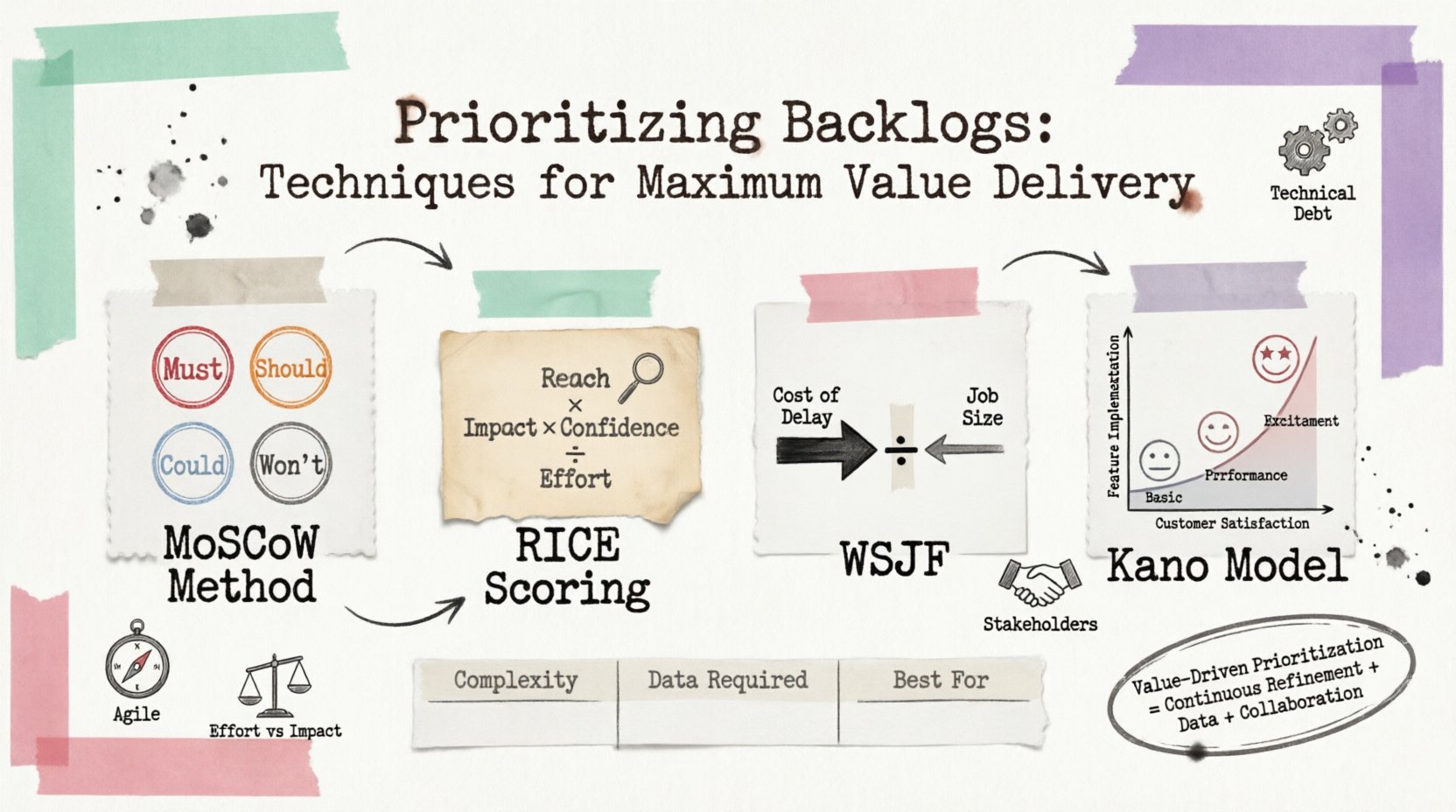
1. The MoSCoW Method
This approach categorizes items into four distinct buckets. It is particularly useful during sprint planning or release planning when time is fixed but scope is flexible.
Must Have: Non-negotiable requirements. If these are not delivered, the release is considered a failure. These are critical for regulatory compliance or core functionality.
Should Have: Important but not vital. These add significant value but can be delayed to the next iteration if necessary.
Could Have: Desirable features. These are nice to have but will not cause major issues if omitted. They are often the first to be cut under pressure.
Won’t Have: Agreed items that will not be completed in the current timeframe. This clarifies scope and prevents scope creep.
Best Use Case: When working with tight deadlines and limited resources where a minimum viable product (MVP) is the goal.
2. RICE Scoring
RICE is a quantitative model that scores initiatives based on four factors. It helps remove bias by forcing the team to assign numerical values to subjective concepts.
Reach: How many users will this impact in a given period? (e.g., 1000 users per month).
Impact: How much will this move the key metric? (Scale: 3 = Massive, 2 = High, 1 = Medium, 0.5 = Low, 0.25 = Minimal).
Confidence: How sure are you about your estimates? (High = 100%, Medium = 80%, Low = 50%).
Effort: How much work will this take? Measured in person-months or sprints.
The formula is: (Reach × Impact × Confidence) / Effort. The resulting score allows for direct comparison between disparate items, such as a marketing campaign and a backend refactoring task.
Best Use Case: Product management teams that need to justify decisions to leadership with data.
3. Weighted Shortest Job First (WSJF)
Originating from Large Scale Agile (SAFe), WSJF calculates the cost of delay divided by the job size. It prioritizes jobs that provide the most value per unit of time.
Cost of Delay: Composed of three components:
Time Criticality: How quickly does value expire?
Job Size: How much does it cost to implement?
Business Value: How much does it help the business?
Job Size: The estimated duration or effort.
The logic is simple: deliver the biggest bang for the buck as soon as possible. This method is excellent for managing a large portfolio of work across multiple teams.
Best Use Case: Large organizations managing complex dependencies and multiple streams of work.
4. The Kano Model
The Kano Model classifies features based on customer satisfaction. It helps distinguish between basic needs and delighters.
Basic Needs: Expected features. If missing, users are dissatisfied. If present, they are neutral. (e.g., login functionality).
Performance Needs: More is better. These features increase satisfaction linearly. (e.g., faster load times).
Excitement Needs: Unexpected features that cause delight. If missing, users do not care. If present, satisfaction spikes. (e.g., a personalized surprise animation).
Best Use Case: User experience teams aiming to differentiate the product in a crowded market.
Comparing Prioritization Frameworks 📊
To help you choose the right approach, consider the following comparison table.
Method | Complexity | Data Required | Best For |
|---|---|---|---|
MoSCoW | Low | Subjective consensus | Sprint Planning & MVPs |
RICE | Medium | Estimates & User Data | Product Roadmaps |
WSJF | High | Financial & Time Metrics | Enterprise Portfolios |
Kano | Medium | User Feedback | UX & Feature Differentiation |
Managing Stakeholder Expectations 🤝
Prioritization is rarely just about the numbers. It involves people. Stakeholders often have valid but conflicting interests. A sales leader wants new features to close deals, while an engineering lead wants time for refactoring. The Product Owner must navigate these dynamics without losing objectivity.
Strategies for Alignment
Transparency: Make the backlog visible to all stakeholders. When people see the cost of adding new items, they understand the trade-offs.
Decision Criteria: Establish clear rules for prioritization before disputes arise. If the rule is “revenue first,” then revenue-generating features take precedence.
Regular Syncs: Hold prioritization workshops regularly. Do not wait for a crisis to reorder the list.
Say No: Politely declining work is a critical skill. Explain that adding item X requires removing item Y due to capacity limits.
When stakeholders feel heard but see that the process is fair and data-driven, trust increases. The focus shifts from “my idea” to “the best idea for the product.”
Balancing Features and Technical Debt 💻
A common challenge in backlog management is the tension between building new features and paying down technical debt. If the team only builds features, the codebase degrades, leading to slower velocity and higher bug rates. If the team only refactors, the product stops delivering value to users.
The 80/20 Rule
Many teams adopt a heuristic where 80% of capacity is dedicated to business value, and 20% is allocated to technical improvements. This ensures steady delivery while maintaining system health.
Integrating Debt into the Backlog
Technical debt should not be hidden. It should be treated as work items:
Refactor Tasks: Break down debt into actionable user stories where possible (e.g., “Improve page load time by 2 seconds”).
Spikes: Use time-boxed investigations to understand the scope of a debt item before committing to it.
Definition of Done: Include code quality standards in the DoD. This prevents new debt from accumulating.
By quantifying the risk of debt (e.g., “Current debt slows velocity by 20%”), teams can make a business case for paying it down. It becomes a feature of stability rather than a hidden cost.
Data-Driven Decision Making 📈
Emotions and opinions have a place in product development, but data should anchor the final decision. Relying on metrics ensures that prioritization aligns with actual user behavior rather than the loudest voice in the room.
Key Metrics to Track
Adoption Rates: Are users actually using the new features?
Retention: Does the feature help keep users coming back?
Conversion: Does the work drive the desired business action?
Support Tickets: Are users reporting issues that indicate a need for improvement?
When an item scores high on impact metrics, it naturally rises in priority. Conversely, items that show low usage or high friction should be deprioritized or removed.
Continuous Refinement and Review 🔁
The backlog is a living document. A list that is perfect today will be outdated tomorrow. Market trends change, new competitors emerge, and user needs evolve. The prioritization process must reflect this fluidity.
Review Cadence
Daily: Quick checks for blockers or urgent changes.
Weekly: Review the top of the backlog to ensure alignment with the upcoming sprint.
Quarterly: Deep dive into the roadmap. Re-evaluate the strategic goals and adjust the backlog accordingly.
Pruning the Backlog
Items that are no longer relevant should be archived or removed. A cluttered backlog creates cognitive load for the team. Regularly cleaning up old, stale, or duplicate items keeps the focus sharp.
Common Pitfalls to Avoid ⚠️
Even with the right frameworks, teams can stumble. Being aware of common mistakes helps maintain a healthy prioritization process.
Voice of the Highest Paid Person: Decisions should not be based on seniority alone. Use data to counterbalance hierarchy.
Sunk Cost Fallacy: Do not continue work just because you have already invested time in it. If the value is gone, cut it.
Feature Factory: Do not prioritize output over outcome. Shipping code is not the goal; solving problems is.
Ignoring Feedback Loops: If you do not measure the impact of what you ship, you cannot prioritize effectively next time.
Moving Forward 🚀
Prioritizing backlogs is a discipline that combines analytical rigor with human collaboration. There is no single perfect method for every team. The key is to select a framework that fits your context, apply it consistently, and remain open to adjustment.
By using structured techniques like MoSCoW, RICE, WSJF, or Kano, teams can move away from guesswork and toward evidence-based planning. Balancing new development with technical health ensures long-term sustainability. Managing stakeholder expectations builds trust and alignment.
Ultimately, the objective is value delivery. Every item in the backlog should answer the question: “Does this help us achieve our goals?” If the answer is no, it does not belong. If the answer is yes, it belongs at the top of the list. With a clear process and a disciplined team, maximum value delivery becomes a standard outcome rather than an exception.
Start by auditing your current backlog. Identify the top five items. Ask the team to score them using one of the frameworks above. Compare the results. You may find that your intuition matches the data, or you may discover a misalignment that needs correction. This small step sets the foundation for a more effective and predictable delivery cycle.