


In the modern landscape of digital product development, feature creation often outpaces strategic alignment. Teams frequently fall into the trap of building what is easy to build or what stakeholders request, rather than what the user actually needs at specific moments of their experience. This misalignment creates friction, leading to churn and disengagement. The solution lies in a disciplined approach to customer journey mapping combined with rigorous feature prioritization. By identifying where the user experience breaks down, teams can target development efforts where they matter most.
This guide explores how to systematically identify gaps within the customer journey and translate those insights into a prioritized feature roadmap. We will move beyond intuition and rely on data-driven methods to ensure every line of code serves a purpose in resolving a user pain point.
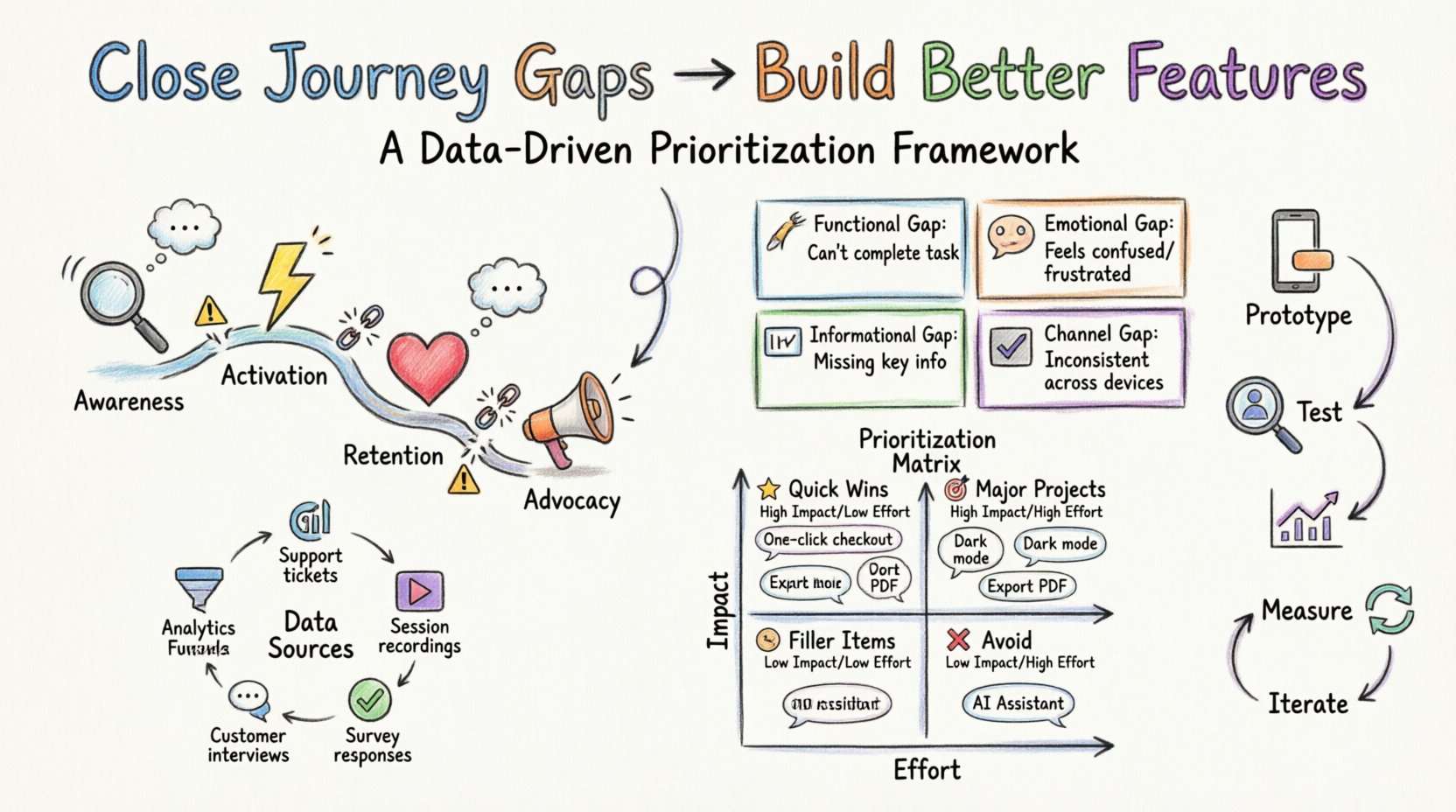
Understanding Customer Journey Gaps 🕳️
A customer journey map is a visual representation of every touchpoint a user has with your product. It tracks their path from initial awareness through to advocacy. However, a map is only useful if it reveals friction. A journey gap occurs when the user’s expectation of the experience does not match the reality of the product interaction.
These gaps are not merely bugs; they are often systemic issues in the flow or design. Recognizing them requires looking at the journey through the user’s eyes, not the business’s metrics alone.
Types of Journey Gaps
Not all friction is created equal. To prioritize effectively, you must categorize the type of gap you are addressing. Generally, these fall into four distinct categories:
Functional Gaps: The user cannot complete a specific task. For example, a checkout button that does not load or a search function that returns irrelevant results.
Emotional Gaps: The user feels confused, frustrated, or undervalued. This often stems from unclear copy, jarring design transitions, or a lack of reassurance during critical moments.
Informational Gaps: The user lacks the necessary information to make a decision. This might manifest as missing pricing details, unclear feature comparisons, or hidden terms of service.
Channel Gaps: The experience is inconsistent across devices or platforms. A process that is smooth on desktop might be broken on mobile, causing abandonment.
When you prioritize features, you are essentially funding the closure of these gaps. A feature that addresses a functional gap in the checkout process often yields a higher return on investment than a feature that adds a new capability to the profile page.
Identifying Where Users Stumble 🔍
Before you can prioritize, you must know where the friction exists. Relying on assumptions leads to building features that nobody uses. Instead, triangulate data from multiple sources to pinpoint the exact locations of journey gaps.
Data Sources for Gap Analysis
Gathering evidence requires a mix of quantitative and qualitative research. No single source provides the full picture.
Analytics Data: Look for drop-off points in funnel analysis. If 40% of users leave at the onboarding step two, there is a significant gap there.
Support Tickets: Analyze the volume and content of customer service inquiries. High volumes of tickets regarding a specific feature indicate a gap in usability or understanding.
Session Recordings: Watch users interact with the product. Heatmaps and scroll depth can reveal where users rage-click or where they stop scrolling entirely.
Customer Interviews: Direct feedback from users provides context. Ask them what they were trying to achieve and what stopped them.
Survey Responses: Net Promoter Score (NPS) and Customer Satisfaction (CSAT) surveys often include open-ended feedback that highlights specific pain points.
Combining these sources allows you to validate whether a gap is isolated or systemic. For instance, if analytics show a drop-off, but interviews reveal users simply don’t understand the value proposition, the solution is not a technical fix, but an informational one.
Framework for Prioritization 📊
Once you have identified the gaps, the next challenge is deciding which ones to fix first. Resources are finite, and time is expensive. You need a framework that weighs the impact of closing a gap against the effort required to build the solution.
A common approach involves scoring potential features based on three criteria: Impact, Effort, and Strategic Alignment.
Scoring Matrix for Feature Requests
Use the following table structure to evaluate feature ideas derived from journey gaps.
Feature Idea | Gap Type | Impact Score (1-10) | Effort Score (1-10) | Strategic Fit | Priority |
|---|---|---|---|---|---|
One-click checkout | Functional | 9 | 7 | High | High |
New dark mode | Emotional | 5 | 3 | Medium | Low |
Export to PDF | Functional | 6 | 2 | Low | Medium |
AI Assistant | Informational | 8 | 9 | High | Medium |
Impact Score: Estimates how much closing this gap will improve user retention, conversion, or satisfaction. High-impact gaps usually relate to core value delivery.
Effort Score: Estimates the engineering time, design resources, and testing required to implement the feature. Lower scores indicate quicker wins.
Strategic Fit: Does this feature align with the company’s long-term vision? Even a high-impact feature should be deprioritized if it diverts focus from core business goals.
Calculating the Priority
To determine the order of operations, calculate the Priority Score by dividing Impact by Effort.
High Impact / Low Effort: These are quick wins. Implement these immediately to build momentum and trust.
High Impact / High Effort: These are major projects. They require significant planning and resources but offer the greatest potential for growth.
Low Impact / Low Effort: These are filler items. Address them only when capacity allows.
Low Impact / High Effort: These are time sinks. Avoid these unless they are mandated by compliance or legal requirements.
Mapping Features to Journey Stages 🧩
Understanding the journey stages helps ensure you are not neglecting parts of the lifecycle. A common mistake is focusing solely on acquisition and ignoring retention. A balanced roadmap addresses gaps across the entire user lifecycle.
Stage 1: Awareness and Onboarding
In this phase, the user is evaluating your product. Gaps here often involve clarity and speed.
Common Gaps: Slow load times, unclear value proposition, complex sign-up flows.
Potential Features: Progressive profiling (ask less info upfront), interactive tutorials, social proof integration.
Stage 2: Activation and Core Usage
Here, the user is trying to derive value from the product. Gaps here are often functional or performance-based.
Common Gaps: Confusing navigation, missing essential tools, slow processing speeds.
Potential Features: Dashboard customization, bulk actions, API integrations, automated workflows.
Stage 3: Retention and Loyalty
At this stage, the user is a repeat visitor. Gaps here are often emotional or relational.
Common Gaps: Lack of personalization, feeling ignored by support, stagnant product.
Potential Features: Gamification, personalized recommendations, loyalty rewards, community forums.
Stage 4: Advocacy
The user is ready to recommend the product. Gaps here involve ease of sharing.
Common Gaps: Difficulty sharing results, lack of referral incentives.
Potential Features: Referral code generation, shareable reports, public portfolios.
Validating Your Priorities ✅
Even with a robust framework, there is risk involved in building new features. Validation reduces this risk before significant resources are committed. You do not need to build the full product to test the hypothesis.
Prototyping and Testing
Low-Fidelity Prototypes: Sketches or wireframes can test the flow of a feature without writing code. This helps identify logical gaps early.
Clickable Mockups: Tools that simulate interaction allow users to click through a journey to see if the solution makes sense to them.
Concierge Testing: Manually perform the function for a small group of users to see if it solves the problem before automating it.
A/B Testing: Once built, test the new feature against the old flow to measure actual impact on conversion or retention.
Feedback Loops
Validation does not stop at launch. Establish mechanisms to capture feedback immediately after the feature is released.
In-App Feedback: Simple prompts asking users to rate the new feature.
Usage Analytics: Monitor adoption rates. If nobody uses the new feature, it may not have solved the intended gap.
Support Ticket Monitoring: Watch for new types of complaints that arise after the release.
Common Pitfalls to Avoid ⚠️
Even with the best intentions, teams often stumble during the prioritization process. Being aware of these common errors can help you stay on track.
The Shiny Object Syndrome
It is easy to get excited about a new technology or a feature a competitor has. However, if it does not address a specific gap in your user journey, it is a distraction. Stick to the roadmap derived from your own data.
Ignoring the Silent Majority
Often, the loudest voices in feedback channels are power users or angry customers. The silent majority, who are using the product successfully, might have different needs. Balance feedback from vocal users with data from the broader user base.
Siloed Decision Making
Journey mapping requires input from multiple departments. If Product, Design, and Engineering work in isolation, the resulting roadmap will be fragmented. Ensure cross-functional collaboration during the gap analysis phase.
Over-Engineering the Solution
Just because you identified a gap does not mean the most complex solution is the right one. Sometimes a simple UI tweak or a clarification in copy resolves a gap better than a full-blown feature build. Always aim for the path of least resistance that achieves the goal.
Measuring Impact Post-Launch 📈
The cycle does not end when the feature is deployed. You must measure the impact to confirm that the gap was indeed closed and to inform future decisions.
Key Performance Indicators (KPIs)
Select metrics that directly correlate to the journey gap you addressed.
For Onboarding Gaps: Time to First Value, Activation Rate, Day 1 Retention.
For Functional Gaps: Task Completion Rate, Error Rate, Support Ticket Volume.
For Emotional Gaps: Net Promoter Score (NPS), Customer Satisfaction (CSAT), Sentiment Analysis.
Iterative Improvement
Treat every feature launch as a hypothesis. If the metrics do not move in the desired direction, return to the drawing board. Analyze why the gap was not fully resolved. Perhaps the feature was built incorrectly, or perhaps the initial gap analysis was flawed.
Building a Sustainable Culture 🏃
Ultimately, prioritizing features based on journey gaps is not a one-time project. It requires a cultural shift where every team member understands the customer journey. When developers understand the friction users face, they write better code. When designers understand the emotional journey, they create more empathetic interfaces.
Share Journey Maps: Keep visualizations accessible to the entire organization.
Invite Feedback: Encourage support and sales teams to share customer stories regularly.
Review Regularly: Conduct quarterly reviews of the journey map to ensure it reflects current user behavior.
Celebrate Wins: Acknowledge when a feature successfully resolves a pain point and improves user experience.
By grounding your product strategy in the reality of the user experience, you create a roadmap that is resilient and responsive. You stop guessing what users want and start building what they need. This alignment fosters trust, drives growth, and ensures that your product remains relevant in a competitive market.
Remember, the goal is not to build more features, but to build the right features. When you prioritize based on journey gaps, you ensure that every development effort contributes to a smoother, more effective experience for your users. This approach transforms product management from a guessing game into a strategic discipline focused on real value creation.