


Business strategy relies heavily on understanding the competitive landscape. For decades, Michael Porter’s framework has served as the backbone for industry analysis. However, the digital economy operates under different rules. Traditional models face new challenges when applied to platforms, network effects, and rapid innovation cycles. This guide explores how the Five Forces framework adapts to modern digital environments without losing its analytical power.
Organizations must evaluate their position not just against direct competitors, but against ecosystem shifts and technological disruptions. By examining each force through a digital lens, leaders can identify vulnerabilities and opportunities that were previously invisible. This deep dive covers the mechanics of the framework, its evolution, and practical application steps for contemporary strategy.
🧠 Understanding the Original Framework
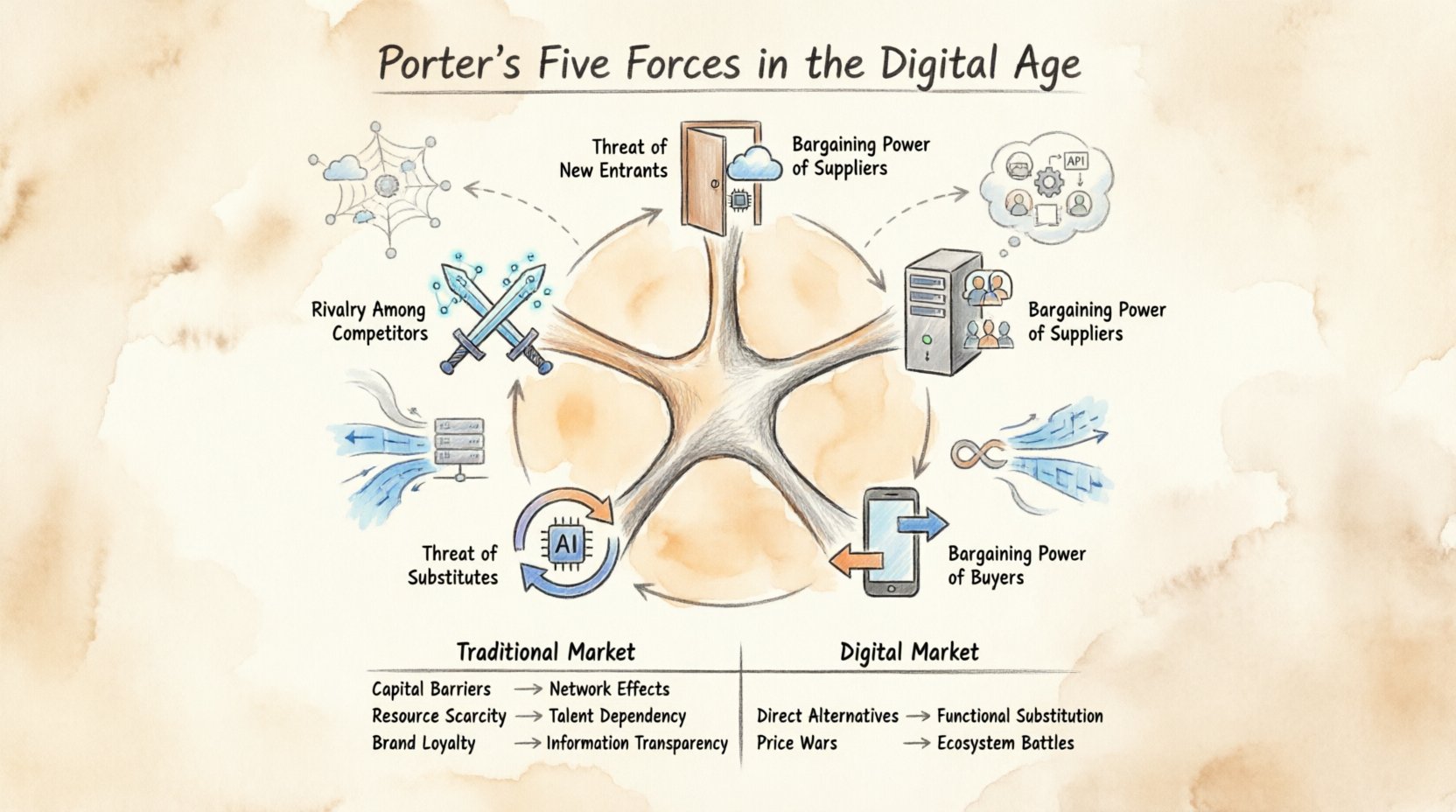
Michael Porter introduced this model to assess the intensity of competition and profitability within an industry. The core premise is that industry structure drives strategy. Five specific forces shape this structure:
- Threat of New Entrants: How easy is it for new players to enter the market?
- Bargaining Power of Suppliers: How much control do providers of raw materials or services have?
- Bargaining Power of Buyers: How much influence do customers have on pricing and terms?
- Threat of Substitutes: Are there alternative solutions that meet the same need?
- Rivalry Among Existing Competitors: How intense is the competition between current players?
In traditional manufacturing or service sectors, these forces were relatively stable. Barriers to entry were physical or capital-intensive. Supply chains were linear. Customer switching costs were tangible. Today, the digital layer has blurred these lines. Understanding the baseline is crucial before analyzing the shifts.
🌐 The Digital Shift in Market Dynamics
Digital transformation has altered the fundamental economics of business. Marginal costs often approach zero. Data becomes a primary asset. Network effects create winner-take-all scenarios. These changes do not invalidate the framework but require nuanced interpretation.
Consider the speed of change. A product that dominated a market five years ago may be obsolete today due to a technological shift. The framework must be dynamic. Static analysis yields static strategies, which fail in volatile markets. Leaders need to continuously monitor these forces.
Key characteristics of the digital shift include:
- Dematerialization: Products become services (SaaS models).
- Connectivity: Users connect directly, bypassing intermediaries.
- Data Accumulation: Information about users drives value creation.
- Scalability: Solutions can scale globally without proportional cost increases.
🔍 Analyzing Each Force in a Connected World
Applying the framework to digital markets requires adjusting the weight of each force. Below is a detailed breakdown of how each force behaves in the current technological landscape.
1. Threat of New Entrants 🚪
In traditional industries, high capital requirements often protected incumbents. In digital spaces, barriers can be low or paradoxically high.
- Low Barriers: Cloud computing allows startups to launch with minimal infrastructure investment. App stores reduce distribution friction.
- High Barriers: Established platforms benefit from massive network effects. New entrants must convince users to switch ecosystems, which is difficult.
- Regulatory Hurdles: Data privacy laws (like GDPR) increase compliance costs for new players.
Incumbents must decide whether to build or buy. Open source models also lower entry barriers by providing free foundational code.
2. Bargaining Power of Suppliers 🏭
Suppliers in digital markets often include technology providers, talent pools, and platform owners.
- Tech Stack Dependency: Relying on a single cloud provider creates supplier power. Diversification mitigates this risk.
- Talent Scarcity: Specialized skills (AI, cybersecurity) give human capital significant leverage.
- Platform Fees: App stores and marketplaces take significant cuts, acting as powerful gatekeepers.
Strategies to reduce supplier power include building proprietary technology and fostering a diverse vendor ecosystem.
3. Bargaining Power of Buyers 💰
Information asymmetry favors buyers more now than in the past. Price transparency is ubiquitous.
- Comparison Tools: Users can instantly compare features and pricing across multiple vendors.
- Switching Costs: While data portability improves, ecosystem lock-in (e.g., integrated hardware and software) keeps buyers within a specific brand.
- Subscription Models: Recurring revenue models allow for churn management, giving buyers the power to cancel anytime.
Companies must focus on value creation beyond price. Customer experience and community building become critical differentiators.
4. Threat of Substitutes 🔄
Substitutes in digital markets are often not direct competitors but alternative ways to solve a problem.
- Functional Substitution: A messaging app may substitute for email in internal communication.
- Technological Disruption: Streaming services substituted physical media. AI tools now substitute certain manual labor tasks.
- Do-It-Yourself: User-generated content platforms allow consumers to create their own solutions.
Monitoring adjacent industries is essential. A bank might compete with fintech apps that offer payment services.
5. Rivalry Among Existing Competitors ⚔️
Competition has shifted from price wars to feature wars and ecosystem battles.
- Hyper-Growth: Many digital companies prioritize user acquisition over immediate profitability.
- Convergence: Tech companies enter finance, healthcare, and retail. Industry boundaries dissolve.
- Innovation Cycles: The pace of product updates is faster than ever. Stagnation leads to rapid decline.
📊 Traditional vs. Digital Force Analysis
To visualize the differences, consider the following comparison table.
| Force | Traditional Market | Digital Market |
|---|---|---|
| New Entrants | High Capital Barriers | Variable (Low cost, High Network Effects) |
| Supplier Power | Resource Scarcity | Talent & Platform Dependency |
| Buyer Power | Brand Loyalty | Information Transparency & Switching Ease |
| Substitutes | Direct Product Alternatives | Functional & Technological Alternatives |
| Rivalry | Price & Distribution | Features, Ecosystems & Data |
📝 Strategic Implementation Steps
Executing this analysis requires a structured approach. It is not a one-time exercise but an ongoing process.
- Define the Scope: Identify the specific market segment. Digital markets are vast; focus on a relevant niche.
- Gather Data: Collect information on competitors, customer behavior, and supply chain dynamics.
- Map the Forces: Visually represent each force and assign a strength level (High, Medium, Low).
- Identify Trends: Look for emerging technologies or regulatory changes that might alter the force balance.
- Formulate Strategy: Adjust business models based on the findings. For example, reduce supplier dependency.
- Monitor & Iterate: Review the analysis quarterly. Digital markets change rapidly.
🔮 Future Trends & Adaptability
Looking ahead, several trends will continue to reshape the competitive landscape.
- Artificial Intelligence: AI will lower barriers for some tasks while creating new moats for data-rich companies.
- Decentralization: Blockchain technology may reduce the power of centralized platform gatekeepers.
- Privacy Regulations: Stricter data laws will impact how companies leverage customer information, affecting buyer power.
- Platform Ecosystems: Competition will increasingly occur between ecosystems rather than individual products.
Organizations must remain agile. The framework provides the structure, but the content must be updated constantly. Relying on historical data alone leads to strategic blindness.
🛡️ Mitigating Risks in Digital Environments
Every force presents specific risks that need mitigation strategies.
- For New Entrants: Invest in brand equity and proprietary technology to create switching costs.
- For Suppliers: Develop alternative sourcing strategies and invest in automation to reduce labor dependency.
- For Buyers: Enhance customer support and build community to increase retention.
- For Substitutes: Innovate continuously to stay ahead of alternative solutions.
- For Rivalry: Differentiate through unique value propositions rather than competing solely on price.
📈 Measuring Success and Impact
How do you know if the analysis is working? Success is measured by strategic alignment and market performance.
- Market Share Stability: Does the company maintain or grow its position?
- Profit Margins: Are margins protected against competitive pressure?
- Innovation Rate: Is the company releasing relevant updates that meet market needs?
- Customer Retention: Are customers staying despite the availability of alternatives?
Quantitative metrics should be paired with qualitative insights. Customer feedback provides context that numbers alone cannot reveal.
🌍 Global Considerations
Digital markets are inherently global. A strategy valid in one region may fail in another.
- Local Regulations: Data sovereignty laws vary by country.
- Cultural Preferences: User interfaces and features must align with local habits.
- Infrastructure: Internet speed and device availability impact product design.
National boundaries are less relevant for digital services, but local compliance remains critical. A global strategy must accommodate local nuances.
🤝 Collaboration vs. Competition
The digital age encourages co-opetition. Companies compete in some areas while collaborating in others.
- Open Standards: Adopting industry standards reduces friction for users.
- API Integrations: Allowing competitors to integrate with your platform can expand the total market.
- Joint Ventures: Partnerships can share the risk of new technology development.
Viewing the market strictly as a zero-sum game limits potential. Expanding the pie benefits all participants.
📉 When the Framework Falls Short
No model is perfect. There are limitations to the Five Forces approach in specific scenarios.
- Rapid Innovation: If technology changes faster than the analysis cycle, the data becomes stale.
- Non-Market Forces: Social movements and public sentiment are not always captured.
- Disruptive Business Models: Models that ignore traditional profitability metrics may not fit the framework.
Use this tool alongside other strategic frameworks like SWOT or PESTEL for a holistic view.
🛠️ Building a Strategic Culture
For the analysis to have impact, it must be embedded in the organizational culture.
- Training: Ensure leaders understand the framework deeply.
- Communication: Share insights across departments to align goals.
- Decision Making: Use the analysis to inform resource allocation.
Strategy is not just a document; it is a mindset. Every decision should consider its impact on the competitive forces.
🔑 Key Takeaways
- The framework remains relevant but requires adaptation for digital contexts.
- Network effects and data create new barriers and opportunities.
- Continuous monitoring is essential due to the speed of change.
- Strategic decisions should balance competition with ecosystem collaboration.
- Quantitative data must be complemented by qualitative market insights.
Applying Porter’s Five Forces in the digital age demands a nuanced approach. It is not about discarding the model but refining it. By understanding how technology reshapes each force, organizations can navigate uncertainty with clarity. The goal is sustainable advantage in a landscape defined by connectivity and speed.
Strategic foresight begins with accurate diagnosis. Use this guide as a foundation for deeper inquiry into your specific industry dynamics. The market will continue to evolve, and so must the tools used to analyze it.
Related posts:
 Porter Five Forces Analysis: A Real-World Case Study for MBA Students
 Porter Five Forces Analysis: How to Identify Threats and Opportunities in Any Market
 Porter Five Forces Analysis: What Students Often Misunderstand (And How to Fix It)
 Porter Five Forces Analysis: A Best Practices Guide for Business School Assignments