


Understanding the competitive landscape is fundamental to sustainable business growth. For decades, strategists and business leaders have relied on a specific framework to dissect industry dynamics. The Porter Five Forces Analysis remains one of the most effective tools for evaluating the attractiveness of a market. By examining five critical areas, organizations can identify where power lies, where risks reside, and where strategic advantages can be built.
This guide provides a deep dive into the methodology. It outlines how to apply this framework to your specific context, ensuring you make data-driven decisions rather than guesses. Whether you are launching a startup, entering a new sector, or repositioning an existing product, this analysis offers clarity.
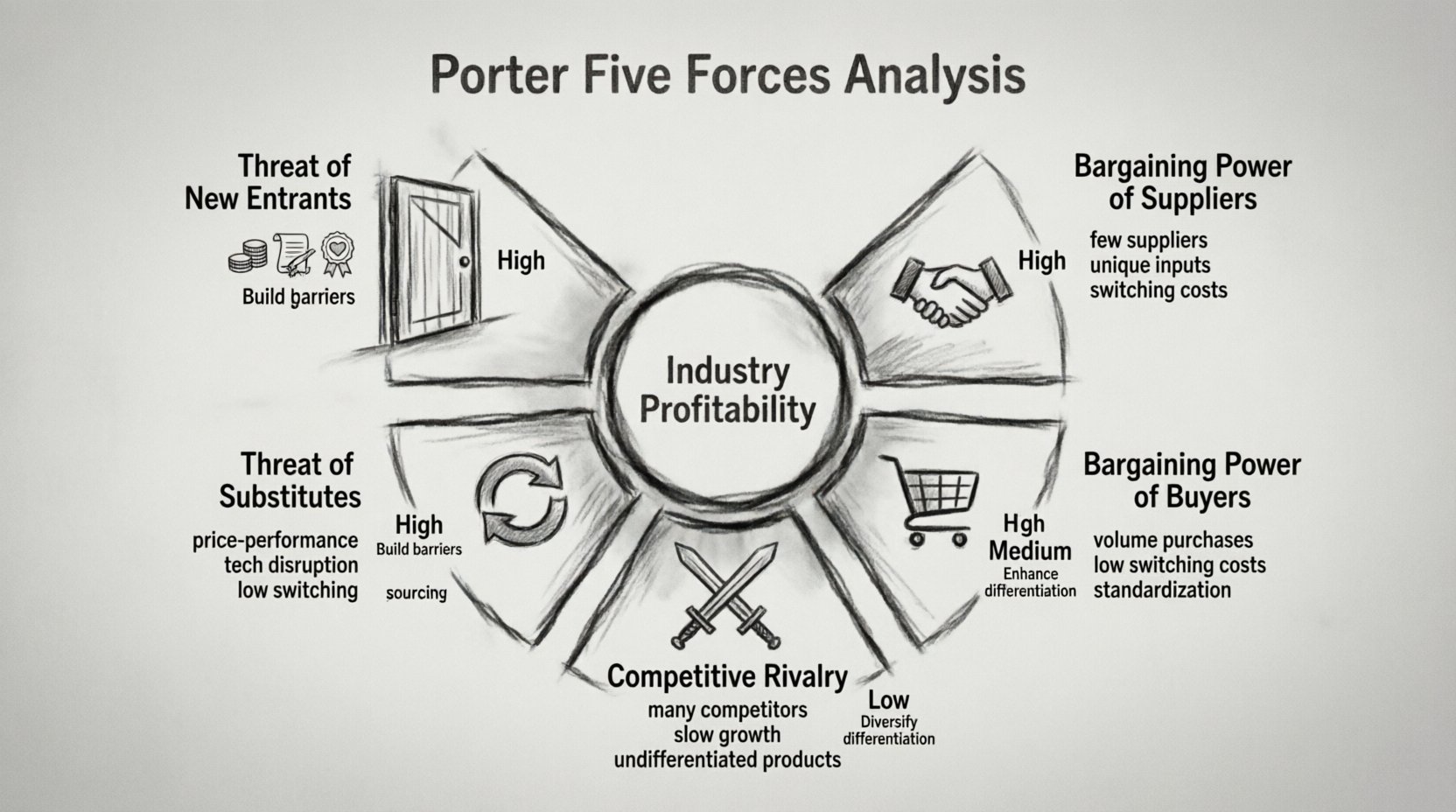
Understanding the Framework 🧩
Developed by Michael Porter in 1979, this model shifts the focus from simple competition to the broader structural forces that shape an industry. It moves beyond looking at direct rivals to understanding the ecosystem surrounding them. The core premise is that industry profitability is determined by these five forces. When the forces are strong, profitability is likely to be low. When they are weak, profitability can be high.
- Competitive Rivalry: The intensity of competition among existing firms.
- Threat of New Entrants: How easy is it for new competitors to enter the market?
- Bargaining Power of Suppliers: How much control do suppliers have over prices?
- Bargaining Power of Buyers: How much influence do customers have on pricing?
- Threat of Substitution: How likely are customers to switch to alternative solutions?
Applying this model requires a systematic approach. You must gather data, assess the intensity of each force, and then synthesize the findings into a coherent strategy. It is not a one-time exercise but a living process that evolves as the market changes.
The Five Forces Explained in Detail 🔍
To use this framework effectively, you need to understand the nuances of each force. Below is a comprehensive breakdown of what to look for in each category.
1. Threat of New Entrants 🚪
This force measures the difficulty for new competitors to enter your industry. If barriers to entry are low, new players can easily disrupt the market, driving down prices and margins. High barriers protect existing firms and maintain profitability.
Key indicators include:
- Capital Requirements: Does the industry require significant upfront investment? High capital needs deter entry.
- Regulatory Hurdles: Are there strict licenses or government approvals required?
- Brand Loyalty: Do existing customers stick to established brands?
- Access to Distribution: Can new players easily get their products to shelf space or online channels?
- Switching Costs: How much does it cost a customer to switch from you to a new entrant?
When this threat is high, you must invest in building moats, such as patents, exclusive contracts, or strong brand identity. If it is low, you must be prepared for rapid changes in the competitive landscape.
2. Bargaining Power of Suppliers 🤝
Suppliers can raise prices or reduce the quality of goods and services. If suppliers have significant leverage, they capture more value from the industry, leaving less for you. Understanding supplier power is crucial for supply chain management.
High supplier power exists when:
- There are few suppliers relative to buyers.
- The products supplied are unique or highly differentiated.
- Switching costs to change suppliers are high.
- Suppliers threaten to integrate forward into your industry.
- Your industry is not a significant customer for the supplier.
To mitigate this, consider diversifying your supplier base, negotiating long-term contracts, or vertically integrating to produce inputs in-house.
3. Bargaining Power of Buyers 🛒
Customers drive price competition. If buyers have high power, they can demand lower prices or higher quality, squeezing industry margins. This force is particularly relevant in B2C markets but is equally critical in B2B contexts.
Buyers have high power when:
- They purchase in large volumes.
- There are many buyers and few sellers.
- The product is standardized or undifferentiated.
- Switching costs for buyers are low.
- Buyers can integrate backward (make the product themselves).
Strategies to reduce buyer power include creating strong brand loyalty, increasing switching costs through ecosystem integration, and offering unique value propositions that cannot be easily replicated.
4. Threat of Substitute Products 🔄
Substitutes are products from other industries that satisfy the same need. A coffee shop competes not just with other coffee shops, but with tea houses, energy drink brands, and even home brewing equipment. Substitutes place a ceiling on potential returns.
Factors increasing substitution risk:
- Substitute products offer a better price-performance trade-off.
- Customer propensity to switch is high.
- Technological advancements create new alternatives.
- Switching costs are low.
For example, video conferencing software became a substitute for business travel. Companies must monitor adjacent industries closely, as disruption often comes from unexpected places.
5. Industry Rivalry ⚔️
This is the most visible force. It refers to the intensity of competition among existing firms. High rivalry leads to price wars, heavy advertising spending, and product innovation races, all of which reduce profitability.
Rivalry intensifies when:
- There are many competitors of roughly equal size.
- Industry growth is slow or stagnant.
- Fixed costs are high, encouraging price cuts to fill capacity.
- Products are undifferentiated.
- Exit barriers are high (it is hard or costly to leave the industry).
Navigating rivalry requires differentiation. You cannot win on price alone if the market is saturated. Focus on niche segments, superior service, or operational efficiency.
How to Conduct the Analysis 📊
Executing a Five Forces Analysis requires discipline and data. Follow these steps to ensure a robust evaluation.
- Define the Industry: Be specific. Is it the “airline industry” or “budget airline services”? Narrower definitions yield more actionable insights.
- Gather Data: Collect information on market share, supplier concentration, customer demographics, and regulatory environments.
- Assess Each Force: Rate each force as High, Medium, or Low. Provide evidence for each rating.
- Analyze Interactions: Forces do not exist in isolation. A high threat of entry might increase rivalry. Map these relationships.
- Develop Strategy: Use the findings to shape your position. Decide where to defend, where to attack, and where to pivot.
To visualize the intensity of these forces, you can use a scoring matrix. Below is a template for structuring your findings.
| Force | Intensity Level | Key Drivers | Strategic Implication |
|---|---|---|---|
| Threat of New Entrants | High | Low capital requirements, open distribution | Build barriers to entry through IP or scale |
| Supplier Power | Medium | Moderate switching costs | Diversify supply chain partners |
| Buyer Power | High | Price sensitivity, low loyalty | Focus on brand differentiation |
| Substitution Threat | Low | High switching costs, unique utility | Maintain innovation pace |
| Industry Rivalry | High | Slow growth, many competitors | Seek niche markets or cost leadership |
Turning Insights into Strategy 🎯
Knowing the forces is only half the battle. The real value lies in acting on that knowledge. Here are strategic responses tailored to specific force configurations.
When Rivalry is High ⚔️
- Focus on Differentiation: Offer features or services competitors cannot match.
- Cost Leadership: Optimize operations to survive price wars.
- Consolidation: Consider merging with a competitor to reduce the number of players.
When Supplier Power is High 🤝
- Backward Integration: Acquire a supplier to control costs.
- Contract Negotiation: Lock in prices with long-term agreements.
- Standardization: Demand components that are industry-standard to increase supplier options.
When Buyer Power is High 🛒
- Value Addition: Bundle products to increase perceived value.
- Customer Lock-in: Create ecosystems where leaving is difficult.
- Market Segmentation: Target customers who are less price-sensitive.
When Substitution Threat is High 🔄
- Innovation: Continuously improve the product to stay ahead of alternatives.
- Repositioning: Shift the narrative to highlight unique benefits substitutes lack.
- Diversification: Expand into adjacent markets to reduce reliance on a single offering.
Real-World Applications 🌍
The framework applies across sectors. Consider the streaming services industry. Rivalry is intense with many players. Supplier power is high because content creators (studios) hold the IP. Buyer power is moderate as subscriptions are relatively low cost, but churn is high. Substitution comes from other entertainment forms like gaming or social media. New entrants face high capital requirements for content, creating a barrier.
Consider the automotive industry. Rivalry is fierce among established brands. Supplier power varies; traditional parts suppliers have moderate power, but battery manufacturers for EVs have high power. Buyer power is high due to the availability of many models. Substitution includes public transport and ride-sharing. New entrants like tech companies face high capital and regulatory barriers.
By mapping these dynamics, companies avoid blind spots. A firm might focus on product quality while ignoring the threat of a substitute technology, leading to eventual obsolescence.
Limitations and Considerations ⚠️
While powerful, the Porter Five Forces model is not a crystal ball. It has limitations that must be acknowledged.
- Static Nature: The model analyzes the industry at a specific point in time. Markets change rapidly, and the forces can shift quickly due to technology or regulation.
- Focus on Industry, Not Firm: It explains industry profitability but does not fully account for individual firm capabilities. A great management team can outperform in a bad industry.
- Complementary Products: The original model does not explicitly account for complements. Sometimes, a complementary product increases the value of your offering.
- Complex Ecosystems: In platform-based businesses, network effects play a larger role than traditional forces.
Use this tool in conjunction with other frameworks, such as SWOT or PESTLE, to get a holistic view. It is best used as a starting point for strategic discussion rather than a final verdict.
Frequently Asked Questions ❓
How often should I perform a Five Forces Analysis?
Conduct a full review annually or whenever there is a significant market shift, such as new regulations, major technological breakthroughs, or economic downturns.
Can this analysis help in B2B contexts?
Absolutely. In B2B, buyer power often centers on volume and switching costs, while supplier power relates to specialized inputs. The logic remains the same.
What if the forces seem contradictory?
This is common. High buyer power might coexist with low supplier power. This suggests a strategy focused on efficiency and volume. Analyze the net effect on profitability.
Is this suitable for startups?
Yes, but with caution. Startups often operate in undefined markets. Focus more on the threat of new entrants and substitutes, as established rivalry may not yet exist.
Final Thoughts on Strategic Planning 🧭
Market analysis is an ongoing discipline. The Porter Five Forces Analysis provides a structured way to navigate complexity. By systematically evaluating the five forces, you gain a clearer picture of where value is created and where it is eroded.
Success comes from aligning your internal capabilities with these external realities. If you understand the pressure points in your industry, you can position yourself to withstand shocks and seize opportunities. Remember that no strategy is permanent. Continuous monitoring ensures you remain agile.
Start by defining your industry boundaries clearly. Gather the data you need. Be honest about the intensity of each force. Then, build your strategy on that foundation. This approach minimizes risk and maximizes the potential for sustainable growth.
Use this framework to challenge assumptions. Ask why a force is strong. Ask if it can be changed. Strategy is not just about reacting to the market; it is about shaping your position within it. With this knowledge, you are better equipped to make decisions that stand the test of time.
Related posts:
 Porter Five Forces Analysis: A Component Breakdown for Undergrads Learning Strategy
 Porter Five Forces Analysis: How to Spot Emerging Threats Before They Become Problems
 Porter Five Forces Analysis: A Future Outlook on Its Relevance in Digital Markets
 Porter Five Forces Analysis: Troubleshooting When Your Analysis Feels Off Target