


Strategic planning forms the backbone of any successful business venture. For MBA students and aspiring managers, understanding industry dynamics is not optional—it is essential. One of the most enduring frameworks for this purpose is Porter Five Forces Analysis. Developed by Michael Porter in 1979, this model helps organizations evaluate the competitive intensity and attractiveness of an industry. 🏭
This guide provides a deep dive into the framework, supported by a comprehensive real-world case study. We will explore how to apply the analysis practically, avoiding common pitfalls while building a robust strategic foundation. Whether you are analyzing a startup or a Fortune 500 corporation, this approach offers clarity on where power lies in the market. 📊
Understanding the Strategic Framework 🧠
The Porter Five Forces model examines five specific forces that determine the competitive strength and attractiveness of a market. Unlike a simple SWOT analysis which focuses internally and externally on a single entity, this framework looks at the structural economics of an industry. It answers the question: How profitable can this business be?
Profitability is not just about sales volume. It depends on the ability to maintain prices and control costs. These five forces dictate that potential:
- Threat of New Entrants: How easy is it for competitors to join the market?
- Bargaining Power of Suppliers: Can suppliers drive up prices?
- Bargaining Power of Buyers: Can customers drive prices down?
- Threat of Substitute Products: Are there alternative solutions to your product?
- Rivalry Among Existing Competitors: How intense is the current competition?
When these forces are strong, industry profitability tends to be lower. When they are weak, the industry offers higher potential returns. For MBA candidates, mastering this structural view is critical for investment decisions and strategic positioning.
The Five Forces Explained in Detail 🔍
To utilize this model effectively, each force must be understood beyond a surface level. Below is a breakdown of what drives each force and the data points required for analysis.
| Force | Key Questions to Ask | Impact on Profitability |
|---|---|---|
| New Entrants | What are the barriers to entry? Is capital required? | High threat reduces prices and margins. |
| Supplier Power | Are there few suppliers? Are inputs unique? | High power increases input costs. |
| Buyer Power | Are buyers concentrated? Is switching easy? | High power forces price reductions. |
| Substitutes | Is there a different way to solve the same problem? | High threat caps the price ceiling. |
| Rivalry | How many competitors exist? Is growth slow? | High rivalry leads to price wars. |
Real-World Case Study: The Streaming Industry 📺
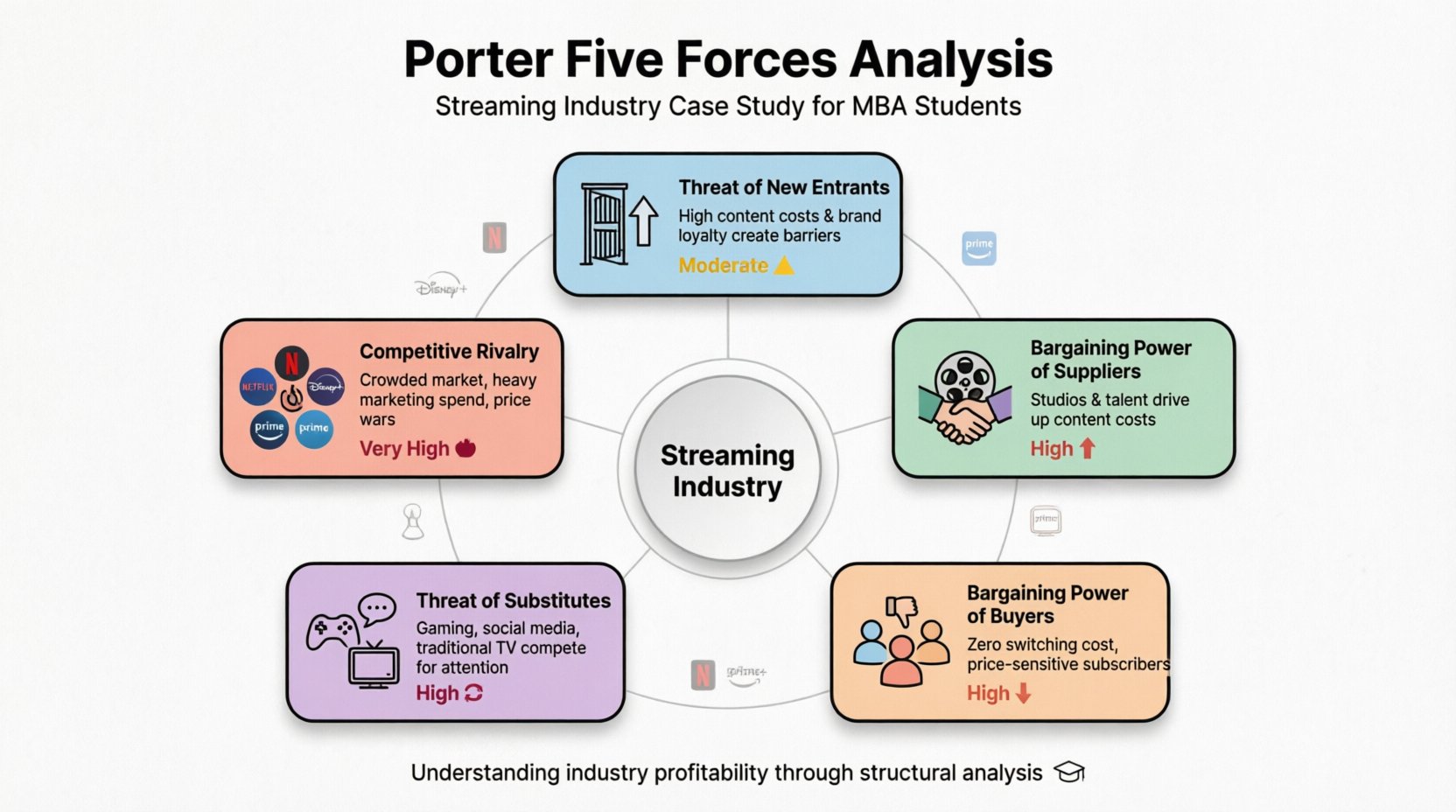
Theory becomes clear when applied to reality. Let us apply the Porter Five Forces to the Global Streaming Video Services Industry. This sector has transformed rapidly over the last decade, moving from a niche market to a dominant entertainment medium. The major players include Netflix, Disney+, Amazon Prime Video, and traditional cable holders transitioning to digital.
1. Threat of New Entrants: Moderate ⚖️
Entering the streaming market is technically easier than in the past, but scaling is difficult. The barrier is not technology; it is content.
- Capital Requirements: High. Producing original content costs billions of dollars annually.
- Brand Loyalty: High. Users prefer established platforms with recognizable libraries.
- Regulatory Hurdles: Varying by region, especially regarding data privacy and content licensing.
While tech giants like Google or Apple could enter, they face the challenge of content curation. Startups struggle to secure licensing deals without a massive subscriber base to justify the cost.
2. Bargaining Power of Suppliers: High ⬆️
In this context, suppliers are primarily production studios, talent agencies, and content creators. Their power has increased significantly.
- Content Ownership: Studios like Disney pulled their content back to launch their own platforms, reducing Netflix’s library.
- Talent Costs: A-list actors and directors command high fees, driving up production budgets.
- Exclusivity: Platforms compete for exclusive rights to popular franchises, driving up acquisition costs.
Streaming services are often forced to pay premium prices to secure rights, squeezing their margins. This force is currently one of the strongest pressures in the industry.
3. Bargaining Power of Buyers: High ⬇️
Consumers have more choices than ever before. The switching cost is virtually zero.
- Price Sensitivity: Users are quick to cancel subscriptions if they feel the value is insufficient.
- Fragmentation: A household may subscribe to three different services, but they will cancel the one with the least value.
- Information Access: Reviews and social media trends dictate which shows people watch, giving buyers influence over content success.
Platforms must constantly innovate to retain subscribers. Price hikes are risky because the alternative is a competitor’s cheaper or free tier.
4. Threat of Substitute Products: High 🔄
Streaming services do not just compete with each other; they compete with other forms of leisure.
- Gaming: Video games offer immersive entertainment that competes for the same time budget.
- Social Media: TikTok and YouTube provide free, short-form entertainment.
- Traditional TV: While declining, live sports and news still draw significant audiences away from on-demand streaming.
- Physical Media: Blu-ray or streaming via ad-supported tiers serve as lower-cost alternatives.
This force caps the price ceiling. If a subscription is too expensive, users revert to free alternatives or stop consuming entertainment content altogether.
5. Competitive Rivalry: Very High 🥊
This is the most intense force in the industry. The market is crowded with deep-pocketed competitors.
- Market Saturation: Many players vie for the same demographic.
- Marketing Spend: Billions are spent on advertising to acquire new users.
- Speed of Innovation: Features like 4K streaming, offline downloads, and interactive content are now standard expectations.
The rivalry is so fierce that profitability is often secondary to user growth in the early stages. However, as the market matures, cost-cutting and profitability become the focus, leading to consolidation.
How to Execute a Five Forces Analysis 📝
Conducting this analysis requires discipline and access to accurate data. You do not need expensive software to begin. The process relies on research, logic, and structured thinking.
Step 1: Define the Industry Scope 🎯
Before analyzing, define boundaries. Are you looking at the global market or a specific region? Is it the luxury segment or mass market? Broad definitions lead to vague results. Narrow definitions allow for precise strategic insights.
Step 2: Gather Data Sources 📚
Reliable information is the foundation of a credible analysis. Use the following sources:
- Public Financial Reports: Annual reports (10-K) reveal supplier and buyer concentration.
- Industry Reports: Market research firms provide data on market share and growth rates.
- News and Trade Journals: Keep track of mergers, acquisitions, and regulatory changes.
- Customer Feedback: Reviews and surveys reveal switching costs and satisfaction levels.
Step 3: Evaluate Each Force Individually 🧐
Score each force from Low, Medium, to High. Do not guess. Use evidence. If you cannot find evidence to support a claim, acknowledge the uncertainty.
Step 4: Synthesize the Findings 🔗
Combine the scores to determine the overall industry attractiveness. If three forces are High and two are Low, the industry is risky. If most are Low, the industry offers stable returns.
Step 5: Develop Strategic Actions 🚀
Analysis is useless without action. Strategies might include:
- Vertical Integration: Buying suppliers to reduce their power.
- Differentiation: Creating unique features to reduce buyer power.
- Niche Focus: Targeting a segment with lower rivalry.
- Cost Leadership: Reducing costs to withstand price wars.
Common Pitfalls to Avoid ⚠️
Even experienced analysts make mistakes when applying this framework. Awareness of these traps ensures accuracy.
- Static Analysis: The market changes. A five-year-old analysis is obsolete. Revisit the model regularly.
- Ignoring Complements: Sometimes products work better together. Ignoring complementary goods (like streaming devices) limits the view.
- Overgeneralizing: Assuming all companies in an industry face the same forces. A startup faces different threats than a legacy corporation.
- Confusing Rivalry with Strategy: Rivalry is the context, not the strategy. You cannot change the rivalry, but you can change your position within it.
Integrating with Other Strategic Tools 🛠️
The Five Forces model is powerful, but it works best when combined with other frameworks. This creates a holistic view of the business environment.
SWOT Analysis
Use the Five Forces to populate the Threats and Opportunities quadrants of a SWOT analysis. The industry structure defines the external threats, while internal capabilities define the Strengths.
PESTLE Analysis
Political, Economic, Social, Technological, Legal, and Environmental factors influence the Five Forces. For example, a new Technology trend might lower barriers to entry, increasing the threat of new competitors. A Legal change might increase supplier power.
VRIO Framework
Once you understand the industry forces, use VRIO to assess your internal resources. Does your company have a resource that is Valuable, Rare, Inimitable, and Organized? If yes, you can exploit the industry weaknesses identified in the Five Forces analysis.
Strategic Implications for Managers 💼
For business leaders, this analysis drives decision-making. It informs where to allocate capital and where to retreat.
- Investment Decisions: If the industry is unattractive, do not invest. If it is attractive, invest aggressively.
- Exit Strategies: If forces are intensifying and margins are shrinking, plan an exit before cash flow dries up.
- Partnerships: Form alliances to increase buyer power or reduce supplier dependence.
- Innovation: Use the analysis to identify where customers are underserved by current substitutes.
Frequently Asked Questions ❓
Is Porter’s Five Forces still relevant?
Yes. While technology changes, the economic principles of supply and demand remain constant. The framework adapts to digital markets, though the specific drivers of power shift.
Can this be used for non-profit organizations?
Absolutely. Non-profits face competition for donors (buyers), grants (suppliers), and other causes (substitutes). The model helps them position for maximum impact.
What if the forces are contradictory?
This is common. One force might be high while another is low. In this case, prioritize the forces that directly impact your core revenue streams. Focus your strategy on neutralizing the strongest threats.
Final Thoughts on Strategic Planning 🌟
Strategic planning is not a one-time event. It is a continuous process of monitoring the environment and adjusting course. The Porter Five Forces Analysis provides a structured lens to view the competitive landscape. By understanding the economic forces at play, MBA students and managers can make informed decisions that sustain long-term growth.
Use this framework to challenge assumptions. Ask hard questions about where value is created and captured. In a complex business world, clarity is the ultimate competitive advantage. 🧭
Related posts:
 Porter Five Forces Analysis: How to Identify Threats and Opportunities in Any Market
 Porter Five Forces Analysis: A Component Breakdown for Undergrads Learning Strategy
 Porter Five Forces Analysis: A Tutorial for Beginners in Strategy & Management
 Porter Five Forces Analysis: How to Use It to Inform Your Business Model Decisions