

Building a product in the modern digital landscape requires more than just a good idea. It demands a structured approach that balances speed, quality, and market fit. The concept of the Minimal Viable Product (MVP) has emerged as a cornerstone of this strategy, particularly when paired with Agile methodologies. This combination allows teams to release value quickly, gather real-world feedback, and adapt without wasting resources on features that users do not need.
An MVP is not a half-finished product. It is a strategic decision to deliver the core value proposition with the least amount of effort required to learn. When integrated with Agile principles, the development process becomes iterative, collaborative, and responsive. This guide explores how to launch faster by leveraging these principles effectively.
🧩 Understanding the Core Concepts
Before diving into execution, it is vital to define what we mean by these terms in a practical context. Many organizations confuse an MVP with a prototype or a pilot. Understanding the distinction is critical for success.
Minimal Viable Product (MVP): A version of a new product that includes only the essential features necessary to satisfy early adopters and provide feedback for future development.
Agile Principles: A framework for project management and software development that focuses on iterative progress, collaboration, and flexibility.
Iteration: The repeated process of planning, executing, and evaluating a cycle of work to improve the product incrementally.
When you combine these, you create a feedback loop. Instead of building a massive platform for two years and hoping it fits the market, you build a small version, release it, measure the results, and learn. This reduces risk and increases the likelihood of product-market fit.
🔄 The Agile-MVP Lifecycle
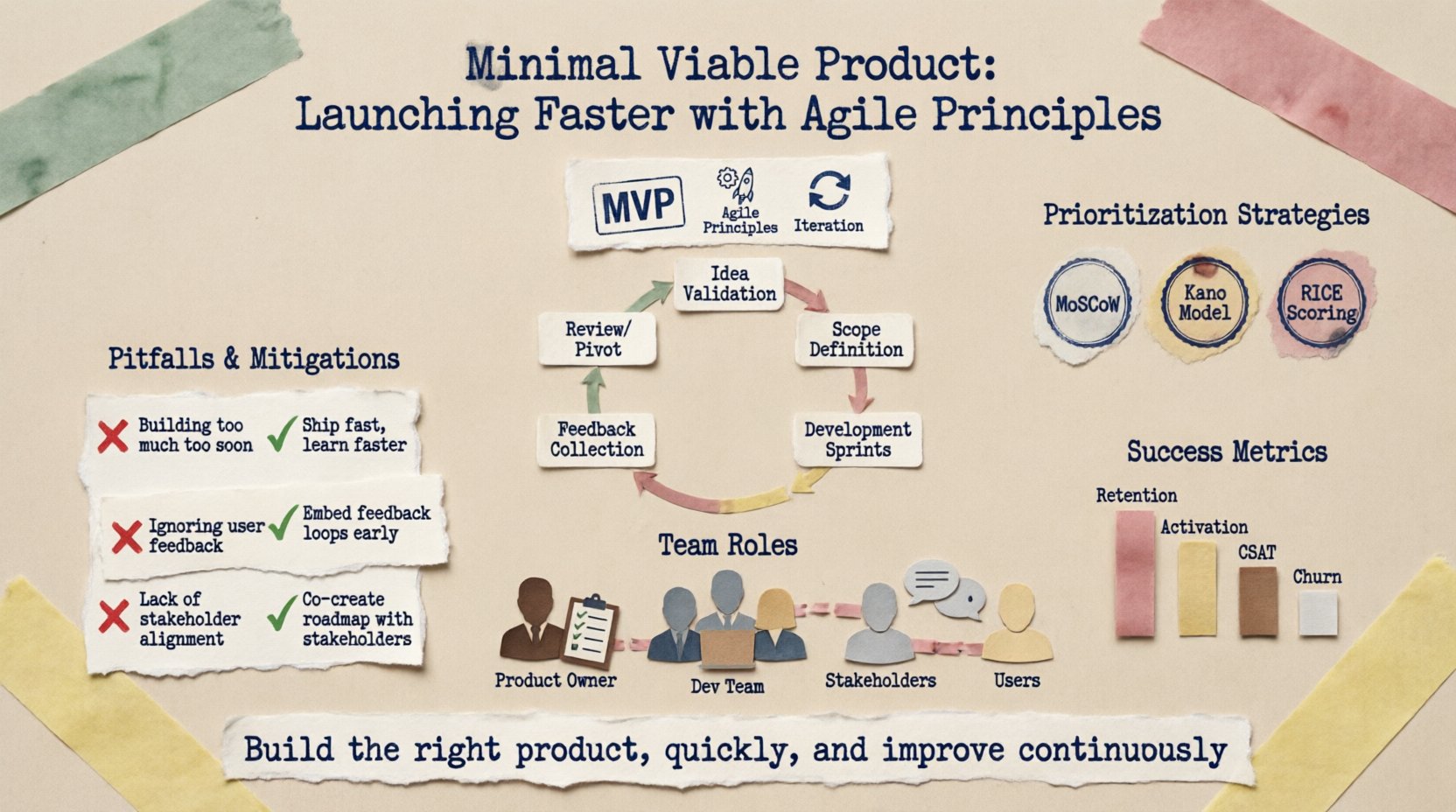
The integration of MVP and Agile is not a one-time event; it is a continuous cycle. The following stages outline how a team moves from concept to a validated product.
1. Idea Validation
Before writing a single line of code or designing a single screen, the team must validate the problem. Does this problem exist? Are people willing to solve it? This stage involves interviews, surveys, and market research. The goal is to ensure the hypothesis is sound before investing significant capital.
2. Scope Definition
Once the problem is validated, the team defines the MVP scope. This involves listing potential features and ranking them. The focus here is on the “Minimum” part of MVP. What is the smallest set of features that delivers the core value? Anything that does not contribute directly to this value is deferred.
3. Development Sprints
Agile works in short cycles known as sprints. Typically lasting two to four weeks, a sprint is a dedicated period to build a specific set of functionalities. At the end of the sprint, there is a working increment of the product. This allows for regular check-ins and adjustments.
4. Feedback Collection
After release, the focus shifts to observation. How are users interacting with the product? Where do they get stuck? What features do they ignore? Data from analytics and direct user conversations fuel the next planning session.
5. Review and Pivot
Based on the feedback, the team decides whether to persevere with the current plan or pivot. A pivot might involve changing a feature, changing the target audience, or changing the business model. This flexibility is a key advantage of the Agile approach.
📋 Prioritization Strategies
One of the biggest challenges in building an MVP is deciding what to build first. Without a clear prioritization framework, scope creep can turn an MVP into a bloated mess. Several methods exist to handle this.
MoSCoW Method: Categorizes requirements into Must have, Should have, Could have, and Won’t have. For an MVP, the focus is strictly on “Must have”.
Kano Model: Classifies features into basic needs, performance needs, and delighters. MVPs should focus on satisfying basic needs to ensure the product functions.
RICE Scoring: Rates features based on Reach, Impact, Confidence, and Effort. This helps quantify the value of a feature relative to the cost.
By applying these frameworks, teams can make objective decisions about what stays in the MVP and what moves to the backlog for future versions.
⚠️ Common Pitfalls and Risks
Even with a solid plan, teams often fall into traps that undermine the MVP process. The table below outlines common risks and how to mitigate them using Agile practices.
Pitfall | Description | Agile Mitigation Strategy |
|---|---|---|
Feature Creep | Adding unnecessary features during development. | Strict backlog grooming and saying “no” to non-essential items. |
Perfectionism | Waiting for the product to be flawless before release. | Adopt a “good enough” mindset for the initial release. |
Lack of Feedback | Building without talking to users. | Schedule regular user testing sessions after every sprint. |
Ignoring Technical Debt | Writing quick code that cannot be scaled later. | Allocate time in sprints for refactoring and maintenance. |
Wrong Metrics | Measuring vanity metrics like page views instead of value. | Focus on actionable metrics like retention and conversion. |
📊 Measuring Success and Value
How do you know if the MVP was successful? Success is not defined by the number of downloads or revenue in the first month. It is defined by learning. Did the product validate the hypothesis? Did users find value?
Teams should establish key performance indicators (KPIs) before launch. These might include:
Retention Rate: Are users coming back after the first week?
Activation Rate: Did users complete the core action required to get value?
Customer Satisfaction Score (CSAT): How happy are early users?
Churn Rate: How many users are leaving the product?
Qualitative data is equally important. Conducting interviews with users helps uncover the “why” behind the numbers. A user might say they love a feature, but if they don’t use it, the data tells a different story.
👥 Team Dynamics and Roles
Agile relies heavily on collaboration. In an MVP context, the hierarchy flattens. The goal is to move fast and communicate constantly. Here is how different roles contribute to the process.
The Product Owner
This individual represents the voice of the customer and the business. They are responsible for defining the vision and maintaining the backlog. They must be decisive about what goes into the MVP and what does not.
The Development Team
These are the individuals building the product. In an Agile environment, they are cross-functional, meaning they possess the skills needed to design, code, test, and deploy the software. They provide technical estimates and feasibility checks.
The Stakeholders
Stakeholders include investors, management, and potential partners. They provide funding and strategic direction. Regular demos keep them informed and aligned with the progress.
The Users
Often overlooked as a formal role, users are the most important stakeholder. Their feedback dictates the roadmap. Involving them early ensures the product solves a real problem.
🛠️ Execution Without Tool Dependency
While many organizations rely on specific software for project management, the principles of Agile and MVP do not depend on any particular tool. The focus should remain on the workflow, not the interface.
Teams can manage their backlog using physical whiteboards, sticky notes, or simple spreadsheets. The critical factor is transparency. Everyone should know what is being built, what is in progress, and what is blocked. Communication channels should be open and frequent.
During the planning phase, teams can hold stand-up meetings. These are short daily gatherings where members answer three questions:
What did you do yesterday?
What will you do today?
Are there any obstacles in your way?
This routine keeps the team aligned and identifies issues before they become critical blockers. It fosters a culture of accountability and continuous improvement.
🚀 Scaling from MVP to Full Product
The journey does not end with the MVP launch. Once the core value is validated and the feedback loop is established, the team begins to scale. This phase involves adding more features, improving performance, and expanding the user base.
However, scaling requires discipline. Just because a feature is requested does not mean it should be built. The same prioritization frameworks used for the MVP should apply here. Each new feature must be evaluated against the core value proposition.
Technical architecture must also be considered. Code written for an MVP might be quick and dirty. As the user base grows, the system needs to handle more load. Refactoring should be a continuous part of the development process, not a one-time event.
🧠 The Psychology of Launching Fast
Beyond the technical and strategic aspects, there is a psychological component to launching an MVP. Teams often fear failure. They worry that a slow release will disappoint investors or that a buggy product will ruin their reputation.
Agile principles help mitigate this fear by reframing failure as learning. If an MVP fails to gain traction, it is not a disaster; it is data. It tells the team to stop spending money on the wrong solution and pivot to a better one. This mindset shift is crucial for innovation.
Leadership plays a significant role here. If management punishes mistakes, the team will hide them. If management rewards learning, the team will take calculated risks. Building a culture of psychological safety allows the MVP process to function as intended.
📈 Long-Term Benefits
Adopting an MVP approach within an Agile framework offers several long-term advantages for an organization.
Cost Efficiency: You only spend money on features that have been proven to work.
Time to Market: Releasing earlier allows you to beat competitors to the punch.
User Alignment: The product evolves based on actual user needs rather than assumptions.
Team Morale: Seeing a product launch and receive feedback provides a sense of accomplishment.
These benefits compound over time. A team that learns to build and release frequently becomes more efficient and more adaptable to change. This agility is a competitive advantage in a fast-moving market.
🔧 Final Thoughts on Strategic Delivery
Launching a Minimal Viable Product is not just about speed; it is about intelligence. It is about making the smartest possible bets on where to invest resources. By adhering to Agile principles, teams can maintain the discipline needed to stay focused on the core value while remaining flexible enough to adapt to change.
The path from idea to market leader is rarely linear. It is filled with iterations, adjustments, and learnings. An MVP serves as the starting point for this journey. It provides the foundation upon which a robust, user-centric product can be built. By avoiding unnecessary complexity and focusing on validation, teams can navigate the uncertainty of product development with confidence.
Remember, the goal is not to build the perfect product immediately. The goal is to build the right product, quickly, and improve it continuously. This approach ensures that the final result is not just a technical achievement, but a business success.