

Understanding the customer journey requires more than just analytics and data points. It demands a deep dive into the human experience behind the clicks and purchases. Conducting structured customer interviews is one of the most effective ways to uncover the friction points, emotional triggers, and motivations that drive behavior. This guide provides a comprehensive set of questions designed to map the customer journey with precision and clarity.
When you listen to your customers, you gather qualitative data that quantitative tools often miss. You learn not just what they are doing, but why they are doing it. This document outlines 20 targeted questions, categorized by journey stage, to help you build a robust picture of your user experience.
Preparing for the Conversation 🛠️
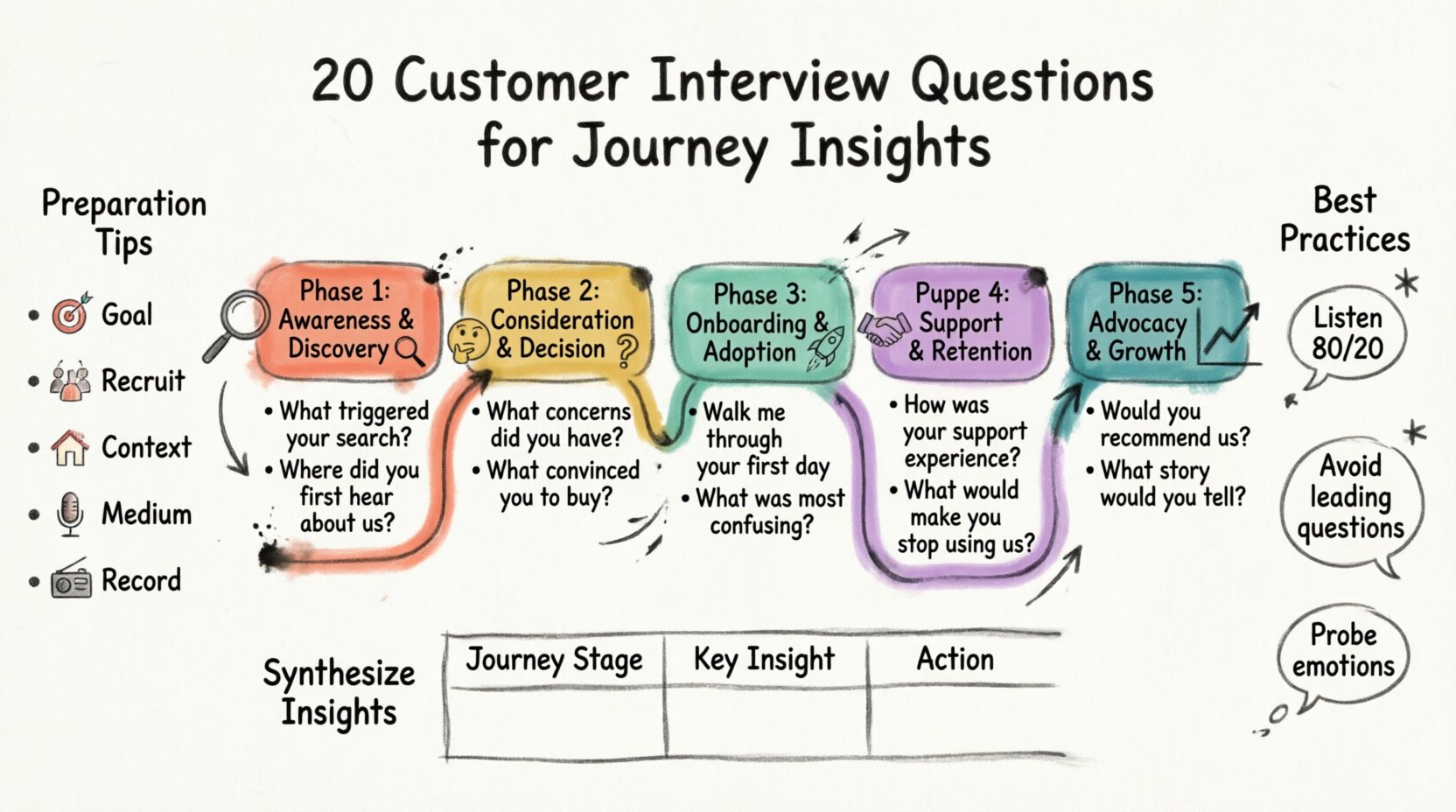
Before you begin asking questions, preparation is key. A successful interview relies on trust and clarity. You want the participant to feel comfortable sharing honest feedback without fear of judgment. Here are essential steps to set the stage:
- Define Your Goal: Are you trying to fix a drop-off point? Understanding onboarding? Or exploring new feature adoption? Clarity here guides your question selection.
- Recruit the Right People: Target customers who represent your ideal personas. Include both power users and those who have churned recently to get a balanced view.
- Set the Context: Explain the purpose of the interview. Let them know you are researching their experience, not evaluating their performance.
- Choose the Right Medium: Video calls often capture non-verbal cues, but phone or in-person can feel more intimate. Choose based on your audience’s preference.
- Record and Note: Always get permission to record. Take detailed notes on tone and hesitation, not just words.
With the foundation set, you are ready to explore the specific stages of the journey. Each phase presents unique opportunities for insight.
The Interview Framework: 20 Questions 📝
These questions are structured to follow the natural flow of a customer relationship. They move from initial awareness through to long-term advocacy.
Phase 1: Awareness & Discovery 🔍
This phase covers the moment a potential customer first realizes they have a problem and begins looking for a solution. Your goal here is to understand their information sources and initial perceptions.
- Can you describe the moment you first realized you had a problem you needed to solve?
Why ask this: Identifies the trigger event. This helps you understand the pain point intensity. - Where did you first hear about our solution?
Why ask this: Pinpoints your most effective acquisition channels. - What other options did you consider before deciding on us?
Why ask this: Reveals your direct competitors and what you need to differentiate against. - What was the first thing that made you curious about our product?
Why ask this: Highlights your value proposition’s hook. - What information were you looking for when you started searching?
Why ask this: Helps optimize your content strategy and SEO focus.
Phase 2: Consideration & Decision 🤔
Once aware, the customer weighs the options. This stage is critical for conversion. You need to know what barriers they faced and what convinced them to commit.
- What concerns did you have before making a purchase?
Why ask this: Uncovers objections you must address in your sales or marketing copy. - What specific features or benefits were most important to your decision?
Why ask this: Validates which features drive value for your users. - Did you speak to anyone else before buying? If so, who?
Why ask this: Identifies key influencers in your buying cycle. - Was there any point where you almost walked away? What happened?
Why ask this: Finds the exact friction point in your funnel. - How did you decide the price was right for the value offered?
Why ask this: Assesses pricing perception and perceived ROI.
Phase 3: Onboarding & Adoption 🚀
The sale is only the beginning. How a customer starts using your product determines long-term retention. This phase is about the initial experience.
- Can you walk me through your first day using the product?
Why ask this: Reveals usability issues and learning curves immediately. - What was the most confusing part of the setup process?
Why ask this: Directly identifies areas for UX improvement. - Did you find the documentation or help resources useful?
Why ask this: Evaluates the quality of your self-service support. - How long did it take to feel confident using the core features?
Why ask this: Measures time-to-value, a key retention metric. - Did you explore any features you didn’t think you needed?
Why ask this: Highlights unexpected value and cross-selling opportunities.
Phase 4: Support & Retention 🤝
Long-term success depends on how the customer feels when things go wrong or when they need more help. This phase covers the ongoing relationship.
- Have you ever contacted support? How did that experience feel?
Why ask this: Qualitative data on customer service quality. - What would make you stop using our product today?
Why ask this: Identifies the top churn risks. - How often do you use the product compared to when you started?
Why ask this: Tracks engagement trends over time. - What is one thing we could do to make your life easier?
Why ask this: Open-ended request for feature ideas. - How does our product fit into your daily workflow?
Why ask this: Understands integration and habit formation.
Phase 5: Advocacy & Growth 📈
The final stage is about turning satisfied customers into promoters. This is where organic growth happens.
- Would you recommend us to a colleague? Why or why not?
Why ask this: The Net Promoter Score (NPS) foundation. - What story would you tell others about your experience?
Why ask this: Reveals the emotional narrative customers share. - Do you feel our product helps you achieve your goals?
Why ask this: Validates overall success and impact. - How do you feel about the roadmap or future updates?
Why ask this: Gauges excitement for future development. - Is there anyone else you know who would benefit from this?
Why ask this: Identifies referral opportunities.
Synthesizing the Data 📊
Collecting the answers is only half the battle. You must organize these insights into a usable format. A table can help structure your findings for your team.
| Journey Stage | Key Insight Type | Example Finding | Recommended Action |
|---|---|---|---|
| Awareness | Source of Truth | Users find us via LinkedIn ads | Increase ad spend on LinkedIn |
| Consideration | Objection Handling | Price seems high compared to competitors | Create ROI calculator page |
| Onboarding | Usability | Sign-up form is too long | Reduce fields to essentials |
| Support | Friction Points | Wait times are too long | Implement chatbot for FAQs |
| Advocacy | Emotional Connection | Users love the customer success team | Feature testimonials prominently |
Look for patterns across your interview transcripts. If three people mention the same confusion, it is not an outlier; it is a systemic issue. Prioritize fixes based on impact and effort.
Best Practices for Researchers 🧠
To ensure the quality of your insights, adhere to these research standards.
- Listen More Than You Speak: Follow the 80/20 rule. Let the customer do most of the talking. Silence is okay; it gives them space to think.
- Avoid Leading Questions: Do not ask, “Did you like the new feature?” Instead, ask, “How did you find the new feature?” This prevents bias.
- Probe for Emotions: Ask “How did that make you feel?” Emotions often drive decisions more than logic.
- Document Context: Note the environment. Was the user stressed? Rushed? This context affects their answers.
- Stay Flexible: If a user mentions something unexpected, follow that thread. It might be more important than your script.
Consistency is important, but adaptability yields the deepest insights. Treat every interview as a unique discovery mission.
Next Steps for Your Team 🏁
Once you have gathered the data and identified the themes, share the findings widely. Customer journey maps are living documents that should be updated regularly. Use these insights to:
- Update your website copy to reflect customer language.
- Train sales teams on the actual objections customers face.
- Guide product development to solve real problems.
- Improve support scripts to be more empathetic and helpful.
Remember that the customer journey is not linear. People move back and forth between stages. Your research should reflect this complexity. By consistently asking the right questions, you keep your organization aligned with user needs. This alignment drives retention, satisfaction, and sustainable growth.
Start with a small group of interviews. Don’t try to do everything at once. Gather feedback, implement changes, and measure the impact. The cycle of research and improvement never truly ends. It is a continuous process of learning about the people you serve.
Utilize these 20 questions as a starting point. Adapt them to fit your specific industry and product context. The goal is to build a deeper understanding of the human behind the screen. When you do that, you create experiences that truly resonate.