

In the landscape of modern product development, communication is the currency of success. When teams move from vague ideas to concrete deliverables, the user story serves as the bridge. However, a story written in isolation often leads to confusion, rework, and missed expectations. This is where structured templates become essential. They provide a consistent framework that aligns stakeholders, developers, and designers around a shared understanding of value.
This guide explores how to utilize user story templates effectively. We will look at the core structure, industry-specific adaptations, and the nuances of acceptance criteria. The goal is to create artifacts that facilitate clarity rather than bureaucracy.
🧱 The Anatomy of a Functional User Story
Before selecting a template, one must understand the fundamental components of a user story. It is not merely a task description; it is a promise of conversation. A well-formed story typically follows a standard format that captures the persona, the action, and the benefit.
- Persona: Who is the user? This could be a customer, an administrator, or a system process.
- Action: What do they want to do? This defines the functionality.
- Benefit: Why are they doing it? This establishes the value proposition.
Consider the standard format:
As a [type of user],
I want [some goal],
so that [some reason].
This structure forces the writer to consider the why, not just the what. It shifts the focus from technical specifications to user needs. While this format is ubiquitous, it often requires adaptation depending on the complexity of the work and the regulatory environment of the industry.
📋 Standard User Story Templates Explained
Different types of work require different levels of detail. A template designed for a simple button click may fail when describing a complex financial transaction. Below are the essential templates that form the backbone of most agile workflows.
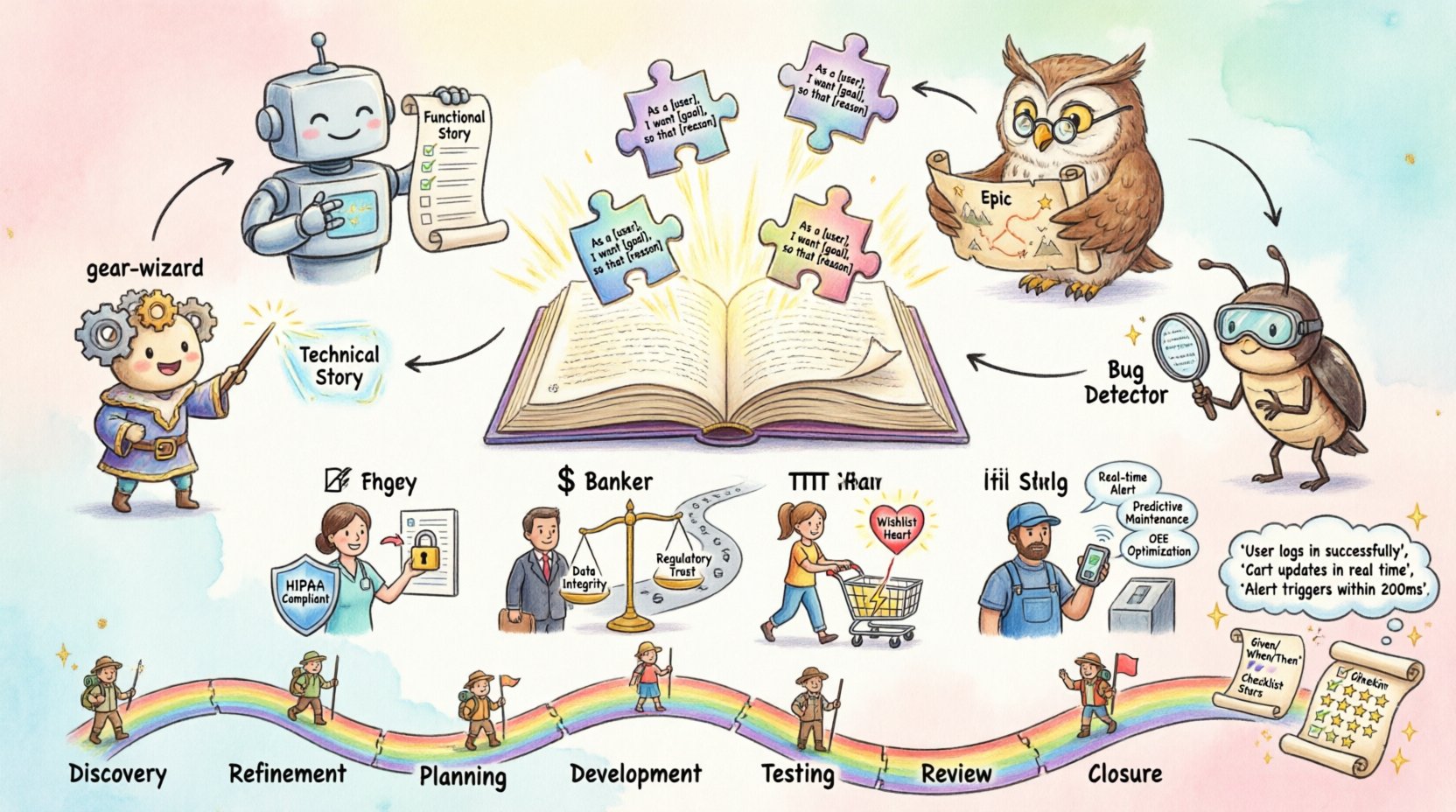
1. The Standard Functional Story
This is the most common template used for features that provide direct value to an end-user. It focuses on the user journey and the outcome.
- Focus: User value and interaction.
- Best For: Front-end features, UI changes, workflow automation.
- Key Fields: Title, Description, Acceptance Criteria, Priority.
2. The Epic Template
Epics are large bodies of work that are too big to be completed in a single cycle. They act as containers for multiple related stories.
- Focus: Strategic themes and long-term goals.
- Best For: Major product launches, significant architectural shifts, multi-phase initiatives.
- Key Fields: Objective, Success Metrics, Related Stories, Timeline Estimate.
3. The Technical Story Template
Not all work involves direct user interaction. Sometimes the work is about infrastructure, security, or maintenance. These stories ensure technical debt is addressed without losing sight of the broader context.
- Focus: System stability, performance, and security.
- Best For: Refactoring, database migrations, security patches.
- Key Fields: Technical Goal, Impact Assessment, Rollback Plan.
4. The Bug or Defect Template
When something breaks, the workflow changes. A bug report needs specific details to be reproducible and fixable.
- Focus: Problem identification and resolution.
- Best For: Reported errors, unexpected behaviors, performance issues.
- Key Fields: Steps to Reproduce, Expected vs. Actual Result, Severity, Environment.
🏭 Adapting Templates for Specific Industries
One size does not fit all. The requirements of a healthcare application differ vastly from those of a retail platform. Regulatory compliance, data sensitivity, and user expectations dictate how a template should be structured.
🏥 Healthcare and Life Sciences
In this sector, accuracy and compliance are paramount. Stories must often adhere to standards like HIPAA or GDPR. The template needs to explicitly address data privacy and auditability.
- Additional Fields: Compliance Check, Data Encryption Requirement, Audit Log necessity.
- Example: “As a nurse, I want to view patient vitals securely, so that I can make timely decisions without risking data privacy.”
- Acceptance Criteria: Access requires two-factor authentication. All data is encrypted at rest and in transit. Logs are retained for 7 years.
💰 Finance and Banking
Financial systems require high precision and traceability. A mistake in calculation can have legal and financial consequences. The template should emphasize validation rules and transaction integrity.
- Additional Fields: Transaction Limits, Fraud Detection Rules, Reconciliation Logic.
- Example: “As a customer, I want to transfer funds to an external account, so that I can pay my suppliers.”
- Acceptance Criteria: Maximum daily limit enforced. Verification code sent via SMS. Transaction ID generated immediately.
🛒 Retail and E-Commerce
Here, speed and user experience are critical. The template should focus on conversion, inventory synchronization, and performance under load.
- Additional Fields: Load Time Targets, Inventory Sync Frequency, Cart Abandonment Rate.
- Example: “As a shopper, I want to save items to a wishlist, so that I can purchase them later without searching again.”
- Acceptance Criteria: Wishlist persists across devices. Notification sent when item goes on sale. Page loads under 2 seconds.
🏭 Manufacturing and IoT
Physical systems interacting with digital software require a focus on real-time data and hardware constraints. The story template must account for latency and connectivity.
- Additional Fields: Device Latency, Offline Mode Capability, Firmware Version.
- Example: “As a machine operator, I want to receive alerts when equipment overheats, so that I can prevent damage.”
- Acceptance Criteria: Alert triggers within 500ms of threshold breach. Notification sent to mobile and desktop. System logs the event locally if network is down.
📊 Comparison of Industry Adaptations
| Industry | Primary Focus | Key Constraint | Template Add-on |
|---|---|---|---|
| Healthcare | Privacy & Safety | Compliance Regulations | Audit Trail Requirements |
| Finance | Accuracy & Security | Transaction Integrity | Fraud Rules & Limits |
| Retail | Speed & UX | Performance | Inventory Sync Logic |
| Manufacturing | Reliability & Latency | Connectivity | Offline Capability |
🎯 Defining Acceptance Criteria
Acceptance criteria are the conditions that must be met for a story to be considered complete. They are the contract between the team and the product owner. Without them, “done” is subjective.
There are several methods to write these criteria effectively:
- BDD (Behavior Driven Development): Uses the Gherkin syntax (Given/When/Then). This is excellent for clarity and allows non-technical stakeholders to validate logic.
- Checklist: A simple list of conditions. Good for quick validation and smaller tasks.
- Scenario-Based: Describes specific use cases or edge cases that need to be tested.
Example of Gherkin Syntax
This format reduces ambiguity significantly.
- Given the user is logged in and has a valid credit card.
- When the user enters an amount greater than their balance.
- Then the system displays an error message and prevents the transaction.
When defining criteria, avoid technical jargon unless the audience is purely engineering. Focus on observable behavior. Instead of saying “The database query must be optimized,” say “The page should load within 2 seconds.”
🚫 Common Pitfalls in Story Creation
Even with a template, teams can fall into traps that reduce the effectiveness of the process. Recognizing these patterns helps maintain high-quality output.
- Too Big (Epics masquerading as Stories): A story must be completable within a single iteration. If it takes weeks, it is likely an Epic.
- Vague Descriptions: Words like “user-friendly” or “fast” are subjective. Define them with numbers.
- Ignoring Edge Cases: Most stories describe the happy path. Ensure the template prompts for error handling and edge cases.
- Missing Acceptance Criteria: A story without criteria is a task, not a user story. It lacks the definition of success.
- Static Documents: Stories are living documents. They should evolve as understanding deepens during refinement.
🤝 Facilitating Collaboration
A template is a tool for communication, not a replacement for it. The most effective teams use the story as a focal point for discussion.
The Three Amigos
Before work begins, the Business Analyst (or Product Owner), a Developer, and a Tester should review the story together. This ensures:
- Feasibility is confirmed by development.
- Testability is confirmed by QA.
- Value is confirmed by the business side.
Refinement Sessions
Regular backlog refinement is necessary. Stories should be pulled through a funnel where they start vague and become detailed. A story ready for development should be clear enough that a new team member could implement it without constant interruption.
🔄 The Lifecycle of a User Story
Understanding where a story fits in the workflow helps in choosing the right template fields. Here is the typical flow:
- Discovery: Idea generation. The story is rough.
- Refinement: Details are added. Criteria are defined. The story is sized.
- Planning: The story is selected for an iteration.
- Development: Code is written against the criteria.
- Testing: Verification against acceptance criteria.
- Review: Stakeholder confirms value.
- Closure: The story is marked complete and deployed.
At each stage, the template serves as a reference point. If the story drifts from its original intent, the template fields help bring the focus back to the user benefit.
🛠️ Implementing Your First Template
Transitioning to a new template system requires a shift in mindset. It is not about adding more paperwork; it is about reducing ambiguity. Start small.
- Choose One Template: Do not implement five templates at once. Start with the Standard Functional Story.
- Train the Team: Explain the why behind the fields. If people understand the value, they will fill them out correctly.
- Iterate on the Template: If a field is never used, remove it. If a field is always needed, make it mandatory.
- Review Regularly: Look at completed stories. Did the acceptance criteria match the final product? Adjust the template if there is a gap.
✅ Conclusion
User story templates are more than administrative overhead. They are the scaffolding that supports complex product development. By selecting the right structure for your industry and maintaining a focus on clear acceptance criteria, teams can reduce waste and increase delivery speed. The best template is the one that your team actually uses consistently. Keep it simple, keep it clear, and always center the conversation on the user.
Related posts:
 User Story vs. Feature Request: What Product Owners Need to Know to Avoid Confusion
 Deep Dive into the INVEST Model: The Secret Framework for Better User Stories
 Stop Wasting Time on Bad User Stories: A Practical Tutorial for Beginners
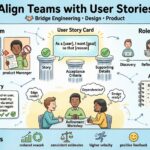 How to Use User Stories to Align Engineering, Design, and Product Teams Effectively