

Enterprise architecture demands precision. When structuring complex organizational landscapes, clarity is the primary objective. ArchiMate provides a standardized language to describe, analyze, and visualize the relationships between business strategy, IT infrastructure, and implementation. However, the framework is structured into distinct layers. Applying these layers correctly is the difference between a coherent model and a confusing diagram.
Many practitioners struggle with the decision of which layer to use for specific use cases. Should a business process be modeled in the Business layer or mapped to an Application function? Does a technology node require a full Motivation layer context? This guide explores the practical application of each layer, ensuring your architecture models remain relevant, maintainable, and valuable to stakeholders.
Understanding the Core Layers 🧱
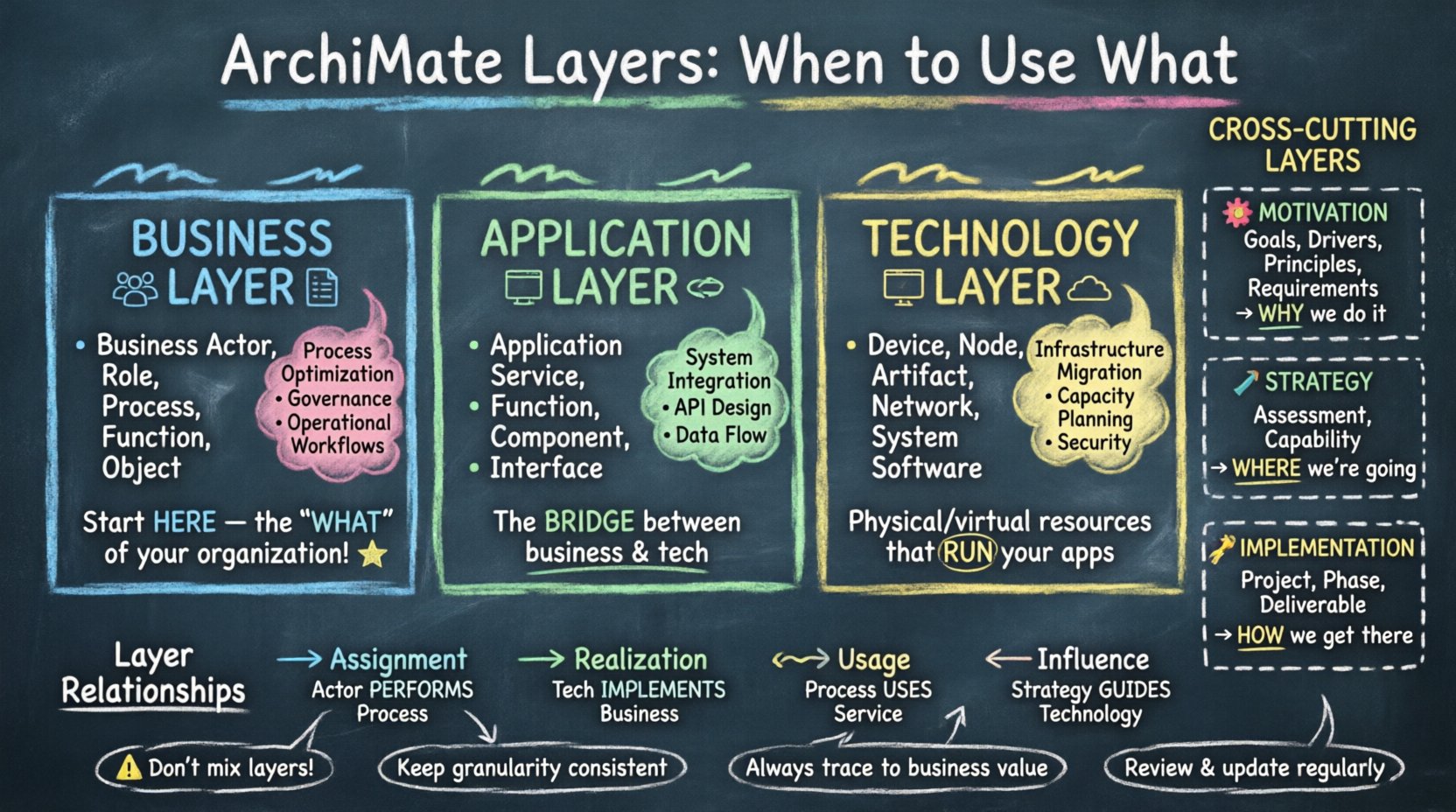
The ArchiMate framework divides the enterprise into three core layers. These layers represent the logical separation of concerns within an organization. They are not silos but interconnected domains.
1. Business Layer 👥
The Business layer represents the organization itself. It describes the structure and processes that deliver value to customers. This is where stakeholders like business managers and process owners operate. It focuses on the “what” of the organization without diving into technical implementation details.
- Business Actor: Entities performing activities (e.g., Customer, Supplier, Employee).
- Business Role: A collection of responsibilities (e.g., Manager, Analyst).
- Business Process: A sequence of activities (e.g., Order Fulfillment, Claims Processing).
- Business Function: A grouping of processes (e.g., Human Resources, Sales).
- Business Object: Information that is created, stored, and used (e.g., Invoice, Contract).
Use Case Application: Use this layer when defining scope, governance, or operational workflows. If a stakeholder asks how a department operates, model here. Do not map specific software buttons here.
2. Application Layer 💻
The Application layer represents the software systems that support the business. It describes how data is processed and managed. This layer acts as the bridge between business logic and technical infrastructure.
- Application Service: Functionality provided to a business process (e.g., Verify Identity).
- Application Function: A grouping of application services (e.g., Authentication Module).
- Application Component: The internal structure of an application (e.g., Web Server, API Gateway).
- Application Interface: The point of interaction between components.
- Application Function: A grouping of application services.
Use Case Application: Apply this layer during system design, integration planning, or software lifecycle management. It is appropriate when discussing data flow between systems or API dependencies.
3. Technology Layer 🖥️
The Technology layer describes the physical or virtual resources required to execute the application layer. It covers hardware, networks, and cloud infrastructure.
- Device: Hardware like servers or routers.
- Node: A computational resource (e.g., a specific cluster).
- Artifact: Physical software representation (e.g., Executable File, Container Image).
- Communication Network: Infrastructure connecting nodes.
- System Software: Operating systems or middleware.
Use Case Application: Use this layer for infrastructure planning, migration strategies, or capacity management. It is the correct place to model physical constraints or network topology.
Cross-Cutting Layers: Motivation, Strategy, and Implementation 🔄
While the core layers describe structure, the cross-cutting layers add context and direction. Ignoring these layers often results in models that look good but lack strategic alignment.
Motivation Layer 🎯
This layer explains why things are done. It captures the drivers behind architectural decisions. Without this, models are just diagrams without purpose.
- Goal: What the organization wants to achieve.
- Driver: A stimulus or reason for change (e.g., New Regulation).
- Principle: A rule to guide decision-making.
- Requirement: A condition that must be met.
Use Case Application: Essential for justification of projects. When explaining budget requests or strategic shifts, link requirements to goals here.
Strategy Layer 📈
The Strategy layer connects business goals to the actual implementation. It focuses on high-level planning and direction.
- Assessment: Evaluation of current state.
- Capability: Ability to achieve outcomes.
Use Case Application: Use this for portfolio management. It helps decide which initiatives align with long-term business capabilities.
Implementation & Migration Layer 🚀
This layer deals with the transition from current to target states. It is crucial for project management and change control.
- Project: A temporary effort to create a unique result.
- Phase: A stage in the implementation process.
- Deliverable: A tangible output of a project.
- Assignment: Linking an actor to a work item.
Use Case Application: Apply this when managing roadmaps. It helps visualize dependencies between projects and the architecture changes they produce.
Mapping Use Cases to Layers 🗺️
Knowing the elements is only half the battle. Knowing when to stop at a specific layer is critical. Here are common scenarios and the recommended layer focus.
Scenario 1: Process Optimization 🏃
Focus: Business Layer.
If the goal is to reduce cycle time or improve customer experience, start with the Business Process. Avoid mapping to Application or Technology unless a specific bottleneck exists in the software.
- Identify bottlenecks in the process flow.
- Analyze Business Objects involved.
- Link to Motivation (Goal: Efficiency).
Scenario 2: System Integration 🔗
Focus: Application Layer.
When systems need to talk to each other, model the Application Services and Interfaces. Ensure the data objects are defined clearly.
- Define the API endpoints.
- Map the data flow between Application Functions.
- Trace back to Business Processes that consume the service.
Scenario 3: Infrastructure Migration ☁️
Focus: Technology Layer.
When moving from on-premise to cloud, focus on Nodes and Devices. Ensure Application Components are assigned to the correct Technology Nodes.
- Map Application Components to Cloud Services.
- Define Security Groups in the Network.
- Assign Projects to migrate specific artifacts.
Scenario 4: Compliance & Governance 📜
Focus: Motivation & Strategy Layers.
Compliance is rarely a technical issue alone. It is a driver. Link Regulations to Principles, and Principles to Requirements.
- Map Regulation (Driver) to Compliance Requirement.
- Link Requirement to Business Process Controls.
- Verify Implementation Phase covers the controls.
Layer Interaction & Relationships 🧬
The power of ArchiMate lies in the relationships between layers. A model is only as good as its traceability.
Assignment & Realization
Relationships define how elements connect. For example, a Business Process is assigned to a Business Role. An Application Function realizes a Business Process. This ensures that every technical component has a business purpose.
- Assignment: An actor performs a function or process.
- Realization: A lower-level element implements a higher-level element.
- Usage: One element uses another (e.g., Process uses Service).
Influence
Use Influence relationships when a decision in one layer affects another without direct implementation. For instance, a Strategy Principle might influence a Technology Standard.
Common Pitfalls to Avoid ⚠️
Even experienced architects make mistakes when applying layers. Being aware of these traps improves model quality.
- Mixing Layers: Do not place a Database (Technology) inside a Business Process. Keep layers distinct.
- Over-Modeling: Do not model every single button click in the Application layer. Focus on services and functions.
- Ignoring Motivation: A model without Goals is just a map. Always anchor the architecture to a Business Goal.
- Static Snapshots: Architecture is dynamic. Ensure your Implementation layer reflects the migration path, not just the target state.
Summary of Layer Applications 📊
The following table summarizes the primary use cases for each layer to assist in quick reference.
| Layer | Primary Focus | Key Stakeholders | Typical Use Case |
|---|---|---|---|
| Business | Value Delivery | Business Owners, Process Managers | Operational Workflow, Governance |
| Application | Software Support | System Architects, Developers | Integration, Data Flow, Lifecycle |
| Technology | Infrastructure | Infrastructure Managers, Ops | Migration, Capacity, Security |
| Motivation | Rationale | Strategic Planners, Analysts | Justification, Requirements |
| Implementation | Change Management | Project Managers, PMO | Roadmaps, Phasing, Deliverables |
Best Practices for Effective Modeling 🛠️
To maintain high-quality architecture models, adhere to these guidelines.
1. Start with the Business
Always begin with the Business Layer. If you cannot explain the business value, the technical implementation is likely unnecessary. Ensure every Application Function can be traced back to a Business Process.
2. Define Granularity Consistently
Decide on the level of detail at the start. If you model Business Processes at a high level, do not drill down into Application Components at a low level. Maintain consistent abstraction across the model.
3. Leverage Stakeholders
Different layers serve different audiences. Present Business Layer diagrams to executives. Show Application and Technology layers to engineering teams. Tailor the view to the user.
4. Maintain Traceability
Use relationships to create a web of traceability. If a Requirement changes, check which Business Process and Application Function it touches. This prevents unintended side effects during change management.
5. Review Regularly
Architecture is not a one-time activity. Schedule regular reviews to ensure the Implementation layer matches the reality of deployed systems. Update Motivation layers when market conditions shift.
Advanced Use Case: Digital Transformation 🌐
Digital transformation requires a holistic view. It is not just about technology; it is about business model innovation.
- Identify Capabilities: Use the Strategy layer to define new capabilities needed.
- Map Gaps: Compare current Business Processes against target capabilities.
- Define Projects: Use the Implementation layer to plan the delivery of new Application Services.
- Align Infrastructure: Ensure Technology Layer supports cloud-native requirements.
In this scenario, the layers interact heavily. A change in Business Strategy (Motivation) triggers a need for new Application Services (Application), which requires new Cloud Nodes (Technology). The Implementation layer orchestrates the transition.
Conclusion on Application 🏁
Effective use of ArchiMate layers ensures that enterprise architecture remains a practical tool rather than an academic exercise. By understanding when to apply the Business, Application, Technology, Motivation, Strategy, and Implementation layers, architects can create models that drive real value. Focus on the relationships that bind these layers together, and always keep the business goals at the center of the design.
Adopting this structured approach allows organizations to navigate complexity with clarity. Whether managing a simple system upgrade or a full-scale digital transformation, the disciplined application of these layers provides the necessary foundation for success.