


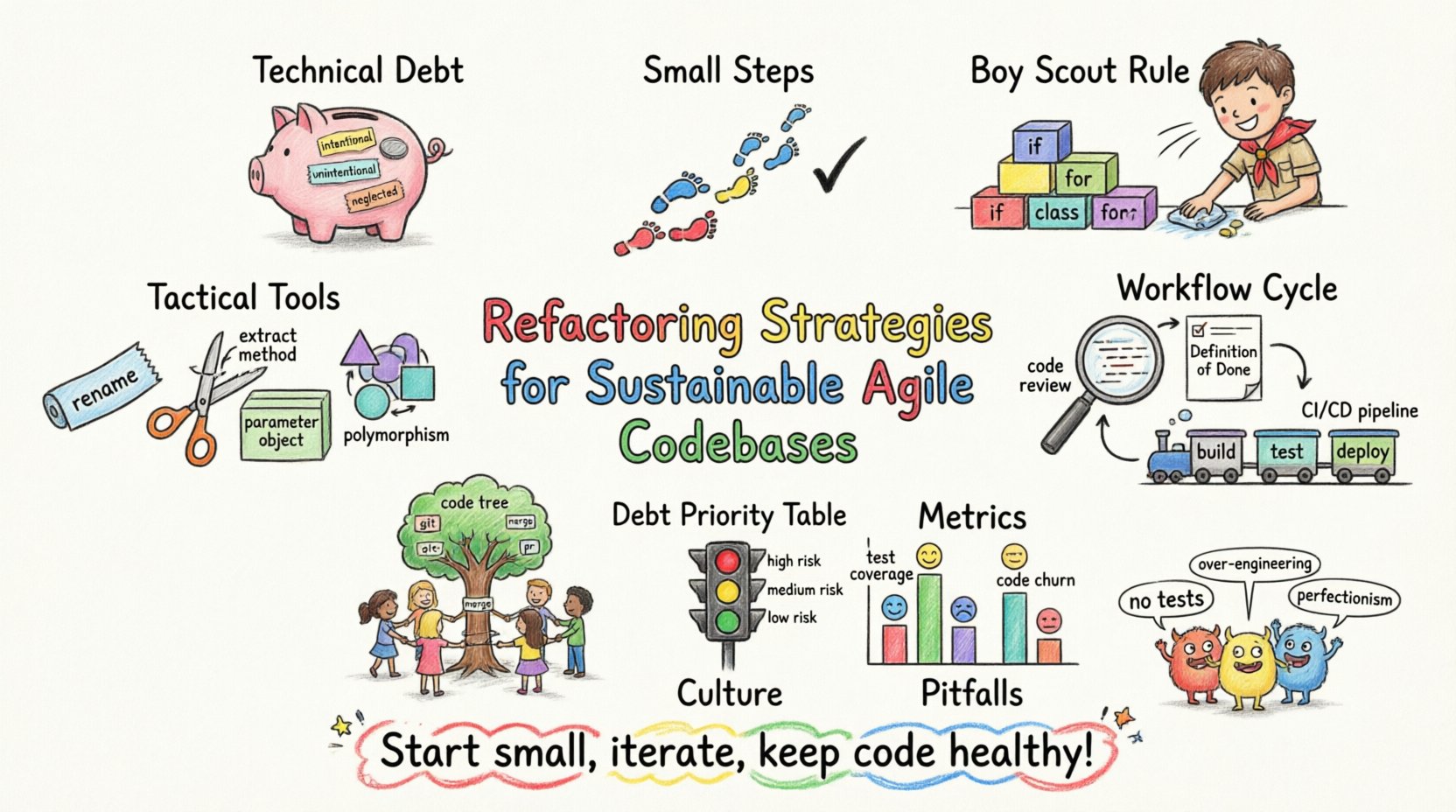
In the fast-paced environment of iterative development, code quality often competes with delivery speed. This tension creates a specific challenge: maintaining a codebase that remains adaptable without accumulating unmanageable complexity. Sustainable refactoring is not a separate phase; it is an integrated practice woven into the daily rhythm of development. This guide explores actionable strategies to maintain code health while adhering to agile principles.
📉 Understanding Technical Debt in Agile Contexts
Technical debt is a metaphor used to describe the implied cost of additional rework caused by choosing an easy solution now instead of a better approach that would take longer. In agile teams, this debt is often accumulated intentionally to meet deadlines or validate hypotheses. However, when debt compounds, it slows down velocity and increases the risk of defects.
Intentional Debt: Borrowed against time to ship a feature quickly, with a plan to pay it back later.
Unintentional Debt: Accumulated through lack of knowledge, poor design decisions, or changing requirements without adaptation.
Neglected Debt: Known issues that are ignored until the system becomes brittle.
When teams focus solely on feature delivery, the codebase can become a “black box” where understanding the impact of a change becomes increasingly difficult. This cognitive load affects new team members and experienced engineers alike. Sustainable practices aim to keep the debt ratio low enough that the system remains navigable.
🧹 Core Principles for Continuous Improvement
Refactoring should not be a massive overhaul project. Instead, it works best when applied continuously. The goal is to improve the internal structure of code without changing its external behavior. This requires a shift in mindset from “fixing bugs” to “preventing complexity”.
The Boy Scout Rule
One of the most effective habits is the Boy Scout Rule: always leave the code cleaner than you found it. If you touch a file for a new feature, check if there are obvious improvements you can make. This might mean renaming a variable for clarity or extracting a small method to reduce duplication. These small wins accumulate over time.
Small Steps, Frequent Feedback
Large refactoring efforts carry high risk. They are difficult to test and hard to revert if things go wrong. Breaking refactoring into small, isolated changes allows for rapid feedback. If a change introduces a regression, it is easier to identify and fix when the scope is narrow.
Frequency: Aim to refactor daily, even if only for 15 minutes.
Scope: Limit changes to a single file or a specific function.
Verification: Ensure tests pass before and after the change.
🛠️ Tactical Refactoring Techniques
There are specific patterns and techniques used to improve code structure. These are not limited to a specific language or framework. They are universal concepts of software design.
1. Rename and Clarify
Code is read far more often than it is written. Ambiguous names create confusion. If a variable name does not clearly describe its purpose, the logic surrounding it is harder to understand.
Replace generic names like
dataorresultwith specific terms.Ensure class names describe the object’s responsibility.
Update comments only when the code itself cannot explain the intent.
2. Extract Method
Long methods are difficult to follow. They often contain mixed responsibilities. Extracting a portion of logic into its own method improves readability and allows for reuse.
Identify a logical block of code within a larger function.
Move that block to a new method with a descriptive name.
Replace the original block with a call to the new method.
3. Introduce Parameter Objects
When a function takes many parameters, it becomes hard to manage. Grouping related parameters into a single object simplifies the signature. This also makes it easier to pass groups of values around without creating new arguments every time.
4. Replace Conditional Logic with Polymorphism
Complex if-else or switch statements often indicate that different behaviors should be handled by different classes. Moving logic into specific classes reduces the complexity of the central controller.
🔄 Integrating Refactoring into the Workflow
Refactoring must be part of the standard workflow, not an exception. If it is treated as a separate task, it is often deprioritized when pressure mounts.
Code Reviews
Peer reviews are a primary mechanism for catching debt. Reviewers should look for code smells, such as duplication, long methods, or deep nesting. The goal is not to nitpick style but to ensure the design supports future changes.
Focus on Structure: Ask how this change affects the overall architecture.
Encourage Questions: If something is unclear, ask the author to clarify or refactor.
Automate Standards: Use static analysis tools to flag violations of naming or complexity rules.
Definition of Done
The “Definition of Done” should include criteria for code quality. A feature is not complete until it is tested, documented, and refactored to meet team standards. This prevents the accumulation of shortcuts.
Continuous Integration
Automated testing and build pipelines provide a safety net. When refactoring, the automated suite ensures that behavior remains unchanged. If the build fails, the change is reverted immediately.
Fast Feedback: Keep build times short to encourage frequent commits.
Quality Gates: Block merges if code coverage drops significantly.
Static Analysis: Run checks on every push to catch potential issues early.
🏗️ Managing Technical Debt Strategically
Not all debt is equal. Some debt is critical and needs immediate attention, while other debt can be deferred. Teams need a strategy to prioritize which issues to address first.
Debt Type | Impact | Recommended Action |
|---|---|---|
Security Vulnerabilities | High Risk | Immediate Fix |
Broken Tests | High Confidence | Fix Before New Work |
Performance Bottlenecks | Medium Risk | Schedule for Sprint |
Code Smells | Low Risk | Fix During Feature Work |
Documentation Gaps | Medium Risk | Add During Onboarding |
Tracking this debt requires visibility. Teams should maintain a backlog item for technical improvements. This ensures that refactoring work is visible to stakeholders and can be planned for alongside feature work.
🧠 Cultivating a Sustainable Culture
Tools and techniques are useless without the right culture. If developers feel punished for slowing down to write clean code, they will prioritize speed over quality. Psychological safety is essential for admitting when code needs improvement.
Shared Ownership
When code is owned by a single person, it becomes a bottleneck. Shared ownership means anyone can modify any part of the system. This encourages developers to care about the health of the entire codebase, not just their assigned modules.
Pair Programming: Two developers working together can catch issues and share knowledge in real-time.
Rotating Responsibilities: Rotate who handles maintenance tasks to prevent silos.
Collective Code Quality: Treat code health as a team metric, not an individual one.
Continuous Learning
Software practices evolve. What was good code five years ago might be outdated today. Teams should allocate time for learning. This could involve sharing sessions, reading technical articles, or experimenting with new patterns.
Blameless Post-Mortems
When bugs occur due to technical debt, focus on the system, not the person. Ask why the debt was created and why it was not caught earlier. This leads to process improvements rather than fear.
📊 Measuring Progress
How do you know if your refactoring efforts are working? You need metrics that reflect quality without encouraging gaming the system.
Cyclomatic Complexity: Measures the number of linearly independent paths through a program. Lower is generally better.
Coverage: The percentage of code executed by tests. High coverage gives confidence in refactoring.
Lead Time for Changes: The time from commit to production. If this increases, debt may be slowing you down.
Defect Rate: The number of bugs found in production. A rising trend suggests hidden complexity.
Avoid vanity metrics. The number of lines of code deleted is not a good measure of improvement. Focus on metrics that correlate with team velocity and stability.
🛑 Common Pitfalls to Avoid
Even with good intentions, teams can make mistakes. Being aware of these common pitfalls helps avoid them.
1. Over-Engineering
Refactoring should solve actual problems, not hypothetical ones. Do not create abstractions for features that do not exist. Simplicity is often better than complexity, even if it looks slightly repetitive.
2. Ignoring Tests
Refactoring without tests is dangerous. You cannot be sure the behavior has not changed. Always ensure you have a safety net before touching complex logic.
3. Stopping Feature Work
Carving out entire sprints for refactoring often leads to a “big bang” release that introduces new risks. It is better to integrate refactoring into feature development continuously.
4. Perfectionism
Code is never perfect. Striving for perfection slows delivery. Aim for “good enough” and iterate. The goal is maintainability, not art.
🚀 Looking Ahead
The landscape of software development is constantly shifting. New patterns emerge, and legacy systems accumulate. The key to longevity is adaptability. By treating refactoring as a core competency, teams can build systems that endure.
Start small. Pick one technique from this guide and apply it to your current work. Observe the impact. Share what you learn with the team. Over time, these small adjustments compound into a robust, sustainable codebase capable of supporting rapid change.
Remember, the value of software lies in its ability to change. A codebase that resists change is a liability. A codebase that welcomes it is an asset. Invest in the structure of your work, and the business value will follow.