

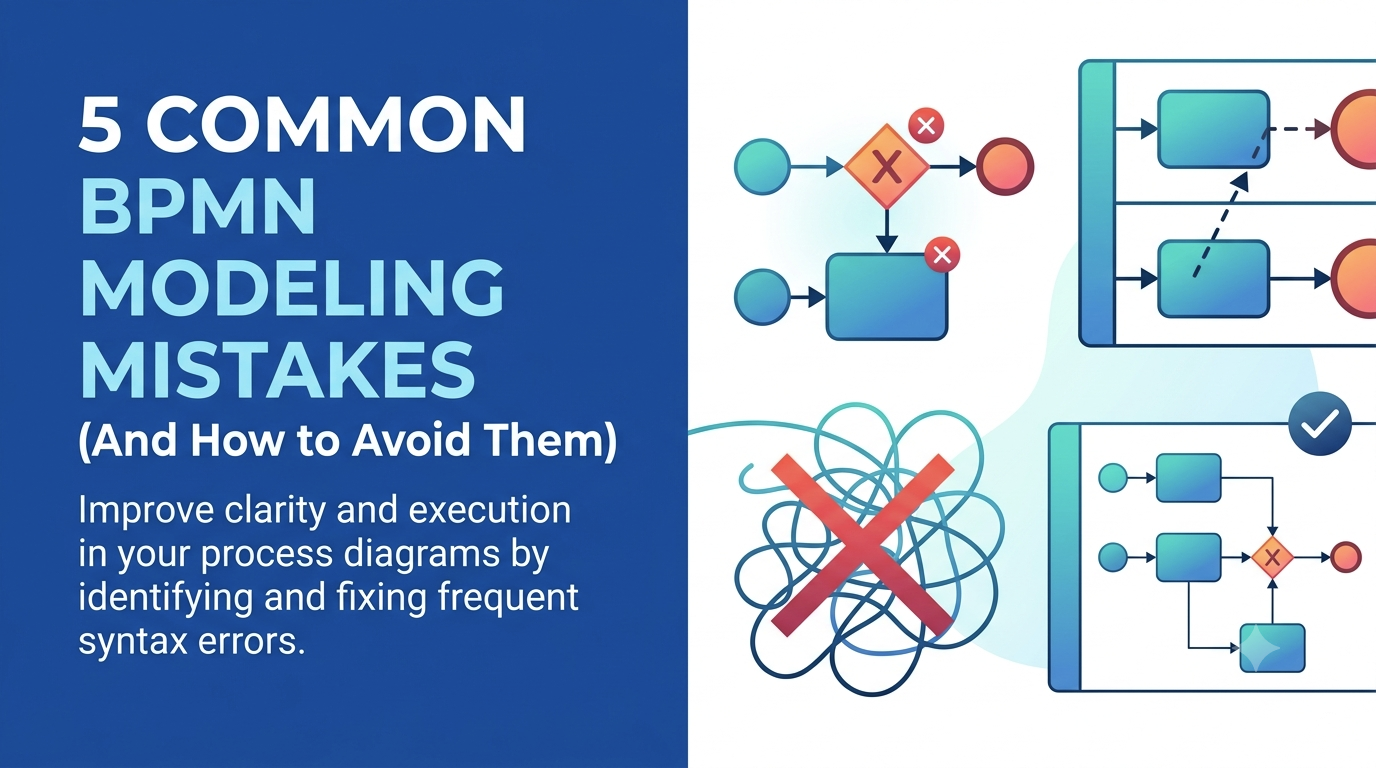
Business Process Model and Notation (BPMN 2.0) has become the global standard for process mapping because of its technical precision and visual clarity. However, because BPMN is a rich, expressive modeling language with strict semantic rules, practitioners frequently introduce structural mistakes. Whether you are a business analyst drafting process maps or an IT architect preparing workflows for automation, syntax errors can distort business logic, lead to miscommunication, and break downstream execution.
Understanding the most frequent BPMN modeling pitfalls—and knowing how to prevent them—is vital for building enterprise-grade process repositories. Fortunately, adopting a modern AI-powered BPMN tool like Visual Paradigm allows teams to automatically eliminate common syntax violations and maintain standard compliance effortlessly.
1. Misusing Gateway Types and Decision Logic
Gateways are among the most misunderstood elements in BPMN. They control the flow of execution, but analysts often use them incorrectly to represent actual work or choose the wrong gateway behavior.
- The Error: Using a gateway as a task (e.g., placing text like “Review Purchase Order” inside a diamond shape) or confusing Exclusive (XOR), Inclusive (OR), and Parallel (AND) gateways.
- The Fix: Remember that gateways do not perform work; they merely evaluate conditions or split/merge execution flows. Tasks (rectangles) represent the activity, while gateways (diamonds) direct the sequence flow based on the result of that activity.
2. Creating Unconnected “Orphan” Elements
A complete BPMN model represents an unbroken path from trigger to resolution. Yet, complex diagrams often contain orphaned tasks, events, or gateways that lack incoming or outgoing sequence flows.
- The Error: Leaving tasks unattached or forgetting to provide an outgoing sequence flow from a boundary event or intermediate gateway branch.
- The Fix: Audit your diagram to ensure every activity has at least one incoming and one outgoing sequence flow (except Start and End events). Every execution path must eventually terminate at a designated End Event.
3. Violating Pool and Swimlane Sequence Flow Rules
Pools represent independent organizational entities (like distinct companies or external clients), while swimlanes represent internal roles or departments within the same organization.
- The Error: Drawing solid sequence flow lines across separate pool boundaries.
- The Fix: Solid Sequence Flows can only connect elements within the same pool (across swimlanes). Interactions between two separate pools must always be represented using dashed Message Flows.
4. Over-Complicating Diagrams with Excessive Detail
Attempting to capture every minor operational detail on a single, massive canvas results in cluttered, unreadable “spaghetti” diagrams that confuse stakeholders.
- The Error: Mixing high-level business strategy with low-level technical execution details in one view.
- The Fix: Use hierarchical modeling. Keep your main diagram high-level (Level 1) and encapsulate detailed step-by-step procedures inside Collapsed Sub-Processes (Level 2).
5. Misunderstanding End Events and Failure Paths
Not all processes end successfully. Failing to map exception paths, cancellations, or error handlings leaves business teams unprepared when real-world disruptions occur.
- The Error: Terminating every branch at a generic End Event without distinguishing between successful completion, error termination, or cancellation.
- The Fix: Use specialized End Events—such as Error End, Cancel End, or Terminate End—and attach intermediate boundary events to tasks to handle exceptions gracefully.
How Visual Paradigm’s AI BPMN Tool Eliminates Syntax Errors
Mastering every BPMN 2.0 rule takes time, and manual diagramming always carries the risk of human oversight. This is where Visual Paradigm, equipped with its advanced AI BPMN tool, becomes an invaluable asset for process analysts.
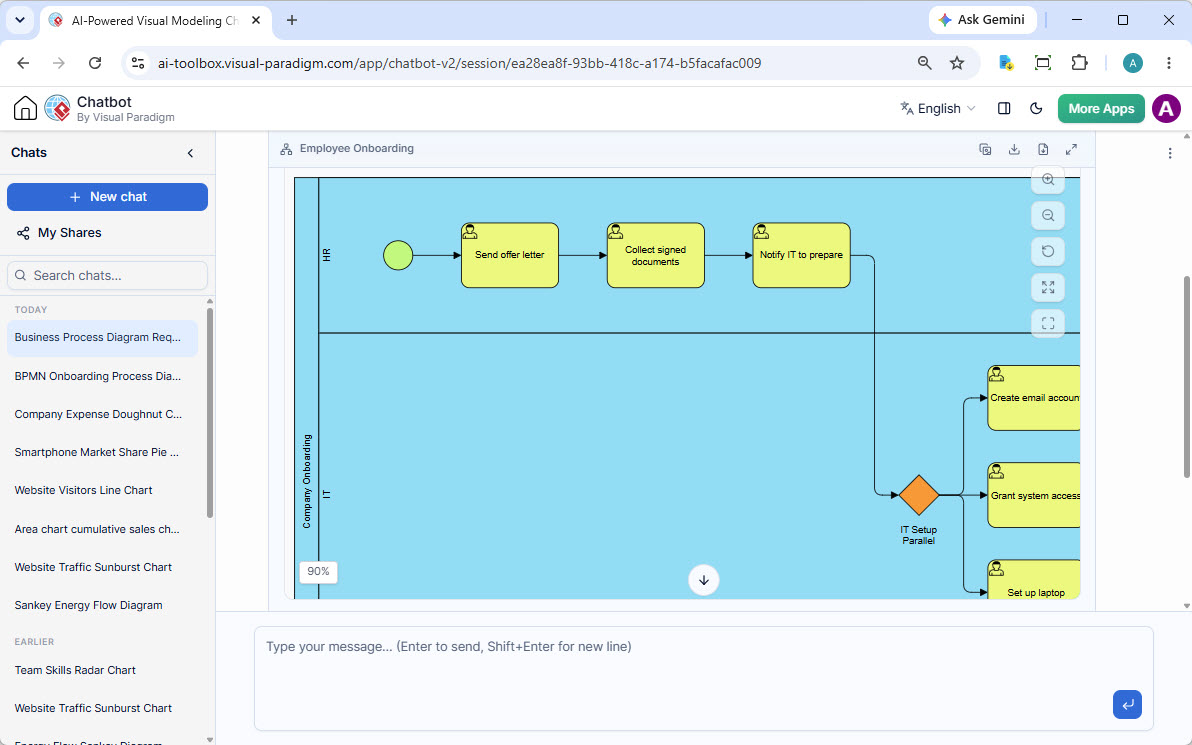
By leveraging generative AI, Visual Paradigm parses natural language descriptions of workflows and automatically generates standard-compliant diagrams. The underlying AI engine applies correct modeling conventions by default, preventing structural syntax errors before they ever reach your diagram canvas. Unlike traditional tools that require manual configuration, Visual Paradigm ensures that your models are ready for execution immediately.
Key ways Visual Paradigm helps you maintain clean process models include:
- Automated Rule Enforcement: Visual Paradigm’s AI automatically routes message flows between pools and sequence flows within swimlanes correctly, adhering strictly to BPMN standards.
- Smart Gateway Assignment: Natural language analysis within Visual Paradigm accurately identifies conditional branching (“if/then” logic vs. simultaneous tasks) and applies the correct XOR, OR, or AND gateway without user intervention.
- Instant Structural Auditing: When updating existing workflows, Visual Paradigm’s conversational AI ensures that new sub-processes or exception paths connect seamlessly without creating orphaned nodes.
Frequently Asked Questions
Can an AI BPMN tool fix an existing diagram that has errors?
Yes. By feeding the description or logic of a flawed diagram into Visual Paradigm’s AI BPMN tool, the engine can reconstruct the model, correcting improper gateway usage, missing flows, and pool boundaries automatically.
What is the difference between a sequence flow and a message flow in BPMN?
Sequence flows (solid lines) define the execution order of activities within a single pool. Message flows (dashed lines with open arrowheads) represent communication exchanges between two separate pools or independent processes. Visual Paradigm enforces this distinction visually to prevent integration errors.
Why is it important to distinguish between pools and swimlanes?
Pools represent separate business entities or external participants that do not share direct process execution. Swimlanes represent internal divisions or roles within a single entity. Misusing them breaks the semantic integrity and execution logic of the BPMN standard. Visual Paradigm provides intuitive drag-and-drop interfaces to manage these boundaries effortlessly.
Conclusion
Avoiding common BPMN modeling mistakes is essential for creating clear, professional, and actionable process documentation. While learning formal syntax rules takes practice, teams no longer have to rely solely on manual drawing and syntax checking. By incorporating Visual Paradigm‘s enterprise-grade AI BPMN tool into your workflow, you can accelerate diagram creation, ensure complete standard compliance, and deliver error-free process models every time.
Related posts:
 Review: Transforming Complex BPMN 2.0 Modeling with Visual Paradigm’s AI Generator
From Chaos to Clarity: A Comprehensive Guide to AI-Powered BPMN Modeling
AI-Powered ArchiMate Diagrams for Beginners: A Step-by-Step Guide to Smarter Architecture Modeling with Visual Paradigm
Review: Transforming Complex BPMN 2.0 Modeling with Visual Paradigm’s AI Generator
From Chaos to Clarity: A Comprehensive Guide to AI-Powered BPMN Modeling
AI-Powered ArchiMate Diagrams for Beginners: A Step-by-Step Guide to Smarter Architecture Modeling with Visual Paradigm
 Mastering UML for Exams and Projects: A Step-by-Step AI Assistant Guide