


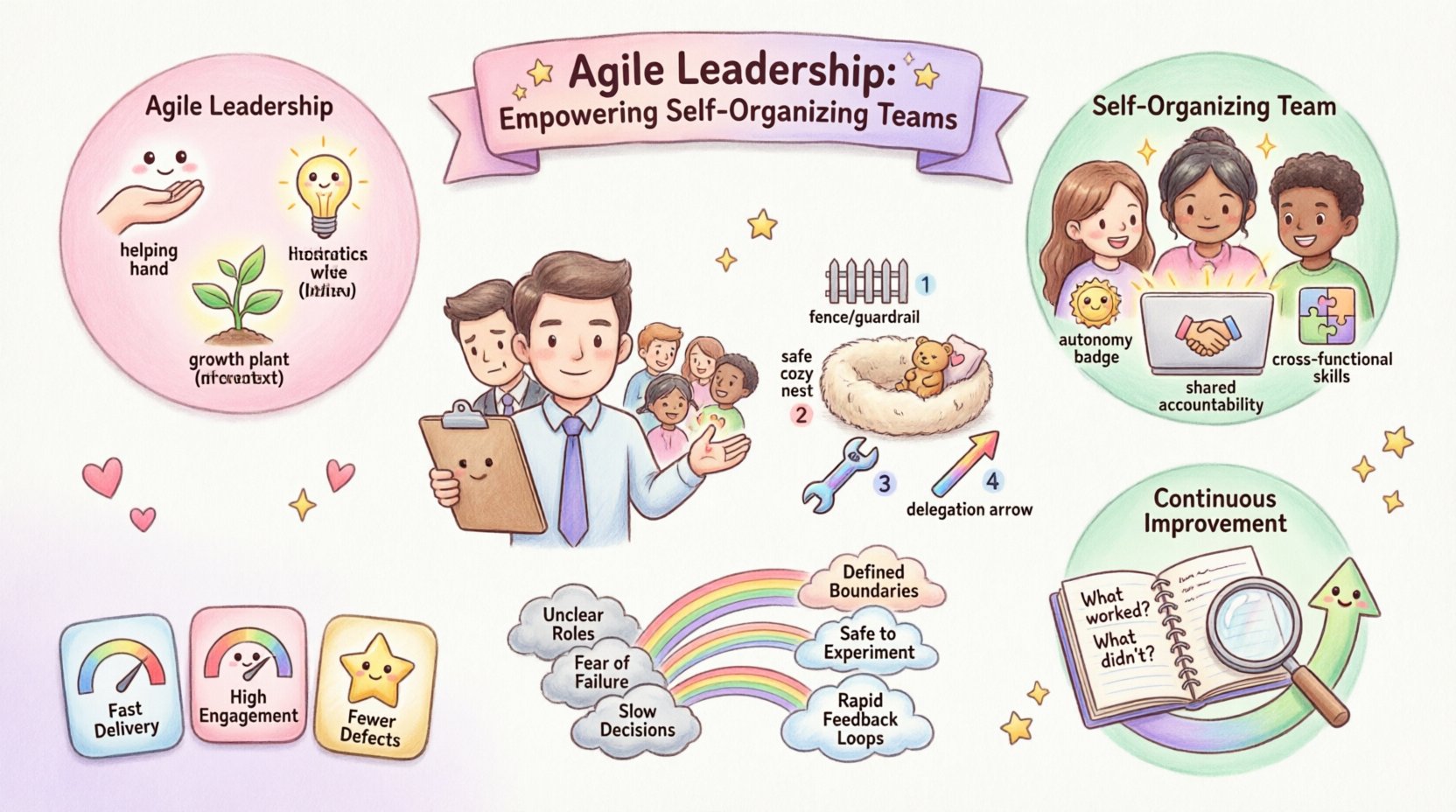
The landscape of modern work has shifted dramatically. The old model of command-and-control management often stifles innovation and slows down delivery. In its place, a new approach has emerged, focusing on autonomy, collaboration, and adaptability. At the heart of this shift lies the concept of Agile Leadership and the creation of Self-Organizing Teams. This guide explores how leaders can transition from directive supervisors to enabling facilitators, fostering environments where high-performing groups can thrive independently.
Understanding the Core Concepts 🧠
Before diving into strategies, it is essential to define what we mean by these terms within the context of agile methodologies. These concepts are not just buzzwords; they represent fundamental changes in how work gets done.
What is Agile Leadership?
Agile leadership is not about a specific job title or a hierarchy rank. It is a mindset and a set of behaviors. An agile leader focuses on serving the team rather than directing them. They remove obstacles, provide context, and ensure the team has the resources needed to succeed. The goal is to create a culture where decision-making is pushed down to the people closest to the work.
Servant Mindset: The leader asks, “How can I help you?” instead of “What did you do today?”
Context Provider: Instead of giving orders, leaders share the “why” behind the work, allowing the team to decide the “how.”
Change Agent: They champion continuous improvement and adaptability in the face of uncertainty.
What Defines a Self-Organizing Team?
A self-organizing team is a group capable of managing its own work without external micromanagement. They decide how to accomplish the tasks assigned to them. They allocate work among themselves, manage their own schedules, and solve problems collaboratively.
Autonomy: The team has the authority to make decisions regarding their workflow and technical approach.
Shared Accountability: Success and failure are collective experiences, not individual ones.
Cross-Functional Skills: Members possess a diverse set of skills that allow the team to deliver value end-to-end.
The Leadership Shift: From Control to Enablement 🔄
Moving from a traditional management style to an agile leadership style requires significant behavioral change. It involves letting go of the need to be the expert on everything and trusting the team to find the best solutions.
Traditional vs. Agile Management
Understanding the difference helps clarify where the friction points lie during a transformation.
Aspect | Traditional Management | Agile Leadership |
|---|---|---|
Decision Making | Top-down, centralized | Distributed, collaborative |
Focus | Tasks and compliance | Value and outcomes |
Communication | Reporting status to managers | Direct collaboration within team |
Problem Solving | Manager identifies and fixes | Team identifies and solves |
Feedback | Annual or quarterly reviews | Continuous and immediate |
Why This Shift Matters
When leaders cling to control, they create bottlenecks. Every decision must pass through the manager, slowing down progress. By empowering teams, organizations can respond faster to market changes. Self-organizing teams are often more motivated because they have ownership over their results.
Practical Strategies for Empowering Teams 💪
Empowerment does not happen overnight. It requires deliberate actions and consistent reinforcement. Here are specific practices to help leaders facilitate this transition.
1. Establish Clear Boundaries and Guardrails
Autonomy does not mean chaos. Teams need to know the limits within which they can operate. Clear goals and constraints allow creativity to flourish without straying from the mission.
Define the Vision: Ensure every team member understands the ultimate goal of the project.
Set Constraints: Clarify budget, timeline, and quality standards.
Identify Risks: Discuss what is off-limits due to regulatory or security concerns.
2. Foster Psychological Safety
For a team to self-organize, members must feel safe to speak up, admit mistakes, and propose new ideas. Without safety, silence prevails, and problems remain hidden.
Encourage Questioning: Reward those who challenge the status quo constructively.
Normalize Failure: Treat failures as learning opportunities rather than reasons for punishment.
Active Listening: Leaders must listen to understand, not just to reply or correct.
3. Remove Impediments Relentlessly
The primary role of the leader is to clear the path. If a team is blocked by external dependencies, bureaucratic red tape, or resource shortages, they cannot be self-organizing. The leader must act as a shield against these distractions.
Identify Blockers: Regularly ask, “What is stopping you from delivering?”
Escalate Issues: Take problems that the team cannot solve to higher management.
Streamline Processes: Reduce unnecessary meetings and paperwork.
4. Delegate Authority, Not Just Tasks
Many leaders make the mistake of assigning tasks without giving the authority to make decisions about how those tasks are completed. True delegation involves handing over the decision-making power.
Outcome-Based Goals: Set the target, not the method.
Resource Control: Allow the team to manage their own budget or tool selection within limits.
Stakeholder Access: Let the team communicate directly with customers or stakeholders.
Common Challenges and How to Navigate Them 🚧
Transitioning to self-organization is rarely smooth. Resistance is common, both from leadership and from the teams themselves. Recognizing these hurdles early allows for proactive management.
Challenge 1: The Leadership Vacuum
Some leaders interpret empowerment as absence. They disappear, leaving the team without guidance. This leads to confusion and lack of direction. The leader must remain present but change how they interact.
Solution: Schedule regular check-ins focused on coaching rather than status updates.
Solution: Be available for escalation, but only when requested.
Challenge 2: Fear of Failure
Team members accustomed to strict directives may fear making the wrong choice. They might wait for permission to act, effectively negating the self-organization.
Solution: Celebrate small wins and bold experiments.
Solution: Create a “fail-fast” culture where mistakes are analyzed, not punished.
Challenge 3: Lack of Skills or Maturity
Not every team is ready for full autonomy. Some may lack the technical skills or the soft skills required for collaboration. Forcing self-organization on an unprepared group leads to dysfunction.
Solution: Invest in training and coaching.
Solution: Start with small areas of autonomy and expand as confidence grows.
Building a Culture of Continuous Improvement 📈
Self-organizing teams do not just exist; they evolve. A key component of agile leadership is ensuring that the team continuously reflects on its processes and outcomes.
Rituals for Reflection
Regular ceremonies help teams stay aligned and improve over time.
Retrospectives: Dedicated time to discuss what went well, what didn’t, and how to improve.
Inspections: Frequent reviews of the product to ensure it meets stakeholder needs.
Adaptation: Making changes to the process based on feedback.
Metrics That Matter
How do you measure the success of a self-organizing team? Traditional metrics like “hours worked” or “tasks completed” are insufficient. Focus on value and flow.
Lead Time: How long does it take from idea to delivery?
Velocity: How much value does the team deliver per iteration?
Satisfaction: How happy are the team members and the customers?
Quality: What is the rate of defects or bugs?
The Role of the Agile Leader in Conflict Resolution ⚖️
In any group, conflict is inevitable. In a self-organizing team, conflict can be a source of innovation if managed correctly. The leader’s role is not to suppress conflict but to facilitate constructive resolution.
Types of Conflict
Task Conflict: Disagreements about the work itself. This is healthy and often leads to better solutions.
Relationship Conflict: Personal friction between members. This is destructive and needs intervention.
Process Conflict: Disagreements about how the work is done. This requires clear agreements.
Intervention Strategies
Facilitate Dialogue: Bring parties together to express their views openly.
Focus on Interests: Move past positions to understand underlying needs.
Establish Norms: Agree on how the team handles disagreement in the future.
Developing the Right Skills for the Team 🛠️
Empowerment requires capability. If a team is given responsibility without the skills to handle it, they will struggle. Leaders must invest in skill development.
Technical Skills
Ensure the team has the technical competence to build the product. This includes coding standards, testing practices, and architecture knowledge.
Soft Skills
Self-organization relies heavily on communication and collaboration.
Communication: Clear and concise exchange of information.
Collaboration: Working together towards a common goal.
Emotional Intelligence: Understanding and managing one’s own emotions and those of others.
Sustaining Momentum Over Time 🏃
Change fatigue is real. Teams may revert to old habits when under pressure. Leaders must remain vigilant to ensure the new ways of working stick.
Lead by Example: Demonstrate the behaviors you expect from the team.
Reinforce Success: Publicly acknowledge when the team makes good decisions autonomously.
Review Goals: Regularly revisit the vision to ensure alignment.
Final Thoughts on the Journey 🌟
Becoming an agile leader is a continuous journey, not a destination. It requires patience, humility, and a genuine belief in the potential of people. When leaders successfully empower self-organizing teams, the benefits are profound. Teams become more innovative, more resilient, and more engaged. The organization becomes more agile, capable of navigating complex environments with ease.
The transition involves unlearning old habits and embracing new mindsets. It is not about abandoning structure, but about shifting the structure to support autonomy. By focusing on enabling the team rather than controlling the team, leaders unlock the full potential of their workforce.
Remember that every team is unique. What works for one group may not work for another. Be willing to experiment, adapt, and learn alongside your team. The goal is not perfection, but progress. With consistent effort and a supportive environment, self-organizing teams can deliver exceptional value and drive meaningful change within the organization.
Start today. Look for one area where you can hand over decision-making power. Observe the results. Listen to the feedback. Adjust your approach. This iterative process mirrors the agile principles themselves. By practicing what you preach, you build a culture of trust and high performance.
The future of work belongs to those who can adapt. Agile leadership is the compass that guides organizations through this evolution. By empowering self-organizing teams, you are not just managing work; you are cultivating a legacy of innovation and resilience.