

As engineering teams expand from a handful of developers to hundreds, the dynamics of software delivery shift fundamentally. What worked for a small squad often breaks under the weight of coordination, dependency management, and cultural drift. Scaling Agile is not merely about applying more processes to more people; it is about redesigning how value flows through a complex system. This guide explores practical strategies for maintaining agility while growing an engineering organization, focusing on structure, communication, and sustainable practices.
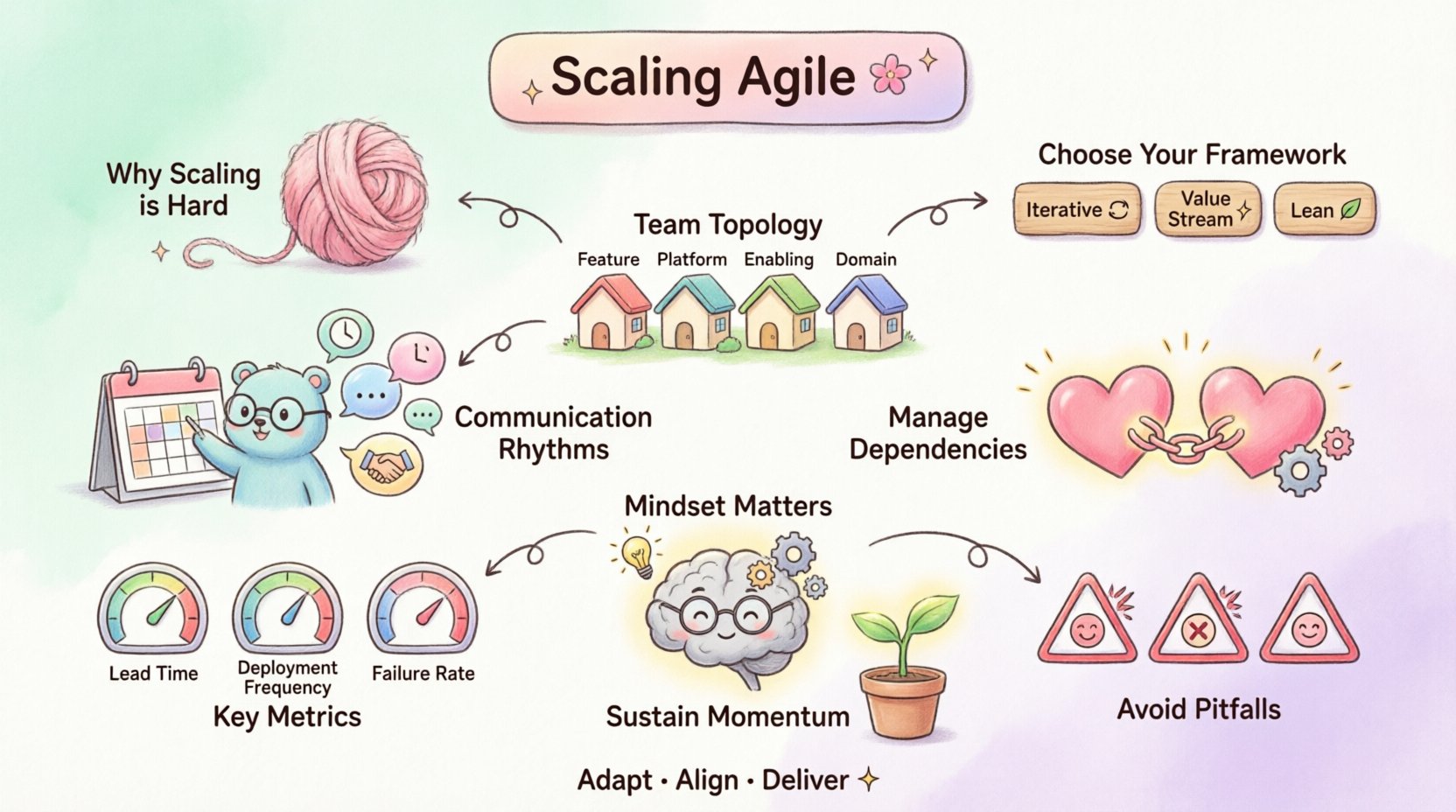
Why Scaling is Harder Than You Think 📉
The transition from a single team to a large organization introduces non-linear complexity. In a small team, communication is informal and direct. Everyone knows what everyone else is doing. As headcount grows, the number of communication channels increases exponentially. This phenomenon, often described by Brooks’ Law, suggests that adding people to a late software project makes it later. In an Agile context, this manifests as increased coordination overhead and reduced flow efficiency.
Organizations often mistake scaling for simply running more Scrum events. However, true scaling requires addressing the underlying architecture of work. Without intentional design, growth leads to silos, bureaucratic bottlenecks, and a loss of customer focus. The goal is to preserve the core benefits of Agile—adaptability, speed, and customer value—while introducing the necessary structure to handle scale.
Choosing the Right Framework 🧭
When teams outgrow a single container, they need a framework to coordinate. Several approaches exist, each with distinct trade-offs. The choice depends on the organization’s existing culture, regulatory environment, and the nature of the products being built. There is no one-size-fits-all solution, but understanding the core mechanics of these approaches helps in making an informed decision.
Iterative Frameworks: These focus on cadence and synchronization. They provide a rhythm for decision-making across multiple teams.
Value Stream Frameworks: These prioritize the flow of value from concept to customer, often decoupling teams by product line rather than technology.
Lean Frameworks: These emphasize waste reduction and continuous improvement, applying lean principles to the entire engineering value stream.
When selecting a framework, avoid copy-pasting a methodology from a different industry. The framework must serve the organization, not the other way around. Adaptation is key. If a process step adds no value to the delivery of customer features, it should be questioned and removed.
Framework Comparison
To clarify the differences between common scaling approaches, consider the following breakdown of their primary focus and structural implications.
Approach | Primary Focus | Best For |
|---|---|---|
Top-Down Coordination | Alignment and Governance | Highly regulated environments |
Bottom-Up Autonomy | Speed and Innovation | Product startups and R&D |
Hybrid Model | Balanced Flow | Enterprise transformations |
Feature Teams | End-to-End Delivery | Complex product ecosystems |
Organizational Structure & Team Topology 🏛️
Structure dictates behavior. If you want agile teams, you cannot organize around functional silos like “Frontend,” “Backend,” and “QA.” These silos create handoff delays and reduce accountability. Instead, organize around value streams or products. This ensures that every team has the skills necessary to deliver a complete feature to production.
Feature Teams: These teams contain all roles required to build, test, and deploy a specific capability. They reduce dependencies on other teams.
Platform Teams: As scale increases, infrastructure becomes a bottleneck. Platform teams build internal tools and services to support feature teams, acting as an internal product.
Enabling Teams: These groups focus on capability building, coaching, and removing systemic impediments for the rest of the organization.
Complicated Domain Teams: For highly specialized work (e.g., security, compliance), these teams operate with distinct constraints but maintain clear interfaces with the rest of the organization.
When restructuring, communication patterns change. Teams should aim for low coupling and high cohesion. If Team A cannot deliver value without Team B, a dependency exists. The goal is to minimize these dependencies through architectural changes and clear ownership boundaries.
Communication Rhythms & Alignment 📢
In a large organization, information asymmetry is a major risk. Decisions made in one corner of the company may negatively impact another. To mitigate this, organizations need established rhythms for synchronization. These are not meetings for status reporting, but forums for alignment and decision-making.
Consider implementing a cadence of meetings that scales with the organization:
Tactical Syncs: Short, focused sessions for team leads to resolve immediate blockers and align on the current iteration.
Strategic Planning: Quarterly or bi-annual sessions where leadership and representatives align on long-term goals and resource allocation.
Architecture Boards: Forums where technical decisions are reviewed to ensure they fit the broader technical strategy without stifling innovation.
Community of Practice: Groups where individuals with similar skills (e.g., DevOps, Testing) share knowledge and standards across teams.
Transparency is the glue that holds these rhythms together. Information should be visible to all stakeholders. Dashboards, roadmaps, and decision logs should be accessible. This reduces the need for meetings to simply share facts and allows meetings to focus on solving problems.
Managing Dependencies & Integration 🔗
As teams multiply, dependencies become the primary source of friction. One team waiting on another creates idle time and reduces overall throughput. Managing these dependencies requires proactive planning and architectural discipline.
Strategies to manage dependencies include:
Contract First: Define interfaces and APIs before implementation begins. This allows teams to work in parallel while adhering to agreed-upon standards.
Feature Toggles: Use code-level mechanisms to hide incomplete work. This allows teams to merge code frequently without breaking the main branch.
Integration Cycles: Schedule regular periods where all teams integrate their work. This prevents the “integration hell” scenario at the end of a release cycle.
Domain-Driven Design: Organize code and services around business domains. This naturally reduces coupling between different parts of the system.
Dependency management is not just a technical problem; it is a social one. It requires trust between teams. If Team A knows Team B is going to be delayed, they must be able to adjust their plans quickly. This requires a culture of honesty and early warning signals.
Metrics That Actually Matter 📊
At scale, vanity metrics like velocity or story points can become misleading. They measure output, not outcome. To understand if scaling is successful, you must measure value delivery and system health. Focus on metrics that reflect flow and customer impact.
Lead Time for Changes: The time from code commit to production deployment. This measures the efficiency of your delivery pipeline.
Deployment Frequency: How often code is successfully released to users. Higher frequency indicates a more stable and agile system.
Change Failure Rate: The percentage of deployments causing failure in production. This highlights quality issues in the process.
Mean Time to Restore: How quickly the system recovers from a failure. This measures resilience.
Customer Satisfaction: Direct feedback from users regarding the value of delivered features.
Do not use metrics to punish teams. Use them to identify bottlenecks and improve the system. If a metric indicates a problem, investigate the root cause rather than blaming the individuals involved. This approach fosters a culture of continuous improvement.
Cultivating the Right Mindset 🧠
Processes and structures are useless without the right mindset. Scaling Agile requires a shift from command-and-control to servant leadership. Leaders must empower teams to make decisions close to the work. This requires trust and a tolerance for failure as a learning opportunity.
Key cultural elements include:
Psychological Safety: Team members must feel safe to speak up about risks, mistakes, or ideas without fear of retribution.
Shared Ownership: Everyone is responsible for the success of the product, not just the code they write. This breaks down silos between development, operations, and business.
Continuous Learning: Invest in training and skill development. As the organization grows, knowledge sharing becomes critical to prevent bus factor risks.
Customer Centricity: Keep the end-user in focus. It is easy to get lost in internal processes at scale. Regular customer feedback loops keep the team grounded.
Leaders play a crucial role here. They must model the behaviors they expect. If leaders demand perfection and hide mistakes, the team will do the same. If leaders admit failures and focus on learning, the team will follow suit.
Common Pitfalls in Large Scale Implementation ⚠️
Many organizations fail to scale because they make predictable mistakes. Recognizing these pitfalls early can save significant time and resources. Awareness is the first step toward avoidance.
Purely Top-Down Implementation: Imposing a framework without team buy-in leads to resistance. The process becomes a box-checking exercise rather than a way to improve work.
Over-Engineering Processes: Creating too many ceremonies and governance layers slows down decision-making. Keep processes lean and necessary.
Ignoring Technical Debt: Scaling often exacerbates technical debt. If the foundation is shaky, the building will not stand. Dedicate capacity to refactoring and infrastructure.
Confusing Size with Scale: Hiring more people without changing the structure does not create scale; it creates a larger mess. Redesign the organization before expanding the headcount.
Lack of Executive Support: If leadership does not understand the shift, they will revert to traditional management styles when pressure mounts. Ensure stakeholders understand the long-term benefits.
Sustaining Momentum Over Time 🌱
Scaling is not a destination; it is a continuous journey. The market changes, technology evolves, and organizational needs shift. To sustain momentum, the organization must remain adaptable. Regular retrospectives should not just be for teams, but for the organization as a whole.
Establish a mechanism for organizational learning. Document what worked and what didn’t. Share these insights across departments. Create a center of excellence that evolves the practices based on real-world feedback. This ensures that the methodology matures alongside the business.
Invest in the people. High-performing teams require high-performing individuals. Provide clear career paths, mentorship, and opportunities for growth. When people feel invested in, they invest in the organization. This reduces turnover and preserves institutional knowledge, which is vital during growth phases.
Finally, remain vigilant about the core principles. Agile is about responding to change over following a plan. If the scaling process becomes too rigid, it defeats the purpose. Periodically review the framework against the principles. Ask if the current practices still serve the goal of delivering value efficiently. If not, adjust. Flexibility is the ultimate safeguard against stagnation in a growing engineering organization.