

In the world of product development, the user story is the fundamental unit of work. It is the bridge between business value and engineering effort. Yet, despite their central role, a significant percentage of user stories stall, require rework, or fail to deliver the intended value. This is not merely a procedural hiccup; it is a symptom of deeper systemic issues within the product management lifecycle.
When stories fail, the cost is measured in wasted engineering hours, delayed time-to-market, and eroded team trust. For product managers, understanding why these artifacts fail is critical. It moves the focus from blaming the team to diagnosing the root causes. This guide dissects the common failure modes of user stories, providing a framework for analysis and remediation.
The Cost of Poorly Defined Stories 📉
Before diagnosing the specific mechanics of failure, it is essential to understand the impact. A weak user story creates ambiguity. Ambiguity leads to interpretation. When developers interpret requirements differently than intended, the result is technical debt or, worse, a product that does not solve the user problem.
Common symptoms of failing stories include:
- Constant Clarification Requests: Developers frequently pause work to ask questions that should have been answered in the description.
- Scope Creep: Stories that start small grow into large projects during implementation due to missing edge cases.
- Failed Acceptance: Work is marked as done by engineering but rejected by the product owner during review.
- Rejection of Testing: Quality Assurance flags the story as untestable because the success criteria are vague.
Addressing these symptoms requires a shift from viewing user stories as simple tasks to viewing them as communication contracts. Below, we analyze the specific root causes that break this contract.
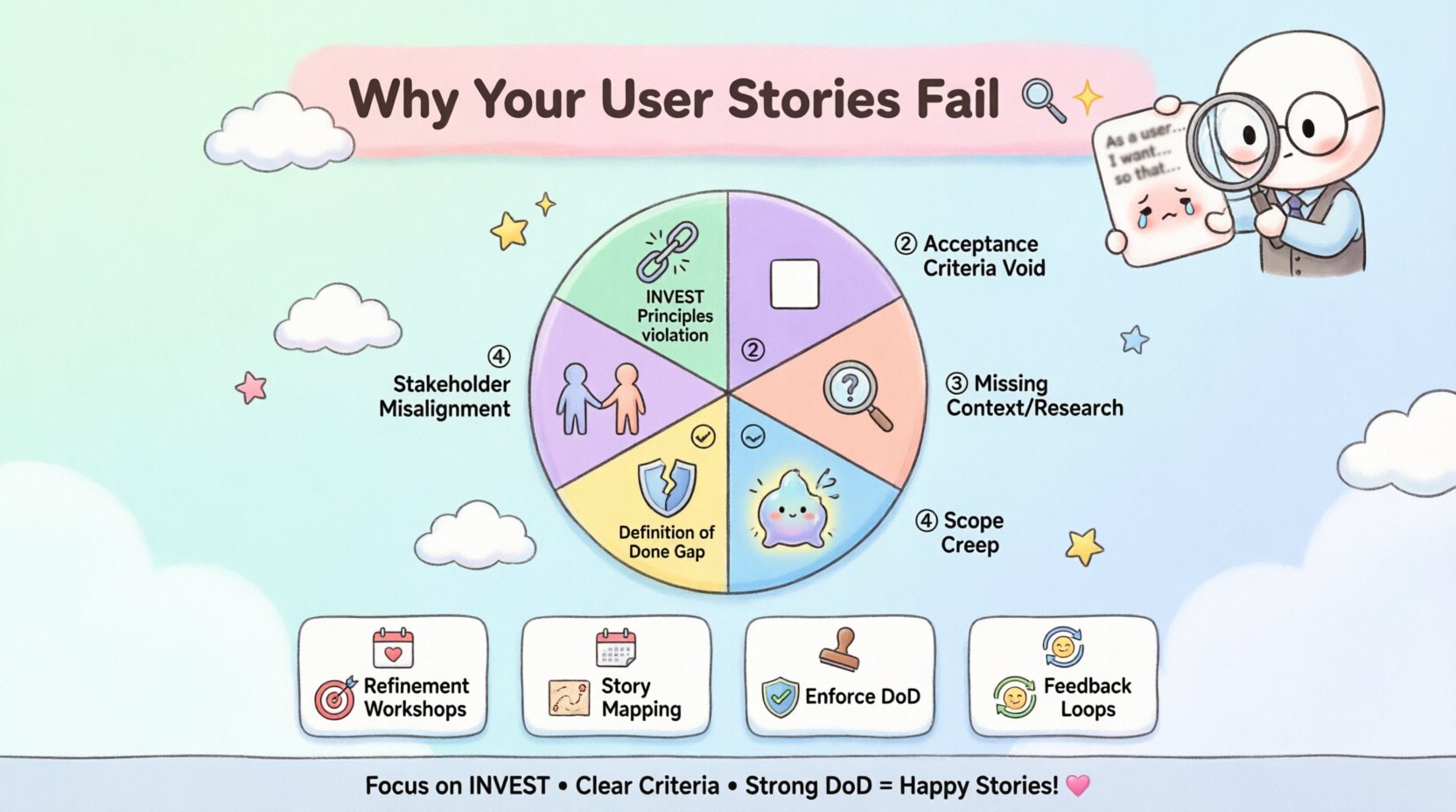
1. Violation of the INVEST Principles 📋
The INVEST model remains the gold standard for evaluating the quality of a user story. It stands for Independent, Negotiable, Valuable, Estimable, Small, and Testable. Failure to adhere to these principles is the most common cause of story rejection.
Independence and Coupling
When a story is dependent on another story that is not yet complete, it becomes blocked. This violates the Independent principle. For example, a story requiring a “Login Button” cannot exist without a “User Authentication Service” story being finished. This coupling creates bottlenecks in the sprint.
Negotiability
A story should not be a rigid specification. It should be a placeholder for a conversation. If a story reads like a technical specification document, it stifles negotiation. Developers should be able to suggest better technical approaches that still satisfy the user need. Rigid stories prevent this collaboration.
Valuable
This is the most critical metric. If a story does not deliver value to the user or the business, it should not exist. Many teams fall into the trap of building “features” that are technically impressive but functionally useless. Every story must answer the question: Who benefits, and how?
Estimable and Small
If a team cannot estimate the effort required, the story is likely too large or too vague. A story that spans multiple sprints is not a story; it is an epic. Breaking work down into smaller increments allows for faster feedback loops and reduces risk.
Testable
If you cannot verify that the work is done, it is not done. Stories lacking clear acceptance criteria fail the Testable principle. This leads to subjective definitions of completion.
2. The Acceptance Criteria Void 🚯
Acceptance criteria are the conditions that a software product must satisfy to be accepted by a user, customer, or other stakeholder. They define the boundaries of the story. When these are missing or poorly written, the story is open to interpretation.
Common Acceptance Criteria Failures
- Binary Logic: Using vague terms like “fast,” “responsive,” or “user-friendly.” These are subjective. A story requiring a page load time of under 2 seconds is testable; a story requiring a “fast” page is not.
- Lack of Edge Cases: Defining only the happy path. What happens when the user enters invalid data? What happens when the network fails? Ignoring negative scenarios causes bugs to surface late in the cycle.
- Technical vs. Functional: Writing acceptance criteria that describe the database schema rather than the user outcome. The story is about the user, not the code.
The Impact of Vague Criteria
When acceptance criteria are weak, QA and Development operate in different zones. The developer builds what they think is correct. The QA tests against the original intent. The Product Manager reviews against the business goal. When these three align poorly, the result is friction.
3. Missing Context and User Research 🔍
A user story is often treated as an isolated item in a backlog. However, it is part of a larger user journey. Without context, the story becomes a feature factory output rather than a solution to a problem.
The “How” Without the “Why”
Teams often skip the research phase and jump straight to the solution. They build a “Search Bar” because they think users want to search. They do not know if users want to search, filter, or browse. Without user research data, the story is built on assumptions. Assumptions are the enemy of product success.
Persona Alignment
Stories should be written with specific personas in mind. A story for an “Administrator” might look very different from a story for an “End User.” If the story does not specify who the actor is, the implementation may prioritize the wrong user needs.
Business Context
Engineering teams need to understand the business motivation. If a developer knows why a feature is being built, they can make better technical trade-offs. For example, if a feature is a one-time experiment, a “quick and dirty” implementation is acceptable. If it is a core revenue driver, robust architecture is required.
4. Scope Creep and Complexity Management 📈
One of the most insidious failure modes is scope creep. This happens when a story is approved, but as development proceeds, new requirements are added without formal re-estimation. This often occurs because the initial story was too complex to understand at a glance.
Hidden Dependencies
Sometimes, complexity is hidden in dependencies. A story might appear simple, like “Update User Profile,” but it requires changes to three different microservices, an API update, and a database migration. If these dependencies are not surfaced during refinement, the story will fail the “Estimable” and “Small” criteria.
Multitude of Stories in One
Product managers sometimes bundle multiple distinct user needs into a single story to reduce the number of items in the backlog. This is a mistake. A story must deliver value in isolation. If a story requires three different pieces of work to be useful, it should be three stories.
5. The Definition of Done (DoD) Gap ✅
The Definition of Done is a shared agreement within a team about what constitutes a completed story. It goes beyond acceptance criteria. It includes code review, testing, documentation, and deployment readiness.
Inconsistent DoD Application
If the DoD is not strictly applied, stories may be marked “Done” in the system while actually being incomplete. This creates a false sense of progress. A story might be coded but not tested, or coded and tested but not documented. This technical debt accumulates silently until it becomes unmanageable.
Missing Non-Functional Requirements
Many stories fail because they ignore performance, security, or accessibility requirements. A story might be functionally complete but fail to meet security compliance standards. The DoD should explicitly state non-functional requirements for every story.
6. Stakeholder Misalignment 🤝
Product managers are often the bridge between business stakeholders and the engineering team. When this bridge is weak, stories fail. This often happens when the business stakeholder has a vision that does not match the technical reality.
The Translation Problem
Business stakeholders often speak in business language (e.g., “increase conversion”). Engineers speak in technical language (e.g., “reduce API latency”). The product manager must translate effectively. If the translation is lost, the story will not meet the business goal.
Conflicting Priorities
When multiple stakeholders have competing visions for the same story, the story often becomes a compromise that satisfies no one. This leads to a bloated feature set that is difficult to maintain and confusing for the user.
Root Cause Diagnosis Table 📊
To help diagnose specific failures, use the following table to map symptoms to root causes.
| Symptom | Root Cause | Diagnosis Question |
|---|---|---|
| Story blocked frequently | Dependency or Lack of Independence | Is this story dependent on another incomplete story? |
| High rework rate | Vague Acceptance Criteria | Can we test this story with binary pass/fail? |
| Scope grows mid-sprint | Complexity or Scope Creep | Was the story broken down into smaller units? |
| Team asks many questions | Lack of Context or Research | Is the user need and business value clearly stated? |
| QA finds bugs after release | Missing DoD or Testing | Are non-functional requirements part of the DoD? |
| Stakeholder complains about value | Stakeholder Misalignment | Did the stakeholder review the story before development? |
Remediation Strategies for Product Managers 🛠️
Diagnosing the problem is only half the battle. Implementing fixes requires a structured approach to backlog management and team collaboration.
Refinement Workshops
Conduct regular backlog refinement sessions. These are not just status updates; they are deep dives into the details of upcoming stories. Use these sessions to:
- Verify INVEST compliance.
- Write clear acceptance criteria together with developers and QA.
- Identify hidden dependencies early.
- Ensure the business value is understood by the technical team.
Implement User Story Mapping
Use story mapping to visualize the user journey. This helps ensure that individual stories contribute to a coherent flow. It prevents the “feature factory” trap where isolated features do not create a cohesive product experience.
Enforce Definition of Done
Make the Definition of Done non-negotiable. A story cannot be moved to “Done” unless all criteria are met. This includes code review, automated testing, and documentation. Protecting the DoD protects the quality of the backlog.
Continuous Feedback Loops
Do not wait until the end of a sprint to validate value. Use prototypes or early builds to gather feedback. If a story is failing to meet user needs, pivot quickly. This reduces the cost of failure.
Deep Dive: Writing Effective Acceptance Criteria 📝
Acceptance criteria are the most tangible part of a user story. They are the contract. To write them effectively, consider the following structure.
Scenario-Based Approach
Use the Given-When-Then format (often associated with Behavior Driven Development). This structure forces clarity.
- Given: The initial context or state of the system.
- When: The action taken by the user or system.
- Then: The observable outcome.
Example:
- Given: A user is logged in with a valid subscription.
- When: The user clicks the “Download Report” button.
- Then: A CSV file is generated and downloaded within 5 seconds.
Handling Edge Cases
Do not forget the exceptions. Write criteria for what happens when things go wrong.
- Given: A user enters an invalid email format.
- When: The user attempts to submit the form.
- Then: An error message appears explaining the required format.
The Role of the Product Manager in Story Health 👤
The Product Manager is the guardian of the story quality. This role requires a shift from “taskmaster” to “coach.” It is not enough to assign stories; you must ensure they are ready.
Pre-Sprint Readiness
Ensure stories are refined before the sprint begins. A sprint filled with unrefined stories is a recipe for failure. The team should know what they are working on before they start coding.
Facilitating Collaboration
Encourage the team to discuss the story openly. If a developer feels uncomfortable questioning a requirement, the story is likely weak. Foster a culture where challenging the story is seen as improving the product, not resisting work.
Monitoring Metrics
Track metrics related to story health. Look at:
- Story Completion Rate: Are stories being completed, or are they carried over?
- Change Request Rate: How often are requirements changing mid-sprint?
- Defect Rate: How many bugs are associated with specific stories?
These metrics provide data-driven insights into where the story definition process is breaking down.
Conclusion 🌟
User stories are not merely administrative tasks; they are the core communication tool of the product development process. When they fail, the entire team suffers. The root causes are rarely accidental. They stem from a lack of clarity, insufficient research, poor prioritization, or weak collaboration.
By diagnosing these root causes and implementing structural changes to the refinement process, product managers can significantly improve delivery quality. The goal is not perfection, but continuous improvement. Treat every failed story as a learning opportunity. Analyze the failure, adjust the process, and move forward. This discipline builds a culture of quality and trust, leading to products that truly serve the user.
Focus on the INVEST principles, enforce clear acceptance criteria, and maintain a strict Definition of Done. These foundational practices will reduce failure rates and increase the velocity of value delivery.
Related posts:
 User Story vs. Feature Request: What Product Owners Need to Know to Avoid Confusion
 Deep Dive into the INVEST Model: The Secret Framework for Better User Stories
 Stop Wasting Time on Bad User Stories: A Practical Tutorial for Beginners
 How to Use User Stories to Align Engineering, Design, and Product Teams Effectively