

In the landscape of software development, clarity is currency. When you begin writing user stories, you often encounter requirements that are vague, incomplete, or open to interpretation. Ambiguity is not a failure; it is a signal that more information is needed before development can begin. This guide provides a structured approach to navigating unclear requirements, ensuring your team builds the right solution without unnecessary rework.
Ambiguous requirements lead to confusion, wasted effort, and delayed releases. By addressing these issues early, you protect the integrity of the backlog and maintain a steady pace of delivery. This article covers strategies for identifying vague language, techniques for eliciting clarity, and methods for documenting precise acceptance criteria.
Understanding the Nature of Ambiguity 🔍
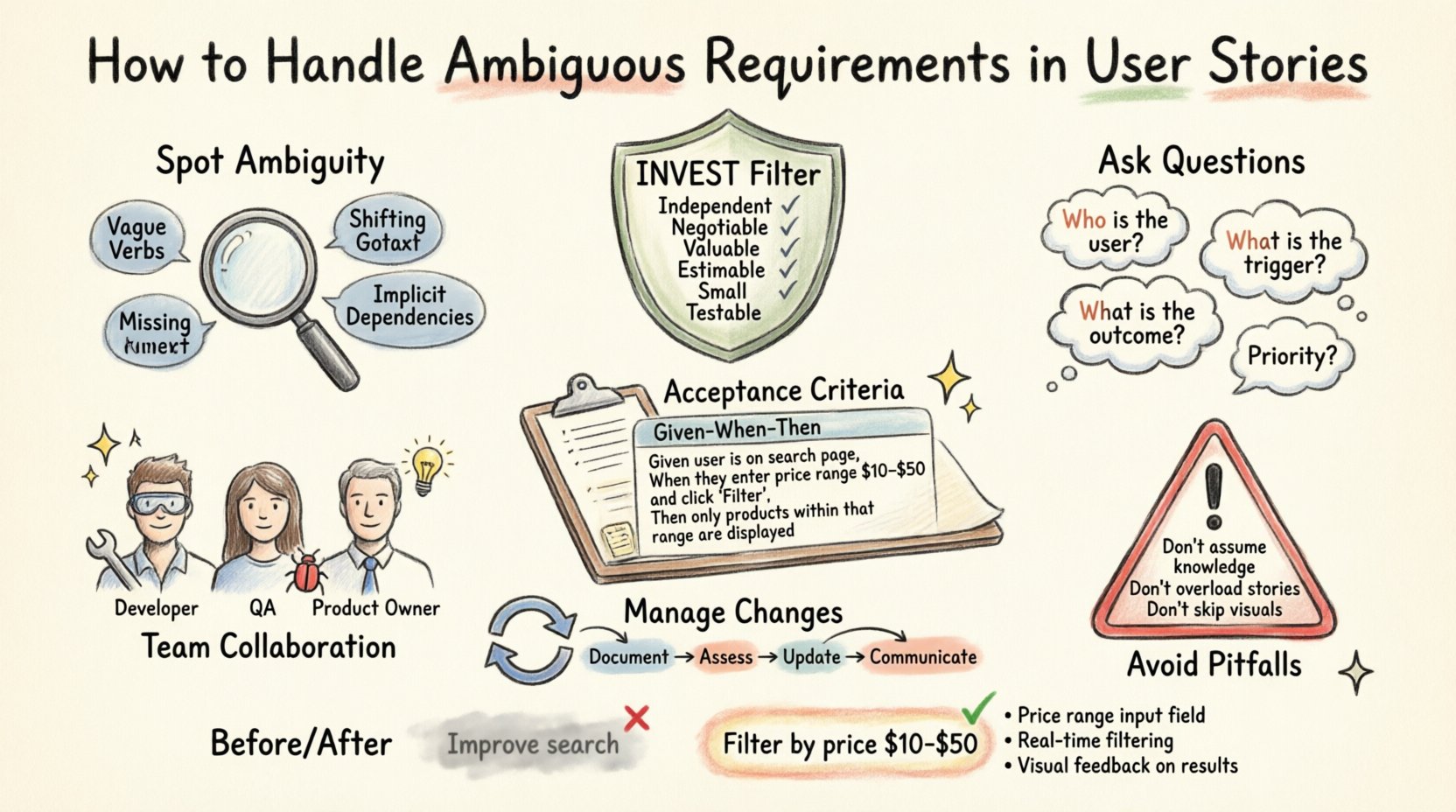
Ambiguity in user stories often stems from a lack of shared context between the person requesting a feature and the team building it. Stakeholders may use high-level language that sounds clear to them but is abstract to engineers. Recognizing the specific types of ambiguity helps in addressing them systematically.
- Vague Verbs: Words like “improve,”” optimize,”” “enhance,”” or “fix” lack measurable outcomes.
- Missing Context: Stories that describe a feature without explaining why it exists or who it benefits.
- Shifting Goals: Requirements that change frequently without formal updates to the backlog.
- Implicit Dependencies: Features that rely on other systems or data points not currently in scope.
When a requirement is ambiguous, the default reaction should not be to guess. Guessing introduces risk. Instead, pause and investigate. Treat ambiguity as a puzzle to be solved collaboratively rather than a barrier to progress.
The INVEST Model as a Filter 🛡️
One of the most effective ways to test the clarity of a user story is applying the INVEST criteria. This framework ensures that every item in the backlog meets specific quality standards. When requirements are unclear, one or more elements of INVEST will likely fail.
- Independent: Can this story be developed without relying on another story being completed first?
- Negotiable: Is there room for discussion regarding the implementation details?
- Valuable: Does this story deliver value to the end user or the business?
- Estimable: Can the team provide a reasonable effort estimate based on the current information?
- Small: Is the scope appropriate for a single iteration?
- Testable: Can we verify that the story is complete based on defined criteria?
If a story fails the Estimable or Testable criteria, it is almost certainly ambiguous. You cannot estimate what you cannot define. You cannot test what you cannot measure. Use these criteria as a checklist before moving a story from the backlog to the sprint.
Techniques for Clarification 🗣️
When you encounter a vague requirement, active inquiry is your primary tool. The goal is to extract specific details that transform a general idea into a concrete task. Avoid asking yes/no questions; instead, ask open-ended questions that require descriptive answers.
Key Questions to Ask Stakeholders
- Who is the primary user? Is it an admin, a guest, or a paid member?
- What is the trigger? What specific action causes this feature to activate?
- What is the expected outcome? How will we know this worked?
- Are there edge cases? What happens if the user enters invalid data?
- What is the priority? Is this a must-have or a nice-to-have for this release?
Documentation of these conversations is critical. Do not rely on memory. Write down the clarifications in the ticket notes or attached documents. This creates a single source of truth that prevents misinterpretation later.
Defining Acceptance Criteria 📋
Acceptance criteria are the conditions that must be met for a user story to be considered complete. They act as the contract between the business and the development team. Without them, ambiguity remains unresolved.
Effective acceptance criteria should be specific, measurable, and agreed upon by all parties. They often follow the Given-When-Then format, which is a structured way to describe behavior.
- Given: The initial context or state of the system.
- When: The action or event that triggers the behavior.
- Then: The observable result or outcome.
Example of Structured Criteria
| Scenario | Given | When | Then |
|---|---|---|---|
| Login Success | User is on the login page | User enters valid credentials and clicks Submit | System redirects to the dashboard |
| Invalid Password | User is on the login page | User enters wrong password and clicks Submit | System displays error message and keeps user on page |
| Empty Email | User is on the login page | User leaves email field blank and clicks Submit | System highlights field with error text |
By breaking down requirements into these granular scenarios, you remove the gray areas. If a story does not have clear scenarios, it is not ready for work.
Collaboration Strategies for Refinement 🤝
Clarification is rarely a one-time event. It is a continuous process known as backlog refinement. This involves regular meetings where the team reviews upcoming stories to identify issues before they become blockers.
The Role of the Team
- Developers: Ask about technical constraints and integration points.
- QA Engineers: Identify potential test cases and edge conditions.
- Product Owners: Provide business context and prioritize value.
When ambiguity arises during refinement, do not rush to assign the story. It is better to leave a story in the backlog than to start work on a misunderstanding. Use refinement sessions to decompose large stories into smaller, clearer tasks.
Common Pitfalls to Avoid ⚠️
Even with the best intentions, teams fall into traps that perpetuate ambiguity. Being aware of these common mistakes helps you steer clear of them.
- Assuming Shared Knowledge: Do not assume everyone knows the history of the project. Document decisions explicitly.
- Overloading Stories: Combining multiple requirements into one story increases complexity and the likelihood of missed details.
- Ignoring Non-Functional Requirements: Performance, security, and scalability requirements often get lost when focusing only on features.
- Skipping Visuals: Wireframes or mockups can convey information faster than text. Use them whenever possible.
Handling Changing Requirements 🔄
Requirements will change. New information will emerge as you work. The goal is not to prevent change, but to manage it without introducing confusion.
When a requirement shifts:
- Document the Change: Record what changed, why it changed, and who approved it.
- Assess Impact: Determine how the change affects the current scope, timeline, and other stories.
- Update Criteria: Revise the acceptance criteria to reflect the new direction.
- Communicate: Ensure the entire team is aware of the update.
This process ensures that the backlog remains a reliable source of truth. It prevents the situation where half the team works on one version while the other half works on another.
Practical Example: Before and After 📉➡️📈
Let us look at a concrete example of transforming an ambiguous story into a clear one.
The Ambiguous Version
Title: Improve the search function. Description: Users should be able to search for products better. Acceptance Criteria: Search works well.
This story is impossible to build. “Better” is subjective. “Works well” is not testable.
The Refined Version
Title: Filter search results by price range. Description: As a shopper, I want to filter search results by minimum and maximum price so that I can find products within my budget. Acceptance Criteria:
- Given I am on the search results page, I see a price filter section.
- When I enter a minimum price of $10 and a maximum of $50, the results update automatically.
- Only products between $10 and $50 are displayed.
- If no products match, display a “No results found” message.
The refined version provides specific functionality, measurable boundaries, and clear expected behaviors. This eliminates the ambiguity and allows the team to proceed with confidence.
Building a Culture of Clarity 🌱
Technical processes are only as good as the culture supporting them. A culture that values clarity rewards asking questions. It does not punish uncertainty.
Encourage team members to speak up when they do not understand a requirement. Silence is often mistaken for agreement. If a developer says they understand a vague story, they may be guessing. In a high-performing team, confusion is treated as an opportunity to improve the documentation, not a sign of incompetence.
- Normalize Questions: Make it safe to ask “Why?” and “How?” during planning sessions.
- Review Notes: Have a peer review the story description before it enters a sprint.
- Visual Aids: Use diagrams or flowcharts to supplement text descriptions.
When the entire team is aligned on the meaning of a requirement, productivity increases. The time spent clarifying upfront saves significantly more time during development and testing.
Tracking and Measuring Improvement 📊
To ensure your strategies are working, track metrics related to requirement quality. This data helps you identify where ambiguity persists and where your processes are succeeding.
- Rejection Rate: How many stories are rejected during sprint planning due to lack of clarity?
- Change Requests: How many stories require scope changes mid-sprint?
- Defect Rate: How many bugs are caused by misunderstood requirements?
If the rejection rate is high, invest more time in refinement sessions. If the defect rate is high, review your acceptance criteria definitions. These metrics provide objective feedback on the health of your requirement process.
Final Thoughts on Documentation 📝
Documentation is not just about writing text; it is about creating a shared understanding. When you write a user story, you are creating a promise. You are promising that the team understands what to build and how to verify it.
Ambiguity is the enemy of that promise. By applying the techniques outlined in this guide—using INVEST criteria, defining clear acceptance criteria, asking the right questions, and fostering a collaborative culture—you can significantly reduce risk. Your team will spend less time guessing and more time building.
Remember that clarity is a skill that improves with practice. Start small. Focus on the next story you write. Ensure it is specific. Ensure it is testable. Ensure it is clear. Over time, these habits will become second nature, and your backlog will become a reliable roadmap for delivery.
Related posts:
 How to Write Your First User Story: A Step-by-Step Guide for New Product Managers
 Troubleshooting Blurry Acceptance Criteria: How to Fix Your User Stories Before Coding Starts
 Comparison: User Story vs. Epic vs. Task: Which Should You Write When?
 From Idea to Code: The Comprehensive Walkthrough of the User Story Lifecycle