


In the fast-paced world of software development, clarity is often the difference between success and technical debt. User stories serve as the primary vehicle for capturing requirements, yet they frequently suffer from ambiguity. Without a structured approach, teams risk building features that do not deliver value or are too complex to implement within a sprint. The INVEST model provides a proven checklist to validate the quality of user stories before development begins. This guide explores the framework in detail, offering practical insights into how teams can apply these principles to enhance delivery and collaboration. 🚀
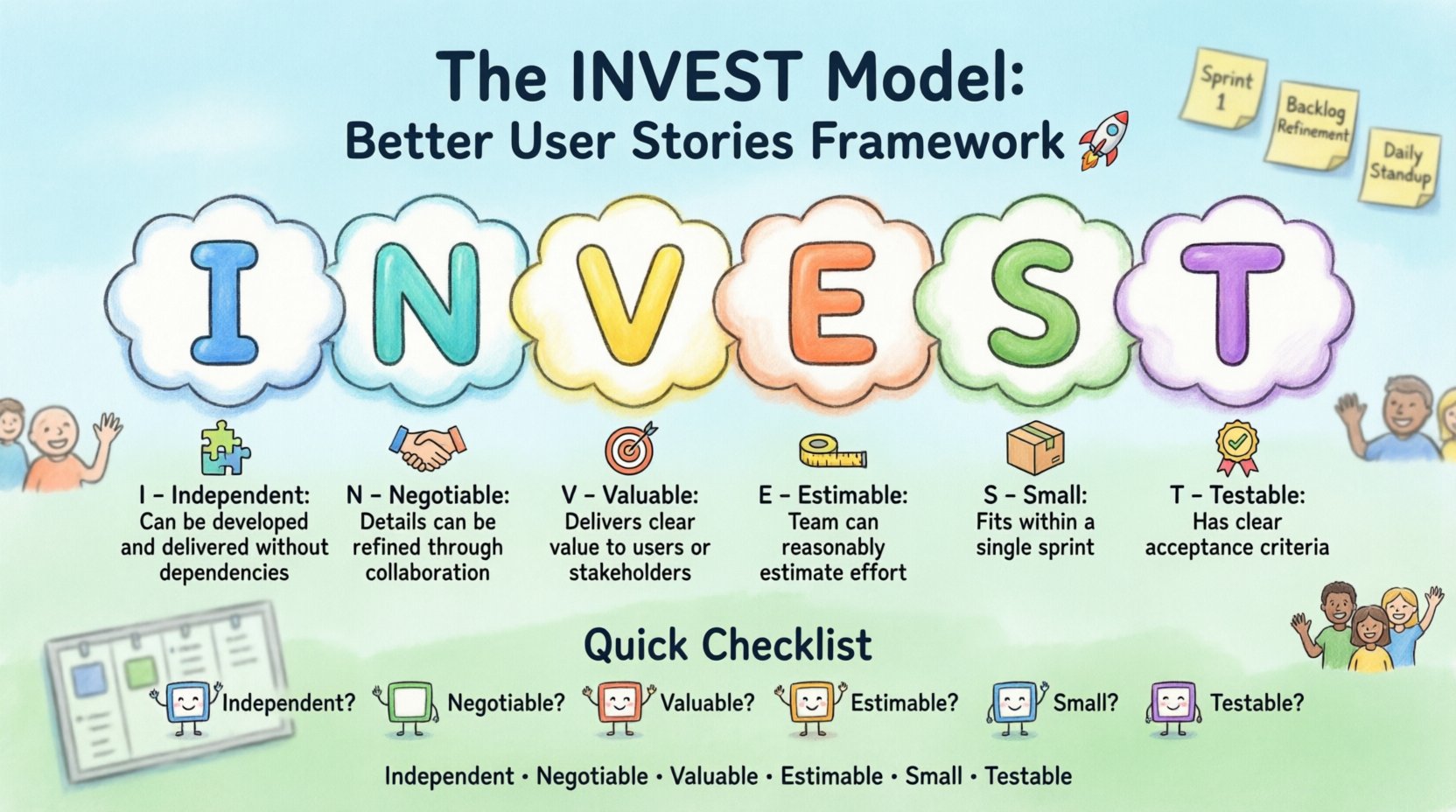
What Is the INVEST Model? 📋
The INVEST acronym was coined by Bill Wrigley and Mike Cohn to describe the characteristics of a high-quality user story in Agile environments. It stands for Independent, Negotiable, Valuable, Estimable, Small, and Testable. Each letter represents a criterion that helps teams determine if a story is ready for the backlog. When a story meets all these criteria, it becomes a manageable unit of work that facilitates planning, estimation, and delivery.
Many teams struggle with vague requirements or bloated tasks that stall progress. By applying the INVEST model, teams can break down complex problems into actionable items. This framework is not just a rulebook but a mindset shift toward collaboration and precision. It encourages stakeholders and developers to engage in meaningful dialogue rather than passing around static documents. 🗣️
The Core Criteria Explained 🧩
To effectively utilize this model, it is essential to understand the nuance behind each letter. Below is a detailed breakdown of what each criterion means in practice and how it impacts the development lifecycle.
1. Independent (I) 🔄
Independence means that a user story should not rely heavily on other stories to be completed. While some dependencies are unavoidable in complex systems, a high-quality story should stand alone enough to be prioritized and developed separately. This flexibility allows teams to reorder work based on business value rather than technical constraints.
- Why it matters: If stories are tightly coupled, the entire sprint can be blocked by a single task.
- Best Practice: Identify technical dependencies early and split stories to minimize coupling.
- Example: Instead of one story for “Backend API and Frontend UI,” split them into “Create API Endpoint” and “Display Data on UI.”
When stories are independent, team members can work in parallel without constant context switching. This autonomy boosts productivity and reduces bottlenecks during the planning phase.
2. Negotiable (N) 🤝
User stories are not contracts; they are placeholders for a conversation. The negotiable aspect implies that the details can be discussed and refined between the product owner, developers, and testers. This flexibility is crucial because requirements often change as understanding deepens.
- Why it matters: Rigid specifications stifle creativity and problem-solving.
- Best Practice: Use the story as a starting point for refinement meetings.
- Example: A story might say “Add search functionality,” but the team negotiates whether to use full-text search or simple keyword matching.
This criterion encourages collaboration. It shifts the focus from documentation to communication. Teams should feel empowered to ask questions and propose solutions that differ from the initial description.
3. Valuable (V) 🎯
A story must deliver value to the user or the business. If a story does not contribute to the product’s goals, it should not exist in the backlog. Value is subjective and can vary by stakeholder, but it must be clearly articulated.
- Why it matters: Building features that no one needs wastes resources and time.
- Best Practice: Always ask “Who benefits?” and “Why is this important?”
- Example: “As a user, I want to save my settings” is valuable because it improves the user experience.
Without value, a story is just technical debt. Teams must prioritize stories that drive the product forward. This ensures that every line of code written serves a purpose. 📈
4. Estimable (E) 📏
Teams need to be able to estimate the effort required to complete a story. If a story is too vague or complex, estimation becomes a guessing game. This criterion ensures that planning remains realistic and reliable.
- Why it matters: Inaccurate estimates lead to missed deadlines and team burnout.
- Best Practice: Break down stories until the team feels confident in their sizing.
- Example: If a story involves a new technology the team hasn’t used, add a spike story to research it first.
Estimability relies on the team’s understanding of the technology and the domain. If uncertainty is high, the story should be refined before it enters the sprint.
5. Small (S) 📦
Stories should be small enough to be completed within a single sprint. Large stories introduce risk and make it difficult to track progress. Breaking large work into smaller chunks reduces risk and increases the frequency of feedback.
- Why it matters: Large stories often hide hidden complexity that causes delays.
- Best Practice: Aim for stories that can be done in a few days, not weeks.
- Example: Split a “User Registration” story into “Create Account,” “Verify Email,” and “Reset Password.”
Small stories allow for faster iteration. They enable the team to release value incrementally and adjust course if necessary. This agility is at the heart of the development process.
6. Testable (T) ✅
A story must have clear acceptance criteria. Without testability, it is impossible to know when a story is truly done. This criterion ensures quality and reduces the risk of bugs reaching production.
- Why it matters: Ambiguity leads to rework and quality issues.
- Best Practice: Define acceptance criteria before development starts.
- Example: “Login fails after three incorrect attempts” is a testable condition.
Testability bridges the gap between development and quality assurance. It provides a clear definition of done. This clarity prevents arguments about whether work is complete. 🔍
INVEST Criteria Comparison Table 📊
| Criterion | Definition | Key Question |
|---|---|---|
| Independent | Can be developed separately | Does it block other work? |
| Negotiable | Open to discussion | Can we change the details? |
| Valuable | Delivers user or business value | Why are we building this? |
| Estimable | Size can be predicted | Do we know how long it takes? |
| Small | Fit within a sprint | Can we finish this quickly? |
| Testable | Has clear acceptance criteria | How do we know it works? |
Common Pitfalls and How to Avoid Them ⚠️
Even with a strong framework, teams often stumble when applying these principles. Recognizing common mistakes is key to continuous improvement. Here are the most frequent issues encountered during backlog refinement.
1. The “Big Ball of Mud” Story
Sometimes, a story accumulates too many requirements over time. It grows until it is no longer small or estimable. This often happens when stakeholders add features without understanding the impact on the sprint capacity. To avoid this, enforce a strict size limit for stories during refinement sessions. If a story is too large, break it down immediately.
2. Ignoring Technical Dependencies
Teams sometimes assume stories are independent when they are not. This leads to blockers during the sprint. Always map out dependencies before finalizing the backlog. If a dependency exists, create a specific story to address it. This ensures that the independent criterion is met.
3. Vague Acceptance Criteria
Testability is often the first criterion to suffer. Teams write “It should be fast” instead of “Page load time under 2 seconds.” Vague criteria lead to subjective testing. Use specific metrics and conditions to define success. This removes ambiguity and ensures everyone agrees on what done looks like.
4. Skipping the Conversation
The negotiable aspect is often overlooked. Teams treat stories as final requirements rather than conversation starters. This leads to building the wrong thing. Schedule refinement meetings where the team can ask questions and clarify details before committing to work.
Implementation Strategy for Teams 🛠️
Integrating the INVEST model into your workflow requires a shift in culture. It is not enough to check boxes; the mindset must change. Here is a practical approach to implementing these standards.
1. Backlog Refinement Sessions
Use refinement meetings specifically to evaluate stories against the INVEST criteria. Do not just move cards from To Do to In Progress. Spend time ensuring each story meets the standard. If a story fails a criterion, send it back for rewriting.
2. Definition of Ready
Create a Definition of Ready that includes INVEST checks. A story should not enter a sprint unless it is Independent, Negotiable, Valuable, Estimable, Small, and Testable. This gatekeeping process ensures quality from the start.
3. Training and Workshops
Not every team member knows what INVEST means. Conduct workshops to explain the model. Use real examples from your current backlog to illustrate the concepts. When everyone understands the framework, alignment improves.
4. Continuous Feedback
Review the quality of stories retrospectively. Did the team struggle with a specific story? Was it too large? Was it not valuable? Use this data to adjust future refinement processes. Improvement is a cycle, not a one-time event.
Measuring Success and Quality 📈
How do you know if the INVEST model is working? Look at the metrics that matter to your team. Quality should improve over time as the team adheres to the framework.
- Sprint Velocity Stability: If stories are well-estimated, velocity should remain consistent.
- Defect Rates: Testable stories should lead to fewer bugs in production.
- Stakeholder Satisfaction: Valuable stories should result in features that users actually want.
- Flow Efficiency: Independent stories should reduce bottlenecks and waiting times.
Tracking these metrics provides objective evidence of improvement. It helps justify the time spent on refinement and ensures the team stays focused on value. 🎯
Real-World Application Scenarios 🌍
To further clarify the application of this model, consider how different types of work fit into the framework. Not all stories are created equal, but they all benefit from the INVEST structure.
Scenario 1: Feature Development
When building a new feature, break it down into functional units. Ensure each unit delivers value on its own. Avoid building the entire feature as one massive story. This allows for incremental releases and feedback.
Scenario 2: Bug Fixes
Bugs can also be treated as stories. They must be estimable and testable. A bug fix that is too broad should be split. For example, instead of “Fix performance issues,” use “Optimize database query on dashboard.” This makes the work testable and small.
Scenario 3: Technical Debt
Refactoring work must be valuable to the business, not just the developers. Frame technical debt stories in terms of risk reduction or future speed. This ensures they are prioritized correctly against feature work.
Final Thoughts on Agile Quality 🏁
Adopting the INVEST model is a journey toward better communication and higher quality output. It requires discipline and a willingness to refine work before starting. However, the payoff is a smoother development process and a product that truly serves its users.
By focusing on independence, negotiation, value, estimation, size, and testability, teams can eliminate ambiguity. This clarity allows developers to focus on coding and stakeholders to focus on strategy. The result is a more efficient and effective delivery pipeline.
Remember that frameworks are tools, not rules. Adapt the INVEST model to fit your team’s context. Use it to spark conversations and drive alignment. When applied with care, it becomes a cornerstone of successful Agile practice. 🚀
Related posts:
 User Story Best Practices: The Hidden Rules Every Beginner Product Manager Must Follow
 Troubleshooting Blurry Acceptance Criteria: How to Fix Your User Stories Before Coding Starts
 Comparison: User Story vs. Epic vs. Task: Which Should You Write When?
 From Idea to Code: The Comprehensive Walkthrough of the User Story Lifecycle